
American Kickboxing
Coaches & Gyms
Apparel & Equipment
Training Programs
The country that invented the sport by accident, a rulebook that made a magnificent fighter and issued him a blind spot, and the champion who went and learned the thing that took his leg.
The Karate Men Who Put On Gloves
The Warrior takes you to a karate school in a strip mall, the kind with a dragon on the sign, and walks you past the children's class to a back room where somebody has built a boxing ring. On the wall are photographs from the seventies: men in long white pants and foot pads and boxing gloves, in a ring, hitting each other. "That's the whole sport in one picture," the Warrior says. "Karate on top, boxing on the bottom, and a rule you can't see that said nothing below the waist counted. They fought like that for fourteen years and made champions, and then one of them met a man from Thailand." In the ring two men are sparring, and one of them checks a low kick with his shin without looking at it. "That check wasn't in the picture," the Warrior says. "That's what the Thai man taught them. Watch how it got here."
Every kicking nation puts its own stamp on the art. The Dutch built a system. The French built an academy. The Americans built a television show, and then found out in one night what the show had never taught them. This room is the American leg: where it came from, who put on the gloves first, the rules that shaped a generation of fighters and hid a hole in every one of them, and what the best of them did the morning after the hole was found. And because the gym with the ring in the back is down the road from you, this room has the same three doors behind it that the boxing gym's national schools had: the room and the man, the kit, and the plan, walked in the order a man meets them.
American kickboxing was not imported. It was an argument that got out of hand. Through the 1960s the country's karate men fought each other in tournaments where a punch was stopped an inch from the face and a judge awarded a point, and a certain kind of fighter looked at that arrangement and found it unbearable. He had spent years learning to hit and was forbidden to find out whether he could. So a handful of those men did the obvious thing, which nobody had done: they put on boxing gloves, climbed into a boxing ring, and agreed to actually hit each other until one of them fell down. They called it full-contact karate, and then they borrowed a better name from Japan, and the sport this whole hall is named after had its first American night.
The Men Who Put On the Gloves
The first man through the door was Joe Lewis, a Marine who had learned his karate on Okinawa and come home to become the most feared point fighter in the country. He had also trained with Bruce Lee and absorbed Lee's contempt for a fight that ended at the moment it started. In January of 1970, in California, Lewis fought the first full-contact bout in American history, gloves on, knockout allowed, and knocked his man out. He was the heavyweight champion of a sport that had not existed the week before. When the promoters went looking for a word for what he had done, they took kickboxing from the Japanese, who had been running their own ring version of karate since the middle of the sixties. Lewis carried the sport on his back through its first years, died in 2012, and is the reason there is a room here at all.
In September of 1974 the sport got its founding night: the first world championships of what would become the Professional Karate Association, four weight classes, on national television, with Lewis at heavyweight and a middleweight named Bill Wallace who would become the most famous kicker the country ever produced. Wallace had wrecked his right knee years before and could not kick with it, so he fought his entire career off the left leg alone, and the left leg was enough. It was clocked at sixty miles an hour. It came as a round kick, a hook kick, and a side kick from the same chamber, so that the man in front of him never knew which one was arriving until it had. He retired in 1980 with twenty-three wins, no losses, and the nickname Superfoot, and he is the proof, still teaching in his eighties, that a man with one weapon who has made it perfect beats a man with six he has merely learned.
The third of the founders took the sport somewhere the other two never did. Benny Urquidez, a small, fast Californian out of a fighting family, flew to Japan in 1977 and fought their kickboxers in their rings under their rules, and won. He kept doing it for years, in Japan and Hong Kong, against men who fought with weapons the American rulebook did not allow, and he came home every time. He was the first American to find out what the sport looked like outside the sport, and he liked it. Behind these three came the men of the eighties and nineties who made the American game a television fixture, Don Wilson, the Dragon, chief among them, who held world titles across nearly every sanctioning body the era invented and fought for twenty years without a serious loss of form.home from doing it and spent the rest of his life turning it into lessons.
The Rulebook That Made the Fighter
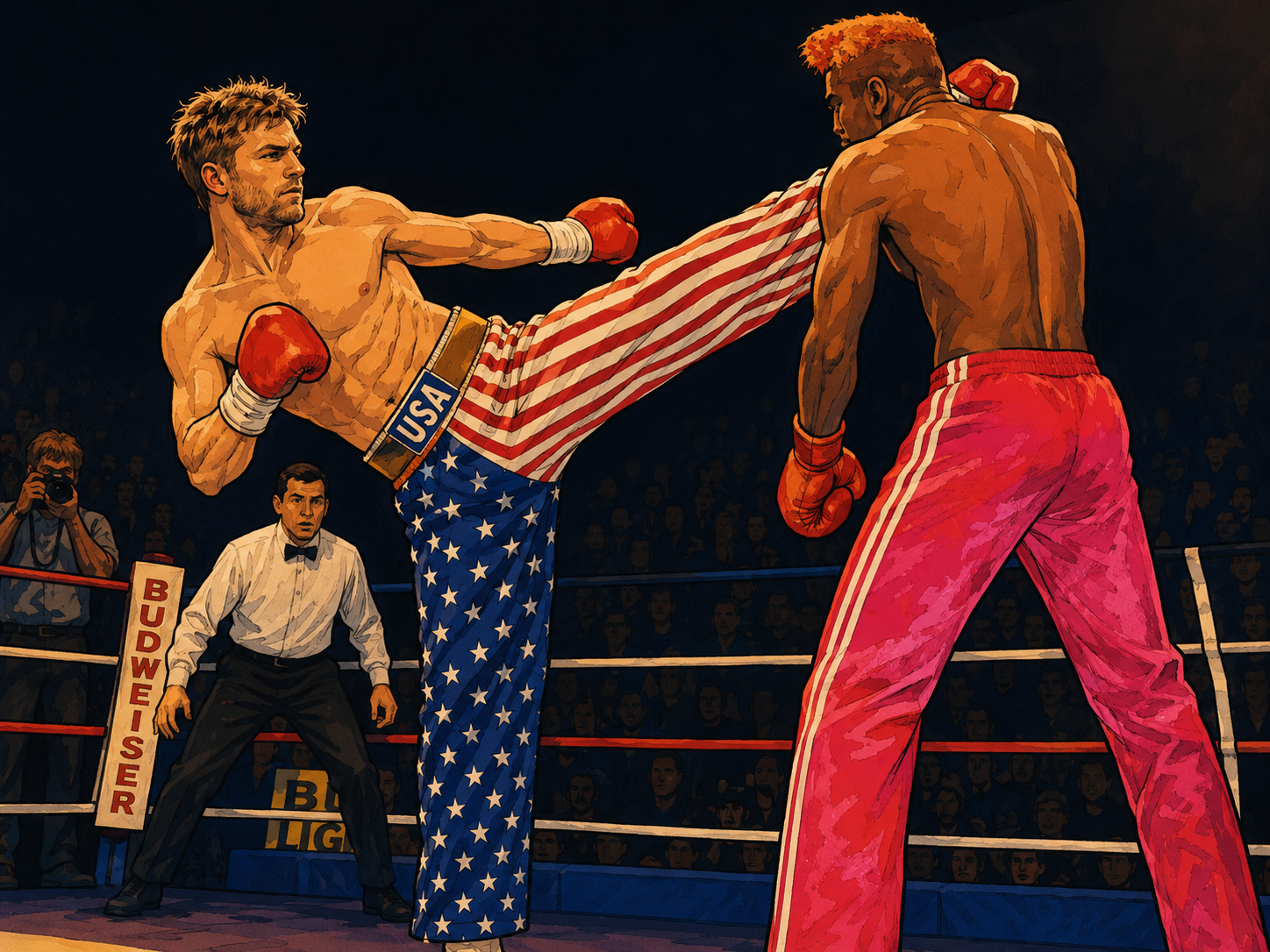
The American fighter looked like nothing else in the world, and the look came from the rules. He fought in long karate pants and foot pads instead of trunks and bare shins, because the sport was still calling itself karate and dressing like it. He threw real boxing hands, because the men who built the sport had gone to boxing gyms to learn how to hit and had brought the whole science back with them. And he kicked high, beautifully, constantly, because the rulebook made him. The Professional Karate Association required a minimum of eight kicks a round. A fighter who threw seven lost a point. So the American kickboxer became the most prolific high-kicker in the standing arts, a man who could throw a head kick as easily as a jab and did, and the crowd loved him for it.
The same rulebook drew a line at the waist. Nothing below it counted. No low kicks, no sweeps, no knees, no clinch. It was a reasonable rule for a sport trying to look like something a network would broadcast, and it had a consequence nobody could see for fourteen years: it produced a generation of world champions who had never once had to think about their own lead leg. The rival body, the World Karate Association, allowed the low kick from its founding in 1976, and the two rulebooks ran side by side for years with the fighters mostly staying inside whichever one they had come up in. A man's blind spot is not a character flaw. It is a rule he trained inside for so long that he stopped seeing it as a rule.
That is the deepest thing this room has to teach, and it is not about kickboxing. Every man is fighting inside a rulebook he did not write. The job he came up in, the family he was raised in, the church or the country or the trade, each one has a line it drew somewhere and a whole category of things it taught him do not count. He is magnificent inside the line. He has no idea what is below it. And one day he meets a man who trained under different rules.
The Morning After
The night itself was told at the pads, on the way into this hall, and it does not need retelling. A Milwaukee fighter with the fastest hands in the sport dropped a Thai fighter twice and lost the fight to his own leg. What this room owns is what happened next, because the night was the education and the morning was the exam.
Rick Roufus did not write a rule against low kicks. He did not announce that the fight had been unfair, though the rules had been agreed to and he could have argued it. He did not retire into the sport that had made him a champion and stay a champion there. He went and learned the low kick. He learned to throw it, which is the easy half, and he learned to check it, which is the half that costs a man months of shin on shin and a lead leg that never stops aching. And then he went back into the ring with the weapon that had beaten him built into his own game, and he kept fighting at the top of the sport for the better part of two decades, into the era when the Japanese built a tournament to answer the question his fight had asked and the best strikers on earth flew to Tokyo to settle it.
The rest of the American game followed him, slowly and then all at once. The sanctioning bodies opened the rules. The gyms that had taught the eight-kick, above-the-waist game started teaching the check in the first month, because they had all watched the tape. Within a decade the American kickboxer had become something closer to the Dutchman and the Thai, hands and low kicks and a lead leg that lifted, and the fighters who came out of the Milwaukee gym the Roufus family built carried the whole lesson into the cage, where it turned out to be the difference between a striker who could survive in mixed rules and one who could not.
The ledger has an honest second column. The American sport lost its television slot in the nineties, the belts multiplied until a world title meant less than it had, and the biggest thing to come out of American kickboxing in that decade was an aerobics video, a former karate champion teaching housewives to throw kicks at the air in front of a camera. That is where the cardio class in fight clothes was born, and this Farm names it because the sport that taught the world to put karate in a ring nearly became a workout tape. A country can learn the hard lesson in a ring and forget it in a living room. The gyms that remembered are the ones still teaching.
Three Rooms, Walked in Order
The boxing gym's three national schools each had a room, a kit, and a plan behind them, and you walked all nine. The American kickboxing hall has the same three doors, and they teach what the boxing rooms could not, because the sport behind them is a different sport with a different history and a different hole in it.
Coaches & Gyms — the room with a ring in the back. What an American kickboxing gym actually is, which is usually one of three other things wearing the name, how to tell in the first ten minutes whether the room learned the lesson of 1988 or is still fighting inside the old rulebook, what to look for in the man, and the rooms the Farm stands behind. The first door, because a kickboxing gym that never taught the check is the most dangerous kind of gym there is: it feels complete.
Apparel & Equipment — the kit with legs. Everything from the boxing paper bag, plus the shin guards, the foot pads that are the sport's oldest inheritance, the long pads a coach holds for kicks, the kick shield, and the honest word about what protects a shin and what only makes a man feel protected. The second door, because a man's first low-kick session in the wrong gear is his last for a month.
Training Programs — the low-kick block. The kickboxing week built on top of the boxing base, the block that installs the check until it fires without permission, the drill the old rulebook invented and the new one kept, the amateur road that runs through smokers instead of a passbook, and the Farm's own courses. The last door, because the program only makes sense to a man who has already learned what it is protecting him from.
The order is the boxing gym's order for the boxing gym's reasons, and it carries one more here. This is the sport that learned its lesson in public, and the three doors are walked in the order the lesson gets installed in a man: first a room that teaches it, then the gear that lets him drill it without breaking, then the program that makes it a reflex. Reverse the order and you have a man with shin guards in a closet and a program off a screen, sparring in a room that still thinks the leg does not count, and he is the champion from 1988 with none of the titles.
The Three Pillars in the Ring
TRUTH — the American sport told itself for fourteen years that its rulebook was the sport, and the truth arrived from Thailand as a leg kick. The rooms behind this door are honest first about their own rules: what they teach, what they do not, and what the sign on the door is actually describing. A man who trains in a room that names its rules honestly can find his blind spot before a stranger does.
LOVE — the two brothers learned the kick and then spent their lives teaching it to everyone who walked in, and one of them is on the wall of the hall you came through. The lesson that cost a champion his leg was handed down free to every hobbyist in Milwaukee, and that is the shape of love this hall keeps: the hard thing learned, then given away.
LAW — the American sport is a family of rulebooks, and a fighter who has agreed to one honors it in the ring and names it outside. The man who fights above-the-waist rules and calls himself a Thai boxer, or trains in a cardio class and calls himself a kickboxer, has broken a law that has no referee, and it is the same law the Farm keeps everywhere: say what you are.
"Whoever disregards discipline comes to poverty and shame, but whoever heeds correction is honored." — Proverbs 13:18
The correction came as a leg kick. The honor is that the man who took it is still teaching the thing that beat him, nearly forty years later, to men who will never lose a fight the way he did. The rooms behind this door are where a man goes to be corrected on purpose, in a gym, before the parking lot corrects him for free.
Walked as a System
The three rooms are the American lesson made practical. The hall told you the story of a rulebook with a hole in it and a champion who filled the hole. The rooms are where a man finds a gym that filled it, buys the gear that lets him drill the filling, and runs the program that makes the check a reflex, and at the end of the third door he owns, in his own lead leg, the thing the whole American sport had to learn on television.
And it leaves with him. The check goes into the Thai camp as the first thing the Kru will test. The honesty about rulebooks goes into every room on the Farm that has a rule, which is all of them. The morning-after habit, the refusal to protect a reputation when a lesson is available, goes home, to the job and the marriage, where the leg kicks are quieter and the men who learn from them are just as rare.
After the American Gym
The Warrior says one thing at the door, and it is about the room after these three.
America learned the low kick one night and one family taught it to a city. The next room is what it looks like when an entire country takes the same lesson, on purpose, and builds a school around it. A small country below sea level, with soccer and skating for national sports, went and found the men who could beat it, learned from every loss, and came home to build a school that the heavyweights of the whole world spent two decades failing to solve. You are about to see the American lesson done by a system instead of a champion, and you should walk in knowing that the system is the more frightening of the two.