
Combat
"For by wise guidance you can wage your war, and in abundance of counselors there is victory." — Proverbs 24:6
The War Room
The Warrior is at the foot of the ladder, the way the Armorer said he would be. He does not say anything. He puts a hand on the rail, looks up, and goes, and you follow him forty feet into the air, up the inside of the watchtower at the high corner of the Farm, to a square room with windows on all four sides.
It is the only room on the property with a chair for you.
There are maps on the walls, and not decorative ones. A county road map with grease-pencil rings on it. A floor plan of a house you do not recognize. A photograph of a hillside with distances written across it in someone's hand. A radio in the corner with the volume turned down to a murmur. A long table with a mug ring on it and a pencil worn to a stub. From up here you can see the gym, the mat behind the barn, the long gray shed with its steel door, the range road, the whole property laid out like a board. And past the fence line, where the land drops away, you can see the road you came in on and a second road, going out.
"Sit," he says, and you do, and it is strange, because on this Farm you have never once been asked to sit. "Down there I taught you to fight a man. In the shed a harder man than me taught you to run a tool. Neither one of us taught you the thing that decides whether you ever should. That gets taught here, and it gets taught sitting down, because the men who make this decision standing up make it wrong."
He pulls a chair around backwards and sits across from you with his arms on the top of it.
"The Armorer told you about the vault. He told you the men whose rifles live behind that door aren't better shots. That's true. Some of them can't outshoot you right now. What they have that you don't is that somebody looked at them for a long time and decided they could be trusted with the choice. Not the trigger. The choice. This is the room where you find out whether you can."
This is the War Room, the third ground of the Farm, where the trained body and the trained tool get aimed by a trained mind. A man can throw hands and run a rifle and still lose, because the gap that gets people killed is almost never a gap in skill. It is the distance between what a man could do and what he should do, right now, with half the information and none of the time. Every other ground on the Farm closes a gap in capacity. This one closes the gap in judgment, and it is the only gap that, left open, makes everything below it more dangerous rather than less.
This page is the top of the ladder, not the room itself. Each of the three arenas has its own floor and its own men. What this page does is tell you why the mind is trained last and commands everything trained before it, how the three arenas are laid out and why they run in the order they do, what the mind is for when the fight is over, and what is waiting at the second road, the one going out.
Why the Mind Runs the Fight
A man who has trained his body and his tools and never trained his judgment has built two things that work beautifully in isolation and has no idea when to use either. The real world is not isolation. It is bad information, surprise, a partner who freezes, a piece of gear that quits, and a clock that runs faster than a man wants it to. The only faculty that operates inside that mess is judgment, and judgment is built three ways that the mat and the shed cannot build on their own.
It is built in the crucible, where a man tests everything he has against a stranger who has trained specifically to beat him, in front of people, with a result he cannot argue with, and stakes low enough that he walks out and learns from it. It is built in the team, because real protection is almost never one man, and the men who believe it is tend to die alone in hallways. It is talking, moving, covering, trusting a voice in your ear when your hands are full. And it is built in the study, by reading the men who thought hardest about war across three thousand years and letting what cost them everything cost you an evening, so that your own small handful of encounters does not have to teach you all of it the expensive way.
Now hear the thing the men below this tower already know. The three arenas do not just add to each other. They climb, and the stakes climb with them. In the cage, the worst outcome is a loss on a record and a week of soft food. In the team, the worst outcome is the man beside you not going home, because you missed the corner. In the study, the worst outcome is a nation, because the man who read the wrong lesson from history wrote the next war with it. The men get harder in the same proportion. The fighters you watched from the bench in the gym are the gentlest men in this tower. The men who sat beside you cracking jokes are in the middle. And the man who has been alone in a jungle for nine days with a rifle, the one you heard about and did not believe, is at the top, and he reads more than any of them. Expect the room to ask more of you at each floor, and expect the men to ask less patiently. That is how a man is measured for the vault.
What Beats the Trained-but-Unwise Man
A man can have real skill and still fall into these. The War Room names them so the world does not have to.
Never audited. He trains only with men who like him and never once puts his capacity in front of a stranger with a whistle. The test he dodged finds him somewhere the tuition is not a tap.
The lone wolf. He built himself, alone, and never learned to work beside another man. The movies sell him as the hero. The men in this tower have carried him out on a stretcher more than once.
A vocabulary with no grammar. He knows how to clear a room, take a corner, run a reload, and he does not know which of those this situation calls for. A pile of answers and no grasp of the question.
A grammar with no vocabulary. The opposite man, who quotes the Chinese general at dinner and has never trained one real skill. A map, and nothing to drive on it.
Mistaking the cage for the street. He competes well and decides the sport is the encounter. The sport has a referee, a weight class, a doctor at ringside, no weapon, no second man, and no lawyer. The cage is honest inside its lines. The street has no lines.
Unready for the fog. His whole picture of a crisis is the plan going as planned. Real events do not. The information missing, the radio dead, the friend who froze, the thing nobody briefed. That chaos is the event, and the man who was waiting for the script comes apart when it does not arrive.
The Three Arenas of the War Room
Three floors in this tower, and a man climbs them in order, because each one produces the thing the next one cannot do without.
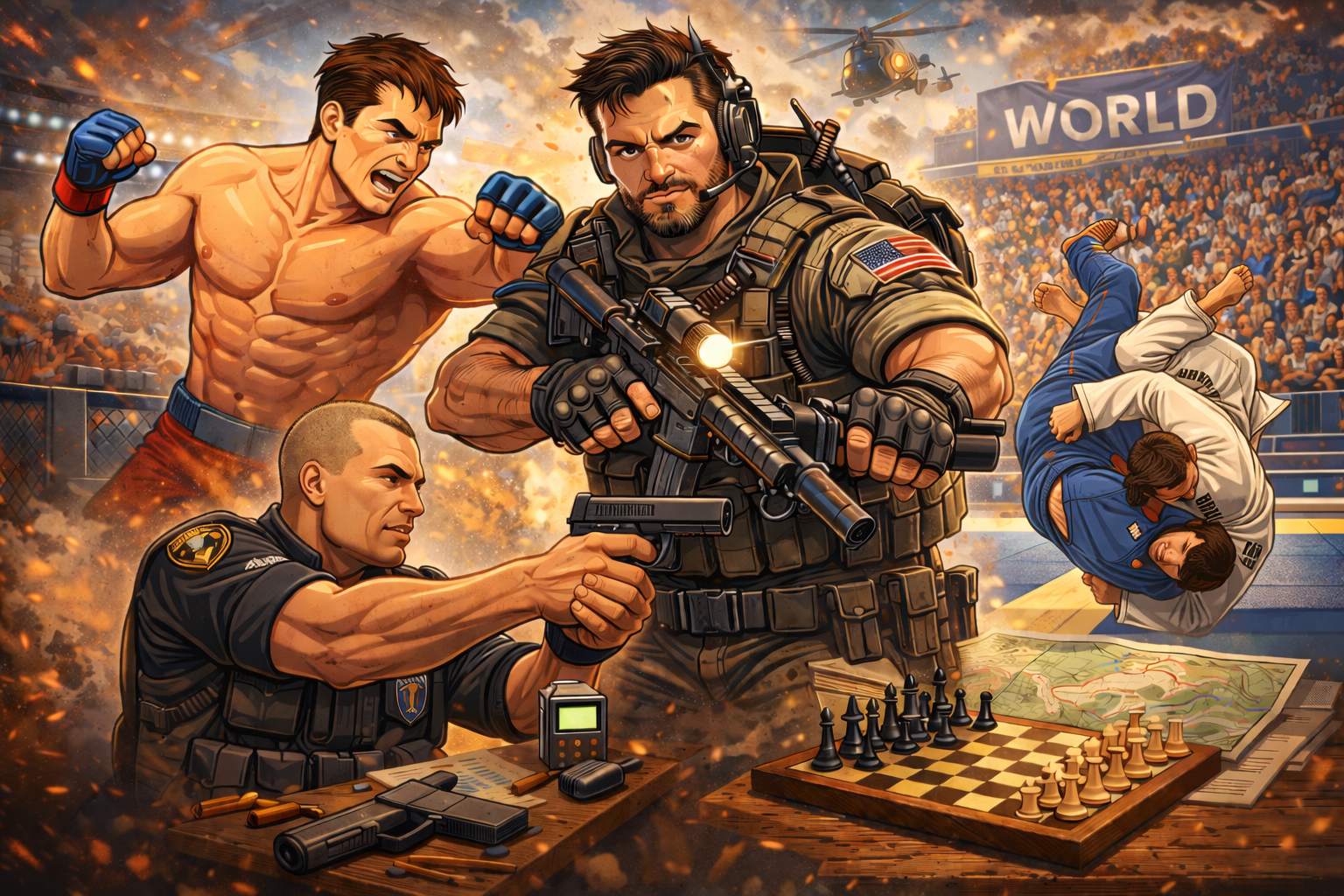
Fight Sports — the cage. The first arena, and the most honest test a civilian can buy. Below the tower in the yard there is a cage, and on the weekends it is full. Here capacity is proven under live resistance with survivable stakes: MMA Fighting, the most complete combat sport there is, where the three ranges you learned on the mat become one fight; MMA Training, how the complete fighter is actually built; Competitions & Tournaments across grappling and striking; and the roots that feed it, Vale Tudo and the ancient Greek Pankration that proved two and a half thousand years ago what the cage proves again every Saturday night. The man in the cage is not learning to fight. He learned that on the mat. He is learning what he is like when it is real and everyone is watching.
Tactical Operations — the team. The second arena, and the professional ground. Here the work stops being one man and becomes a crew operating where the consequence is real and the clock is short: Recon & Intel, because most fights are decided in the knowing before the doing; Signals & Communications, the words that keep a team alive; Breach & Entry and Movement & Transportation; the discipline of the Combat Ready Load Out; and Tactical First Aid (TCCC), the skill that decides whether a wounded man goes home to his family or his family goes to a funeral. Built for the men in uniform. Read by the trained civilian because the same logic governs a family that has to move through its own house in the dark, and because he owes it to the men whose work his life will one day touch to understand what they do.
Modern Warfare — the long study. The third arena, the top floor of the tower, and the one a man reads for the rest of his life. Here are the men who thought longest about all of it: The Art of War and the wider tradition of strategy; Battlefield Strategies from Direct Action to Counterterrorism; The Fog of War, the chaos every real operation lives inside; Fieldcraft and Combatives; the survival discipline of S.E.R.E.; the hard knowledge of Interrogation; and the sober map of The Spectrum of Men Under Threat. And folded inside the fog, where it belongs, The Warriors Prayer, because the man who has been in the chaos knows the plan was never the last word, and this floor is where the Farm finally lets him say so.
The Three Pillars in the War Room
TRUTH is refusing the movie. You do not let your own handful of encounters convince you that you have seen the whole range of what goes wrong. You study the failures harder than the victories, because the failures teach and the victories flatter. And the result gets recorded the way it happened, not the way it felt. The cage does not care how you felt about the round. The debrief does not care how you felt about the entry. The honest picture of how things actually fall apart is the whole asset of this room, and a man who edits it to protect his feelings has thrown the asset away.
LOVE is who the mind is being sharpened for. The competition serves your honest audit, and the audit serves the people you will one day stand in front of. The team serves the public and the man beside you. The study serves the judgment you will spend, across a lifetime, on behalf of the people your life is bound to. Aimed at them, all of this is service. Aimed at yourself, at the record, the reputation, the story, it is something with a much shorter shelf life.
LAW is the lines you operate inside. The rules of the sport, the policy of the agency, the standing orders of the unit, the use-of-force statute of your own town. The lines are drawn before the night, by the most careful man in the room, and they do not get redrawn during it by the least careful one. Staying inside the lines under pressure is exactly the thing that separates the trained protector from the dangerous one, and it is decided up here, in advance, or it is not decided at all.
"All those gathered here will know that it is not by sword or spear that the LORD saves; for the battle is the LORD's." — 1 Samuel 17:47
The boy who said it had a sling in his hand and had already chosen his stones. He is not telling you the preparation did not matter. He is telling you, with the preparation done, whose the outcome was. The War Room sharpens a man's judgment to the finest edge the Farm can put on it, and the last thing the edge learns is that it is not what decides.
Walked as a System
The three arenas are one mind, and the order is the teaching. The cage comes first because a man cannot be trusted with a team until he knows what he is like when it is real, and the cage is the cheapest place on earth to find out. The team comes second because the man who has passed his own audit is finally worth something to the men beside him, and because the team is where he learns that his own capacity was never the point. The study comes last because it is the only floor with no ceiling. A man ages out of the cage. He rotates off the team. He reads until he dies, and every year he reads, the judgment gets better, which is the one thing on this Farm that is true of nothing else.
Everything from the two grounds below comes up the ladder. The three ranges from the mat are what the cage tests. The tools from the shed are what the team carries. And the tower reaches down into the Homestead, where the encounter is actually met, because every plan drawn on this table is drawn for a night that will happen in a hallway with the lights off, not in a room with maps on the wall.
After the War Room
Before you go down to the cage, look out the window on the far side of the room, at the second road. The one going out. The Warrior wants you to see where it goes before you have earned it, because a man who does not know where the road goes will mistake this tower for the destination.
Here is what it looks like from each floor of this room.
The cage fighter comes home from a war that lasted fifteen minutes. His eye is closed and his ribs are taped and he won, or he did not, and either way he cannot get his own shirt off. There is a woman in the kitchen who did not watch, because she cannot, and she does not ask who won. She sits him on the edge of the tub and takes the tape off slowly and puts ice where the ice goes, and he lets her, which is the hardest thing he has done all day.
The sniper comes home from a war that lasted one second. There was a man in a house with his own wife and children held at gunpoint, and a negotiator on the phone for six hours, and a decision that nobody else could make, because nobody else was looking through the glass. He made it. Three children in that house will grow up without their father, and they will grow up, and the difference between those two facts is the whole of what he did. He comes through his own front door and his own children hit him at the knees, and he holds on longer than he usually does, and does not say why.
The soldier comes home from a war that lasted a year, and there is a sign. Somebody's kid made it in marker. His mother is holding one end and a cousin he barely knows is holding the other, and there are more people at the arrivals gate than he has spoken to in twelve months, and they are all looking at him. Behind him the doors slide shut on a place where none of this existed. In front of him is the whole ordinary, loud, unearned peace he spent a year defending for people who will never know what it cost. He is not sure he deserves to walk into it. He walks into it anyway. And somewhere on the drive home, with his mother talking and the sign folded on his lap, the question he cannot put down is whether the peace was ever his to deserve, or whether it was always something that gets given.
That is the second road. That is what receives every hour you are about to spend in this tower. The Farm does not exist to make you a man who can win. It exists to make you a man who can win and then come home, walk through a door, and be the safest thing in the house to the people who were the reason. Israel's officers knew it three thousand years ago. Before a battle they walked the ranks and sent men home: the man who had built a house and not lived in it, the man who had planted a vineyard and not tasted it, the man who was pledged to a woman and had not married her (Deuteronomy 20:5-7). Not because those men were weak. Because the army existed for the house and the vineyard and the woman, and a man who had them and had not yet lived them was sent to go live them first. That is the order of things. The fight is for the home. The home is not for the fight.
Past the second road the maps run out and the tower drops behind you, and a man is waiting at a gate who is nothing like the one who met you here. He is not imposing. You will be short with him, because you will be tired, and he will not mind. He will ask you one question and it will land harder than anything the Warrior ever said to you, and then he will take you somewhere the hands that learned to end fights have to learn the one thing no fight ever asked of them.
"Everyone will sit under their own vine and under their own fig tree, and no one will make them afraid." (Micah 4:4) That is the promise the whole Farm has been standing guard over. Read it carefully. It is not a promise the guard produces. It is a promise the guard is invited into, and the door is at the end of the second road.