
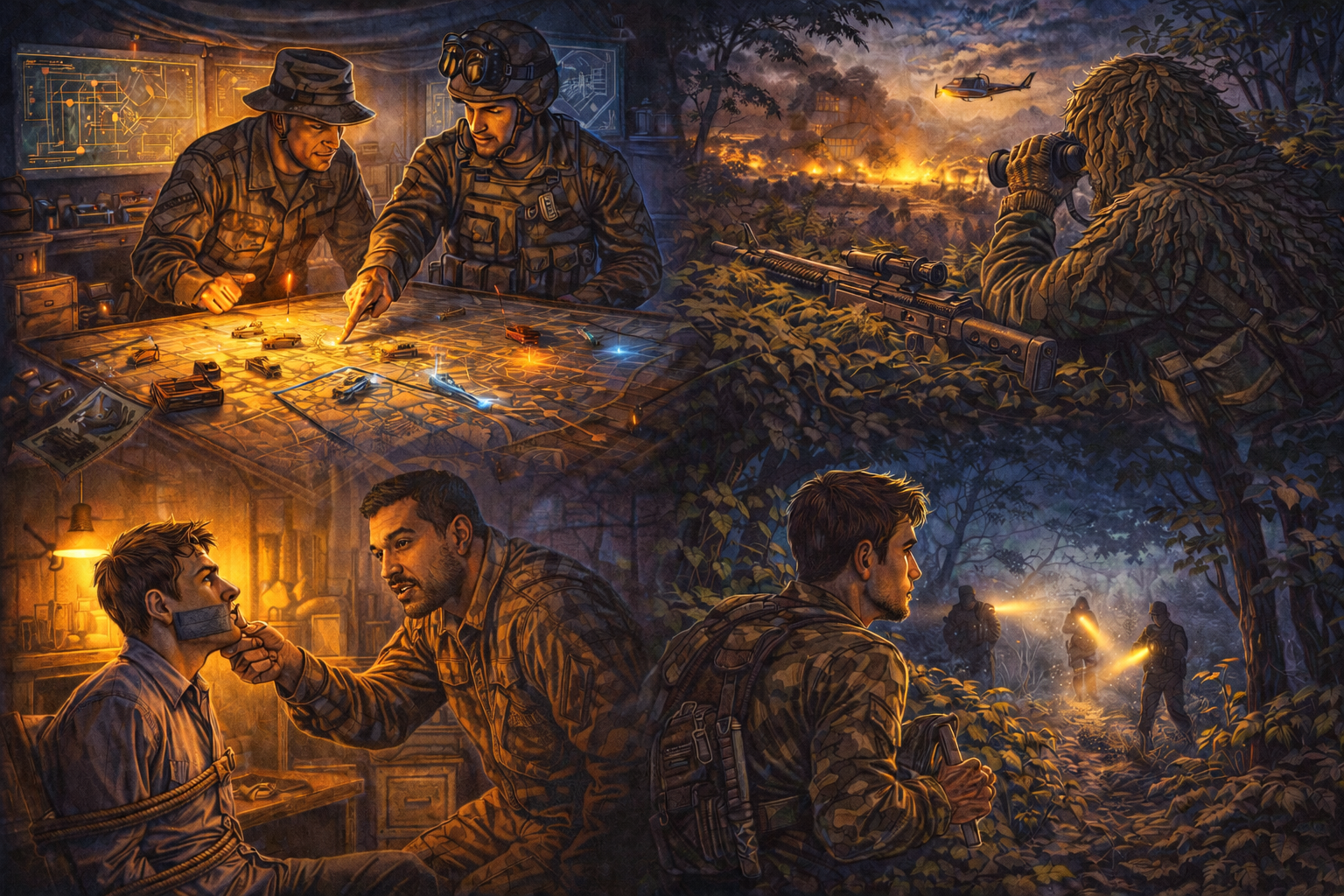
Modern Warfare
The Art of War
Battlefield Strategies
The Fog of War
S.E.R.E.
Tools & Resources
"Wisdom is better than weapons of war." — Ecclesiastes 9:18
The Long Study
The top floor of the tower is one room with a lamp in it, and the Warrior leaves you there at dusk with a book and no instructions.
It is not a thick book. The spine is cracked and the margins are written in three different inks, and the newest ink is his. You read it twice before the lamp burns down, because it is short and because the second reading is a different book, and when you hear him on the ladder at first light you have not slept and you are not sure you understood a page of it. He sets a mug down beside you and does not ask what you thought.
"Two things," he says. "First: you know less this morning than you did last night. That's what this floor does. Every floor below it made you more sure. This one makes you less, and it'll keep doing it for the rest of your life, and the day it stops is the day you've stopped reading it honestly." He nods at the ink in the margin, the oldest, faded almost to brown. "Second: I've been reading that book since I was nineteen. I've got no idea who wrote those first notes anymore. I don't agree with him. He was a fool about most of it." He picks up the mug and drinks. "Point is, he was me. And the man who reads it at sixty is going to think I'm a fool now. That's not a flaw in the book. That's what it's for."
Modern Warfare is the third arena of the War Room and the last ground on the Farm. It is not a skill. The cage was a skill, and the team was a craft, and both of them a man can learn in a few years and lose in a few more. This is the study that decides what the skill and the craft were for, and it takes the rest of a man's life, because it is the record of what the men who thought longest about war left behind, read against the reader's own years as he accumulates them. The floor is laid out the way the study is done: the old books first, the canon that has not been improved on; then the modern forms war actually takes, so a man can read his own century without being a hostage to it; then the fog, the chaos inside every fight that no plan survives and no doctrine describes, and what a man carries into it; and last the man alone, cut off, hunted, held, and coming home, because that is where the study ends and where the Farm does. And the floor exits, like every ground on this property now, through a shop, and on this floor the shop is a bookshelf.
Why the Mind Is Built Last
Because it commands everything built before it, and because it is the only thing on the Farm that improves with age. The body peaks and declines. The team hands a man his last patch at forty. The reading has no last year, and the judgment it builds is the thing the cage and the team were always waiting for. The tactician without strategy has a vocabulary and no grammar. He can clear the room, run the platform, and move the stack, and he cannot tell you which fights to take, which to walk away from, which are the trap built for a man exactly like him. Tactics are a pile of answers. Strategy is the judgment that knows which question the moment is asking, and it is built slowly, off pages, checked against a life.
There is a second reason, and it is about honesty. Every other floor tested a man against something outside him: a stranger, a stopwatch, a door. This floor tests him against the record, which has no interest in his opinion. The generals who lost wrote it down. The men who were sure and wrong wrote it down. The reader who takes the record seriously finds himself in it, on the losing side of a battle he would have sworn he would have won, and the finding is the education. There was once a small city with only a few people in it, and a powerful king came against it and built huge siegeworks against it. Now there lived in that city a man poor but wise, and he saved the city by his wisdom. But nobody remembered that poor man (Ecclesiastes 9:14-15). The Preacher told that story to make a point about wisdom, and made a second one by accident: the man who saved the city is not in anybody's book, and the king who built the siegeworks is. The record is written by the men who won and the men who mattered, and a reader who does not know that reads it wrong.
And a third, which the whole Farm has been walking toward. Somewhere in the long study, a man who has learned to fight, to run a tool, to lead a stack, and to read a war, is going to ask what all of it is for, and who the man who commands the violence answers to. The books do not answer it. They ask it, over and over, in every century, and the ones worth reading are the ones that were honest about not knowing. The Farm has a floor above this one for the answer, and it is not on this property.
What Beats the Man Who Will Not Read
Tactics only. He clears the room flawlessly and never asks whether it was the room to clear. Technical excellence aimed at the wrong objective, which is the most common way good men do harm.
Doctrine worship. He treats the manual as the answer instead of the raw material his judgment adapts. Correct on paper, wrong on the ground, in exactly the way the manual could not have prevented, because the manual was written about a different ground.
The movie war. His whole picture of conflict is film: the clean victory, the wound that heals by the next scene, the enemy who deserves it. The real thing, the chaos, the years of wreckage afterward, the man on the other side who also had a mother, is foreign to him, and the gap shows the first time it arrives.
Strategy with no skill. The opposite man. He quotes the general in China and cannot clear a room. A map with no vehicle. The study is for men who came up the ladder, and the man who skipped the floors below to get to this one has a library and no hands.
No history. He never read it seriously, so he repeats mistakes that earlier men documented in blood, and he calls the repetition experience. The study is half history, and the man who skips that half improvises his way into lessons that were already written down and paid for.
Reading to be confirmed. He reads the books that agree with him and calls it study. The floor's whole discipline is reading the men who would have beaten him, from their side, until he can make their argument better than they did.
No floor under the skill. The deadliest one. His strategy is technical and not moral, and he grows more capable every year with no answer to what the capability is for, until competence with nothing above it serves his own ego or whatever the moment finds expedient. The Farm has a room on this floor for the thing that goes under the skill, and a man who reads every other book on the shelf and skips that room has become the thing the Farm exists to stand against.
The Four Shelves, in the Order the Study Is Read
Four shelves, and they run the way a man's reading runs across a life: the old books first, then his own century, then the chaos, then the man alone.
The Art of War — the canon. The first shelf and the foundation, the handful of books a man is never finished with, because each decade of his own life opens a page he could not read the decade before. The general in China who wrote the shortest book on the subject and the one nobody has improved on. The Prussian who defined war and named its friction. The swordsman with his five rings. The American fighter pilot who drew the loop every fight runs on. And behind them, the warrior traditions, the Greek and the Roman and the Japanese and the ones closer to home, that produced the men who wrote. A man reads this shelf at twenty-five and again at fifty and finds two different books with the same title.
Battlefield Strategies — the forms war takes. The second shelf, and the modern one. How organized force is actually applied and answered in the century a man was born into: the mechanics underneath every contact, the speed of life and the reaction gap and the ladder of escalation; the whole spectrum of warfare from the oldest kind, where range collapses to the weight of a man, to the kinds that did not exist when the Warrior was nineteen, machines that think and machines that fly and wars fought through wires; and the short-duration violence and the long patience of counterterrorism. Read so a man can see the shape of the fight he was born into without being a hostage to the news about it.
The Fog of War — the chaos. The third shelf. The one thing every book on the first two shelves agrees on is that the plan does not survive, and this shelf is about what a man is inside the part that does not, when nothing he knows is certain and nothing he carries can be trusted and the clock in his head has stopped keeping time. It holds two rooms. The prayer a warrior carries into the fog, because the cleared mind is not the last word. And the honest map of how men sort under pressure, who fights and who runs and who sells, and where the reader actually lands on it, not where he hopes.
S.E.R.E. — the man alone. The fourth shelf, and the last room on the Farm. The hardest knowledge on the Farm: a man with no team, staying alive, staying unfound, staying himself in a cell, and finding his way back. Professionals read it as training. Everyone else reads it to learn what is left of a man when the Farm's whole inheritance has been stripped off him. Its last room is the road, because the road is what the property was for.
Tools & Resources — the bookshelf at the exit. Not a shelf of the study. The shop the study leaves through, where the books are the goods, with the honest card beside each about what it will and will not do for a man, and the door out of it is the road to The Estate.
How the Study Is Done
One thing sits on this page rather than on any shelf, because every shelf assumes it.
The study is read slowly, in the margin, against a life. A man does not read the canon once. He reads it at twenty-five and writes in the margin, and reads it at thirty-five and argues with what he wrote, and reads it at fifty and is embarrassed by both. The book did not change. He did, and the margin is the record of it, and the Warrior's copy with three inks in it is the only diploma this floor gives.
It is read from the other side. The floor's hardest discipline is reading the men who would have beaten the reader, from their chair, until the reader can make their case better than they made it. The general who lost is read for what he saw that the winner did not. The enemy's doctrine is read as doctrine and not as villainy. A man who cannot state his adversary's argument has not studied him; he has only disliked him.
And it is read with the floor below in mind. The study is not a hobby for men who never came up the ladder. Every book on these shelves is checked against the cage, the team, and the ground, and the reader who has stood in all three reads a sentence about friction and knows exactly which night it is describing. The Farm put this floor last on purpose. A man who arrives here without the floors below reads about war the way a boy reads about it, and the floor has no patience for boys.
Walked as a System
The floor assumes the tower beneath it and repeats nothing from it. What it adds is the reading.
A man goes first to the canon and reads the old books, and learns that they are about him, and that he has already made most of the mistakes in them at a smaller scale. Then to the modern shelf, where he learns the forms war takes in his own century and how to read the news about them without being owned by it. Then into the fog, where he learns that the plan does not survive and what to be when it does not, and where he reads the prayer and finds his place on the map of men under pressure, honestly. Then to the last shelf, where he is alone, and cut off, and hunted, and held, and where the last room is about coming home. From that room he walks through the shop, which is a bookshelf, and out the door, which is the road, and at the end of the road is a gate with a man under it who is nothing like the one who met him here.
Under all four shelves runs the margin. Every room on this floor is read more than once, and the reading changes, and the floor is the one place on the Farm where being less sure is the evidence that the work is being done.
After the Study
What the floor teaches goes down through the whole tower. It goes into The Team as the judgment that knows which operation to run and which to refuse. It goes into The Cage as the honesty about what a win proved. It goes into The Armory as the answer to what the tools are for, and into The Homestead as the whole reason the hallway plan exists. And it goes home, because the study's last shelf is about a man coming home, and it is not an accident that the Farm ends there.
But hear the thing the whole floor has been building toward, and the whole Farm before it. None of it was the point. A man learned to fight so that someone would never have to. He built the body and readied the tool and led the team and read the war, and a man can go so far down into the study of violence that he forgets the way back up. He hardens. He keeps the war running in his own head long after the field has gone quiet. He becomes a man who can win any fight and has nothing left worth fighting for, no warm house, no full table, no one glad to hear his boots on the porch. That man did not finish the Farm. He got lost on its top floor, with the lamp and the books, and the Warrior has watched it happen to men he liked.
The warrior's own prayer knows better. The psalm that begins with a man's hands being trained for war does not end with war. It ends in a house. Then our sons in their youth will be like well-nurtured plants, and our daughters will be like pillars carved to adorn a palace. Our barns will be filled with every kind of provision. There will be no breaching of walls, no going into captivity, no cry of distress in our streets — Psalm 144:12-14. Read the order. The hands are trained in verse one. The children and the barns and the quiet streets are the last verses, and they are what the hands were for. A man who has read the whole psalm and only remembers the first line has read it the way the movie war is read.
So the Warrior closes the book and walks you down the ladder, and out past the cage, and past the barn, to where the property ends and a road begins that he has never once walked with you. He stops at the edge of it. He is not coming. Blessed is the people of whom this is true; blessed is the people whose God is the LORD — Psalm 144:15. That is the last line of the warrior's psalm and the last thing the Warrior says on his own ground, and then he turns back toward the tower, because there is another man coming up the road behind you, and the study never ends.
At the end of the road there is a gate, and a man under it, and he will ask you how your day was.