
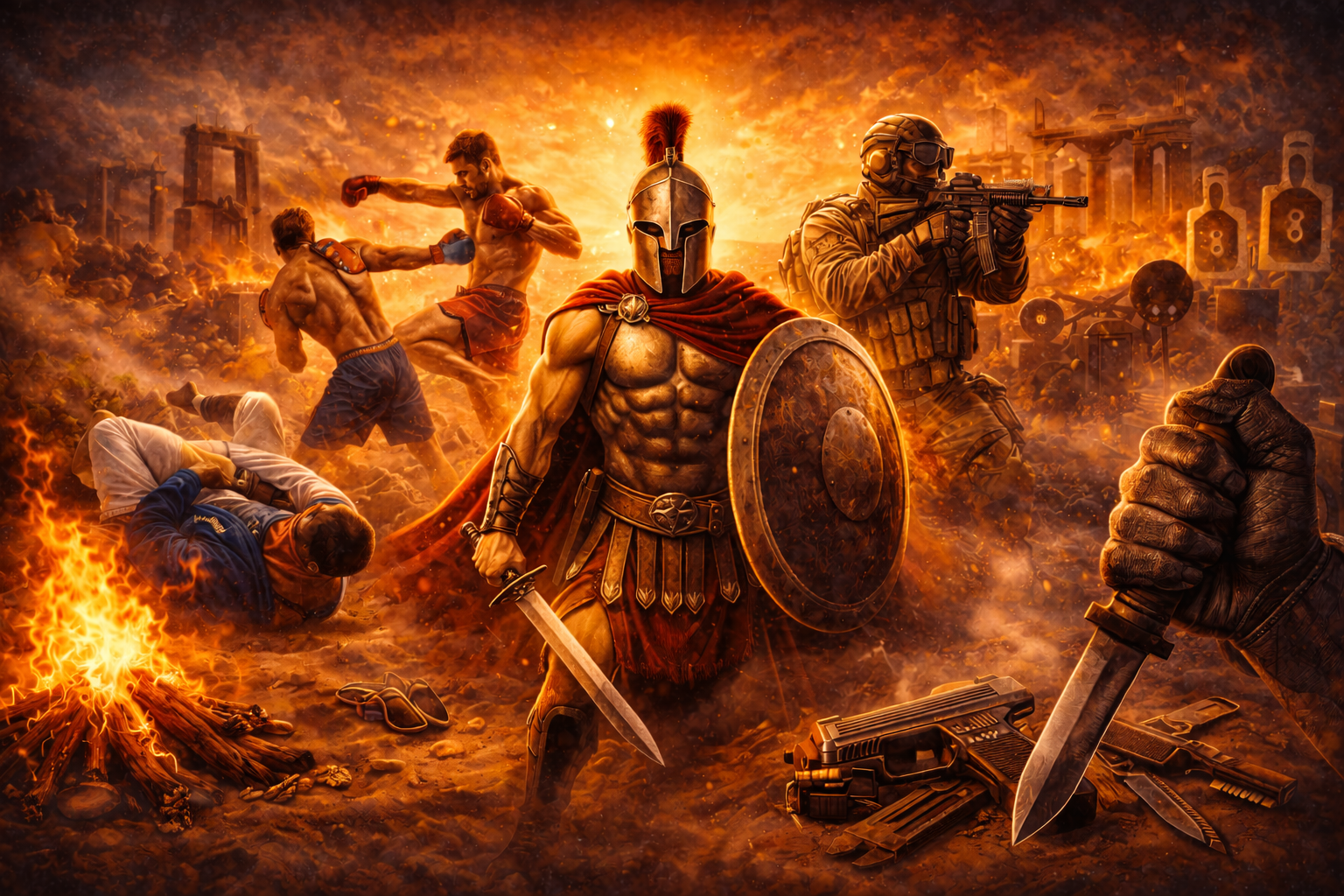
DEFENSE
"Si vis pacem, para bellum — if you want peace, prepare for war." — Vegetius
The Farm
You drop the suit and the tie at the cleaners on your way out of the Exchange. You will not need them where you are going, and they would only get torn.
The mentor walks you past the last tower and down a long gravel road, and the city gives up in stages. Sidewalk, then shoulder, then ditch. The last streetlight. The last fence anybody bothers to paint. Then a plank gate at the end of the road with three words burned into the crossbeam deep enough to read with your hand in the dark.
KEEP THE WATCH.
Past it is a working farm. Barns. A watchtower at the high corner of the property where a man can see the whole road coming. A long shed with a rack of tools along the wall. And a low steel building with the doors thrown open and heat rolling out of it like a kitchen, and that is where he takes you first.
It is a gym, and it is nothing like the one in your building. The mats are worn gray in the middle. The boxing ring has a canvas that was white once and has since taken so much blood that the stains have stains. There is a cage in the back corner with men in it. The air is sweat and leather and the sting of whatever they mop the mats with, and nobody looks up when you come in.
That is the first thing you notice. Nobody looks up. On the top floor of the Exchange a room changes shape when you walk into it. Men stand a little straighter, laugh a little sooner, find a reason to be near you. Half of them want something and the other half want to be seen wanting nothing. Here nobody cares what your title is. Nobody here kisses your ass. You are a nobody in a borrowed rash guard, and in about four minutes a nineteen-year-old is going to put you on your back and hold you there, and you are going to find out that you like it. You like it more than you have liked anything in years. It is the first honest room you have stood in since you got rich.
Then you start to know the men in it. The kid who choked you is a phenom, the best grappler in three states at his age, and he needs a sponsor for a tournament in two months that his mother cannot afford to send him to. The lean fighter working the heavy bag has a bout coming and a landlord who does not care, and it was you who quietly covered his rent this month, and he has never said a word about it and neither have you. The man in the cage is headlining a card in Las Vegas in six weeks. He is in camp, so he does not stop and he does not talk. He looks over once and gives you a nod. That is all you get, and it is more than most men in this building will ever get from him, and you already have the flight booked. Front row. You would not miss it.
Then the mats clear and you sit on the bench between a cop who just came off shift and two soldiers home on leave, and the humor is exactly the humor it has always been. That's what she said. It never changes and it never gets old. They roast you for the shoes and you roast them for the haircuts, and it gets settled without anyone saying so that this weekend the four of you are driving out to a private range so they can run the new rifles you picked up last month. You have money and they have skill, and out here that trade is even, and nobody keeps a ledger.
Look at what you have been doing with the money. A tournament fee. A month's rent. A plane ticket. A range day. Nobody on the Exchange taught you that, and nobody here had to. Something is being built between you and these men that no deal ever built, and it has a name, and you will learn it in the next Kingdom.
The man who runs this place is leaning against the cage. Heavy through the shoulders, thick in the neck, ears swollen flat from too many years of being grabbed and twisted on the mat. He puts out a hand, and his voice is the surprise. Warm. Easy. Glad you came. "Welcome to the Farm." But the handshake is a vise, and the eyes do not blink, and somewhere under the kindness you understand without being told that this man has put another man in the ground and slept fine afterward. He is gentle because he can afford to be. That is the whole lesson before he has said anything else.
This is DEFENSE. This is the Farm, and the man by the cage is the Warrior. Behind him stand all the men like him, the ones who keep your home, your street, and your country safe while the rest of the world sleeps. They are rough. They are loud, abrasive, too much for a dinner party. And the average soft man owes them everything he has and almost never says so.
Understand something about the room you are standing in. It is the front porch. Every ground on this Farm has a back room, and the men in the back rooms are not the men on the porch. Somewhere past that cage there is a man fighting bare-knuckle on a reservation for a purse that would not cover your parking, and he is better than anyone in this building. Somewhere past the range there is a man who has been alone in a jungle for nine days with a rifle, has not showered in any of them, and would be embarrassed to hear himself described as remarkable. The deeper you go into this place, the less the suit at the cleaners means and the more the man leaning on the cage does. You will feel it happen. The businessman who trains a little becomes the man who trains and happens to own a business, and one day you will catch yourself standing on the mat thinking about nothing but the mat, and the Exchange will be a place you go to fund this.
You built the engine on the Proving Ground. You took the reins in the Library. You funded the ride on the Exchange. Here you learn to keep all of it, because a man who can build a homestead but cannot defend it has built a barn for someone else's wolves. Everything you have made up to now sits inside a perimeter. The Farm is where you learn to hold it.
Why a Man Builds This
Get one thing straight at the gate: violence is real. It is not a movie, not a thought experiment, not a primitive thing the modern man has evolved past. It is a permanent feature of a broken world, and it visits most homes quietly across a lifetime and a few homes loudly. You do not get to vote on whether it comes. You only get to decide, long before it arrives, whether you will be ready to meet it.
The culture you came up in trained you into two opposite mistakes at the same time, and you have to throw out both.
The first says the capacity to defend is itself the problem. It treats the trained man as a cartoon, calls awareness paranoia, and quietly raised a generation of men who outsource their own protection to professionals who, by the nature of the job, arrive after the event is over. Police are a report, not a shield. They show up to take pictures and chalk outlines. The man who staked his family on a nine-minute response time made a bet he never read the terms of. That is cowardice wearing the costume of virtue, and the Farm names it plainly.
The second mistake runs the other way and kills just as many men. It says manhood is aggression, that the angry man is the strong one, that the answer to every disrespect is a fist, that capacity and appetite are the same hunger. This is the gospel of the loud corner of the internet, and it produces brittle men who walk into fights a trained man would have walked out of and lose the ones they should never have entered. That is appetite wearing the costume of readiness, and the Farm names that one too.
The Warrior the Farm forms refuses both. He holds capacity with an open hand: trained without rehearsing for a fight he hopes never comes, dangerous without being a danger, peaceful by choice and strength rather than by weakness and default. He is the most capable man in the room and almost always the calmest, because the man who knows exactly what he can do has nothing left to prove.
And know what you are protecting before you learn how. The capacity is never for display. Not for the bar fight, not for the camera, not for the ego. It is for the wife asleep beside you, the children down the hall, your parents in their last years, the brother whose business is being leaned on, the congregation that needs a man at the door who can read a room. The trained man is dangerous on someone's behalf, never on his own. Capacity pointed at your own pride is appetite. Capacity laid down in front of the people you love is stewardship. That line runs through everything on this Farm.
"He trains my hands for battle; my arms can bend a bow of bronze."
— Psalm 18:34
The Ground Under the Grounds
Before you walk anywhere, there is the Homestead, and you never stop working it.
Defense 101 — the house, the land, and the law. This is the ground everything else on the Farm defends, and the one most men neglect because it is the least glamorous. Here you learn the mechanics that sit under every fight there is, and the awareness that ends most of them before they start. Here you harden the place your family sleeps: Home Defense and the perimeter, Personal Defense and what you carry on your body every day, Public Defense and how to move through a parking lot and a crowd. Here you learn the part that decides everything after: Legal Defense, because the fight is not over when the fight is over, and what you say to the first officer and what sits in your phone and your post history will decide whether you go home or go to prison. Here is Psychological Defense, the interior no one can hack, the Gray Man Theory disposition of the trained man who never advertises, the Social Dynamics read that means you rarely have to use anything else, and the men in uniform who hold the line in the cities so the rest of us can sleep, whose whole trade is laid out here for the man who wants to understand it or join it.
None of that is the walk. It is the ground the walk is on. Work it first, and come back to it for the rest of your life.
The Three Grounds of the Farm
The Farm has three grounds, and a man walks them in order. The mat makes the man the rack can trust, and the rack makes the man the watchtower can use, and the man who skips a ground carries a capacity nothing under it can hold.
Martial Arts — the Dojo. The trained body, and the reason you started in the gym. Behind the barn is a worn mat where men test each other under live resistance, and there is no faking it down there. You learn to fight standing up, to put a man on the ground and survive being put there, and to finish it or escape it once you are both down. Those are the three phases of one fight, and together they are the foundation of the most complete unarmed fighting there is. Every hour of it is filtered through one merciless question the Farm calls The Pressure Test: did it work against a man who was actually trying, or did it only work in the rehearsal? The body comes first on this Farm because every weapon eventually jams, runs dry, or gets taken, and the body is the one tool that is always loaded. The man who has not trained it has not built defense. He has imagined it.
Weapons — the Armory. The extended tool. On every real farm there is a rack by the door and a man who respects what hangs on it. Here you learn what multiplies one man's reach: Firearms, and the discipline of the man who carries one. The blade, the oldest fighting tool still in daily use. The close-quarters fight where the tool and the body have to work as one thing, inside the distance where a gun is a liability instead of an answer. And the force options below the lethal line, for the many encounters that do not justify crossing it. Every step up the ladder of force demands a matching step up in what you will answer for. The man who bought a gun and never trained did not buy safety. He bought a story he tells himself about safety, and the story does not load.
Combat — the War Room. The strategic mind. Up in the watchtower is the room where it all comes together against a thinking enemy. Here capacity gets tested in the crucible of the Fight Sports, the cage and the tournament mat, where it is proven under real resistance with consequences low enough to survive the lesson. Here is the professional ground of Tactical Operations, moving as a team, the high-stakes work the men in uniform actually do. And here is the oldest study of all, Modern Warfare, the fog and friction of a real fight and the way the greatest commanders in history thought before they moved. The man who trained his body and his tools but never the mind that runs them built two thirds of a warrior. The War Room is the third third, and it decides whether the other two ever get used right.
The grounds are not a ladder you climb once and leave. The disciplined man works all of them for life and then forces them to operate together against live resistance, because that is the only place the seams show. Most men never do that work, because it is uncomfortable, expensive in time and ego, and impossible to fake in front of men who know. The Farm is built to make it the destination.
Grace at the Gate, None at the Post
Here is something you have felt on every ground before this one and probably never put into words. The men who taught you were patient when you arrived and got harder on you the further in you went, and it was not a mood. It was a standard doing what a standard does.
Think back. In the quiet rooms where you took your own beliefs apart, the man who sat with you did not hold your ignorance against you. You did not know. A man who does not know what he is doing is owed patience, and you got it. But the closer you drew to the truth, the more was expected of you, because a man who has seen cannot claim he did not see. On the Proving Ground the trainer never mocked the heavy man on his first morning. That man was doing the bravest thing in the building. The same trainer tore into a competitor a week out from a show for a plate of carbs he thought nobody saw, and he was right to, because that man knew better and had been told. In the Library the scholar sat an hour with a boy who could not get his fractions to come out, and did it kindly, and would have put an engineer through the wall for a decimal in the wrong place, because a boy's wrong fraction costs the boy an hour and an engineer's wrong decimal costs somebody a bridge. On the Exchange a young man who overdrafted his account on a cheeseburger because he never reads his statement got a talk and a second chance, and the realtor who made one careless remark about whether a client could afford the couch in the penthouse lost the contract and then his job, and nobody on that floor thought it was unfair.
The higher the climb, the harder the fall, and the smaller the margin. A rookie in any league gets a season to be bad. A veteran gets cut in a week for the same numbers. The standard is not different because the men are loved differently. It is different because the stakes are.
Now hear what that means here, because on this Farm the stakes are not a bridge or a contract. The white belt is allowed every mistake there is. He can get choked forty times in a night and the room will slap him on the back for showing up, because that is what a white belt is for. But the officer on the range who lets his muzzle drift across his partner gets corrected once, hard, in front of everybody, and if he does it twice he is gone. Nobody who trains men for that hour has any patience left for the man who has been told. He cannot afford it, because the third time is not on a range. It is two in the morning on the shoulder of a highway, and his partner is on the ground with a hole in the back of his head that he put there. The margin ran out at the gate.
Scripture builds the whole law of Israel on this. When the anointed priest sinned, the offering was a bull. When a leader sinned, a goat. When one of the common people sinned, a lamb would do (Leviticus 4:3, 4:22, 4:32). Same sin, three prices, and the price climbed with the man's position, because the man who stands closest to the holy thing does the most damage when he stumbles and has the least excuse for it. That is not God being harder on some men than others. It is God being honest about what a stumble costs at each post.
So expect the Farm to get harder on you the deeper you go, and understand that the hardening is a compliment. The day the Warrior stops letting you off is the day he has decided you are one of the men he counts on. And the further in you walk, the fewer men you will find beside you, and the harder they will be. Gideon started with thirty-two thousand and told every man who trembled to go home, and twenty-two thousand walked (Judges 7:3). The men who were left were not nicer. They were the ones the work could be trusted to. That is the road in.
The Warriors Who Came Before
The man leaning on the cage is not the first of his kind. He is the latest link in the longest chain there is.
The chain starts in Scripture, and Scripture tells it straight. David killed lions and bears in a field where nobody was watching before he ever walked out to the giant, and the famous morning went the way it did because the unwatched afternoons had. But read further down the page than most men do. The men who gathered to David in the cave were the rough ones, the ones in distress, in debt, and discontented (1 Samuel 22:2), and out of that crowd came the man who fought until his hand froze to his sword and the man who stood alone in a lentil field when everyone else had run (2 Samuel 23:10-11). Those are the back rooms of this Farm, three thousand years early. Joshua and Gideon learned that the size of the army was never the point. And the same book that honors every one of them tells you David was kept from building the temple because he was a man of blood. Scripture honors the warrior and bounds him in the same breath, and the man who cannot hold both will break on one of them.
Then come the centuries when a man's capacity to fight was simply part of being a man. The Spartan told to come home with his shield or on it. The Roman who marched twenty miles and dug a camp before he ate. The general in China who wrote down how a commander thinks and has not been improved on since. The samurai who fused the sword and the soul. The frontier militiaman, the sheriff in a town with no other law, the boy in the hills who could shoot the head off a turkey at a hundred yards and fed his family before he could shave. Men whose capacity was built by the life itself, who would not have understood the question.
Then, inside about a century, the ground shifted under all of it. Protection became something a man paid other men to do, and violence became something he watched on a screen. The capacity did not go away. It moved out of the ordinary man's hands and into a uniform he was taught to call when it was already too late, and the whole of this Farm is an argument for taking it back, under law, on someone's behalf.
And the line runs right up to this morning. The lawyer who teaches the law of force and what a man says to the first officer. The old boxing trainer who has never once watched a fight from the front row. The wrestler who built a dynasty out of a room with no windows. The pistol instructor who has fired a million rounds and treats every one like the first. The blade man who teaches that the weapon was in the hand long before the hand was ever empty. The retired commander who learned the hardest lessons about leading men into danger and wrote them down for the rest of us. Those men are real, and this Farm will walk you to them. But each one is met in his own room, in front of the one thing he has spent his life on. Nobody teaches from the gate. The gate only tells you what you are here to keep.
The Word Over the Gate
There is no name burned into that crossbeam. Nobody's photograph hangs in the gym and nobody's medal is in a case by the door. That was decided on purpose, and you should know why before you walk past the cage.
Every other place that trains men to fight hangs a face over the door. The champion with the belt, the founder in the old photograph, the soldier with the medal. And the moment a face goes up, the training changes shape under the men doing it. They stop asking who am I keeping the watch for and start asking how do I measure against him. A face turns a duty into a contest, and a contest has nobody behind it to protect. On this Farm you will be told about more great men than you can remember, and you will meet some of them in the flesh. Not one of them is over the gate, because the moment one of them was, you would be training toward a man instead of toward a post.
So the crossbeam carries no face. It carries three words, and the three words are an order.
KEEP THE WATCH.
A watch is a post with hours on it. Somebody sleeps because you do not. It is not a title, not a belt, not a medal. It is an assignment, it points outward, at the people behind you and the road in front of you, and it is over when you are relieved and not before. It's like a man going away: he leaves his house and puts his servants in charge, each with their assigned task, and tells the one at the door to keep watch. (Mark 13:34) The man at the door is not the master of the house. He is not the most important man in it. He is the one the house depends on at the hour nobody else is awake, and that is the whole of what this Farm is trying to make of you.
And the watch carries the hardest standard on the property, which is why it belongs over the gate. In every army that ever marched, the sentry who fell asleep at his post was shot, and the cook who fell asleep was not. Same sleep, different post. A man who understands that already understands everything this Farm is about to do to him.
Not keep the fight. Not keep the score. Keep the watch. The question the gate asks every morning is not how dangerous am I. It is who is sleeping behind me tonight, and will I still be awake.
The Three Pillars on the Farm
Three questions filter every hour of training and every decision in the field, and they are how the trained man stays a different category of thing than the merely dangerous one. TRUTH. LOVE. LAW. Always in that order.
TRUTH is telling yourself the truth about what you can do. The warrior tells himself the truth about what he can actually do. He does not inflate his belt, does not pretend the gym round is the street, does not let the costume stand in for the competence. Most men who lose a violent encounter lost it in the rehearsal, in the story they sold themselves about their own capacity, which the encounter then audited without mercy. TRUTH on the Farm is the willingness to test honestly: to roll with men who do not flatter you, to spar against real resistance, to throw out the parts of your training the test exposes as theater, and to keep the parts it confirms are real. The Pressure Test is where this discipline lives, and it runs through the whole Farm.
LOVE is the name of who is behind you. The warrior builds because there are people whose safety he is answerable for, and the whole thing is delivered in the spirit of service, not appetite. The man who trains to dominate, to intimidate, to feel large, has failed this pillar no matter how hard he hits. The same strength laid down to shield a household is a different thing entirely from the same strength used to rule one. Before any man on this Farm raises his hand or his weapon, one question has already been asked and answered: who am I doing this for, and what do they lose if I am wrong?
LAW is accountability for force. The warrior knows the rules his capacity operates inside, what justifies, what mitigates, what convicts. He knows the fight is not over when the fight is over. He does not deploy a capacity he cannot answer for, and he does not freeze on a deployment the law would have honored because he never bothered to learn the law. On the Farm the legal ground is not an appendix. It is the fence the whole property sits inside, and the man who trains the strike but not the statute built half a thing.
The man with all three pillars in place builds capacity the people around him can rest behind. The man with the skill and none of the pillars is the one everyone should be afraid of, and usually is.
How the Warrior Goes Wrong
Every kind of man has a shadow, and the Warrior's are the most dangerous on the whole journey, because his go wrong with other people's blood. A man learns their faces before one of them is his.
The Brawler — the man who confused the capacity with the appetite. He went looking for the fight his training was supposed to let him avoid. He answers disrespect with violence, mistakes a short fuse for strength, and turns a tool meant for defense into a hammer looking for nails. He is dangerous to everyone, most of all himself.
The Vigilante — the man with real capacity and no one above him. He saw a wrong and appointed himself judge, jury, and arm, and called it justice. But the warrior without accountability does not produce justice. He produces the mob. Every man on this Farm answers to something over himself: a brotherhood that vets him, a law that binds him, a God who outranks him. The warrior who answers to no one is one bad night from becoming the very thing the Farm exists to stand against.
The Cosplayer — the man who bought the gear, posed for the camera, collected the patches, and never once tested any of it against a man who was actually trying. He confused the costume for the competence and the merchandise for the capacity. The Dojo and the Pressure Test exist to keep you from becoming him.
The Tourist — the rich man's version of the same disease, and you will be tempted by it before you are tempted by any other. He came to the gym for the photograph, and he got it, and it is the only thing he will ever get here. He sponsors the kid for the post, not the kid. He wants the front-row seat in Las Vegas so that he can be seen in it. He never gets on the mat, or gets on it once and tells the story for a decade. The room reads him in a week, and the nod from the cage never comes, because the men in that room can smell the difference between a man who wants to be one of them and a man who wants to be seen with them.
The Coward — the opposite sin, just as deadly and far more common. He inherited the flinch and never did the work to unlearn it. He tells himself violence is beneath him when the truth is he is simply afraid of it, and he has quietly decided that the cost of that fear will be paid by whoever happens to be standing behind him when the day comes.
The disciplined Warrior refuses the appetite and the avoidance both. He is the hardest man in the room and the slowest to use it.
No Warrior Stands Alone
The lone wolf is a myth the movies sell and the graveyard collects. The real protector has always moved inside a band, a brotherhood that trains him, vets him, holds him accountable, and stands the line beside him. You sat in the middle of one on that bench, and it did not look like anything special, which is how you know it was real. The Farm honors the whole brotherhood: the first responders who run toward what everyone else runs from, the police who hold the line in the cities, the military who carry it overseas, the coaches and instructors who run the mats and ranges where men are forged, and the trained civilians, the concealed carrier, the hunter, the father who hardened his own home, who hold capacity outside the uniform and ask no one's permission to protect their own.
And the Warrior owes the other Kingdoms as much as they owe him. He cannot stand the line alone any more than the Provider can fund it alone. The Saint anchors his soul so the violence in his hands never makes it into his heart. The Champion built the body that carries the fight. The Scholar sharpens the mind that decides whether the fight happens at all. The Provider funds the training, the gear, the tournament, and the rent. The Shepherd is the household the whole thing is for. It is one man with seven debts, and the people behind him sleep because he is paying every one of them.
Where DEFENSE Stops and Scripture Continues
The Farm builds a man's power to protect. The power is real, the work is decisive, and a household with a trained protector at the door sleeps a different sleep than one without. But the Farm cannot answer the question that ruins every shadow above: what is the strength finally for, and who commands the man who commands the violence? The most capable warrior alive, with no answer to that, drifts into the Brawler, the Vigilante, or the cold hired hand, because strength with nothing above it always ends up serving itself.
Scripture answers it. The Lord Himself is named a man of war (Exodus 15:3), so the trained protector is not deviating from God's character. He is participating in it. David, the greatest warrior-king, was loved by God and still told he could not build the temple, because he was a man of blood (1 Chronicles 28:3). Capacity is honored and capacity is bounded, both at once, and the warrior who cannot hold both truths will break on one of them. And on the last night, when Peter finally drew the sword he had been itching to use, the answer came: Put your sword back in its place (Matthew 26:52). Not because the sword was wrong, but because that was not the hour, and the warrior who cannot sheathe on command is not a warrior. He is a loose weapon.
The whole arc of the Farm bends toward one figure standing in a garden who could have called down more than twelve legions of angels (Matthew 26:53) and chose, instead, the cross. That is the Warrior this Kingdom is finally pointing at: perfect strength under perfect control, the most powerful one of all laying the power down on purpose, for the people He was protecting. The Farm is honored when a man builds real capacity and holds it the way the King held His, ready, accountable, patient, and laid down without a fight when the One above him says the word. It is dishonored when the strength becomes the man's god, and the protector becomes the thing the gate was built to keep out.
And there is one more line, and it sits under the three words on the crossbeam like a foundation stone. Unless the LORD watches over the city, the guards stand watch in vain. (Psalm 127:1) Keep the watch. Keep it with everything this Farm gives you. And know, standing at your post at three in the morning, that the watch is not what keeps the city. Something else does, and a man who has kept the watch long enough and honestly enough eventually finds that out, and it does not make him put the rifle down. It makes him hold it differently.
Leave here the warrior you were called to be. Then carry the sword up the road, and learn, in time, when to put it away.
Where the Watch Comes Home
Before you go find the mat, hear one more thing, because it will make more sense now than it will at the end.
Everything this Farm will make of you is for a single hour, and the hour rarely comes. You will train for years for a night that, God willing, never arrives, and the people you trained for will never know what it cost. That is the deal, and it is a good deal. But it leaves a question the Farm cannot answer. What does a man do with the strength on all the ordinary nights? The lion's share of a protector's life is not the fight. It is the years around the fight, at a kitchen table, with people who need him to be the safest thing in the room and have no idea what he is capable of.
The men on that bench already know it. Look at where the money went. Look at whose rent got paid, and who got a nod from the cage, and who is driving to the range this weekend with men he would have crossed the street to avoid a year ago. You were already building the thing the next Kingdom teaches before you had a name for it, and the Warrior saw it in you, which is part of why he let you in.
So train here knowing where it all lands. The body you harden on the mat is going to hold a child. The steadiness you earn on the range is going to sit at a hospital bed and not shake. The awareness that reads a parking lot is going to read a room where your wife has gone quiet. Every hour you spend learning to lay your life down once, fast, on the worst night of somebody's life, is buying you the man who can lay it down slow, over forty years, for people who will never see the worst night because you were there.
He is already waiting at the far end of this property, at a gate you have not come to yet, and he is not what you will expect. The Warrior teaches you to end a fight. The Shepherd teaches you what you were ever fighting for.