
Weapons
Less-Lethal & Non-Lethal Weapons
"He said to them, 'Let the one who has no sword sell his cloak and buy one.'"
— Luke 22:36
The Armory
You still owe a man dinner.
The Warrior walks you across the yard from the barn to the long building at the side of the property and stops short of the door, which is the first time on this Farm he has stopped short of anything. "This one's not mine," he says. "Mind your muzzle." And he leaves you standing there.
The man who comes to the door is the one who flicked the rubber blade onto the whole mat with every teacher on the property watching, and paced you to nothing, and never stopped smiling. Up close he is older than you thought, shorter than you thought, and wider. A mustache like a push broom gone to iron gray, and a voice that sounds like it was dragged behind a truck for forty years and never fully recovered. He looks at you the way a man looks at a used truck. "Tacos," he says. "Thursday. You're driving." Then he steps back and lets you in.
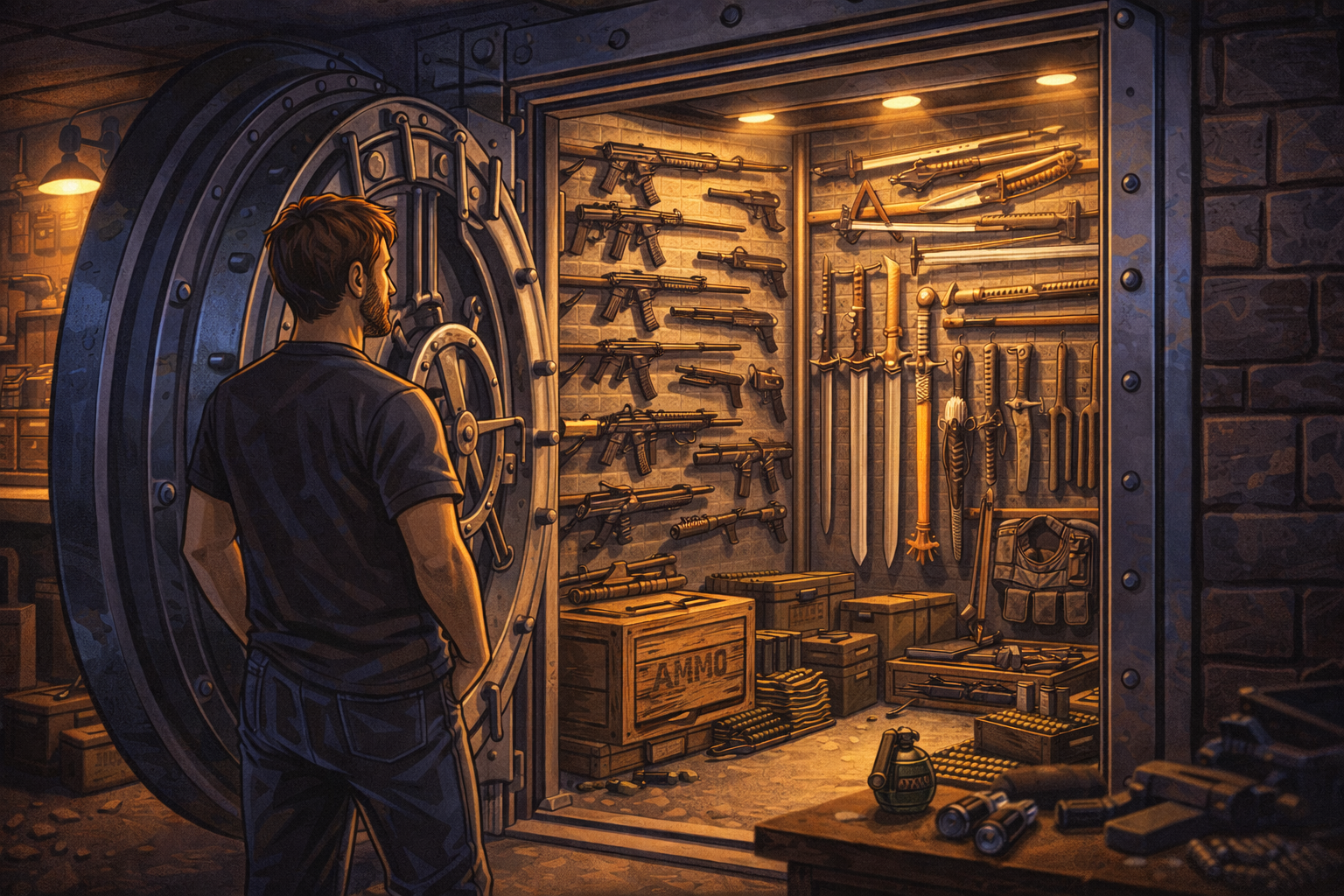
The shed is quiet in a way the gym was not, and it is the cleanest room on the Farm. A rack runs the length of one wall: a pistol, a rifle, a shotgun, half a dozen knives with edges you could shave with, a baton, a canister of spray, every one of them where it belongs and none of them dusty. A workbench under a window with a stone on it and a rag folded square. One stool. And at the back of the room, a steel door with a wheel on it, painted the same flat gray as everything else, shut.
You ask what is behind it. He does not answer, and he does not answer because he does not have to. After a minute you understand that everything about the way this man carries himself, the flat voice, the unhurried hands, the fact that he does not raise his voice and has plainly never needed to, comes from knowing exactly what is on the other side of that door. He is not showing you the vault. He is showing you the rack. The rack is what a man gets when he walks in off the mat. The vault is for the men in the back rooms of this Farm, and you are not one of them yet, and he is not sorry about it.
"Two rules in here," he says, "and I say them once. You point that at me by accident, I'll tell you. You do it twice, you're back on the mat and you don't come in this building again this year." He lifts the rifle off the pegs, runs the bolt without looking at it, shows you the empty chamber, and hands it to you with the muzzle already aimed at the floor. "Now hold it like a man who's been hit before. I hear you have. I hear nine of them hit you last week."
This is the Armory, the second ground of the Farm, where the reach of a trained man extends past the end of his own arm. Everything on that rack is leverage. A tool multiplies what one man can do across distance, across force, and across consequence, and it multiplies in both directions, which is the whole of what this building teaches. A trained hand on the rack makes the people behind it safer than they have ever been. An untrained hand on the same rack is the most dangerous thing on the property, and the man who keeps this room knows it better than anyone alive, because he has cleaned up after both.
This page is the door, not the rack. Each tool has its own room, and the rooms are walked in an order that carries a reason. What this page does is tell you why the tools come second on this Farm and not first, how the rack is laid out and what is actually kept in each room, what the Armorer's rules are and why he only says them once, what puts armed men in the ditch, how the three rooms hand each other off, and what is waiting up the hill when the last of them is finished with you.
Why the Tools Come Second
Most men who walk onto this Farm want to start here. The Farm makes them earn the door, and there are three reasons.
The first is the hand. Nothing in this room fixes a hand that has never been hit. It only makes the shake louder, and puts a trigger under it. The Armorer has watched a thousand men come to his door straight from the parking lot, and he can tell inside a minute which ones have been on the mat, because a man who has been choked and got up again holds a rifle like it is a tool, and a man who has not holds it like it is a wish. He does not teach the second man. He sends him back across the yard. The whole mat, the day in the barn against nine arts, was the Warrior's way of making sure the man who reaches this door has been hit by strangers and is still standing.
The second is the consequence. A mistake on the mat costs a bruise and an evening. A mistake on this rack costs a life, and then it costs the next ten years of yours, and the two costs land in that order. Every other ground on the Farm lets a man be wrong and learn. This one lets him be wrong exactly once, and the law then takes as long as it likes to decide whether he was. A man has to have already learned to be calm under contact before he is handed a thing that will not forgive him for panicking.
The third is the story the tool tells. A pistol in a nightstand drawer feels like a decision made. A rifle in a closet feels like a household protected. Neither is true and both feel true, and that is what makes the tool dangerous to the man before it is ever dangerous to anyone else. It tempts him to believe the work is done because the object was purchased. The mat cannot be bought, and a man who has spent a year on it knows the difference between owning a thing and being able to do a thing. The Farm sends him to the mat first so that he walks into this building already immune to the story on the rack.
How the Rack Is Laid Out
Three rooms, walked in order, and the order is not the order of danger or of age. It is the order of how a man actually comes to need each tool.
Firearms — the gun rack. The gun comes first because it is the tool a man will actually own, the tool the law is written around, and the tool whose consequence is highest and least reversible. The room holds three platforms and the workshop under them. The Pistol a man carries on his body, which the room calls the hardest gun in the rack to shoot well and the only one that is there when the day comes, taught by the man who once fired twelve aimed rounds from a revolver, with a reload in the middle, in less than three seconds. The Rifle that holds the house and reaches out past it, the gun that wants to hit, taught by a man who wore a Ranger's uniform for four deployments before he wore a hat for a living. And the Shotgun that ends things at a doorway, the most misunderstood gun America owns, taught by a butcher who broke a clay at a hundred and thirty yards to prove the spread does not aim the gun for you. Under the three sits the workshop, and the workshop is most of the room and fifty rooms deep: the four rules stated in full and the warning that breaking one is manageable risk and breaking two is predictable tragedy; the draw in five steps, timed, with a trained concealed draw split into tenths of a second; dry practice at the kitchen table, which the workshop says three times over is what actually makes a man better, with the five safety rules that keep it from ending the way it ends in somebody's house every year; the three kinds of stoppage and the one that tap-rack-bang will not clear; grain and bullet type and what a load has to do in gelatin before it rides in a carry gun; the patterning board that the shotgun room calls truth with a staple gun; holsters and lights and dots and the plateau every man hits with a dot in his first three months; ear protection against a muzzle blast that runs past a hundred and forty decibels; the range and its commands; and the cleaning bench where cleaning turns out to be inspection. Scripture records seven hundred men from one tribe who could sling a stone at a hair and not miss (Judges 20:16). Nobody is born with that. It is what a workshop produces when men live in it for years.
Edged Weapons — the blade. The blade comes second because it goes where the gun legally cannot, rides in a man's pocket every day of his life, never runs dry, and does a hundred honest jobs between the one it was feared for. And because the blade room teaches the lesson the gun rack cannot: that when steel comes out, everybody bleeds, and the trained man is the one most committed to never being in that fight. The room opens on a police trainer's stopwatch, an attacker at twenty-one feet who closes and stabs in about a second and a half, faster than a trained man draws and fires, and it says plainly that the Filipinos knew that four hundred years before anyone timed it. Choosing a working blade in Blades & Knives, where a blade is a purpose with a handle and eight families of purpose are laid out by the job. Keeping it in Knife Sharpening, where there is no such thing as sharp, only sharp for a job, and the angle is chosen by the work. The Filipino craft of Pekiti Tirsia, the one room on this rack a living man holds, where the weapon teaches the empty hand and the first target is never the man but the hand that holds the blade, because take the fang and the snake is still a snake but it cannot bite.
CQB & CQC — inside arm's reach. The close range comes last because it is where the first two rooms get fouled. The draw that took a second at the range takes forever with a man's weight on it. The blade gets trapped. The gun becomes a thing to be wrestled over. Here the tool and the body have to become one thing, and the room says it in a line the whole building runs on: self-preservation before weapon presentation. A man learns to keep his weapon when another man has hold of it, to move the body and not just the gun, and to take a weapon away only as the last thing on a five-step list that starts with leaving. He learns to move through his own house in the dark, and the first rule of that is not to, but to stop, arm, light, barricade, and hold, and to move only to reach the people he loves, and when he must move, to slice the doorway a sliver at a time with the weapon leading, and to know that a wall that stopped the first round may not stop the tenth. He learns to fight with empty hands inside weapons distance, and to read the eight different men behind the eight different doors that a fight can open with, sorted by what the man wants: your property, you, your pride to answer his, or the man in the mirror. And he learns the day everyone in the building hopes never comes, the one where the answer is run, hide, and then fight, told through three real afternoons where an ordinary armed man had an answer, and one where nobody on the ground did. The oldest account of a disarm is a single verse about a man who snatched a spear out of an Egyptian's hand and killed him with it (2 Samuel 23:21). It is told as a wonder, in a list of wonders. That is how this room treats the disarm too: possible, trained, and the last thing you try. Off this room, and not on the line, hang the middle rungs: Less-Lethal & Non-Lethal Weapons, the spray and the baton and the electrical tools and the improvised, everything a man reaches for when the moment needs more than words and far less than a bullet, because a ladder with two rungs is not a ladder, it is a cliff with a step at the bottom. And beneath them the one drawer in the building that is a warning, Mall Ninja & Spy Gadgets, where a man's money goes when he buys the idea of being dangerous instead of the work. Neither is the next step. They hang off the close range because that is the distance where the ladder of force actually gets climbed.
The Armorer's Rules
The four rules of the gun belong to the gun rack, and you will learn them there from a man who means them like Scripture. These are the rules of the building, and they are the Armorer's, and he says each of them once.
The muzzle, once. He told you at the door. Sweep him by accident and he will tell you. Do it twice and you are done here, and he does not care what you paid for the rifle. Understand why the grace runs out so fast. The first time is ignorance and he forgives ignorance, because every man in the building was ignorant once. The second time is a man who was told, and the third time is not in this building. It is in a driveway or a hallway with somebody he loves on the wrong end of it. He is not being hard on you. He is being hard on the third time.
Nothing leaves the rack until you can run it blind. You will clear a stoppage with your eyes on the threat and not on the gun. You will reload without looking down. You will draw from the holster you actually wear, under the shirt you actually wear, at the speed you can actually manage, before he lets you carry it off the property. A tool you have to look at is a tool that is not ready, and the workshop's clock will tell you how far from ready you are, in tenths of a second, whether you want to know or not.
The statute is stapled to the tool. Every object on that wall has a law wrapped around it, and it is a different law in the next county and the next state and the building you work in. The baton on that rack is a felony to carry in some states and a permit in others. The blade an inch too long is a charge. The short rifle is a federal form and a tax stamp. The Armorer will not hand a man a tool until the man can tell him what the law says about carrying it there. Read it before you buy, not after you are asked.
Storage matches the life you actually live. The gun a child can reach, the rifle a burglar takes from a truck, the pistol staged somewhere it cannot be reached in the dark, the carry ammunition that has not been rotated in five years. He asks about your house before he asks about your caliber, and he asks again every time your house changes.
You own the rack, not a tool. The fight does not care which tool you love. The gun runs dry, the blade gets trapped, the hands are what is left, and a man who can only move down the rack in one direction is a man with one plan. Transitions are trained here like anything else, and the drill that moves a man from an empty gun to a blade to his bare hands and back again is on the wall of the workshop for a reason.
No costume. A thing earns its place on your belt by the reps you have put through it and nothing else. He can tell the men who bought the gear for the photograph from across the room, and he does not say anything to them, because he does not have to. The rack does, and so does the drawer at the bottom of the middle rungs, which was built for exactly that man and which he will not look in.
"Not a blacksmith could be found in the whole land of Israel, because the Philistines had said, 'Otherwise the Hebrews will make swords or spears!' So all Israel went down to the Philistines to have their plow points and mattocks sharpened... So on the day of the battle not a soldier with Saul and Jonathan had a sword or spear in his hand; only Saul and his son Jonathan had them."
— 1 Samuel 13:19-22
That is why the Armory exists, and why it is open to the ordinary man off the mat and not just to the men behind the steel door. A people with no smith sharpen their tools at their enemy's forge, and they go to the field with whatever their enemy was willing to let them keep. The Armorer has read that passage more times than he has read anything else in the book, and it is the reason the door to this building opens for you at all.
What Puts the Armed Man in the Ditch
The same handful of mistakes put armed men in the ground or in prison, over and over, and the Armorer has a name for each. Learn them here so the rack does not have to teach you.
The nightstand decision. He bought the gun and considers the household protected. He has fired it twice, both times at a paper plate in daylight, and he cannot find the safety in the dark. The purchase was the last thing he did about it.
The caliber lawyer. He can argue ammunition for an hour and has never put five hundred rounds through the gun he actually carries. The platform matters at the edges. The reps matter at the center. He has the two reversed, and the workshop's honest line about grain weight, that it is a specification and not a quality, was written for him.
The paper shooter. Everything he knows about shooting he learned standing still, at a known distance, with all day to decide. He has never moved, never been timed, never had to choose whether to fire at all. The close-range room has a line for him that he will not enjoy: he will be half as good on his best day on the range.
The statute-blind. He carries a blade that is an inch too long for his state, a baton that is a felony in his, and a pistol into a building that bars it, and he will find all of this out from a prosecutor.
The one-tool man. He trained the gun and nothing else, or the blade and nothing else. The moment the fight moves off the tool he loves, he is an untrained man holding an object.
The collector. He owns eleven guns and can run none of them well. He owns nine knives and none of them is sharp. The drawer at the bottom of the middle rungs was built for him, and he will not look in it.
The tool with no hands under it. He came to this building without going to the mat, or he went to the mat for a month and called it done. When the fight closes inside his draw, the gun becomes the thing being fought over, and the body he never built is the only tool left in the room. The Armorer's own phrase for the man he wants is the one the close-range room quotes: a fighter who happens to carry a gun, not a gun-handler who happens to be in a fight.
The Three Pillars in the Armory
TRUTH is the timer and the cold bore. Neither of them cares how you feel about your shooting. You run the gun on a clock, from the holster, with movement and a decision in it, and you believe the bad score over the comfortable one. You put the shotgun on the patterning board and find out that two loads with the same name throw a fist and a basketball. You test the blade against a man who is trying to take it. You find out whether your draw survives a hand on your chest. The Armory is the second place on the Farm where a man can lie to himself about what he can do, and the first place where the lie is loaded.
LOVE is the reason there is a rack at all, and it reaches further in this building than in any other on the Farm. The tool rides for the people behind you. It does not ride for the picture, the debate, or the loudmouth who needed putting in his place. But the middle rungs are on this wall for a second reason, and a man should hear it plainly. They are there for the stranger on the other end. A night that ends with a man on the ground gasping from spray, and alive, and you home, is a better night than the one where you were right and he is dead, and the Armory builds you the option so that you have it. The blade room says the same thing with an edge: take the fang, not the snake.
LAW is the statute stapled to every tool, the graduated ladder the courts will measure you by, and the plain fact that what you cannot lawfully carry stays on the wall no matter how much you like it. A man who reaches for a tool he cannot answer for has already lost, and so has the man who left it on the wall on a night the law would have stood behind him, because he never learned where the line was. And the law has a second edge the close-range room teaches: the man who agrees to the fight in the parking lot has thrown away the shield the law would have held over him, before a hand is raised.
"I put no trust in my bow, my sword does not bring me victory." — Psalm 44:6
The man who wrote that owned a bow and a sword, kept both, and used both. He is not telling you to leave the rack empty. He is telling you what he learned by filling it: that the tool is real, and the training is real, and neither one of them is what finally keeps a man. The Armorer would not put it that way. He would say the best shot he ever trained was the one who least believed the rifle was the reason he came home, and leave it there.
Walked as a System
The three rooms are one hand. You learn the gun first because it is what you will carry, and the gun rack teaches the draw, the shot, and the discipline that surrounds both. You learn the blade second because it is what you will have when the gun is not allowed or not reachable, and because the blade room takes the confidence the gun rack gave you and bleeds it, on purpose, so that you carry both tools humbly. You learn the close range last because it is where both tools meet the body, and where the drill that moves a man from an empty gun to a blade to his bare hands stops being a drill.
Everything from the mat comes back in here. The clinch you learned in the takedown room is the clinch a man fights you in for your pistol, and the retention room drills it with the same ties and underhooks the wrestling room taught. The ground you learned is the ground you will be on when the blade comes out, and the close-range room's whole instruction for the ground is to get up and go home. The calm under contact you paid for on the mat, and proved in the barn against nine arts, is the only reason your hand does not shake on the trigger. And two things from this building reach upward. Moving through a structure in the dark, learned here for your own hallway, becomes the team work of the watchtower, with its priorities and its radio traffic and its stack. And the eight doors a fight can open with, learned here as mechanics, are met for real back at the Homestead, where the encounter actually happens and the law actually watches. The tools live in this shed. The night they are used for does not.
After The Armory
Before you go find the gun rack, hear what this ground cannot do, so that you do not expect it to.
Everything in this building teaches you how. The draw, the shot, the edge, the retention, the room cleared, the rung of the ladder chosen. Nothing in this building teaches you whether. The rack does not know if the man in your doorway is a threat or your neighbor's drunk brother-in-law. The rifle does not know if the shape in the dark is a stranger or your son home early, and the home-invasion room says it plainly: positive identification before force, every time, because the one shot a man can never take back is the one at his own boy. Every tool on that wall does exactly what a hand tells it to, instantly and without opinion, and the one question that decides everything, the question of whether the hand should have moved at all, is not answered anywhere in this shed. A man can run every tool on the rack and still lose, because most men who lose lost in their own head before they reached for anything.
On Thursday, over tacos, the Armorer will tell you the only thing he will ever tell you about the vault. The men whose rifles live behind that steel door are not better shots than the men who use the rack. Some of them are worse. They are men who were trusted with the decision, and the decision is not made in this building. It is made up the hill, in the room at the top of the watchtower, where a man stops being a fighter with tools and becomes the one who decides when the tools are used and when they stay on the wall.
That is what receives everything you build here. The Warrior is already waiting at the foot of the ladder.