
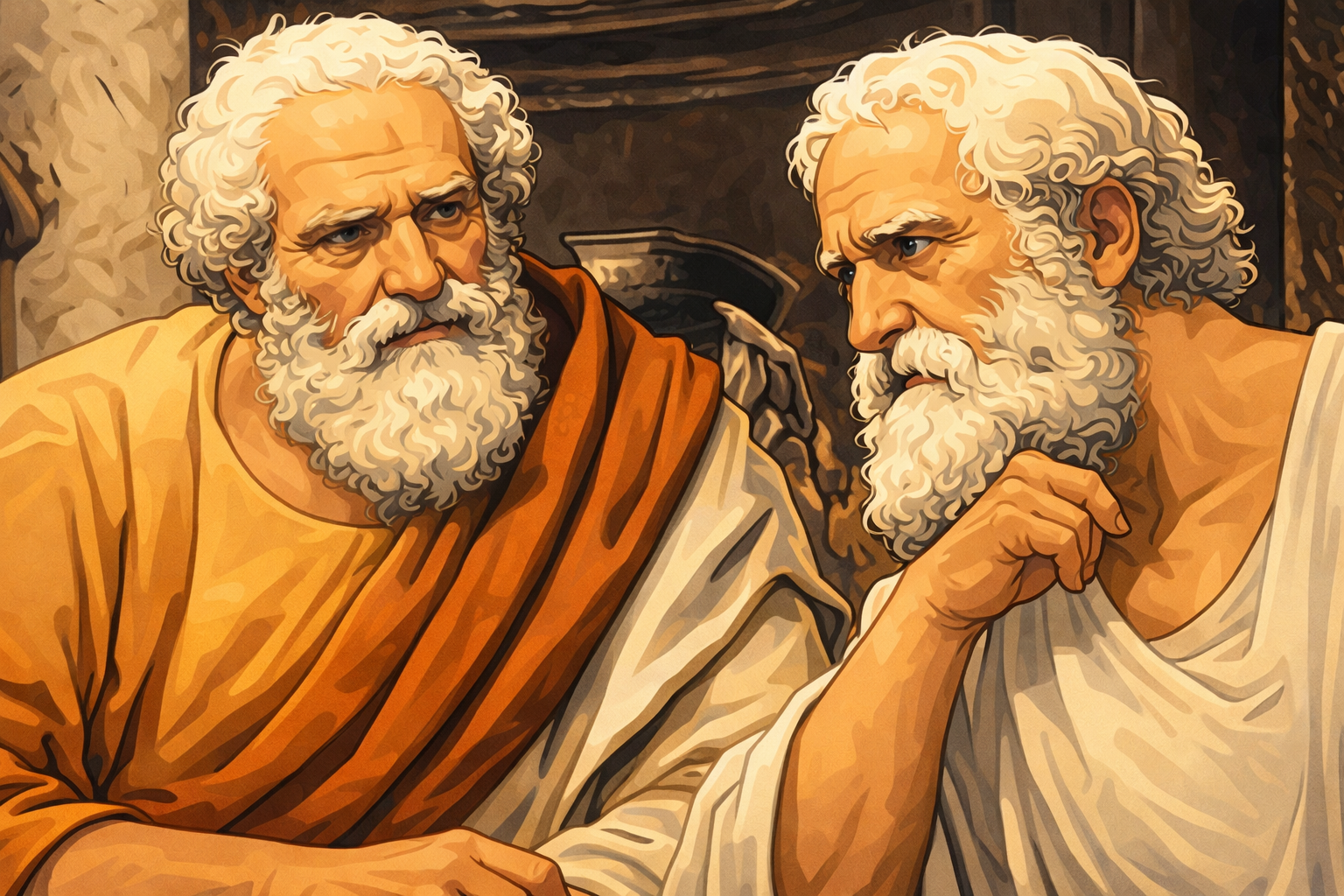
Philosophy
Every man eventually runs into a question he cannot outrun. For our generation, one of them is this.
Have we lost our way as a society?
Ask it plainly and the answer arrives in the gut before the mind can argue. Something is off. Men feel it without being able to name it — a low sense that the map everyone is handed no longer matches the ground under their feet. We are richer, faster, and more connected than any generation in history, and somehow more lost. More anxious. More alone. The instruments all read fine and the ship is still drifting.
Philosophy is the discipline that asks why. It is the oldest work there is — the practice of stopping long enough to examine the beliefs you have been running on without ever inspecting them. Before a man can find his way back, he has to know where he stands and how he got there. That is what this Kingdom is for. SPIRIT is the foundation under every other domain. Philosophy is where that foundation gets dug, because nothing built on borrowed assumptions survives the first real storm.
This is the starting line. After it, the journey maps its way through all seven domains — but a man cannot build strength, wealth, or legacy on a worldview he has never questioned. So we start here, at the beginning, with the questions every honest man eventually has to face.
We do not start by handing you conclusions. We start by emptying the cup. The only true wisdom is in knowing you know nothing. That was Socrates' posture, and it is the right one for entering this section — not because nothing is true, but because a man who already has all the answers cannot learn anything. Set down what you think you know. Come in ready to test it. Nothing here is forced; everything here is examined. The unexamined life is not worth living.
From Socrates to Seneca, from Aquinas to Kierkegaard, we will walk with the men who gave their lives to understanding the depths of our existence. We will dive into the deep end. We will set their theories against one another and against the great belief systems of the world — the Four Noble Truths of the Buddhist, the Stoic's resignation, the modern man's autonomy — and see which ones hold weight when pressure is applied. This is how a man sharpens his ability to think.
But sharpening reason is not the whole job, and there is a filter that runs through everything in this Kingdom. If a philosophy cannot make its practitioners virtuous, it is not a philosophy that should guide your search for truth. A system can be clever, elegant, and internally consistent and still produce hollow men. The test is not whether an idea is interesting. The test is what kind of man it builds. We are not collecting clever arguments. We are looking for truth that can be lived.
This section reveals why some men develop clarity, perspective, and wisdom while others stay stuck repeating what they were told, never having understood any of it. It is a place for men willing to seek truth rather than comfort, clarity rather than noise, responsibility rather than excuse. Through disciplined reflection, timeless principles, and deliberate action, character is not assumed — it is forged. This is the starting line for men who intend to build lives that can withstand pressure, carry meaning, and stand the test of time.
Foundational Beliefs
Everything you become rests on what you believe. This section exposes the unseen assumptions shaping your life — and gives you the chance to rebuild from solid ground.
Fundamental Practices
Belief without action is empty. This section reveals the daily disciplines and repeatable actions that turn truth into strength and intention into results.
Doctrines & Tenets
When chaos rises, principles decide. This section defines the non-negotiables — the rules you live by when pressure strips away comfort and exposes character.
The Test of a Philosophy
Every age produces no shortage of thinking. The problem has never been a lack of ideas. The problem is sorting the ideas that make a man better from the ones that only make him sound smarter.
So carry one question through everything you read here: what kind of man does this produce? A philosophy is not proven by how well it argues. It is proven by the lives of the people who actually live it. A worldview that excuses cowardice, dissolves responsibility, or leaves its followers bitter and small has failed the only test that matters, no matter how refined it looks on paper.
This is why we test every system against the others and against the standard of a life well lived. Reasoning well is a skill worth building. But reasoning is a tool, and a sharp tool in the hands of a hollow man only does more damage. Truth that cannot be lived is not truth you can stand on.
Why Philosophy Cannot Be Killed
Some of the loudest voices in modern science dismiss philosophy as useless. The dismissal does not survive contact with the history of every discipline they practice. Bertrand Russell named the pattern: every time philosophy becomes useful, we just rename it. Physics began as natural philosophy. Psychology began as philosophy of mind. Mathematics is the philosophy of abstract structure and logical pattern. Every working method now called science started as a philosophical question — and was relabeled a science only after the philosophy did the deeper work that made the method possible.
The implication is simple. When a man does science, mathematics, or any rigorous inquiry, he is not escaping philosophy. He is standing inside it. To call philosophy useless is to dismiss the very ground the dismisser is standing on. The man who notices this stops mistaking renamed philosophy for the absence of philosophy — and starts paying attention to the assumptions underneath everything he believes.
That is the whole invitation of this Kingdom. You already have a philosophy. Every man does. The only question is whether you chose it, or whether it was handed to you by a culture that has lost its way. Examine it. Test it. Keep what is true. Then build.
But a worldview kept in the head is still only an argument. We have carried one question through everything here — what kind of man does this produce? — and that is a question no page can answer. It gets answered in how a man carries himself, how he treats the people under his roof, what he does under pressure he did not ask for, and how he behaves when no one who could reward him is watching. A man does not get to call a belief his own until it has shown up in his conduct and held. So having tested what he believes, he now turns to test what it has made of him.