
Entertainment
The best things a family remembers are never bought, streamed, or scrolled. They are gathered for, traveled to, and celebrated together — and a man has to build them on purpose, because the world will happily sell him the cheap counterfeit instead.
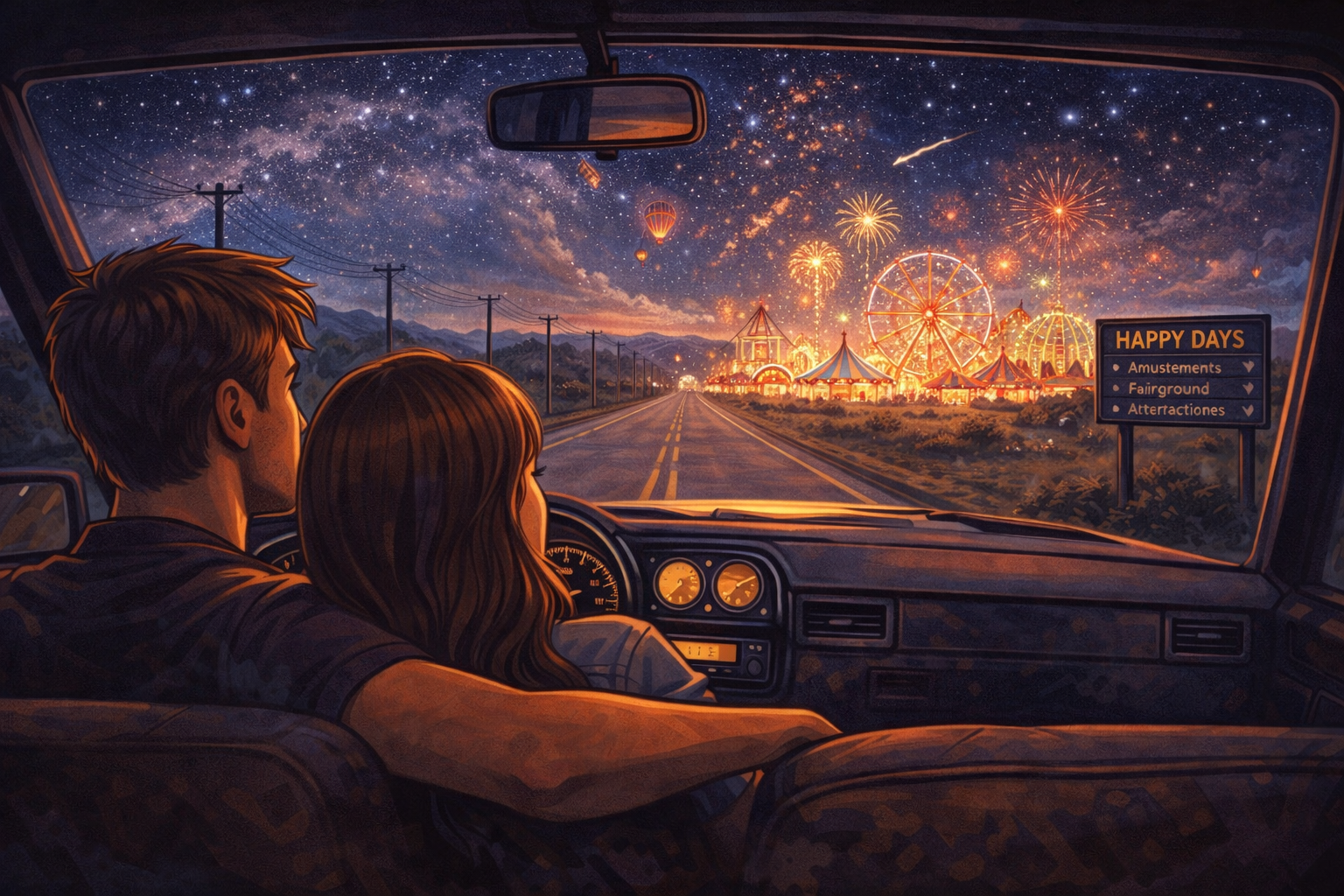
The Adventurer brings you down out of The Backcountry as the light is going. You come over a last rise tired and quiet from days in the wild, and there below you in the valley is a glow — strings of lights, a Ferris wheel turning slow, music drifting up, the smell of a grill, and people. A lot of people, all in one place, laughing. He stops the side-by-side at the top of the hill and just lets you look at it for a second. "You don't end a day like this one alone," he says, and he means more than today. "This is where it all comes together."
This is The Fairgrounds, the last ground of the Open Country — and it is last on purpose. The Workshop built what your hands could make. The Backcountry rebuilt the man himself. The Fairgrounds is the cherry on top, the cream that rises last, the celebration the whole life earned. You do not start a meal with dessert and you do not start a life with the party; you build something worth celebrating first, and then you gather everyone you love and you celebrate it. That is what entertainment was always supposed to be — the trip the kids talk about for thirty years, the holiday table, the wedding, the party everyone wants an invitation to, the shared joy that marks a family's years and outlives the man who threw it.
And that is exactly why this ground is the most stolen one of all. Because the modern world took the word entertainment and gutted it. It turned the cherry on top into the whole rotten meal — replaced the gathering with the feed, the trip with the binge, the celebration with the endless dopamine drip of a thumb dragging a screen at midnight. It built a counterfeit fairgrounds in everyone's pocket: a midway of flashing lights engineered by brilliant people to keep you on the ride forever and send you home with nothing. The doom-scroll, the autoplay, the rage-bait, the hollow distraction that eats an evening and leaves you emptier than it found you. That is what most men now call fun. The real Fairgrounds takes the word back. You leave the cheap dopamine at the gate. What you trade it for is the wholesome thing — the experiences a household actually remembers, the joy you can only have with other people, in the room, on purpose.
Why a Man Has to Build the Good Kind on Purpose
Here is the trap, and almost every man is in it: the bad kind of fun requires nothing. The feed serves itself. The binge needs no planning. The scroll asks for no courage and no effort and no other human being. It is frictionless, and that is the whole problem — because the things that actually feed a man and his family all have friction. The road trip has to be planned. The party has to be hosted. The holiday tradition has to be started and then kept for twenty years before it becomes the thing the grandchildren can't imagine Christmas without. The good kind of fun is work, and the cheap kind is the path of least resistance, and a man who never chooses the harder one ends up with a family whose entire shared memory is everyone sitting in the same room staring at four different screens.
A household runs on a calendar whether anyone built it or not. If the man does not architect it, it gets architected for him — by the algorithm, by whatever the targeted ad caught him with, by inertia, by the lowest-effort default the surrounding industries are delighted to supply. The man who takes the editorial pen back decides which holidays his house keeps and how. He picks the trips that become the anchor points of his children's growing up. He decides what the family watches and listens to instead of letting the feed decide. He throws the BBQ everyone remembers and learns to give the toast and, when the hard day comes, to stand up and lead his people through a funeral. That is not a small skill. It is one of the most visible marks of a man worth being around — and it is almost entirely gone in a generation of men who were never taught that a celebration is something you make, not something you order or stream.
And it compounds like nothing else, because it compounds across generations. The family that has kept the same Christmas for thirty years has something the family with no traditions will never manufacture. The marriage that took the same trip to the same coast across twenty summers has a vault of shared memory a newer couple can only envy. And the children who grew up inside a household that celebrated on purpose carry the blueprint out the door and build the same thing in their own homes. The man who architects the Fairgrounds is not just making this year good. He is teaching his grandchildren how to gather, before they are born.
How a Man Gets the Fairgrounds Wrong
The celebration ground has its own traps, and most of them wear the mask of fun. Name them at the gate.
The Scroller. The man whose entire entertainment life is whatever the algorithm fed him this week — the shows, the clips, the rage-bait, the midnight scroll that eats the evening and leaves nothing behind. He did not choose any of it; it was chosen for him by people who profit from his attention and owe him nothing. He thinks he is relaxing. He is being farmed. The cure is to take the editorial pen back — pick what enters the house, and trade the drip for things that actually fill: the gathering, the trip, the table.
The Outsourcer. He has been present at every celebration of his life and led none of them. The planner runs the wedding, the event company runs the kid's party, an assistant picked the anniversary gift, and the holidays happen at whoever else's house will take them on. He shows up and consumes his own family's milestones like a guest. The household notices, even if nobody says it. The cure is to take the work back — host it, cook it, plan it, give the toast. The labor is not the inconvenience; the labor is the love.
The Performer. The wedding staged for the album. The vacation curated for the feed. The kid's birthday party run for the audience instead of for the kid. The anniversary post longer and more heartfelt than the anniversary conversation. He is performing his family's life instead of living it, and the children can feel the camera between them and their father even when the photo gets a thousand likes. The cure is to put the phone down and let the moment be real and unwitnessed. That is the version they'll actually remember.
The Over-Booker and the Hermit — the two opposite errors of the calendar. The Over-Booker crams every weekend with a party, a trip, an event, until the family has no breath left and the celebrations blur into noise; honor fewer things more deeply. The Hermit refuses it all — never takes the real trip, never throws the party, lets the kids grow up having seen nothing past the radius of the commute, and dresses the inertia up as thrift or practicality. Both starve the household. The good calendar has a few real celebrations honored fully, and room around them to breathe.
The Capitulator. He handed the culture of his home entirely to the peer group and the platform — the kids watch whatever the school is watching, the house plays whatever the algorithm served, and nobody is curating anything. The result is a household indistinguishable from the default the industries ship. The cure is to actually curate: keep the older films and the real music the feed would never surface, hand the kids the things they will not find on their own, and refuse the slow cultural drift the screen is engineered to produce.
The Man Who Can't Do the Hard Days. He can show up for the party and goes missing for the funeral. He cannot give the eulogy, cannot lead the family through the grief, cannot stand steady at the graveside the way his people needed him to. But the same man hosts the wedding and leads the funeral; the composure is one composure. The cure is to build it for both — because a household needs a man who can carry them through the worst day as much as it needs one who can throw the best one.
The man who has named these refuses both the cheap fun that asks nothing and the staged fun that is secretly for strangers. He builds the real thing, for the real people, on purpose.
The Grounds of the Fairgrounds
The Fairgrounds is three grounds in one, and a man works all three to give a household a full life.
Travel & Sightseeing — going somewhere together. The trips that widen a family's whole world: Road Trips (the windshield hours and the shared route — the most underrated family memory there is), Landmarks (the deliberate visit to the places worth standing in front of — historical, natural, holy), International Tourism (the wider world the family steps into — the trip put on the list years before it happened), and Hotels & Lodges (knowing how to choose the base that honors the trip). The kids who have done the long drives and seen the country and crossed a border carry a horizon the kids who never left the cul-de-sac do not have. The trip is never the point — the children formed inside the trip are the point.
Special Events & Social Functions — the days a family circles on the calendar. The milestones that mark a life: Weddings & Funerals (the threshold days that bookend the lifecycle), Birthdays & Holidays (the annual rhythm — the birthday kept the same way every year until it is the child's permanent memory of being celebrated, the holidays carried with the family's own traditions), Anniversaries & Celebrations (the marriage marked, the wins honored), Family Gatherings & Reunions (the wider clan held together across all the miles modern families scatter over), Community Events (the neighborhood and the town), and Parties & BBQ's (the gatherings a man hosts — the door open, the grill going, the people glad to be there). A wedding kept well sets the tone of a marriage; a funeral led well carries a family through its grief; a birthday kept across enough years becomes a child's lifelong proof that he mattered.
Amusements & Local Attractions — the everyday lights. The regular, close-to-home joy and the family's cultural diet: Theme Parks & Fun Centers (the day at the park, the place that becomes "ours"), Fairs & Festivals (the seasonal lights — the county fair, the harvest festival, the small-town parade), Movie, Music, & Food Reviews (the actual curating — what the family watches, plays, and tastes, chosen instead of fed), and Memes & Silly Stuff (the shared humor and inside jokes that hold a family together at a level no formal celebration can reach). This is the ground the counterfeit competes for hardest, because this is where the phone wants to be — so this is the ground that most needs a man's hand on the dial. The family that laughs at the same things is a family bound by something the feed cannot give it.
The Three Pillars in the Fairgrounds
This is the ground where the three questions matter most, because this is the ground the counterfeit imitates most convincingly. TRUTH. LOVE. LAW. Always in that order.
TRUTH — Am I glorifying God in this, or have I gotten drunk on it? This is the ground Scripture warns about by name: when you have eaten and are full... beware lest your heart be lifted up and you forget the LORD (Deuteronomy 8:12–14). The danger out here is not the celebration; it is the celebration cut loose from the One it was supposed to thank — the belly full and the heart proud, the entertainment that has quietly become the thing a man worships, the excess that calls itself a good time. The doom-scroll is the modern golden calf: a glowing thing a man bows to for hours and gets nothing back from. The honest question is whether the joy is pointed up in gratitude or curved in on itself into gluttony. Whatever you do, do all to the glory of God (1 Corinthians 10:31) — and the party is included.
LOVE— Am I enjoying this, or performing it? Love is presence; the counterfeit is performance. There is the trip taken for the family and the trip staged for the feed, the party thrown for the guests and the party thrown for the photo of the party. And this is the ground where a man has to think hard about who he lets entertain his household, because the people on the screen are professionally performing — the rockstar and the showman are required to be "on," in public and in private, and the question this Kingdom keeps asking is whether they are men a son should actually copy. Most are pure act with nothing real underneath; a rare few are genuinely the thing they look like, on stage and off. The Fairgrounds will weigh the great entertainers honestly — the talent in the spotlight and the character behind the curtain, because they are two different questions and only the second one tells you whether to follow the man. Love asks it of you, too: in your own celebrations, are you present, or are you on stage?
LAW— Are you being the buzzkill? Out here the law pillar is not mostly about restraining your fun — it is about whether your attitude is killing everyone else's. There is a man who walks into a celebration and drains the room: too rigid, too sour, too important to step into the joy, the one who won't come to the party and quietly resents the people who did. Scripture has a name for him — the elder brother, standing outside his own father's feast, technically right and completely joyless, refusing to go in (Luke 15:28). Rejoice with those who rejoice (Romans 12:15) is a command. The law of the Fairgrounds is to read the room, keep the joy clean and honest, and never be the man whose vibes kill the very thing the night was for.
The man with all three throws open the gate the right way: a joy pointed up in thanks, shared with the people actually in the room, and clean enough that everyone is glad he came.
The Man Whose Name Is on the Gate — Dick Clark
The Fairgrounds calls for one of the great showmen, and the name over this gate is Dick Clark — not because he was the biggest star, but because he was the greatest host America ever produced, and hosting is the whole craft of this ground. A host is not the man in the spotlight. He is the man who builds the room, opens the door, runs the night, and puts everyone else in the light — and almost no one ever did it better or longer than Clark.
He started on American Bandstand in the late 1950s, at the exact moment the grown-ups were sure rock and roll would corrupt the nation's kids. Clark did something quietly radical with it: he brought the music into the family living room and made it wholesome — clean-cut, good-mannered, every afternoon, a place where a teenager and his mother could watch the same show and both be glad they did. He gave a thousand artists their first national stage, and he put Black performers and Black dancers on television early, when much of the country was not ready, because he thought the music and the kids deserved it. He took something the culture was treating as dangerous and made it a thing a household could share. That is the exact move the Fairgrounds is built on.
Then he became the host of the nation's single biggest milestone. For some forty years, Dick Clark's New Year's Rockin' Eve stood in Times Square and counted the entire country — every household, all at once — into a new year. Think about what that is: one man, faithfully showing up to mark the same milestone for everyone, every single year, for four decades, until a whole nation could not imagine the turning of the year without him. He did not throw a different spectacle each time to keep himself interesting. He kept the same rhythm, the same steady hand, the same trusted voice — and the keeping was the gift. That is the LAW pillar of this ground lived out on the largest possible stage: the calendar honored, the milestone kept, the showing-up that becomes an inheritance.
And then the part that put his name on the gate. In 2004 a stroke took much of his speech. He could have stayed home and protected the polished image he had spent fifty years building. Instead he came back the very next New Year's, in front of the whole country, voice slurred and halting — because being there to count his people into the year mattered more to him than looking flawless doing it. He chose presence over performance, in front of the largest audience a man can face. The host showed up diminished rather than not show up at all.
Look at the shape of that life, because the shape is the whole ground. He was never the star — he was the host. He made joy clean enough for the whole family. He kept the same milestone faithfully for forty years until the keeping became something a nation leaned on. And when his polish was gone, he showed up anyway, because the people mattered more than the image. That is the Fairgrounds: the man who builds the celebration, keeps the calendar, and is present for his people over and over until the showing-up itself becomes the thing they remember him by. (Jim Henson and Walt Disney were the other two names weighed for this gate — Henson the cleanest maker of wholesome wonder, Disney the builder of the literal Fairgrounds, filtered from the empire he became. Both belong in the cluster; the gate is Clark's.)
The Fairgrounds Inside the Whole Life
The three grounds feed each other, and the Fairgrounds feeds the whole life behind it. The things made in the Hobbies Workshop become the gifts the celebrations are built around — the cabinet for the anniversary, the framed photo for the fiftieth, the song recorded for the wedding. The trips out of the Recreation Backcountry are themselves kept rhythms of the calendar — the annual camp is both a trip into the wild and a circled day on the family's year.
And the Fairgrounds is where the whole journey's joy gets spent. MONEY finally has its best destination — wealth poured into experiences a family remembers instead of stuff that depreciates in a garage. LOVE is fed most of all: this is the ground where the Estate's Legacy work actually happens — Making Memories is built here, the family's traditions and the Family Manifesto's celebrations run through here, the marriage Anniversaries & Celebrations are honored here. A man can build the deepest bonds in the world on the Estate, but it is on the Fairgrounds that he gives them a calendar to be celebrated across.
When the Lights Go Down
The Fairgrounds is the last ground of the last Kingdom — the cherry on top, the farthest a man ever travels from the Foundational Beliefs where the whole journey began. And the nearest thing it leaves behind is a household that knows how to gather. The children raised at his table, on his road trips, at his ridiculous BBQs and his solemn funerals walk out the door knowing how to make joy for the people they will love, and they string up the same lit valley in their own country before he is even gone. That is the real cherry on top — not the man's own good time, but a family that learned from him how to have one.
But every fair closes. The music winds down, the lights come off the wire one string at a time, the crowd drifts back toward the cars, and the man who built the whole night is left standing in a valley that an hour ago was full of noise. All good things come to an end — and the quiet after this one is the strangest moment of the entire journey, because for the first time across seven domains there is nothing left to gather, nothing left to build, and no next field to cross. The work is finished. The man is built.
And that is not the ending. That is where it finally begins. Everything until now made the man; what is left is to meet him. The way out of this valley runs in only one direction — up, a dark climb above the emptied lights toward the highest ground the whole journey holds. There is a crown waiting at the top of it, and it is honestly yours; you paid for every inch of the road that earned it. This last celebration you hosted was always pointing at one more — a table already set, somewhere up that climb, where for once a man walks in as the guest and not the host. Leave the lights behind you.
Go up.