
Travel & Sightseeing
Road Trips
Hotels & Lodges
Landmarks
International Tourism
Visit Salt Lake City
The Open Road
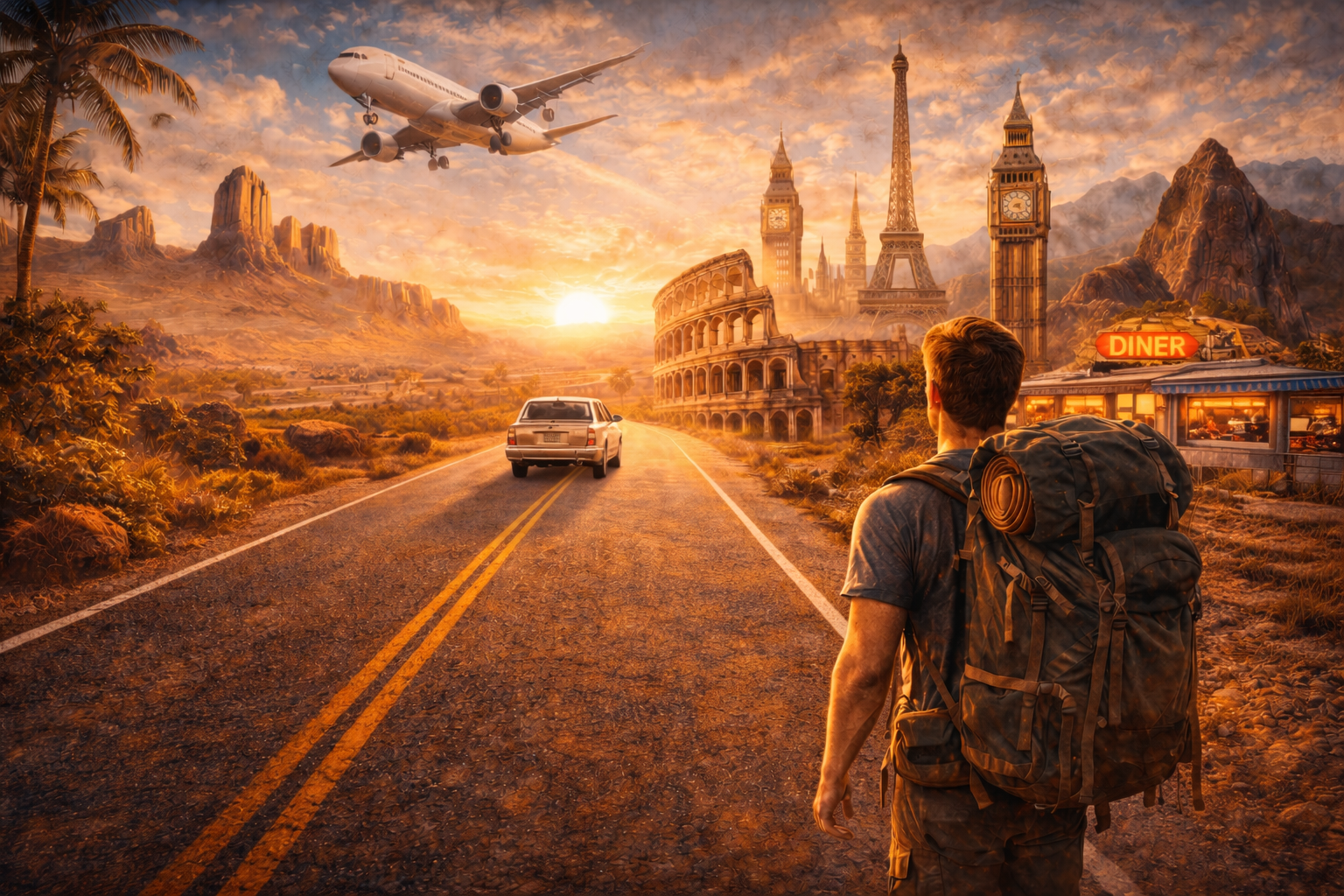
The Adventurer pulls the side-by-side onto the shoulder of a two-lane that runs straight to the horizon and turns off the engine. "This is where I hand you the keys," he says, and he actually does. Ahead of you the road just keeps going: past the county line, past the state line, past the place where the map in your head runs out. Maybe it's a tank of gas and a cooler in the back and the kids already asking how much longer. Maybe it's a red-eye to a country where you can't read a single sign. The mentor unfolds a paper road map across the dashboard, the old kind that never folds back the right way, and taps a small town two hundred miles out. "Eat there," he says. "Wherever the pickups are parked."
This is Travel & Sightseeing, the last ground of the Fairgrounds and the one that widens a family's whole world. Five rooms, walked in order. The long road trip and the windshield hours. The motel or lodge that becomes part of the story. The landmark worth crossing the country to stand in front of. The first trip to a country where nobody speaks your language. And last, the trip that turns around and comes back to a valley under a wall of mountains. The whole ground stands on one stubborn idea: the trip is never about the photograph you bring home. It's about who you and your children become along the way.
Why a Family Has to Get Out and See It
A child raised inside one small circle grows up believing the circle is the world. His town's way of doing things is the way. His family's normal is the normal. His problems are the size of the sky. Then you put him in the car for three days, or on a plane to somewhere truly foreign, and the circle breaks. He sees people living a thousand different ways, most of them getting along fine without his assumptions. He sees mountains that make the tallest building he knows look like a toy, an ocean that doesn't end, a city older than his country. Something permanent happens to a kid the first time the world turns out to be bigger than he thought. He gets a horizon, and the horizon shapes what he thinks is possible for the rest of his life.
That's what travel really is: the deliberate widening of a person. It's also exactly what the travel industry has trained families to skip. Many families now consume trips the way they consume everything else, a stream of destinations chosen for the photo, posted, and forgotten. They went to Mexico and saw a resort. They went to Paris and saw the line for a selfie. The trip never touched them. That's travel as consumption. Travel as formation is what this ground rebuilds.
And the most formative trip an ordinary family can take is also the cheapest. Not the bucket-list flight to the far side of the world, but the road trip: a tank of gas, a cooler, and six hours in the car where the conversation finally goes deeper than it ever does at the dinner table, because nobody has to make eye contact and there's nowhere else to be. A man doesn't need to be rich to widen his children. He needs a car, a direction, and the willingness to go.
Go to the Table
Everything on this ground comes back to one habit: find out where the locals eat, and pull up a chair.
Nearly everything that ruins modern travel is a way of avoiding that table. The all-inclusive resort exists so a family never has to leave the compound and meet the country it's parked in. The cruise brings the country to you as a four-hour stop and takes you back aboard to sleep. The tour bus shows you the landmark through tinted glass without one unscripted conversation. All of it delivers a destination while protecting you from the place.
The better way works at every scale, from a family road trip to the other side of the planet. Skip the chain on the interstate and eat at the diner where the pickups are parked. Talk to the person behind the counter. Take the road through the small town instead of the bypass around it. Let the kids order the thing they can't pronounce. A shared meal is the oldest door into another place there is, because almost every culture on earth says the same thing when it sets a place for a stranger: you're welcome here. A family that travels to the table comes home having met the world. A family that travels resort to resort comes home having met a hotel.
How a Man Gets Travel Wrong
The Resort Captive. Every trip is a compound, and the country outside the gate is only a backdrop. Comfort is fine, but a man who only ever travels this way has never really traveled.
The Photographer. Every destination is picked for the shot, and the whole trip happens through a lens held between him and the place. The point was to be there, not to prove it.
The Over-Planner and the Under-Planner. One schedules two weeks in fifteen-minute blocks and exhausts everyone by day three, leaving no room for surprises. The other plans nothing and wastes the trip on logistics. Plan the bones, the route, the beds, and the few things you crossed an ocean to see, and leave the rest open.
The Trip the Kids Won't Remember. He takes an elaborate, expensive trip abroad with children too young to hold onto any of it, and tells himself it was for them. A four-year-old gets more from a lake an hour away. Save the big one for when they'll carry it.
The Man Who Never Showed Them Home. He chases passport stamps and has never shown his own kids the canyons, coasts, battlefields, and small towns of the country they were born in. See the world, but see home too.
The Five Rooms of This Ground
Road Trips — the windshield hours. The long drive and the shared route, the diner instead of the chain, the stop nobody planned, and how to travel lightly on the country you pass through.
Hotels & Lodges — the base. When the lodge is the trip and when a room is just a place to sleep, how to choose well, and a family's own running list of places worth going back to.
Landmarks — the places worth standing in front of. Battlefields and founding-era sites, natural wonders, great museums and cathedrals, pilgrimage sites, and the family's own landmarks, visited with enough time and reading to actually understand them.
International Tourism — the wider world. The trip outside the home country, where the language, money, food, and manners all change.
Visit Salt Lake — home country. A homecoming to one real valley, shown the way a local would show a friend, and the last stop in the Open Country.
Ten Things a Traveling Family Holds Onto
1. Pick the trip for the family, not the feed. Choose a destination because of what it will do for your people, not because it photographs well.
2. Drive first, fly when you have to. The road trip is the most formative trip a family takes. Save flights for the places a car can't reach.
3. Plan the big pieces and leave the rest open. Book the beds and the main stops. Leave room for the unplanned hour, the detour, and the conversation that runs long.
4. Stay and eat local when you can. A family-run inn and a local diner put your money into the place you're visiting instead of into a chain.
5. Match the trip to the kids' ages. The same trip that's wasted on a four-year-old can shape an eleven-year-old for life.
6. Take at least one stop nobody recommended. The small town, the unmarked overlook, the regional museum no app promoted.
7. Meet the place, don't just visit it. Try the language, eat where locals eat, and learn the customs.
8. Take pictures on purpose, not constantly. Photograph the moments worth keeping, write a few notes, and leave the phone in your pocket the rest of the time.
9. See your own country too. Your home country is a lifetime's worth of travel. Don't skip it on the way to somewhere else.
10. Keep a returning trip. The same lake every summer for twenty years builds something a new destination every year can't.
The Three Pillars on the Road
The Open Country's questions ride along in the car and cross the border too. TRUTH. LOVE. LAW. Always in that order.
TRUTH — Am I seeing the world as God's, or just collecting it? Travel done right is one long lesson in wonder: the size of the canyon, the age of the city, the variety of people who all bear the same image. When Jacob left home for the first time, running for his life, God met him on the road with a promise: I am with you and will watch over you wherever you go, and I will bring you back to this land — Genesis 28:15. A traveler who knows that sees every mile differently. There's a plainer truth too: be honest afterward about what the trip actually gave your family, so the next one is better.
LOVE — Am I traveling with them, or performing the trip? Nothing posts like a vacation, which is exactly why the camera tempts hardest here. Set the pace for the people you brought, not for the itinerary's appearance, and choose trips for who they'll form, not how they'll photograph.
LAW — Am I keeping the rhythm, and honoring the places I pass through? Inward, keep at least one real, planned trip a year, because the family that waits for the perfect time never goes. Outward, be a good guest in every place you visit: respect its ways, tip the people who serve you, and leave it better than you found it. God told His people why: And you are to love those who are foreigners, for you yourselves were foreigners in Egypt — Deuteronomy 10:19. Every traveler is a foreigner somewhere.
Hold all three and a man gets his family out of the circle every year, to the table and into the place, and brings them home wider than they left.
How This Ground Feeds the Rest
A dollar set aside in MONEY for a trip buys something a boat or a bigger TV can't: a story the grandchildren will still be retelling. It's the wider-world cousin of Amusements & Attractions and the traveling sibling of Special Events & Social Functions, since the annual trip is itself a circled date. It shares a road with the Recreation Backcountry, because the drive to the trailhead and the trip into the wild are often the same trip. And it feeds LOVE, because Making Memories gets built on its largest canvas out here.
Where the Road Stops and Scripture Continues
Every traveler learns sooner or later what it feels like to be a foreigner: the language you can't read, the customs you keep getting wrong, the ache of being far from home. Most of us come back from that feeling glad to be home.
Scripture says some people carry that feeling all their lives, even at home. Describing Abraham and the people of faith who came after him, it says: All these people were still living by faith when they died. They did not receive the things promised; they only saw them and welcomed them from a distance, admitting that they were foreigners and strangers on earth — Hebrews 11:13. And it says what they were looking for: they were longing for a better country—a heavenly one — Hebrews 11:16. A man who has traveled enough to feel far from home in a strange land has had a small taste of that longing. It points somewhere.
After the Road
A man who has traveled his family well raises children with a particular largeness in them. They've broken the circle. They know the world is big and various and mostly kind to people who show up humble and hungry, and that knowledge makes them brave in a way the kid who never left the cul-de-sac rarely is. They carry a store of shared road: the breakdown that became the best story, the meal in a country whose name they couldn't pronounce, the canyon that shut them up for once, the long drives when the real things got said.
Every road on this ground opens outward: more country, more tables, more strangers who became friends. The last one in the Open Country turns the other way. It comes home to a valley, and behind the valley stands the high ground no road climbs. They were glad when it grew calm, and he guided them to their desired haven — Psalm 107:30. The keys the Adventurer handed you at the start of this ground are still in your pocket. They won't be needed much longer.