
Recreation
The wild does not care who you are at the office. It only asks whether you can read it, carry yourself through it, and get home — and a man needs that question asked of him more than he knows.
The Adventurer doesn't slow down when you leave the Workshop. He climbs back in the side-by-side, drops it into gear, and drives until the shed and the last cut fence line are gone in the mirror and there is nothing out the windshield but timber and ridge and a creek cutting through the bottom. Then he kills the engine. And you hear it — or rather, you hear the absence of everything you are used to hearing. No hum of a building. No traffic. No notification. Just wind in the high branches and water over rock and your own pulse, which you can suddenly hear because nothing else is competing with it. "Out here," he says, climbing out and stretching, "is where a man finds out what he's actually made of. And where he tends to remember Who made it."
This is the Backcountry, the second ground of the Open Country and the one the Fox was born for. The Workshop builds a man's hands; the Backcountry rebuilds the whole animal. Because here is the thing nobody tells you: a man was not built to live indoors. For almost the entire run of human history he woke up under the sky, read the weather off the horizon, walked real ground, made fire, and slept where the dark found him — and his body, his eyes, his nervous system, his attention are all still tuned for that life, not for the climate-controlled box he now spends ninety percent of his waking hours inside. The Backcountry is where a man goes to remember he is an animal that God made for the world God made. The trail, the camp, the cold morning, the long climb, the water and the woods and the hunt — this is the ground where the indoor man comes back to life.
Why a Man Has to Get Out There on Purpose
Nobody drifts into the outdoors anymore. The whole machinery of modern life is built to keep you in — the indoor job, the indoor commute, the indoor entertainment, the indoor everything. A man can go weeks without his skin ever feeling weather that wasn't an inconvenience between two buildings. And the cost of that is real even though it is invisible, because there is no contrast to measure it against. The eyes that only ever focus at arm's length forget how to read distance. The body that only ever moves on flat conditioned floors gasses out on the first real hill. The nervous system that is never regulated by sky and season and silence stays wound tight and the man calls it normal because he has never felt the other thing.
The Backcountry is where the other thing gets handed back. And it is not soft. A man can be in great shape in the gym and still be unable to carry his own pack eight miles across actual terrain, because the gym never asked the body to do the real thing. The treadmill builds lungs that quit on the first half-mile of a climb. Conditioning with nowhere to go is a truck with no road under it. The outdoors is the road — the place all that built strength finally does what it was built for. The man who trains his body and never takes it outside built an engine and never drove it anywhere.
And then there is the literacy, which almost no modern man still has and every man used to. Reading a sky and knowing whether that storm passes or settles. Knowing which ground holds water. Knowing where the deer move at dusk and why. Knowing how to make fire when it is wet, how to stay warm when it drops, how to find the way back when the trail disappears. This is not survivalist theater. It is the plain competence men carried for ten thousand years and lost in two generations — and a man who rebuilds it can take his family into the wild and lead, instead of standing at the trailhead hoping the app knows the way. It compounds, too: the man who has hunted the same country fifteen seasons knows it the way you know your own street, and no single trip and no amount of gear can shortcut the years.
How the Outdoorsman Goes Wrong
A man can want the wild and still get it wrong in ways that keep the wild from ever changing him. Name them at the trailhead.
The Indoor Animal. He has adapted so completely to climate control that the actual outdoors now reads to him as hostile. The wind is too much. The cold morning is too much. The eight miles are too far. He doesn't know how indoor he's become because he has nothing to compare it to. The cure isn't a heroic expedition — it's small and repeated: the walk before work, lunch outside the building, the local trail on Saturday, until the body remembers it was built for this and the tolerance comes back.
The Tourist. He visits the outdoors instead of living in it. The once-a-year national park gets photographed, posted, and left behind, and he goes home unchanged. The one big guided hunt gets him the animal while the outfitter does all the actual work and he learns nothing about the country it lived in. The cure is rhythm over spectacle — the regular, unglamorous, nobody's-watching trips that actually build a man, not the annual highlight reel.
The Content Creator. His outdoor life exists for the footage. The trail run is posted, the kill photo uploaded, the summit documented, the trip is content before it's even over. He's really out there — but it's happening for the audience instead of for him, and the wild can't reach a man who's filming himself the whole time. The cure is to put the phone away and let the trip be unwitnessed. The best ones usually are.
All Gear, No Miles. He spent ten thousand dollars on the optic, the rifle, the technical shells, the truck, the boat, the rods and reels and the pack — and he's hunted three weekends and camped twice. The kit is flawless and the man underneath it is thin. Gear follows competence; it can't manufacture it. Modest equipment and several real seasons beat a showroom and no miles every time.
The Daredevil and the Paved-Path Man — the two opposite errors of risk. The Daredevil chases the most extreme thing before he's earned the skill for it, because the danger itself is what he's after; he free-solos his ego and the mountain doesn't grade on a curve. The Paved-Path Man refuses anything with any real stakes — paved trails, RV hookups, water he can't fall into — and ends up with indoor-grade outdoor experience and the shallow competence to match. Real competence lives between them: hard ground taken in proportion to skill actually built, stretching the edge without pretending the edge isn't there.
The Comfort Slide. He started at twenty able to sleep on the ground anywhere, and across his thirties and forties he surrendered the wild one upgrade at a time. The tent became the camper, the camper became the cabin, the cabin became the hotel near the trailhead, and the trail itself kept getting shorter. It never felt like quitting because each step was so small. The body a man has at fifty is the floor of the body he'll have at seventy — unless he keeps fighting for the terrain. Hold the line on the hard ground while you still can stand on it.
The seasoned outdoorsman refuses the man who never leaves the building and the man who's only out there for the camera, both. He gets out there for real, reads it honest, and lets it do its work on him.
The Grounds of the Backcountry
The Backcountry is not one thing. It runs from the easy local trail to the hardest country there is, and a man builds across all of it.
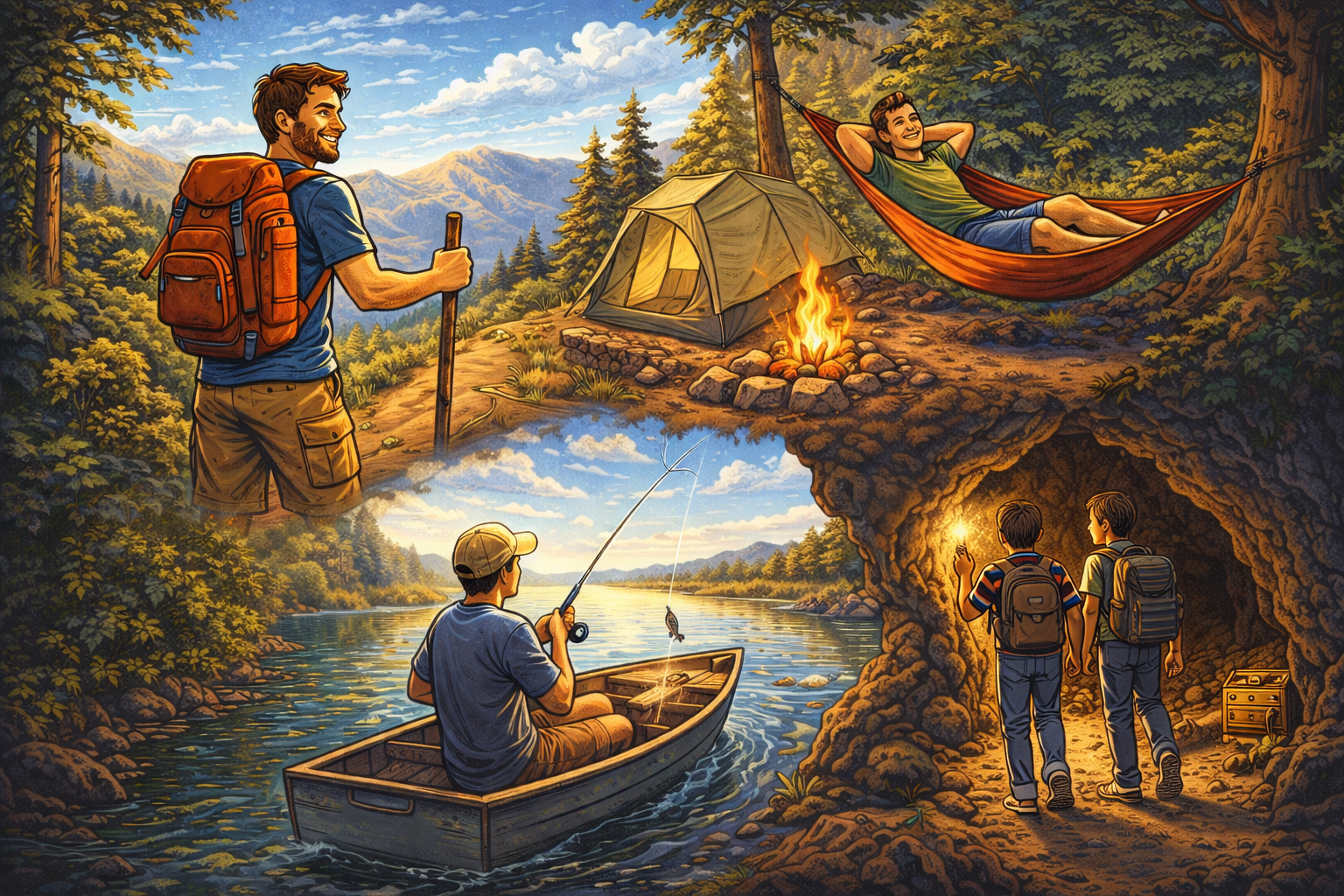
Hiking & Camping — the trail and the camp. The ground everything else stands on: Hiking (walking real terrain — the day hikes and the multi-day treks, the legs and the lungs and the trail-and-weather sense the indoor man lost) and Camping (staying out overnight and being fine — tent and tarp, fire and food, cold and heat, the plain competence of making a home in the open). This is the foundation, and a man who skips it has a glass floor under everything else. The hunter who can't hike won't be where the game is. The man who can't camp limits himself to day trips. Learn to carry yourself across ground and sleep under the sky, and the rest of the Backcountry opens up.
Outdoor Exploration — the deep country. The harder ground the foundation unlocks: Rock Climbing (vertical terrain — strength, technique, and the honest judgment of stakes welded into one), Cave Exploring (the underground world almost no modern man has set foot in), White Water Rafting (rivers that do not negotiate), Parks & Recreation (the local parks the weekly rhythm is built on and the national parks the family hasn't seen yet), and Abandoned Mines & Secret Finds (the off-trail places the feed hasn't discovered and a seasoned man learns to find). This is where a foundational hiker becomes a man who can actually operate in country that humbles the casual visitor.
Fishing & Hunting — the oldest pursuits there are. Fishing (the patient work of water across the seasons — Fresh Water Fishing and Salt Water Fishing and Hunting (the patient work of game — Bird & Fowl Hunting, Big Game Hunting, the deer seasons and elk hunts and the duck blind before dawn). This is the beating heart of the whole Open Country, because this is where the deepest thing the Kingdom does gets done: a father takes a boy fishing at six, and that boy is in the boat at sixteen and on his own water at thirty-six and back on the lake with his own son at forty-six. The fish is never the point. The hours of quiet, the patience taught without a lecture, the hands shown how, the time that nothing else in modern life makes a father and a child spend together — that is the inheritance, and Fishing & Hunting are the ground where it gets handed down more reliably than anywhere else a man goes.
The Three Pillars in the Backcountry
The three questions that govern the whole Open Country sharpen out here, where the stakes are real and the country tells you the truth whether you wanted it or not. TRUTH. LOVE. LAW. Always in that order.
TRUTH — Am I worshiping the Creator out here, or have I made a god of the wild itself? The Backcountry is the largest sermon a man will ever stand inside — the heavens declare the glory of God (Psalm 19:1), and a sunrise off a high ridge will tell you more about Him in a minute than most men learn in a year. But there is a counterfeit, and it is popular: the "church of nature" that conveniently has the mountain and the silence and the awe with no God in it, the man who worships the creation and skips the One it points to, the adrenaline junkie whose real religion is the next high. Truth out here also means reading what's actually in front of you and not what your ego wishes — the storm coming faster, the ice on the trail, your own honest limits. The wild does not negotiate with a man's self-flattery, and the humble reading is the one that gets him home.
LOVE — Am I out here enjoying this, or performing it? The trip taken with the people you love builds something that lasts; the trip staged for the audience evaporates the second the post stops getting likes. There is the father who brings his daughter on the hike she can actually do and the friend he keeps the annual hunt with for thirty years — and there is the man whose every summit and every kill is a photo for strangers. The Adventurer's wild is shared with the people his life is actually inside, and honored alone when solitude is the point — the morning fished by yourself, the day in the woods no one else is on. What it is never for is the crowd that isn't there.
LAW — Are you leaving it better than you found it, or wrecking it for the next man? Out here the law pillar is stewardship, and the buzzkill is the man who poisons the wild for everyone behind him — the slob who leaves the fire ring full of trash, the poacher who ignores the seasons and the limits, the guy who blasts a speaker down a quiet trail, the man who takes more than the country can give and leaves it poorer. Pack it out. Keep the seasons and the laws. Catch and release where it's right. Leave the campsite cleaner than you found it. The land is loaned, not owned — handed to you in trust and meant to be handed on whole to a kid who isn't born yet.
The man with all three holds the wild the way it was meant to be held: as a place to meet God, share with the people he loves, and keep in trust for the ones coming after him.
The Man Who Carries This — Bear Grylls
If one living man has come to stand for the wild in the modern imagination, it is Bear Grylls — and he earned the right to. He served in the British Special Forces, broke his back in three places in a parachute accident, and against every prognosis fought his way back and climbed to the summit of Everest at twenty-three. Then he spent two decades showing the world the harshest country on earth and how a man survives it — eating what there is to eat, drinking what there is to drink, crossing terrain that has killed better-equipped men, and making it look not glamorous but plain: this is what it takes, and you are more capable than you think.
But the reason his name belongs over this ground is not the stunts. It is what the wild did to the man. Bear Grylls is openly, unembarrassedly Christian, and he says it straight — that his faith is the "backbone" of his life, as essential and as unseen as the air he breathes. He came to it not in a comfortable pew but in the places where a man is stripped down to nothing, where the weather and the mountain and the dark take away every illusion of self-sufficiency and leave him with the truth: he is small, the creation is enormous, and Someone made all of it. That is the exact thing the Backcountry does to a man, and Grylls is the proof of it. He is a husband and a father who takes his sons into the wild the way the Open Country says a man should, and he points past the adventure to the Author of it without apology.
Look at the shape of that life, because it is the shape of this ground. He went to the hardest places a body can go, found out how small he was, and came back not with a brag but with a faith. That is what the wild is for. It is not the church of nature with no God in it. It is the cathedral the God of nature built, and the men who go deepest into it most often come out, like Grylls, on their knees. Most of the great outdoorsmen the Backcountry will point you toward are masters of skill and country; Grylls is the one whose name sits over the trailhead, because his whole life says out loud the thing this ground was always whispering.
The Backcountry Inside the Whole Life
The grounds feed each other. The man who only hikes has the legs but not the deep country or the hunt; the man who only hunts has the pursuit but not the broader competence it's supposed to sit inside. Start with the trail and the camp — that foundation is the prerequisite the hard country and the long hunt both depend on — and build outward from there.
And the Backcountry only works held against the rest of the man's life. It is the place the body built in HEALTH finally gets used in the terrain it was made for. It shares a fence line with the DEFENSE Farm — the same firearms competence, terrain navigation, weather reading, and composure under physical stress the warrior trains, the hunter lives. It hands LOVE the trips the bonds are deepened across — the father-son fishing arc, the hike with the wife, the friendship that survives on the annual hunt. And it keeps a man from becoming the indoor craftsman of the Hobbies Workshop whose hands are sharp and whose body hasn't seen a trail in three months. The hands and the legs were always meant to belong to the same man.
After the Backcountry
A man who has rebuilt the wild in himself walks back into the rest of the Open Country changed. He arrives at The Fairgrounds with a family whose year is already marked by seasons and shared trips instead of only by screens. He carries an attention that can sit in silence, a body that can do hard things, and a quiet confidence that he and the people he loves would be all right out there — which is a steadiness the household feels in him long before anyone could name it.
The deepest thing The Backcountry hands forward is the same thing the whole Kingdom keeps pointing at: the wild passed down. The boy at six on the first fishing trip. The daughter at ten on the first hike. The grandchild on the first night under the stars, scared and then not scared, because his grandfather is right there and the fire is warm. The trip ends and is forgotten. The boy who learned the country, and learned to find God in it, does not forget.
But the wild is solitary work, and a man is not meant to end there. One ground is left, and it is the one where the doors open and the people come back in — where everything built across the whole Open Country gets carried down out of the timber and into the light, and celebrated with the ones it was always for. You do not start a life with the party; you build something worth celebrating first. Then you come down the hill toward the lights.