
Martial Arts
"I fear not the man who has practiced 10,000 kicks once, but I fear the man who has practiced one kick 10,000 times." — Bruce Lee
The Dojo
The morning after the gym, the Warrior does not take you back to the steel building. He walks you behind the barn to an open-sided shed with a patch of mat under it, gray in the middle, patched at one corner with duct tape, and nobody on it. No ring. No cage. No fighters in camp. Just the mat, a heavy bag on a chain, and the two of you.
"Put your hands up," he says. You do. You put them up the way every man puts them up the first time, the way the movies taught you, and he reaches out and slaps them down without any hurry at all. "Nobody who has been hit stands like that." He steps in close enough that you can smell the coffee on him. "Yesterday a kid put you on your back and you liked it. Today we find out why you liked it. It was not the choke. It was that for four minutes nobody on earth was lying to you."
That is the Dojo. It is the one place on the Farm where the truth about a man costs him nothing but his pride, and he pays it in full every night he shows up. The steel building is where the fighters work. This mat is where the Warrior teaches, and he keeps it out here, away from the crowd, on purpose. A man cannot fake a round. The other man is trying. Your wind gives out or it does not. You stay calm or you panic. You tap or you get hurt. There is no other room in your life where the grade is that honest, and that is exactly why most men avoid it, and exactly why the ones who do not become something the others only talk about.
This page is the gate to the mat, not the mat. Each range of a fight has its own room, and the mat has one more room at the end of it that none of the ranges can stand in for. What this page does is tell you why the body comes before every other ground on the Farm, how a real fight is shaped and why that shape sets the walking order, how to choose a mat that will not lie to you, and what the four rooms hand each other on the way down.
Why You Train the Body First
Most men will go their whole lives without a real fight. So why does the Farm start here, and not at the rack, and not in the watchtower?
Because the damage in an untrained man is not mainly about whether he could win a brawl. It is about what he carries every day because he has never been tested. The man who has never had his body pushed against another trained man's body walks around with a question he cannot answer: what would I actually do? He compensates for it, or he shrinks from things he could have handled, or, worst of all, the day finally comes and years of unspoken doubt come out all at once as the wrong thing at the wrong time. The mat answers the question on a Tuesday night, so that it stops answering itself on a Friday in a parking lot.
The second reason is control. The trained man has a whole ladder of options between do nothing and do permanent damage. He can hold without hurting, move a man without striking him, close a distance without committing to anything, walk a drunk relative to a chair without anybody getting a black eye. The untrained man owns two settings, flinch and explode, and most of the regret in this world lives in the gap between them. The protector you are becoming needs every rung on that ladder, and the rungs are only built by training the body.
The third reason is the one the Armory and the War Room both depend on. A weapon in a hand that has never been hit is a weapon in a hand that will shake. A plan in the head of a man who has never been pressed is a plan that comes apart the first time somebody pushes on it. The mat installs the thing every other ground on this Farm assumes is already there: the ability to keep working while the body is screaming at you to stop. Nothing above this ground can teach it, and everything above this ground requires it.
And it compounds like nothing else. The man who started boxing at twenty-two and is still rolling at fifty-two has banked something no crash course can hand a latecomer. The first year of any fighting art is humbling. Grown men get thrown around by teenagers who started earlier, and it stings badly enough that most of them quit. The return takes three to five years to show. The friction starts in week one. That is the whole test. The gym costs money, the schedule fights your family for the evening, the early months bruise your pride, and the culture out there sneers at the trained man as a meathead. Train anyway. The body does not care what the culture thinks, and the day you need it the culture will not be there.
What Puts the Untrained Man on the Ground
The same handful of failures put untrained and badly trained men on the floor over and over. Learn their names now so you can catch them in yourself before the mat has to.
The story he tells. A man who has never been tested builds a picture of himself out of movies, a high-school memory, and a few seconds of adrenaline he still tells at parties. The first time reality checks that picture against the facts, the gap opens at the worst possible moment. The mat runs the same check on a weeknight, where the only thing it costs is the story.
The belt with no rounds behind it. He earned the rank, collected the stripes, posted the photographs, went to the seminars, and never once rolled hard against someone who was trying to beat him. The rank is real. What the rank is supposed to mean is fiction. A belt nobody ever tested is a participation ribbon with a knot in it.
One range only. He trained a single art deeply and never tested it against the others. The ground man who has never felt a real wrestler's takedown. The boxer who has never had to defend his legs. The encounter does not care which art he loves. It starts standing, it usually tangles, it often ends on the floor, and the man who trained one of those three is hoping the fight stays where he is comfortable. The fight has never once agreed to that.
Quitting in the valley. Most men who start a fighting art quit inside eighteen months, right where it is all friction and no payoff yet. They read the plateau as a verdict on the art instead of the price of admission. The man who quit in year one misread the only signal that mattered.
Confusing the mat for the street. The opposite error, and the trained man's temptation. What works on the mat is most of the answer, but the mat has no asphalt, no second attacker, no blade, no surprise, and no lawyer waiting afterward. The Dojo is the laboratory. You build the engine here and you learn to deploy it honestly on the Homestead, in the Armory, and under the law.
A man who has walked this ground honestly has been inoculated against all five. The walking is the inoculation.
How a Fight Is Shaped
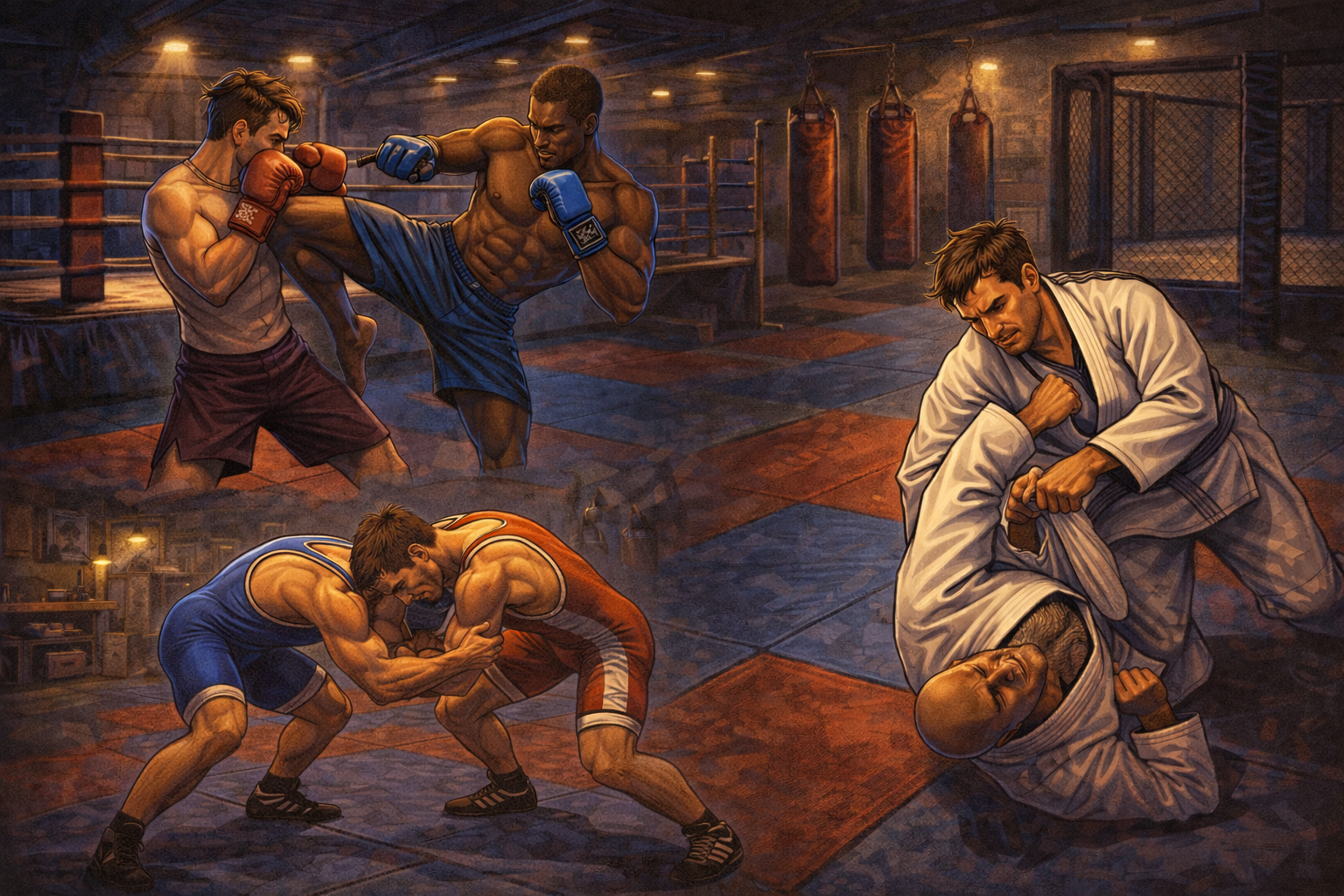
A real fight has three ranges, and they are not three hobbies. They are three phases of the same thirty seconds. It starts on the feet. It usually crashes into a clinch or a takedown. It often ends on the ground. Train one range and you are betting the fight stays there. Train all three and you are ready wherever it goes. Put them together and you have the most complete unarmed fighting a man can build, which is what the world now calls mixed martial arts. The Dojo walks the three in the order the fight runs them, and then puts you in one more room that asks whether any of it was real.
Striking — on the feet. The first range, where almost every encounter opens and where many are decided before anything hits the floor. Hands first: Boxing is the foundation, footwork and head movement and the art of hitting without being hit. Then the eight weapons of Muay Thai, fists, elbows, knees, and shins, the most battle-proven striking on earth. Then the ring-tested blend of Kickboxing. What this range really installs is not the punch. It is the man who can be punched and keep thinking. Learn to manage distance and you control whether the fight even happens.
Takedowns — deciding where it goes. The second range, the bridge between standing and the ground, and the most neglected of the three in the average gym, which is exactly why it decides so many real fights. Here you learn to put a man down when standing favors him, to stay up when the ground favors him, and to own the clinch where most real violence actually tangles. The roots are Wrestling, the American engine of control and top pressure, Judo, the Japanese throwing art with a soul to match its science, and Sambo, the Russian blend of throws and leg attacks. The man who decides where the fight takes place usually decides who wins it.
Submission Grappling — finishing on the ground. The third range, where untrained fights collapse whether anybody wanted them to or not. Here you learn to control a man from the floor, to stay safe under someone bigger, and to end it without throwing a single damaging strike, through Brazilian Jiu Jitsu, the most developed ground game there is, its street-closer No-Gi Jiu Jitsu, the Brazilian tradition of Luta Livre, and the shared principles of base, frame, weight, and leverage gathered in Grappling Modalities. On the ground the smaller trained man beats the bigger untrained one more reliably than anywhere else in fighting, which is the whole point.
The Pressure Test
The last room on the mat, and the only one that is about you rather than an art. Everything in the three rooms before it was learned against partners who, whether you noticed or not, were helping you. This room sends you where nobody is. A gym across town where no one knows your name. A tournament bracket. A round against a man who does not care how you feel about yourself. It is not a technique and it cannot be drilled. It is the audit, run once and then run for the rest of your training life, and a man who skips it has three rooms of good material and no idea whether any of it holds.
How to Choose a Mat
Before you walk into the first room you will have to choose a gym, and most men choose wrong, because they choose by the sign on the door. So learn the standard at the gate. It is not complicated, and it is the reason this Farm teaches the arts it teaches and not others.
Three things have to be true at the same time on any mat you give your years to. Live resistance. Your partner is trying to win. Not pretending. Not letting you finish because the choreography says he should. If he sees the opening he takes it, and if you make the mistake it costs you. Trained opposition. The man across from you knows what you know, and maybe more. Anyone can finish the man who has never been finished. The question is what happens against the man who has. Honest outcomes. A fall, a tap, a knockdown, a point on a scoreboard. Something recorded that does not care what you intended. A mat where all three are true is training. A mat where any one is missing is theater with a monthly fee.
Here is the shortcut for telling them apart, and it is older than any of the arts. If men fight for a living in a system, it has been tested at the highest stakes there are. Boxing, Wrestling, Judo, Muay Thai, and Brazilian Jiu-jitsu have each put their best men across from other systems' best men in front of a crowd for decades, and an outcome was produced every time. If men compete in a system at the amateur level under real rules, it has been tested at meaningful stakes and it gets honest data. And if nobody fights in a system, ask why. Sometimes the answer is honest: too young, too small, too far away to have produced a competition. And sometimes the answer is that the techniques are too dangerous to use on a resisting partner. Eye gouges. Throat strikes. Pressure points. The knockout that needs no touch. Hear that answer for what it is. A technique that cannot be tested cannot be trusted, and a man who has never used a thing against someone fighting back does not know what he says he knows. He is repeating his instructor, who is repeating his. A chain of repetition does not become evidence by getting longer.
Now the honest complication, because this is not a verdict on old arts. Karate lineages exist that spar full contact and have fed champions into kickboxing and the cage. There are men doing push hands at a level that is genuine grappling. There are schools of the old Chinese and Israeli systems that test hard, and there are jiu-jitsu academies that never roll. The age of the system is not the question. The question is what this school does on a Wednesday night: do the highest belts go live against each other, fully resisting, both of them trained? If yes, the art is being practiced honestly whatever its age. If no, it is being practiced as a story whatever its age. So walk in and watch a class before anyone gives you the tour. Watch how the senior men move against each other when they think nobody new is looking. That tells you the truth the brochure never will.
The Three Pillars on the Mat
TRUTH is the honest audit, and on this ground it has teeth. You test against people who can expose you. You do not round your rank up. You do not avoid the partner who finds your holes and you do not count only the rounds you won. The grade is the prize. The belt is the receipt.
LOVE is the reason the body is being built at all. The body is yours and the reason is not. You train so that the people behind you, the wife, the children, the friend in the worst week of his life, are standing behind a man who can do something rather than one who hopes he could. Not for the highlight, and not to have a story to tell. And love governs the mat itself: you take care of the man you are rolling with, because he is lending you his body so you can learn, and a torn shoulder given to a training partner is a debt you cannot repay.
LAW is the code of the room and the law beyond it. You honor the gym, the coach, the lineage, and above all your partner's body. You do not crank the submission, you do not blast past the agreed pace, you do not break the room to win a round. And you carry one hard fact off the mat: in many places trained hands are held to a higher standard than untrained ones, and what you build here you keep accountable to the law you study on the Homestead in Legal Defense.
"I will refine them like silver and test them like gold. They will call on my name and I will answer them." (Zechariah 13:9) The mat refines and the mat tests. It does not answer. A man who has been ground down and made honest by ten thousand rounds knows the difference between a thing that tested him and the One he called on while it did, and the Dojo is honored when it produces that man, and not the one who believes the mat is the whole of what made him.
Walked as a System
The four rooms are one fight and one lesson, and the order is the teaching. You learn to stand first because that is where it starts and because a man who cannot take a shot cannot learn anything else about fighting. You learn the clinch second because that is where the fight goes when the striker's hope runs out, and because the man who owns the middle decides everything after it. You learn the ground third because that is where it ends, and because the smallest man in the room can own the biggest there, which is the whole argument for training at all. And then you go to the last room and find out whether any of the three was real, because the mat you trained on knew you, and a mat that knows you is a mat that helps you.
The Dojo shares a fence with The Proving Ground. The wind you built on the road is what lets you finish a third round, and the strength you built under the iron is what a takedown spends. And the three ranges do not stay behind the barn. They come back inside arm's reach in The Armory, where a fight for a weapon is a grappling match with a blade in it, and they come back in The War Room's cage, where the whole of it is tested against a man who trained for you specifically. Everything on this mat is used again somewhere else on the Farm. Nothing here is a hobby.
After the Dojo
Before you go find the heavy bag, understand what this ground is for and what receives it.
The body you are about to build is the floor every other ground on this Farm stands on, and it never leaves you. It feeds back through the whole of your life. The Proving Ground gets a reason for the wind. The quiet rooms where you took your beliefs apart get a new kind of humility, because few things on earth teach a man his own limits like years of being tapped, resetting, and going again. The household you have not reached yet gets a husband who carries himself differently, because a man who can actually protect stands in a room differently than one who only hopes he could.
But the trained body has one hard limit, and The Warrior wants you to know it now so it does not surprise you later. Its reach ends at the end of your arm. The day a second attacker, a blade, or a locked door between you and your family enters the picture, bare hands stop being the whole answer. The next ground on this Farm is where the protector's reach extends past his own body, and the tools that do it are hanging on a wall right now, waiting for a hand that has been trained.
That is the point. The Armory will not teach a flinching hand. It cannot. A man who has never been hit will shake with a tool in his grip, and a shaking hand with a tool in it is more dangerous to the people behind him than to anything in front. So you build the hand first, on this mat, until it is calm under contact and strong in the grip and honest about what it can do. Then, and only then, you put a tool in it. The hands come first so the tools never become a crutch.