
The Pressure Test
"It is impossible for a man to learn what he thinks he already knows."
— Epictetus
The Whole Mat
The Warrior has spent the morning pulling walls. Every partition in the Dojo is down, every mat in the building dragged into the long barn and taped edge to edge until the floor is one gray field the size of a basketball court, and men are arriving in it who have never stood on the same surface before.
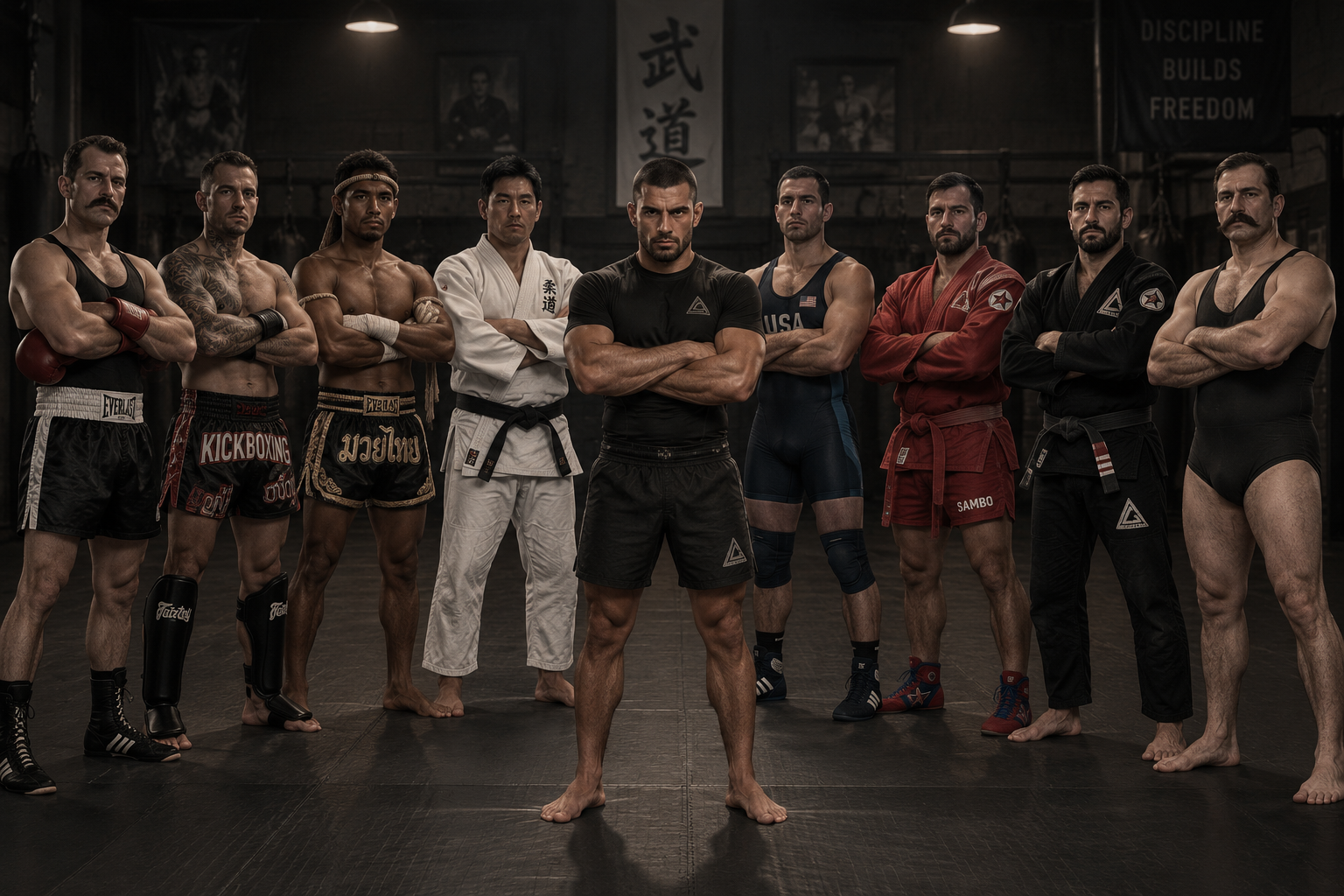
The boxing coaches come in with their hands in their pockets and their fighters behind them, wrapped and quiet. The kickboxers, the Dutch-trained ones and the ones from the American line, stand together and do not talk to the boxers. The Kru from the Thai room bows onto the mat and sits, and his students sit behind him. The wrestling coach arrives with a dozen men in shoes who look at the bare feet around them like a warning. The sensei's people are in white jackets. The sambo men are in red and blue. The professors from the jacket academies and the men in rash guards from the room without one stand at opposite ends of the same group. And in the far corner, a small crowd of men nobody recognizes, with thick ears and old sweatshirts, who came from the tent at the end of the ground and stand like men who have done this in tents. A referee walks the tape line. He is nobody's coach and has never met the reader.
"Every art in this building earned its room by winning somewhere," the Warrior says, to all of them, and then he turns to you. "You walked all three ranges. You were taught by men who were on your side. Today you fight men who trained in rooms you never entered, under a man who does not know your name, in front of every teacher on the property. Every range live, gear on, the tap honored, three-minute rounds, and you fight whoever the card says. When the day is over we'll know two things. What you actually have. And which art dominated this mat this time around, because it will not be the same one next year."
This is the last room on the mat, and it is the only one that is not about an art. The three ranges taught you the feet, the clinch, and the ground, and every hour of them was spent against men who were, whether you noticed or not, on your side. This room puts every art the Dojo teaches on one floor and puts you in the middle of it. It is not a technique. It cannot be drilled. It is the question the whole Farm is built on, asked of you instead of your gym: did it work against a trained man from a different room who was actually trying?
Why These Arts Are on the Mat
Understand first why the men in the barn are the men in the barn, because the Dojo did not pick its arts by tradition or by beauty.
Every room on this mat is there because its art dominated an open test somewhere, in front of everyone, against arts that did not. The boxer's hands are the hands every cage fighter on earth had to learn because nothing else lands as fast or as often. The Thai clinch and the low kick are on the mat because they ended fights in the ring for a century and then in the cage. The wrestler is there because wrestling decides where every fight happens, and the man who decides where a fight happens usually decides how it ends. The judoka is there because his throws put men on concrete from a standing grip, and the sambo man because his country built a hybrid that has owned the cage's lightweight divisions for most of a decade. The jacket art is there because of one night in Denver. The room without the jacket is there because the cage fights in shorts. And the tent is there because a small man raised on its holds beat four members of the family from Denver.
The Dojo is not a museum of martial arts. It is a shortlist of what won. That is why there is no room for the arts that looked good and lost, and why the men on this mat have earned the right to find out, today, which of them wins now.
The Wheel Turns
Here is the second thing the Warrior wants understood before the first round, and it is the reason the day is worth holding every year.
In November 1993 one art dominated the first open test the modern world ran, and for two years a man in a jacket choked his way through every style put in front of him, and the fighting world concluded that the ground was everything. Then the wrestlers arrived, men who could not be taken down and could hold a man on the floor and hit him, and by 1996 a wrestler was the most dangerous man in the sport and the jacket men were being held down and punched. Then, in the summer of 1997, a kickboxer who had spent a year learning to get up off the floor beat the wrestler who had beaten everyone, standing, and the conclusion changed again. Then the complete fighter, who could do all three ranges, and for a decade nothing else could compete. Then, in the last ten years, the sambo and wrestling men from the mountains of the Caucasus, who take a complete fighter down anyway and keep him there. And in the grappling halls, the same wheel on its own: the jacket ruled, then the wrestlers, then the leg lock, and the leg lock is being answered now.
Dominance is a season. The audit is permanent. The arts that survive are the ones that go home from a losing year and learn what beat them, and the men who taught them are the ones who admit, in public, that they lost. That is why the Dojo runs this day and why the answer to which art dominated is written in pencil. When the jacket men dominated in Denver it was true, and when it stopped being true the honest academies learned to wrestle. Whatever dominates the barn this year will be adapted to by next year's students, and that is not a failure of the winning art. It is the whole reason it won.
Why the Test Has to Be Run on You
At the gate of the Dojo you learned how to judge a gym. Live resistance, trained opposition, honest outcomes. Three things that have to be true at once or the training is theater. You used that standard to pick your rooms, and you picked well. Here is the part nobody told you: the same three conditions have to be true of your hours, not just your school's, and a good school can quietly fail all three for one man while passing them for everyone else. The whole mat fixes all three in a single afternoon.
Was your resistance live? Think about the last month of rounds with the man who trains you. You have been catching him. Once a night, then twice, and the ground room already told you what that was: a coach growing a student at the pace the student can survive. He chose which of your attacks to let through the way a father chooses which pitches to swing at when his boy is on the mound. That is instruction dressed as a fight, and it is good instruction, and it means the number in your head was his number, not yours. The wrestler across the tape from you today has never seen you and has no reason to let anything through.
Was your opposition trained? Look honestly at who you have been beating. The new men. The ones lighter than you. The ones who started after you. And every one of them trained in your art, with your vocabulary, in a room that fights the way you fight. A man can go three years in a good gym and never once be across from someone who is his size, his senior, and from a different room, because gyms are small and the rounds sort themselves by comfort. Every tap you collected from a man in your own school is real, and it tells you nothing about the boxer in the corner.
Were your outcomes honest? Count. Not the rounds you remember, the rounds that happened. The man who tells the story of the night he caught the brown belt is telling a true story and leaving out the forty nights the brown belt caught him. The mat kept the real score. You kept the one you could live with. Today the score is kept by a referee who is nobody's coach and watched by every teacher in the building, and there is nowhere to keep the other one.
A man who has only been tested by people who like him, in an art that fights the way he fights, has not been tested.
The Ladder
The test is not one event. It is a ladder, and a serious man climbs the whole thing over and over for as long as he trains.
At the bottom is the drill, where your partner gives you the position so you can learn the movement. Above it is positional sparring, where he resists from one spot and you have a job to do. Above that are the live rounds in your own room, where he is trying to win. Above those is the open mat at a gym where nobody knows you, a purple belt your size who does not care how you feel about yourself doing whatever he wants for six minutes, and the drive home with an honest number in your head. Above that is the whole mat, the day in the barn, where the man across from you is trained in an art you never studied and every teacher on the property is watching. And at the top of the ladder is the tournament: one bracket, one weight class, one afternoon in a school gymnasium with a referee who does not know your coach and an opponent who has spent three months preparing to beat someone exactly like you.
Understand what the tournament and the whole mat are for on this Farm, because there is another place on the property where men compete and it is not the same thing. Up in the watchtower there is a cage, and men make their living in it. That is a career, with a camp and a purse and a record that follows a man for life. This is not that. The whole mat is an audit, and so is the bracket. A man who has never once put his training in front of a stranger has never had his training graded by anyone who was not paid by him. The barn is the cheapest honest grade there is. You do not have to win it. You have to show up to it, and read the result without flinching.
There is a line in Scripture that fits the man who skips this rung. A king with a great army sent word ahead that he was going to grind his enemy into dust, and the answer that came back was one sentence: Let not him who straps on his armor boast himself as he who takes it off (1 Kings 20:11). Do not talk before the round like a man who has already had the round. The armor going on is a promise. The armor coming off is a result. This room only counts the second kind.
What the Day Actually Shows
By the fourth round the barn has learned things about you that your own room could not have.
Your hands, built in the boxing hall, were good enough to keep a kickboxer honest and were not good enough to keep a wrestler off you, because you had never once thrown a jab at a man who was going to change levels under it. Your sprawl, drilled in the wrestling room, held against the sambo man once and then he changed his grip and you were in the air. Your guard, built in the jacket academy, did nothing to the man in the rash guard because there was no collar, and the Thai fighter's clinch, which you had read about, turned out to be a place where a man can hit you with his knees for a very long time. And then a round against a man from the tent, who did not care what position you thought you were in, caught an ankle from nowhere, and made you say the word before you had understood what he had hold of.
Every one of those is information, and none of it was available in your own room, because your own room does not have a Thai fighter in it or a man from the tent. That is what the whole mat is for. Not to humiliate a man. To show him, in one afternoon, the seams between his arts that his rooms could not show him, because a seam is only visible from the other side of it.
What the Test Does Not Promise
Be clear about what a passed test buys you, because men who pass it often buy the wrong thing with it.
It does not promise that you beat the seasoned fighter. He has more rounds. He has been hit more, finished more men, and quit fewer times. A tested foundation gives you a real chance against him, measurably better than the chance a man with no foundation has, and it is a chance, not a promise. The promise is the foundation. The outcome was never for sale.
It does not promise the street. The mat has no asphalt. The barn has no second attacker coming from your blind side, no car door, no staircase, no wet floor, no glass. The environment is part of the problem out there and it was never part of the problem in here. A man who has trained honestly is far more dangerous in those conditions than a man who has not, and he is not invincible. The test removes a layer of fantasy from the floor he is standing on. It does not pour concrete under him.
And it does not promise a different man overnight. Composure under pressure is built one round at a time. Five rounds of hard sparring teach you what panic feels like inside your own chest and how to keep working through it. Five hundred rounds of choreography do not teach it at all. The change is real. It is paid for in honest hours across honest years, and nothing on this mat lets you pay it faster.
Which Instructor Dominates
The men who taught you are on the mat too, and the day grades them harder than it grades you.
Every teacher in the barn brought students, and every student's round is a sentence about his teacher. The boxing coach whose fighter got taken down four times has learned something about his room that no amount of pad work would have told him. The professor whose purple belt could not hold a wrestler down has learned what his academy's Friday no-gi class has been skipping. And the Kru, sitting at the edge of the mat with his hands folded, watching a boy he has trained for six years lose a round to a man from the tent who caught a heel, has learned which range his room does not teach and has already decided what he will do about it on Monday.
That is the honest instructor, and he is the reason the wheel turns. He wants to lose here, in front of his peers, on a taped mat with a referee, rather than have his student lose the same way on a sidewalk with nobody watching. He goes home from a losing year and adds the thing that beat him, and the man who taught the thing that beat him goes home knowing that by next year his advantage will be gone. The instructor who dominates this year is the one whose art fits the moment. The instructor who dominates for a decade is the one who kept coming back to the barn after losing, and the reader should know, by the end of the day, which of his own teachers is which. Some of them will not come back next year. Watch for that.
The Man Who Can Fight Chooses Not To
Here is what the test is actually for, and it is not more fighting.
The man who has stood on the whole mat does not need to run the audit again at the gas station. He has nothing to prove to the man yelling in the parking lot, because he has been across from a Thai fighter and a wrestler and a man from the tent, men who could hurt him far worse than that man can, and he is still here. The provocation does not move him. He steps back not from fear but from sufficiency. He has the capability, so he does not need the demonstration.
The man who has never run it is the one most likely to be pulled into a fight he cannot win. He has read the technique. He has imagined the situation. He has never lived either one. He overestimates what he can do and underestimates what the stranger can do, and he gets hurt, or worse, the people he was supposed to protect get hurt because he stepped in carrying a story instead of a skill.
That is the whole reason this room exists. Not so a man can fight. So he can stand on something real on the day he has to, and carry himself the rest of his life like a man who does not have to. The tested man's presence ends most fights before they start. That is the prize. Not the round he won against the boxer, not the story of the day in the barn. A life largely free of the violence the untested man keeps walking into.
The Three Pillars on the Whole Mat
TRUTH here is the card at the end of the day, with every round on it, kept by a man who is nobody's coach. Not the rounds you remember, not the ones your teacher was kind enough to let you believe. A man who has been across from strangers from other arts who did not care about him knows what he can do, and knows which of his arts has a seam in it. A man who has only been complied with does not, and no amount of rank changes which of the two he is.
LOVE is why every teacher in that barn is a teacher worth having, and why the man who will not bring his students is not. The instructor who tests what he teaches in front of his peers, and loses, and goes home and fixes it, is doing the men in his room a faithfulness the comfortable teacher never will. He sells them nothing he has not watched break. And the stranger across the tape who beats you cleanly and shakes your hand has done you the same kindness the purple belt across town did: he showed you where you were weak while it was still cheap to find out.
LAW is that a claim which cannot be tested cannot be trusted, on this mat or anywhere else, and that the whole mat runs on a rulebook or it becomes the riot beneath the tent. The honest arts built the test into themselves: sparring, rolling, the bracket, and now this. The arts that removed it removed the one thing that could have told them whether they were real. The rule is not severe. It is the lowest bar that lets nine arts share one floor for a day without anyone being carried out, and lets a man know whether ten years of his life did what he thinks it did.
The Last Roll
So the day is done and the card is read and the Warrior lets you roll one more time, on the whole mat, with the teachers packing up around you, and you are good now. Honestly good. You know it and he knows it and the wrestler who took you down four times knows it too, because the fifth time he did not.
A second man has been standing at the barn door for a while, watching. You have not met him. He keeps the long building at the side of the property, the one with the rack on the wall, and he has seen a tested man's shoulders a thousand times. He does not say the cruel true thing he could say to a barn full of martial artists. He tilts his head at the two of you and asks one question, loud enough for the Kru to hear it.
"Nice. Now what do you do when he comes up with a knife?"
And before you can answer he flicks something onto the tape, a red rubber training blade, and it skitters to a stop on the mat between you and the Warrior.
"Dinner's on whoever's still breathing."
You both go for it, and everything you know about rolling is gone. There is no tap that saves you here, because the man who reaches the blade first decides whether the round ever ends. You scramble harder than you have ever scrambled, the two of you tearing for six inches of rubber like it is the only object left on earth, because right now it is. Your lungs quit first. Then the clean technique frays into raw blind effort. You are not thinking about dinner.
He gets it. Of course he gets it. And as the rubber edge settles against the side of your neck you learn the mat's last lesson, the one it saved for after you had passed: he was never tired. He let you burn yourself down, played hurt the whole way, and kept his real tank in reserve until the blade was in reach. He paced a man to nothing and never stopped smiling.
"You're buying," he says, already up, already walking toward the man at the door.
You stay down a beat longer than your pride wants, flat on your back, looking at the underside of a tin roof, and the barn is very quiet, because every teacher in it just watched the same thing you did. The thought lands cold and whole. Every hour on this mat, every round in the stranger's gym, the whole day against nine arts, the honest card, and four inches of steel could have ended me anyway. By the time you sit up the two of them are on the bench lacing their boots, arguing easy about a taco place on the highway, like nothing happened at all.
That is the whole turn, and it could only be taught here, after the test, to a man who had earned the right to hear it, in front of the men who taught him. The hands you built are real. You proved it against every art in the building. And they are not enough. The instant a weapon enters the room the game changes, and the trained man does not get to opt out of that fact. He only gets to train for it. The mat has done everything a mat can do for you, and nine arts have signed the card. The rest hangs on a wall.
"Now these are the nations the LORD left to test all those Israelites who had not experienced any of the wars in Canaan. He did this only to teach warfare to the descendants of the Israelites who had not had previous battle experience."
— Judges 3:1-2
Read that slowly. The opposition was left in the land on purpose, and not to punish. A generation that had never been tested was given something to be tested against, because a people who had only heard about war could not be trusted to hold what their fathers won. That is what the purple belt across town was, and the wrestler in the barn, and the man from the tent, and the man with the rubber knife. Nobody put them in your way to break you. They were left there so that when the real night comes you will not be a man who has only heard about it. The test was arranged, and it was arranged for you.