
Relationships
"Also, if two lie down together, they will keep warm. But how can one keep warm alone?" — Ecclesiastes 4:11
The Hearth
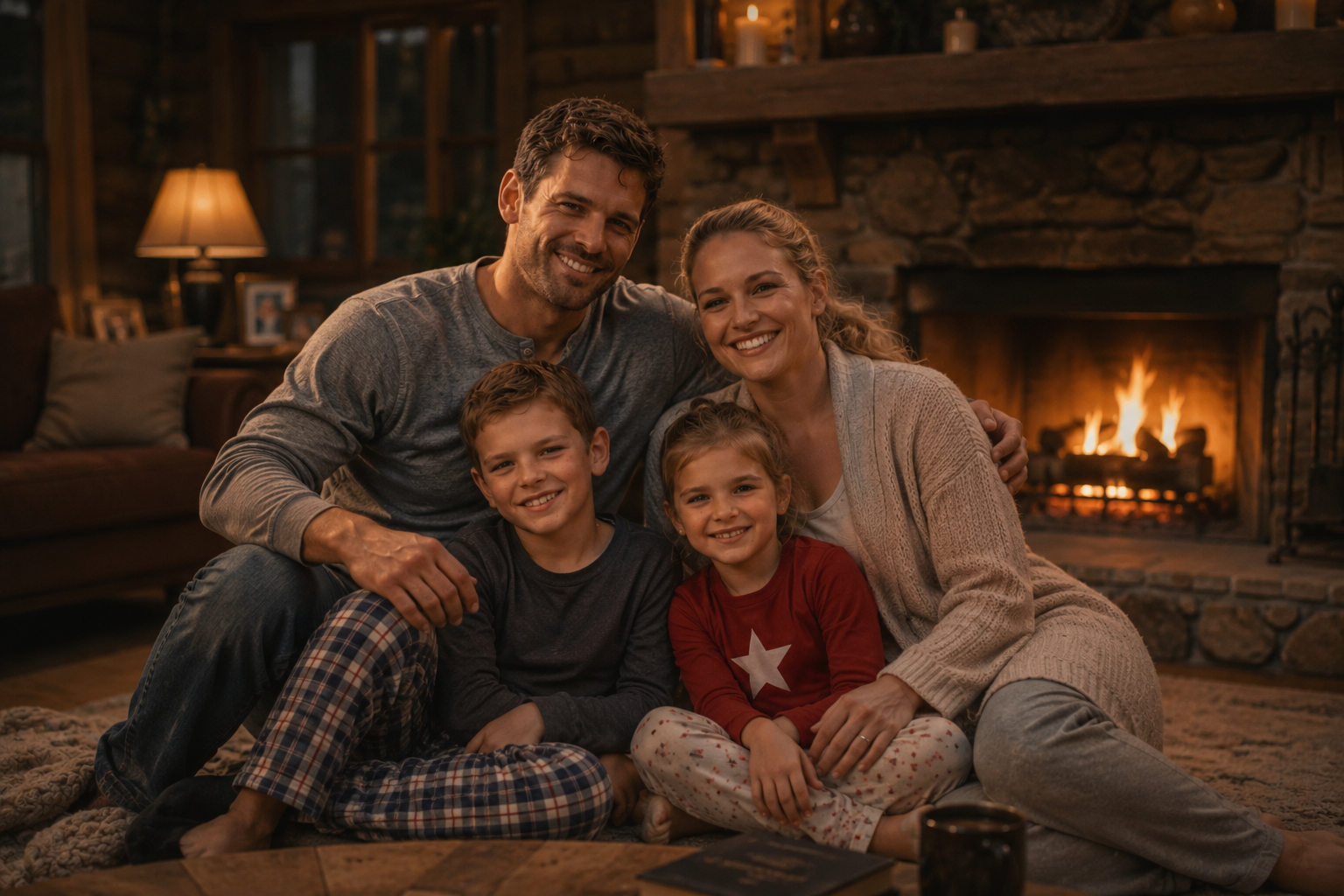
The Shepherd rides you onto the Estate and the first place he takes you is not the study or the office or the barn. It is the fire. Every home worth the name has one, the spot the whole household drifts toward when the day is done, where the meals are eaten and the hard conversations are had and the children fall asleep against somebody's leg. It is the warmest place on the property and the most important, because everything else the Estate builds gets built by people who first sat around this fire and learned how to be with each other.
He does not sit down yet. He stands in the doorway of the main room and counts it off for you. "Three fires in this house," he says. "This big one, where everybody you were given and everybody you gathered comes to sit. That one," and he nods at the dog lying on the warm stone, who has not moved since you came in, "which isn't a fire at all, but you'll see why I count it. And one more, down the hall, in a room with two chairs in it, that you don't get to see until you've sat at these." He steps in and takes his own chair. "Men come to this Estate wanting the room down the hall. Every one of them. I make them sit here first, because the man who cannot keep a brother warm has no business being handed a wife."
Here is the truth the Shepherd wants you to hold before anything else. The quality of your relationships is the quality of your life. Not your bank account. Not your record. Not your name. A man can win in every other Kingdom and come home to a cold house full of people who tolerate him, and he has lost. A man can be ordinary everywhere else and be the warm center of a household that would walk through fire for him, and he has won. This fire is where that gets decided, and it gets decided by inches, over decades, by a man who either shows up or does not.
Where It All Begins
You did not arrive at this fire empty, and the Estate has already told you so at the gate. You walked in carrying a whole way of loving that was handed to you before you could speak, and most men run it their entire lives without once looking at it. The Hearth is where that stops being a warning and becomes work, because the people you learned it from are sitting right here, and so are the people you are about to hand it to.
The first bonds of a man's life were not his choice. Every bond after them is. That is the whole turn the Hearth asks a man to make: to stop being the product of the bonds that happened to him and start being the author of the ones he builds. The heavy work of that, the grief and the anger and the old script, does not get done here in front of the people he is trying to love. It gets done in the quiet rooms where the journey began, in private, before God, so that the man who sits down at this fire is the man his people need and not the boy his childhood made. The past is worked upstream. The present is lived at the fire.
The Climb Toward Intimacy
There is an order to this fire, and the order is everything.
A man is not handed another person's whole heart on the first day. Closeness is a climb, and every step up costs more and means more. At the bottom are the bonds that can push back and forgive: the brother, the old friend, the parent who has seen every version of you. Then the bond that cannot push back at all, the creature that will be neglected or kept and never file a complaint. And at the top, alone, is intimacy, the one place a human being is trusted with all of you.
Here is what intimacy is, underneath the candlelight the world sells. It is letting one person see the parts of you that everyone else is kept from, the failures, the fears, the places you are not strong, the version of you that nobody at work or at the gym will ever meet, and betting your whole heart that what she sees will not be too much. That she will not leave. That she will not quietly stop loving you once the mystery is gone, or stay only out of habit, or fear, or what she gets from you. When a person shows you their soft underside they have handed you a loaded weapon and trusted you not to fire it. There is nothing braver a human being does, and nothing that wounds deeper when it is betrayed.
This is why the climb matters and why a man cannot skip steps. How he treats the bonds with low stakes is exactly how he will treat the one with everything at stake. He just will not find out until the stakes are real. The man who lets a friendship die of silence will let a marriage die the same way. The man who keeps a ledger on his brother will keep one on his wife. The man who cannot be trusted to feed a dog on a cold morning cannot be trusted with a daughter's heart. Care and respect are not faucets a man turns on when intimacy finally arrives. They are muscles built for years on the people and the creatures in front of him now, so that when someone finally hands him everything, his hands already know how to hold it.
That is the work of the Hearth, and it runs in a straight line. Learn to honor the people you did not choose, and to keep the creature that cannot hold you to anything, so that you are fit to be trusted by the one you do choose. Intimacy is the summit. Everything below it is the training.
The Three Fires
Three fires are kept at the Hearth, walked in order, each one hotter and smaller than the last, and each one handing to the next.
Friends & Family — the ground you stand on. The first bonds, and the foundation under all the rest. The family a man was born into, the parents and the siblings and the wider blood he did not choose and cannot return. The friends he built with his own hands across the years, and the brotherhood he has to build on purpose now because the world stopped handing it out. The rings that run outward from the fire to the stranger on the street. This is where a man first learns loyalty, first honors people whose failures he can see plainly, first finds out who he is in the one room where nobody is impressed. The man with no real friends at forty is not free. He is exposed. Start here, because every other fire is fed by this one.
Pets & Animals — the clean mirror. The bond a man keeps with a creature that cannot argue, cannot bargain, cannot pay him back, and cannot leave when he fails. The dog at his feet. The horse that will not follow a man who is lying to himself. The stock on the hill that he keeps for what it gives, all the way to the morning he ends it with his own hands. Precisely because the animal has no recourse, how a man treats it is the truest reading of his character there is, and it is the gentlest place on the Estate to learn the thing the summit will demand: caring for something that cannot hold him to it, every day, expecting nothing back.
Romance & Intimacy — the deepest fire. The room down the hall, the two chairs, the one person out of everyone alive. The choosing, the vowing, and the keeping, across every season the weather sends. This is the place a man is trusted with everything and the place the world has lied to him about the most. Everything the two lower fires built in him gets used here, and the watch that guards all three fires hangs off this one, because this is the fire it most has to guard.
The Watch
There is one more door at the Hearth, and it is not a step. Off the deepest fire hangs the room where a man learns to read the patterns that burn down what the fires build: the partner who idealizes and then discards, the mask that slips when a child arrives, the parent whose loyalty is control, the friend whose warmth is a hook. Toxic Relationship Dynamics is the watch, and a man keeps it from the first date to the last day and turns it on himself before he turns it on anyone. It is walked from the third fire, not after it, and it rejoins the Estate at the Nursery, where the same watch is kept for the children. A man does not visit it once. He carries it.
Love that cannot recognize a predator is not love. It is prey. The Shepherd will say that again in the room where it belongs.
How a Man Goes Wrong Here
Each fire has its own failures, and the rooms name them. These are the ones that belong to the whole Hearth, because a man carries them from fire to fire without noticing.
Running the inherited script. He never examined the home he came from, so he is repeating it blind. His marriage looks like his parents' marriage in all the ways he swore it never would, his friendships end the way his father's did, and he cannot see any of it because the pattern was the air he breathed. A man names the script before he can stop reading from it.
Going it alone. He decided he needs no one, handles everything solo, treats needing people as weakness, and is fine right up until something lands that is bigger than he is, and there is no one there because he never let anyone close. Self-sufficiency is a fine story until the night it is not, and the night always comes.
Dissolving into other people. The far end of the same ditch. He has no self left. His moods are downstream of his wife's, his opinions downstream of his friends', his whole interior borrowed from whoever is nearest. He feels warm to others and exhausted to himself, because a man has to actually be someone before he can be close to anyone. Closeness between two whole people is love. Closeness that erases one of them is absorption.
Performing the bond. He runs every relationship with one eye on who is watching. The friendship exists in the photographs, the family in the holiday card, the marriage in the caption. An audience will not sit with a man when the thing cracks, and the people who were supposed to be the point find out, one day, that they were the set.
Warm to strangers, cold at home. The most-liked man at the office and the church, generous with every acquaintance, and a stranger at his own table. He spends the warmth where it earns him something and arrives home with the tank empty. The people who should have had him first get what is left, and there is never much left.
Waiting for the summit. He let every lower fire go cold while he waited for the one that counted. No brothers, a dog he never trained, parents he calls at Christmas, and a whole heart saved up for the woman who will fix all of it. She cannot, and she will find out on the honeymoon that she married a man with no practice.
The Shepherd refuses both ditches, the armor and the dissolving, and builds a self solid enough to give away on purpose.
Two Things Under Every Fire
The rooms carry the practices, and each fire has its own list. Two things sit under all of them, and a man who loses either one loses the fire no matter what else he does right.
Respect. It comes before everything, because nothing else survives its absence. A man values the other person's feelings, opinions, and limits before he wants anything from them. He listens all the way through. He keeps contempt out of his voice, and out of the joke, and out of the look across the table, because contempt is the single thing that kills a bond fastest, and the people who have studied marriages for forty years say they can hear it in the first five minutes and predict the divorce from it. Respect is the soil. Everything else at the Hearth is planted in it or it dies.
Trust. The most valuable thing in any bond, built slowly through years of small reliable acts and burned in a single afternoon. A man guards it like it cannot be replaced, because it nearly cannot. He says what he will do and does it. He is where he said he would be. He does not tell the small lie that would be easier, because the person across the fire is keeping a count he cannot see, and the count is the relationship.
The Three Pillars at the Hearth
Three questions are asked at every fire in this house. TRUTH. LOVE. LAW. Always in that order.
TRUTH is looking at the person. Not the fantasy, not the do-over, not the audience. The real brother with the real failure, the real dog with the real needs, the real woman across the real chair. A bond built on a version of someone is a bond with nobody, and most of the cold houses on this Estate are cold because the man in them stopped looking years ago.
LOVE is the reason the skill exists. Everything the Hearth teaches can be turned around and used: to manage a mother, to steer a friend, to win an argument with a wife, to keep a dog because of what it says about him. Every one of those is the skill without the pillar, and the house it produces looks warm from the street and is not. Every fire at the Hearth asks the same thing of the man sitting at it: who is this warmth for, and would he still bring the wood if nobody thanked him for it.
LAW is the part that does not depend on the mood. The visit made in the month he did not feel like visiting. The dog walked in the busy season. The vow kept through the year it went cold. A man who only shows up in good weather is not keeping a fire. He is visiting one.
Tended as One Fire
The three fires are one fire, and a man keeps the whole thing burning at once or he finds out, years later, which one went out while he was tending another.
The man who built only a marriage has a wife and no brothers to hold him up when the marriage strains. The man who built only friendships has a great crew and no one to come home to. The man who keeps a dog and a horse and a barn full of stock and no people has a mirror and nobody to show it to. Most men over-invest in whichever bond the current season is forcing on them and let the others go cold, and the cold is quiet, and it is always noticed too late.
The seasons shift the weight. The single years lean into the brothers and, if a man is wise, into the choosing. The early marriage pours into the deepest fire and is the decade the friendships die by neglect. The middle years are where a man's lifelong friendships take their final shape, where his parents start needing rides, and where the animals teach his children what he taught them. The later years ask him to read every bond with what the decades taught him and to keep the watch on the people who are now coming to his fire. The order is not rigid. The discipline of tending all three, for life, is the whole point.
And the Hearth is never tended alone. It draws on the quiet rooms, where the man was made ready to sit here at all. It draws on the Proving Ground, because the body that carries the groceries at seventy was built at forty. It draws on the Farm, because the people at this fire are the whole reason the watch is kept, and the bench a man sat on there was this fire with the lights off. And it feeds every room on the Estate, because a home is built by people who first learned to sit together, and there is no other order in which it can be built.
Where the Hearth Stops and Scripture Continues
The Hearth teaches a man to build and keep the bonds a life is made of, and a man who does it well has a full table at sixty and men who would drive through the night for him. What it has no answer for is the question a man asks in the cold year. Why he should keep warming people who will fail him, and where the warmth is supposed to come from after they have.
Scripture puts the answer in two fires, and it is not an accident that they were fires. On the night He was arrested, Peter stood in a courtyard warming himself at a charcoal fire, and denied three times that he knew the man being tried inside (John 18:18). It is the only time that word for a charcoal fire appears in the Gospels, until it appears once more. Weeks later, on a beach, the risen Jesus built a charcoal fire, put fish on it, and waited for the men who had abandoned Him to row in. When they landed, they saw a fire of burning coals there with fish on it, and some bread (John 21:9). Jesus said to them, "Come and have breakfast" (John 21:12). He did not start with the denial. He started with breakfast. The second fire was built by the One who had been betrayed at the first, for the men who did it, and He cooked.
That is the Hearth. Not a fire the man built for the people who deserved it. A fire that was built for him, by Someone he had walked away from, who fed him before He said a word about it, and who then asked him, three times, whether he loved Him, and sent him to feed the others. Dear friends, since God so loved us, we also ought to love one another (1 John 4:11). The since is the whole supply. A man does not keep warming people who fail him because he is a good man. He does it because he has eaten at a fire he did not deserve, and he will find, somewhere up the road, that he has been sitting at it the entire time.
What the Hearth Feeds
Everything at this fire was between people who could leave. The brother could walk out. The dog could be given away. The woman in the other chair chose to sit down and could choose to stand up, and half of what this ground taught a man was how to be the kind of man she never does. Every bond here had two ends, and both ends were held by someone who was there on purpose.
The next ground is different in one way that changes everything. The child did not choose. He cannot leave, cannot bargain, cannot find a better house, and for eighteen years the warmth or the cold of this fire is the only weather he has ever known. The people at the Hearth can be loved badly and survive it. A child is formed by exactly how he was loved, and he carries the shape of it into every fire he ever sits at, and then he hands it to his own. Even the sparrow has found a home, and the swallow a nest for herself, where she may have her young (Psalm 84:3). The psalm puts the nest beside the altar. The Shepherd puts the Nursery on the sheltered side of the hill, inside the highest fences on the property, downwind of this fire, and everything a man learned to keep warm here is the first thing that ground is going to ask him for.
So he leads you out of the main room, and not down the hall this time, but out the back, past the house, to a low fenced piece of ground where something small is growing under a roof two people built.