
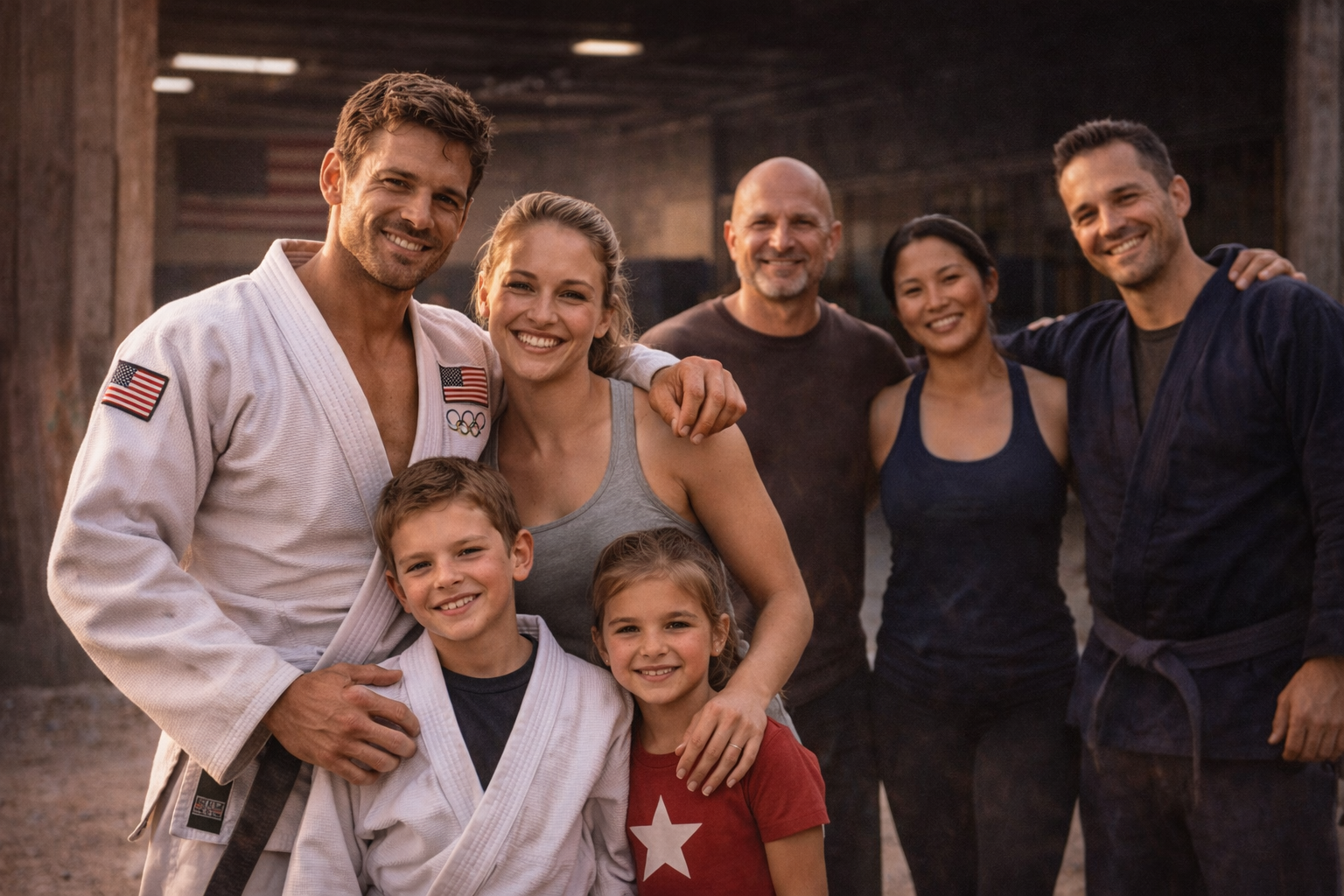
Friends & Family
Family Matters
Friends & Friendship
Social Circles
"Where you go I will go, and where you stay I will stay. Your people will be my people and your God my God." — Ruth 1:16
The Ground You Stand On
The Shepherd does not start by teaching you anything. He sits down at the fire, stretches his boots toward it, and nods at the people already there.
Look at them. Some of them you picked. Most of them you did not. Your mother is there, whether she is alive or not, because the way she said your name is still the way you hear it in your own head. Your father is there, in the way you hold your shoulders. The brother you fought with at eight and again at thirty-eight is there. The cousin who was your first friend before you knew what a friend was. And then, further from the flames, the ones you gathered yourself: the kid from the old street, the man from the unit or the shop or the pew who stayed when the rest scattered, the two or three men in the world who have seen you at your worst and did not leave.
"Everybody you will ever love," the Shepherd says, "you will love with hands that were trained on these people. Before you choose a wife you have already learned, right here, whether you keep score, whether you show up, whether you can honor somebody you can see straight through. This is the ground. Everything else on the Estate gets built on it."
The verse over this fire is a foreign widow talking to her mother-in-law. Ruth had no blood tie to Naomi and no law holding her, and every reason to go home. She said your people will be my people, and with one sentence she took a family she was given and turned it into a family she chose. That is what this ground asks of a man. The people he did not pick, he keeps on purpose. The people he picked, he keeps like blood.
Why a Man Works This Ground First
Every man arrives at the Hearth wanting to talk about the woman. The Shepherd will not let him, yet, and the reason is not modesty. It is that a man's marriage is going to be run by habits he built somewhere else, long before he met her, on people who had no say in whether he showed up.
Two kinds of bond sit at this fire, and a man needs both.
The first was assigned. Family is the bond a man did not earn and cannot return. The parents who raised him well or badly. The siblings who share his history and remember the year the money ran out. The extended blood that turns up at funerals and holidays and asks about the job. A man does not get to pick any of it, and that is the whole lesson. Family is where he first learns to keep a bond he cannot quit, to honor people whose failures he can see plainly, to love somebody because loving him is right and not because it is easy. A man who can only love people he selected for their convenience has not learned to love. He has learned to shop.
The second he built with his own hands. Friendship is the bond no law and no blood requires. He chose it, another man chose him back, and across the years it either deepened into something that holds weight or quietly went cold. This is where loyalty stops being a feeling and becomes a decision: the call placed when a friend has gone silent too long, the drive made when the calendar fought it, the showing-up nobody forced and everybody remembers. A friendship in its thirtieth year is a different thing from a friendship in its third, and it cannot be manufactured late. A man starts early and keeps going.
The modern world is built against both. The uncles who used to live down the road live four states away, and the friends a man makes at twenty get scattered by every move the career demands, until at forty-five he has a wife, a job, some coworkers, and nobody left who knew him before any of it. None of that is his fault. It is still his to fight, because the bonds the world dissolves are exactly the ones that hold a man up when the hard season comes, and no promotion ever built a man a single person to call at two in the morning.
The People Who Remember the Boy
Everywhere else in your life you get to choose the version of yourself that shows up. Your coworkers meet the professional. Your friends meet the man you decided to be at twenty-five. Your wife met the man you were on your best year. Family met you before you could choose anything. They remember the boy who wet the bed and lied about the window and cried at the top of the stairs. They have leverage nobody else on earth has, and they know exactly where the old buttons are, because they installed them.
Jesus went home once, to the town that raised Him, and the people who had watched Him grow up could not see past the carpenter's son. A prophet is not without honor except in his own town, among his relatives and in his own home (Mark 6:4). If it happened to Him it will happen to you. The mother who still corrects your grammar at forty. The brother who will never quite believe you have changed. The uncle who tells the story about the fireworks every Thanksgiving. A man's character is not proven in the rooms he gets to curate. It is proven in the one room where nobody is impressed, and where the people across the table have a thirty-year file on him.
That is why this ground comes first. The man who can stay warm, honest, and himself at his own mother's table has passed a test the office will never set. The man who cannot has only found out who he is in front of strangers.
How a Man Goes Wrong Here
Nobody fails this ground loudly. It goes wrong by inches, over years, and the six ways it goes wrong all look reasonable from the inside.
Running from the family. The home he came from was hard, so he handles it with distance. The mother's pattern muted instead of faced. The father's failures filed instead of forgiven. The brother not spoken to in three years over something neither of them can quite name anymore. The distance feels like peace and works like rot, because what was never faced does not disappear. It gets aimed at the wife and handed to the children. A man takes that wound where it belongs, into the quiet rooms, and comes back to his family with his own feet under him.
Never leaving the family. The opposite ditch. He never grew up out of the house he came from. He still runs decisions past his mother that are not hers, still measures his marriage by what his parents would think, still cannot make a move without the old household in the room. His wife ends up married to a crowd. A man honors his parents without being governed by them. There is a difference between a son and a subject.
Letting the brothers go cold. He did not decide to lose his friends. He just stopped initiating. He read every silence as distance instead of an invitation, and one year he looked up and could not name a man who had known him longer than his current job. The men who carry you through a crisis have to be in place before the crisis. He had none in place, and the crisis came on schedule.
Borrowing his circle from his wife. He has no men of his own. He goes where her friendships take him and sees the people her family invites, and quietly has nobody who is his. It works until the marriage hits a wall or she is simply not available, and then he discovers he handed his whole social life to one person. A man keeps his own brothers so that he comes to his marriage as somebody, not as a dependent.
A full roster and nobody to tell. He has plenty of men to watch the game with and trade jokes with, and not one he could tell the truth to. Surface friendship photographs exactly like the real thing and holds nothing when weight lands on it. A man builds at least two or three bonds deep enough to be honest inside, where he can give correction and take it, and where the other man has seen him fail and stayed.
Letting the crowd pick him. His circle got assigned by his employer, his zip code, his kids' league, whatever happened to surround him, and he never once chose it. So his whole picture of the world drifts to match the crowd that caught him. A man chooses his circles on purpose, feeds the ones that sharpen him, and walks away from the ones that are quietly sanding him down.
The Three Rooms Off This Fire
Three rooms open off this ground, and they are walked in order, from the blood a man was born into out to the wide world he moves through. Each one hands to the next, and the last one hands back to the fire.
Family Matters — the house you came from. The parents, held one at a time: the first man a boy ever studied, and the first woman he ever knew. The brothers and sisters who were his first negotiation and his first forgiveness. The wider clan, the grandfathers and uncles and the in-laws a man takes as his own, and the old authority of the male line that the world has tried to turn into a slur. And the harder rooms inside it: the home that broke, the family that ran on silence and roles and one protected secret, and the plain rules a household writes down so that it does not have to relearn them every generation. This is the deepest room on the ground, because everything a man carries into every other bond was packed here.
Friends & Friendship — the brothers you chose. The friendships that survive the moves and the years. The brotherhood a man has to build on purpose now, because the world that used to hand it to him for free is gone, and the permission to feel anything in front of another man went with it. The inner circle and the wider company. And the honest half of the room the culture flinches from: some men are enemies, a few of them are sitting at your table, and a man who cannot tell a friend from a frenemy will bleed out slowly without ever knowing where the cut was.
Social Circles — the wider world. The rings that run outward from the fire: the familiar faces, the partners and mentors and coaches, the peers and the regulars, the associates and colleagues and coworkers, out to the stranger on the street. A man calibrates what he shares and how much he trusts to the ring a person actually stands in, refuses to load a coworker with a brother's weight, and walks into every room as a man who contributes rather than one who consumes. He chooses the field his life is played on instead of letting the field choose him.
The Work of Keeping
A bond is not kept by feeling warmly about it. It is kept by a handful of plain things done over and over across decades, most of them small, none of them dramatic. These are the ones the men whose tables are still full at seventy have in common.
They show up in person. Time is the only currency this ground accepts, and it has to be spent in the room. The visit made, the trip taken, the phone put face down. A man's family and friends do not compound on his intentions. They compound on his presence.
They mark the days. Birthdays, graduations, the retirement, the funeral. Every one of these is a door, and a man who walks through it is remembered for it thirty years later. The man who sent a text instead is remembered for that too.
They come when it costs something. The illness, the layoff, the divorce, the child in the hospital. Anybody can be present at the wedding. Paul, chained in a Roman prison and abandoned by nearly everyone, remembered one man by name: he often refreshed me and was not ashamed of my chains (2 Timothy 1:16). Every man on this ground should be somebody's Onesiphorus, and should know which brother would be his.
They say the hard thing while it is small. Long bonds are not the ones with no conflict. They are the ones where conflict got spoken early, to the person's face, before it hardened into a grudge that would outlive them both.
They forgive fast and do not keep the receipt. Whoever would foster love covers over an offense, but whoever repeats the matter separates close friends (Proverbs 17:9). The man who keeps a ledger of his brother's failures will one day present the bill, and the friendship will not survive the reading.
They leave room. The other man's time, his house, his marriage, his interior are his. A man honors the line where he ends and the other begins, and says where his own lines are, out loud, before anyone has to guess.
They keep the traditions. The summer trip, the standing breakfast, the way the holiday is done. Rhythms are how a family remembers itself, and the man who keeps them is handing his children a memory they will keep for people not yet born.
They push each other forward. A brother who needs you to stay the same is not a brother. The men worth keeping want to see you outgrow them, and tell you when you have stopped trying.
They go first. Nobody in a family or a friendship follows a rule they have only heard. They follow the man who does it. Whatever a man wants at his table, he brings first.
The Three Pillars on This Ground
Three questions run under every bond on this ground. TRUTH. LOVE. LAW. Always in that order.
TRUTH is refusing the two false versions. There is the sanitized family, the one a man tells himself about so he never has to grieve what actually happened at that address. And there is the indicted family, the one he has prosecuted so thoroughly that he can no longer see anything they gave him. Both are lies, and both are easier than the truth, which is that the same people did real harm and real good, and a man has to carry both facts at once. The same goes for the friend. Loyalty wants to see him better than he is. A grudge wants to see him worse. TRUTH sees him as he is and stays anyway.
LOVE is the reason a man keeps the bond at all. The skill this ground builds can be turned to bad ends. A man can learn to read his mother's moods and use it to manage her. He can learn what his brother needs and use it to steer him. He can build a circle of men whose only purpose is to make him feel important. Every one of those is a failure of this pillar no matter how full the calendar. The question that runs under every bond here is whether the man is spending himself on these people or spending these people on himself.
LAW is the honor that does not wait for the feeling. Honor your father and your mother is the only commandment on the list with a promise attached, and it is not conditional on their having earned it. The brother is called when there is nothing to say. The parent is visited when the visit is a chore. The friend's funeral is attended when it means a red-eye and a lost day of work. Feeling is weather. Showing up is the vow, and a man whose presence is as reliable as his word is the rarest man left.
Walked as One Ground
The three rooms are not three subjects. They are the same loyalty, pointed at three distances from the fire, and a man who is good in one and absent in another has learned a trick, not a character.
Which room carries the most of a man changes with the decade. In his twenties the friendships carry the most of him, and his family of origin is something he is trying to get clear of. In his thirties the household he is building pulls hard, and this is the decade friendships die by neglect and parents get put on hold. In his fifties the order reverses without asking his permission. The parents start to need rides and then need more than rides. Put their religion into practice by caring for their own family and so repaying their parents (1 Timothy 5:4). The siblings become the only other people alive who remember the house. The friends who survived the busy decades turn out to be the ones he will grow old beside. A man who understands the seasons tends what the season is asking for, and does not discover at his father's bedside that he has not called his brother in four years.
And the ground is never worked alone. It draws on the quiet rooms, because a man engages his family out of whatever is actually inside him. It feeds the Farm, because the bench a man sat on there, with the cop and the two soldiers, was this ground with a rifle on it. And it feeds everything warmer on the Estate, because the wife and the children are going to be loved with the exact hands this ground trained.
Where This Ground Stops and Scripture Continues
This ground teaches a man to keep the bonds he was given and the bonds he built, and a man who has done the work well arrives at sixty with a full table and men who would drive through the night for him. What the ground cannot supply is the thing underneath the keeping. Why a man is owed anything by anyone. Why a bond he did not earn should hold at all.
Scripture answers with two brothers. Jacob had cheated Esau out of everything a brother could be cheated of, and had run for twenty years, and was walking back toward him with his family behind him in the order he was least able to lose them. But Esau ran to meet Jacob and embraced him; he threw his arms around his neck and kissed him. And they wept (Genesis 33:4). Nothing Jacob had done deserved that. He had spent two decades bracing for the other thing. The bond held because Esau decided it would, and Jacob spent the rest of his life knowing what it feels like to be forgiven by a man he had wronged.
And it answers with a father standing in a doorway, and an older brother in the field who would not come in. My son, you are always with me, and everything I have is yours. But we had to celebrate and be glad, because this brother of yours was dead and is alive again (Luke 15:31-32). The family that cannot be quit is a picture of something. A man who has ever been welcomed home when he had no right to be knows what the picture is of, and a man who has never felt that will find, at the end of this whole road, that it was waiting for him the entire time.
Then Jesus said the strangest thing anyone has ever said about friendship. I no longer call you servants... Instead, I have called you friends (John 15:15). The One who owed no one anything chose a bond He did not need, with men who would fail Him within the week, and kept it. Every friend a man keeps on this ground is a small copy of that. Every family he honors without their having earned it is a smaller copy of the other thing. He is not building the original. He is learning, on these people, what it costs, so that when the original finds him he will know what he is looking at.
What This Ground Feeds
Everything warmer at the Hearth is lit from this fire. The man who learned loyalty, repair, and honor on the people who could not be returned carries it up every step of the climb, into the woman he chooses and the children he raises and the name he leaves. The man careless with a brother will be careless with a wife. There is no exception to that on record.
But before the Shepherd takes you one step higher, he turns you back to the same fire, because there is somebody at it you have not counted. You have now looked hard at every human being who sits here, from the mother who bore you to the stranger at the far edge of the last ring, and every one of them can answer you. They can keep score. They can name your failures to your face. They can demand repair, or walk out the door and not come back. Every bond you just learned to keep has a second party holding the other end of the rope.
One does not. It is lying near your boots with its chin on the warm stone, and it has been there the whole time you were talking about people. It has no vote, no leverage, no thirty-year file on you, and no recourse if you fail it. It cannot tell anyone. Which is exactly why the Shepherd wants you to look at it next, because how a man treats the one creature that cannot hold him accountable is the truest thing you will learn about him on this Estate.