
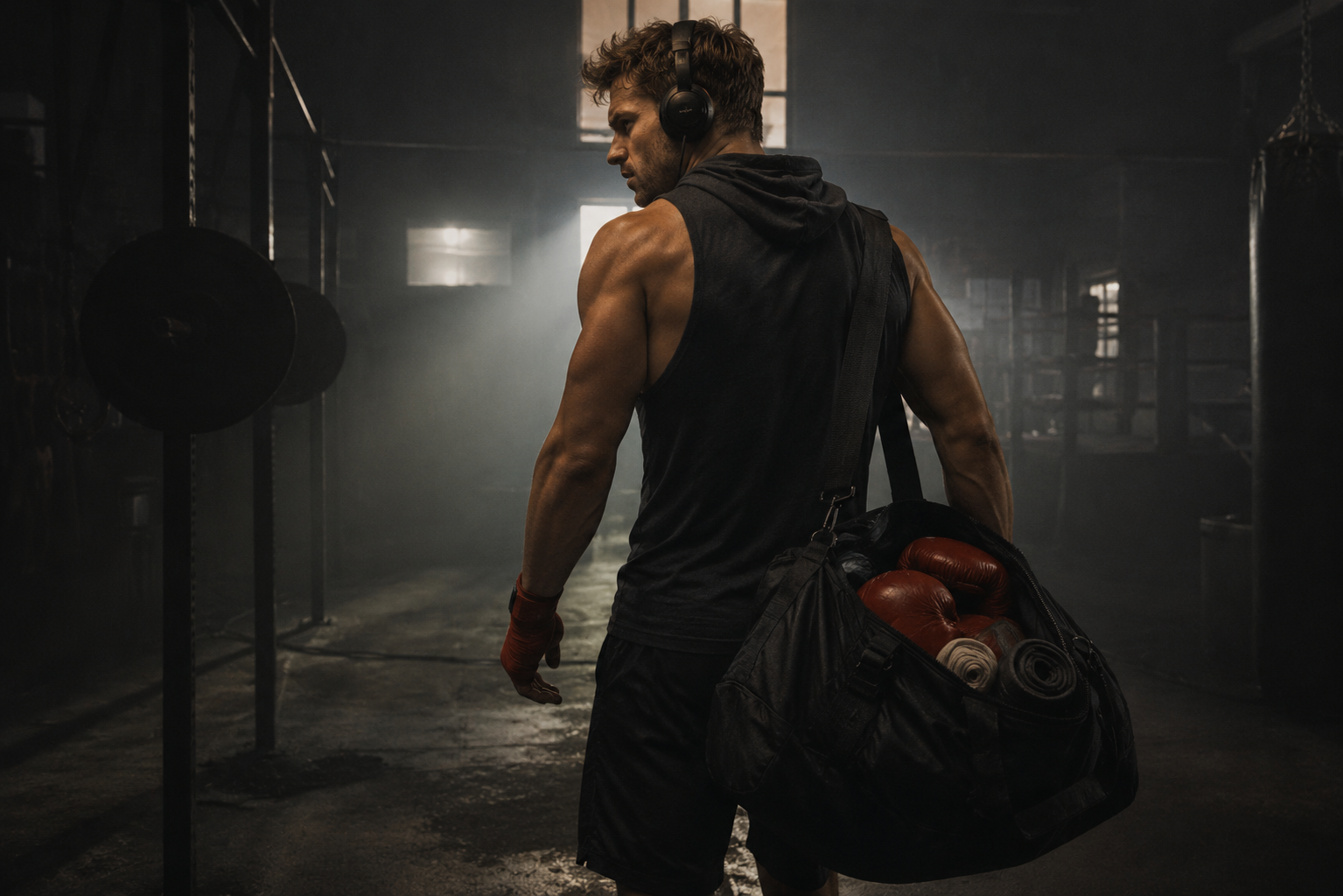
Boxing
"Rhythm is everything in boxing. Every move you make starts with your heart, and that's in rhythm or you're in trouble." — Sugar Ray Robinson
Hands First
The Warrior pulls a pair of wraps off the shelf and holds his hand out for yours. He laces them slow so you can watch, around the wrist, between the fingers, back over the knuckles, snug but not tight. "Four punches," he says. "Jab, cross, hook, uppercut. I can show you all four before supper." He ties off the wrap and looks you in the eye. "Men spend fifty years getting them right. That's boxing. The simplest art in this building, and the deepest hole in it."
Then he walks you to the heavy bag and tells you to hit it. You hit it the way you have hit things your whole life, with the arm, from the shoulder, as hard as you can. The bag swings a few inches. Your wrist folds sideways and something in the second knuckle lights up. He does not say anything. He sets his feet beside you, turns his hip about four inches, and the bag jumps like a horse kicked it. His arm barely moved. "Every man who walks through that gate already thinks he knows how to punch," he says. "The bag just told you the truth. Now we can start."
Boxing is where the standing game begins. It is the oldest answer a man has ever given to another man's violence, older than the gloves and the ropes, old as the bare-knuckle yards and the ancient games, and the modern sport is the most refined system of hand fighting the human race has produced. Two fists, and everything it takes to land them on a man who is trying to land his on you. Nothing else on the Farm turns a beginner into a dangerous man as fast, and nothing else he learns here will show up in as many places later, because every striking art on earth is boxing with something added. The man who owns the four punches walks into the kickboxing room, the Thai camp, and the cage already speaking half the language.
This page is the front door of the gym and the map of the rooms behind it. It tells you what the four punches actually are and why they take a lifetime, how a boxer breaks and what keeps him from breaking, and then it walks you through four rooms in an order that carries a reason: the craft first, with no accent on it, and then the three countries that took the same four punches and turned them into three different kinds of man.
Why the Hands Come First
Boxing teaches fast and deepens forever. The four punches come in your first week. The defense, slip and roll and parry and block and pull, comes in your first month. The footwork that carries both takes years, and the timing that makes all of it matter takes as long as you are willing to give it. A man one year into honest boxing sees a stand-up encounter in a way the untrained man around him simply does not. Not because he learned secrets. Because he drilled the obvious ten thousand times until his body answers before his panic can vote.
The punch is not the arm. That is what the bag just taught you, and it is the first thing every coach in every gym on earth has to undo in a grown man. The arm is the last thing to move and the least important. A punch is a turn. The back foot screws into the floor, the hip goes first, the shoulder follows the hip, and the hand goes along for the ride and arrives at the end of it with the whole man behind it. The Warrior's four inches of hip moved the bag because two hundred pounds turned; your full swing did not because thirty pounds of arm swung. Learn the turn and you will hit twice as hard by Friday and never again break your hand on a man's head.
The jab is the whole art in one punch. Beginners want the cross, because it is the one that looks like a punch. Old men want the jab, because it is the one that wins. The jab measures the distance so the cross knows where to go. It blinds a man for the quarter-second the hook needs. It scores, it keeps a man off you, it tells you what he does when he gets touched, and it is the one punch you can throw all night without paying for it. Every great fighter you have ever heard of owned his jab, and the ones who owned nothing else still had careers. Own that one punch and you will beat men who know six.
Hands that come home. The throw is half a punch. The other half is the return, and the return is where beginners get hurt. The hand that stays out is a door left open, and a trained man walks through it before it closes. So the discipline is drilled from the first day: every punch comes back on the line it left, the chin stays behind the shoulder while it travels, and the other hand stays glued to the cheek the whole time. A man learns to hit in a week. He spends the year after learning to hit without being hit back, and that year is the one that separates the boxer from the man who took a boxing class.
The first honest round. Somewhere near the end of the first month the Warrior puts a headgear on you, pulls on the sixteen-ounce gloves that make this possible, and steps in with you. He is not trying to hurt you. He is trying to touch you, and he does, and the strangest thing happens: you get hit in the face by a man who knows how, and you are still there. Your eyes water and your nose stings and you are still counting, still moving, still throwing. Nobody is born with that. Every man in the gym bought it the same way, one round at a time, and it is the thing the gloves were invented to sell. Though an army besiege me, my heart will not fear; though war break out against me, even then I will be confident (Psalm 27:3). The gym cannot give a man that. It gives him the first taste of it, in a room where the war is three minutes long and the man across from him wishes him well.
How a Boxer Goes Wrong
His hands come down. Tired, between exchanges, talking, showing off. The hands-down knockout is the one every corner saw coming three rounds before it landed. Chin tucked, elbows in, hands up is a discipline, not a mood, and it is the first discipline boxing demands.
He swings for the fences. A slow punch is a rumor. The wide, loaded, everything-I-have right hand gets read from across the ring and slipped, and the man who threw it is now standing sideways with his chin in the air. The crisp punch arrives. The trained boxer throws sharp at sixty percent for a year before he throws hard at a hundred, because the snap is what turns a swing into a shot, and the snap cannot be learned angry.
He falls in love with the bag. The bag never answers, so every combination he throws at it works. A man can spend two years getting beautiful on equipment and have nothing that lasts thirty seconds against a partner who is allowed to move. Joe Louis said of a man who planned to dance away from him all night, he can run, but he can't hide, and the bag-only fighter is running from the same thing. The Dojo's one honest question gets asked here weekly, headgear on, against a partner who is allowed to answer, and the man who keeps finding reasons to miss that day is not training. He is rehearsing.
He copies the back room off television. He has watched the shoulder roll on a Saturday night and shows up Monday with his lead hand at his belt and his chin behind a shoulder that is not yet worth hiding behind. There is a corner of this gym where that style is taught, and it is earned, and the man who borrows it before he has earned it eats the exact punches it was built to turn away. Hands up first. For years.
He thinks the fight will stay where he wants it. Boxing is the foundation, not the whole house. The hands-only man has no answer for the grab, the clinch, or the floor, and a real fight changes layers without asking him. The boxer who has also stood in the Takedowns room gets to keep fighting on his feet. The one who has not gets to find out what the ground is like.
He thinks he already knows. The one under all the others. He came through the gate with a punch he has been throwing since the schoolyard and a story about a night it worked, and he does not want the four inches of hip because he wants his punch. The wise fear the LORD and shun evil, but a fool is hotheaded and yet feels secure (Proverbs 14:16). Feeling secure is the whole problem. The bag will take that story off him in a week if he lets it. The street will take it off him in a second if he does not.
Four Rooms, Walked in Order
Boxing 101 — the craft with no accent on it. The stance, the four punches, the footwork, the first defense, the wraps and the gloves and the bags, and the slow honest road into sparring. Nothing exotic. Everything that matters. This is the only room in the gym with back doors, and they matter: the defense taught as its own study, the counter game, the hall of styles with the shoulder-roll corner behind it, the strategy room with the southpaw problem inside it, and two halls of names, the fighters and the men who built them. Every one of those doors opens off the first room and only the first room, and none of them is the next step. The walk leaves this room by the front, not through a back door.
American Boxing— the melting pot. The country that never settled on one answer. Every style ever named has an American who did it best, and the thing that ties them together is not a technique but a temperament: speed over plodding, the individual over the company model, and a fighter who wants to win and be watched winning. The corners here are as famous as the champions, and the ring was the one door in the country that never asked a man his father's name.
Mexican Boxing— the war. One answer, taken all the way. Walk forward, take one to land one, and dig at the body until the other man's legs vote against him. The crowd loves it because it is honest and the fighters carry the whole barrio in with them, and underneath the spectacle is a hard logic about what pressure does to a technician and what a body shot in round three is worth in round ten. It is the bravest of the three schools, and the room is honest about what the bravery costs.
Russian Boxing— the machine. The opposite answer. A state that built fighters by the thousand on one blueprint, and whose first lesson, ahead of any punch, was how not to be hit. Range managed like a ledger, the jab as an education, the percentage played every time. It is the coldest school of the three and the most complete, and the walk ends here on purpose, because the most schooled hands in the world leave a question standing that no amount of schooling has ever answered.
The order carries the teaching. You cannot hear an accent until you speak the language, so the craft comes first with no country on it. The American room comes next because it is the room you are standing in, and because a country that never picked one style shows you all of them at once, which is how a man finds the one his body already is. Mexico follows because it is what happens when one of those styles is taken to the end of the road with the heart turned all the way up. Russia is last because it is the other end of the same road, heart replaced by system, and because a man who has just watched the war needs to see what the exam looks like before he decides which one is walking toward him.
The Three Pillars in the Gloves
TRUTH — no room on the Farm strips a man's illusions faster. The bag believes whatever you tell it. The man in front of you has his own opinion. You spar people who can expose you, you log the rounds that went badly, and you do the roadwork in the dark when there is nobody to perform for. The gym keeps perfect books.
LOVE — your sparring partner is not your enemy. He is the whetstone and you are his. You give him honest rounds without hunting his head, you take care of the new man the way somebody once took care of you, and you remember what the hands are for: the people behind you, at home, who will never see the gym that built them.
LAW — you keep the agreed pace, you respect the corner, you protect the man you are working with. And the wraps do not come off at the gate. A judge treats a trained man's fist as a weapon, and God treated it that way first, so the boxer who throws hands over a parking space has not learned boxing. He has learned to punch, which any fool can do.
"He trains my hands for battle; my arms can bend a bow of bronze."
— 2 Samuel 22:35
The man who wrote that had killed a lion and a bear with those hands before he was old enough to enlist, dropped a giant with a sling in front of two armies, and outlived every man a king sent to kill him. He knew exactly what his hands could do. And when he sat down to sing about where the hands came from, he did not name a coach, a gym, or himself. A boxer will spend fifty years training his hands, and it is worth knowing from the first wrap that the most dangerous man in the Bible gave the credit somewhere else.
Walked as a System
The four rooms are one boxer. The first room builds his hands, and the other three teach him what a temperament does to them. Walk them in order and something happens that a man cannot get from a single gym: he recognizes himself. He watches the American hall and sees the whole family of styles and feels one of them pull. He watches the Mexican war and finds out whether the pull was heart or just noise. He watches the Russian exam and learns what discipline can build on top of whatever he is, and what it cannot. By the fourth room a man knows what kind of boxer he is, which is a different thing from what kind he wanted to be, and he knows the three kinds of man who might be walking toward him, and that each one has to be beaten a different way.
And the hands leave the room. They go up the walk to the two rooms that stack the legs and then the elbows on top of them, and everything learned here is the floor they stand on. They go down to the clinch as the short punches that keep working after the arms tangle. They follow the man into the Armory, where the same fist closes on a blade and the feet under it do not have to learn anything new. They go into the cage as the one weapon no fighter in it was allowed to skip. And the roadwork goes home with the man, because the Proving Ground was never separate from this gym. It was the first hour of it.
After the Gloves
One more thing before the first room, and the Warrior says it quietly, because nobody else in this gym will. The year ahead is going to educate your eyes from the belt up, and it is going to feel like a complete education. It is not.
Everything below the belt line is a foul in the boxer's world, so he never learns to look there. His whole read, the shoulders and the hips and the chin and the lead foot, is a read of the upper half of a man, and it is a magnificent read, and it is half. There is a man out there who stands two feet outside the reach of any jab ever thrown and does his work in the half the boxer was taught not to see. The boxer's beautiful hands cannot reach him, and the boxer's beautiful eyes do not know where to look. The next room keeps every punch you are about to build and teaches your eyes to drop.
Tools & Resources - Boxing
Impak Training Bag