
Takedowns
"Maximum efficiency, minimum effort." — Jigoro Kano, founder of Judo
Deciding Where It Goes
The Warrior hands you a t-shirt two sizes too big, waits while you pull it on, and then grabs a fistful of it at the chest.
"This is how it starts," he says. "Not with a punch. With this." He does not pull, he does not push, he just holds, and you find that you cannot move in any direction he has not already decided on. You try to step back and the shirt comes with you and so does he. You try to shove and your shove goes into the fabric and disappears. "Every man who has ever been jumped in a parking lot was grabbed first. The shirt, the collar, the wrist, the back of the neck. Nobody squares up and boxes. They grab. And the man who owns the grip owns the next three seconds, and the next three seconds are the whole fight." He lets go. "Now grab me."
You do. You take two fistfuls of his shirt and he lets you, and then something happens in his hips that you do not see and your grip is still full of shirt but your feet are not under you anymore, and the mat comes up and takes the air out of you. He is standing over you. He has not let go of your sleeve.
"You had the grip," he says. "I had the floor. Guess which one decides."
This is the middle range, the bridge between the feet and the ground, where the clinch tangles and the level changes and the fight gets decided before it has finished happening. It is the most neglected range in the average gym and the one that decides the most real fights, and those two facts are the same fact. Train it and you choose: keep the fight standing where your hands are good, put him down where your ground is better, or break off and walk away with your family behind you. Skip it and the fight chooses for you, and it will choose the other man's terms.
This page is the door to the clinch, not the clinch. Three arts put a man on the floor, each in its own room, and the order they are walked in is itself a lesson. What this page does is tell you why the middle range is its own skill and not a gap between two others, what the takedown is actually made of, how the three rooms hand each other off, and why the range you are about to learn to own is one you will follow all the way to the floor.
Why the Middle Range Is Its Own Skill
A man who trains striking and trains the ground and skips the takedown has built two good rooms with no hallway between them. Every fight that starts on the feet and ends on the floor passed through the clinch on the way, and the man who never trained that passage has no say in it. He is a passenger between two places he trained, on a stretch of road he did not.
Three things are learned here that are learned nowhere else on the mat.
The first is the grip. Real violence is a grabbing sport. The shirt, the collar, the wrist, the hair, the bear hug from behind, the two hands on the throat. Every one of those is a grip, and grip fighting is what this range drills until it is reflex: how to strip a hand, how to win an underhook, how to make a man's grab into the thing that puts him down. The striker never trains it because the rules of his sport forbid holding. The ground man rarely trains it because his sport starts after the grip has already been won. It lives here or it lives nowhere.
The second is base. The trained man is simply harder to put down, because he has spent years learning how the floor holds him up. His weight is where it should be. His feet are under his hips and his hips are under his shoulders, and a shove that would knock an untrained man into a wall slides off him like water off a post. Every other range on the mat assumes a man can stay on his feet when somebody tries to take them. Only this one builds it. They are brought to their knees and fall, but we rise up and stand firm (Psalm 20:8) is a line about a battle, and every wrestler who has ever been driven to the edge of the mat and stood back up knows what it means in the body.
The third is the vote. On the feet the other man votes with his fists and you answer with yours, and neither of you has changed the question. Here the question itself changes. Standing, or on the ground? On his terms, or yours? The man who has trained this range casts the deciding vote, and the man who has not finds out that the vote was cast for him, usually about the time his back hits the pavement.
What Puts the Untrained Man on the Ground
The same handful of holes drop untrained and half-trained men in the clinch, over and over, and a man who knows their names can catch them in himself before a stranger does.
No takedown at all. He has hands and he has a ground game and nothing in between, and the fight changes levels without his permission. This is the classic hole of the man who spent years in striking gyms and jiu-jitsu gyms and never once wrestled, and the middle range finds him every time.
Sitting down on concrete. The grappler who never learned to wrestle for the position starts his ground game by pulling the other man down with him. That works on a padded mat with a referee. On a sidewalk, with the man's friends arriving, sitting down is how you die. The takedown exists so that a man reaches the ground on top and on purpose.
One shot only. He has a single takedown he trusts, usually the double-leg, and a man who has trained to stop it shuts him down cold and then punishes him for trying. The trained man chains: the stopped double becomes a single, the stopped single becomes a snap-down, the snap-down becomes a duck-under, and something in the chain lands because he never stopped moving.
Power with no setup. The untrained takedown is a lunge from open space at a man who is braced and ready, and it fails on contact. The trained takedown is the last move in a sequence of grips, fakes, and level changes. It is the finish of the sentence, not the first word.
Ducking the clinch. He avoids the tie-up because it is exhausting and humbling and there is nowhere to hide in it. It is exhausting and humbling because he avoids it. The man who lives in the clinch eats him alive there, and every real fight lives in the clinch for at least a moment.
Bending at the waist. He drops for the legs the way a man picks up a box, folding forward, and hands the other man his neck and his back in the same motion. The trained man drops at the knees and keeps his head up, and the difference between the two is the difference between finishing the shot and getting flattened under it.
What a Takedown Is Made Of
Every coach in the three rooms below, from the wrestling room that smells of mat cleaner to the jacket dojo to the hard Russian gym, agrees on ten things about how a takedown man is built, and they agree on the order.
The basic takedowns before anything else. The double-leg, the single-leg, and the hip throws. Three families that work across every takedown art on earth and inside the cage, and the seasoned man has them at a depth where he no longer thinks about them at all. Everything exotic is built on those three, and everything exotic built over weak versions of them collapses when somebody leans on it.
Technique as a chain. Level change, penetration step, lift or drive, finish. The takedown is engineered, and the man who has drilled the chain runs it cleanly where the untrained man muscles through bad mechanics and blows out a knee doing it. The chain is drilled until it requires no decision.
Timing and the setup. The takedown lands when the other man's weight is wrong, his balance is compromised, or his attention is somewhere else. The seasoned man builds that moment with a fake, a snap, a grip, a step, and then shoots into it. The untrained man shoots cold and hopes.
The level change. Smooth, fast, deep. The drop from standing to shooting range is the moment the takedown completes in, and the man with a quick level change creates that moment at will. He drops at the knees, never at the waist, and his head stays up.
The clinch. Collar tie, underhook, overhook, body lock, the two-on-one. The clinch is the bridge between the striking distance and the takedown, and the man who owns it has takedown opportunities the man at distance will never see. It is also the one place every real fight visits, so the work done here is never wasted.
The grip. Grip controls posture, and posture controls everything. The man with the stronger, smarter hands controls the other man's hands, his options, and his balance, and grip strength is trained deliberately because it is the lever every other technique pulls on.
Base and balance. The man who shoots without base gets countered. The man who finishes the takedown and loses base on top gets reversed. Balance is the floor everything else stands on, and it is built by being pushed, pulled, and thrown a thousand times until the body finds its own center without being asked.
Escapes and counters. The takedown attempted against you will sometimes land despite your defense, and the man who has drilled the sprawl, the technical stand-up, and the hip escape recovers his feet. The man who has not stays where the other man put him. Getting up is a trained skill, and the wrestling room grades it.
Conditioning. Takedowns are explosive, and the tenth shot of a match costs what the first one did. The man who has built the engine shoots at minute fifteen with the same drive as minute one, and few things on the Farm tax a man's wind like a partner who will not go down.
A coach, because a man cannot feel himself. The seasoned coach sees the detail the student is missing, and the partners who have wrestled for years teach what the techniques actually feel like against a man who is fighting back. That relationship compounds for a lifetime, and it is why this Farm walks you to a room and not to a video.
The Three Rooms in the Clinch
Three arts, walked in order, and the order is how a man comes to understand what a takedown is for.
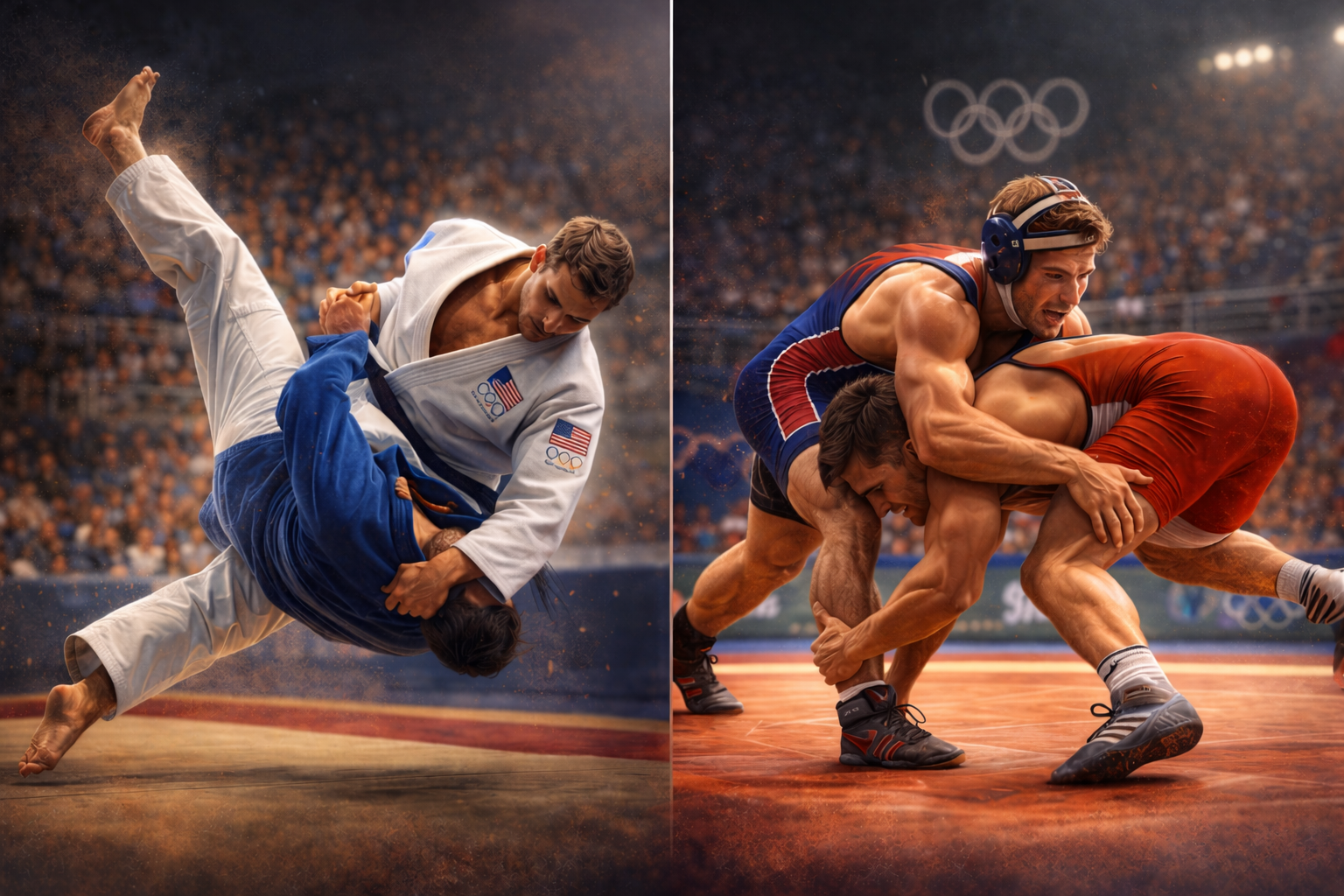
Wrestling — the American engine. No jacket, no ceremony, and no submission, only control. The level change and the shot, the upper-body throws and trips, the hand fight, and above all the chain that turns a stopped attempt into a finished one through nothing but relentless forward pressure. Wrestling builds the most transferable base of the three and the grip-and-hip control everything else extends, and it is the takedown foundation nearly every complete fighter is built on. Inside the room there are three ways to wrestle: the American schoolhouse style that grades the escape and refuses to let a boy accept being under, the world's style that grades exposure and offense, and the old Olympic style that forbade the legs and built the deepest clinch knowledge on earth by working with what was left. The engine under all three is laid out piece by piece in Wrestling Techniques. The wrestling room is in every high school in America, and it takes any boy who walks in, and it is the hardest room on the Farm to stay in.
Judo — the throwing art with a soul. The jacket arrives, and with it the collar and the sleeve, and a whole different way to put a man on the floor. The judoka does not drive. He yields, borrows the other man's push, breaks his balance before the throw is thrown, and lets the bigger man launch himself. The sweeps, the hip throws, the shoulder throws, the breakfall that lets a man hit the ground without injury, and a philosophy of mutual benefit that lifts the art above sport and made it the grandfather of the ground game you will learn next. The room has a home, in Tokyo, and a founder who thought he was building an education. Inside it are the fundamentals, the ground follow-up, and three national rooms where the same art was bent by a strong nation, a horse nation, and the nation that made it.
Sambo — the Russian blend. Judo's throws taken by a hard country, married to every wrestling style an old empire held, and pointed at the one place the jacket arts had agreed not to look: a man's legs. Harder and more permissive than the Olympic rules allow, the sambo man reads the leg-lock game the gi-only judoka misses, and he treats the ground as the next place to work rather than an emergency. It spent half a century denying the art it came from. It is the last room on this range because it is the room that already knows where this range is going.
The Three Pillars in the Clinch
TRUTH on this range is measured in a way the feet never allowed. A punch can be pulled and nobody knows. A takedown either lands or it does not, and the man on his back has no argument left. So the honest scramble is the audit, and it runs every night in every room on this range against partners who are trying to stay up. A takedown that has never been stopped has never been tested, and a man who has only ever thrown people who let him has a record and no facts.
LOVE is what the control is being built to keep. The power to decide where a fight goes is a protective power. It is how a man keeps a confrontation away from the people standing behind him, and it is how he puts a drunk cousin on the floor without breaking anything. It reaches inside the room as well. The partner who lets you throw him a hundred times is lending you his body, and the throw you control so that he lands safely is the first act of love this range teaches.
LAW here is the care of the other man's joints and the weight of the floor he lands on. Takedown training carries real risk to knees, shoulders, and necks, and the man throwing controls the landing while the man thrown learns to take it, and both halves of that bargain are the discipline. The room has a referee's authority over it even when no referee is present, and the man who keeps going after the room has said stop is not tough. He is untrustworthy. And the standard follows him out the gate: a trained man who puts an untrained one on concrete will answer for where the head landed, and the answer will be measured against what he knew.
"Truly he is my rock and my salvation; he is my fortress, I will not be shaken."
— Psalm 62:6
A man will spend years on this range learning not to be moved. Base, posture, feet under the hips, weight where it belongs. It is worth knowing, going in, that the man who wrote that line was not describing his own balance. He was describing what he stood on. The best base a wrestler ever builds is still his own, and it still gives way one day, to age or injury or a bigger man. The one he is writing about does not.
Walked as a System
The three rooms are one fighter, and the order is the teaching. Wrestling first, because it is the engine and it builds base, grip, and the chain with no jacket to hide behind, and because its only answer to the ground is control. Judo second, because it teaches the opposite road to the same floor, yielding instead of driving, and because it hands a man the jacket grips that every real attacker's clothing offers him, and the breakfall that lets him survive being thrown on something harder than a mat. Sambo last, because it is the room that takes both roads and follows them down, and because it is the first room on this mat that treats the takedown as a door instead of a destination.
Everything from the feet comes with you. The read that saw a punch before it existed sees a level change before it comes. The composure that let you be hit is what lets you be grabbed, lifted, and turned upside down without your mind leaving the room. And everything built here travels on. The base goes across the yard to the Armory, where a fight for a weapon is a wrestling match with a blade in it. The clinch goes up the hill to the cage, where the wrestler's base is the platform nearly every complete fighter stands on. And the grips go down to the ground, where the fight you learned to steer finally gets finished.
After the Clinch
Before you go find the wrestling room, hear what this range can do and what it cannot, so that you do not mistake the door for the destination.
Deciding where the fight goes is half the answer. It is a large half. The man who can put another man down, or refuse to be put down himself, has settled most real encounters before they become fights. But a great many fights answer the question for you and hit the floor whether anybody wanted them there or not. Two men tangle and trip. The ground is wet. The takedown lands and both men go down together. And there the range you are about to learn goes quiet, because a wrestler's answer to the floor is to hold a man there, and holding is not finishing. The pin wins a match. It settles nothing in a parking lot, where there is no whistle and the man underneath you has a free hand.
So learn the clinch with the floor already in mind. The base you build here is the base that will keep you calm underneath a man who is bigger than you. The grips you fight for here are the grips that will control an arm long enough to break it or a neck long enough to end it. The takedown you drill ten thousand times is a door, and the last room on this range already knows it, which is why it hunts a man's legs the moment he lands. Below this range is where the smallest trained man in the building owns the biggest, and it is where the fight has nowhere left to run.