
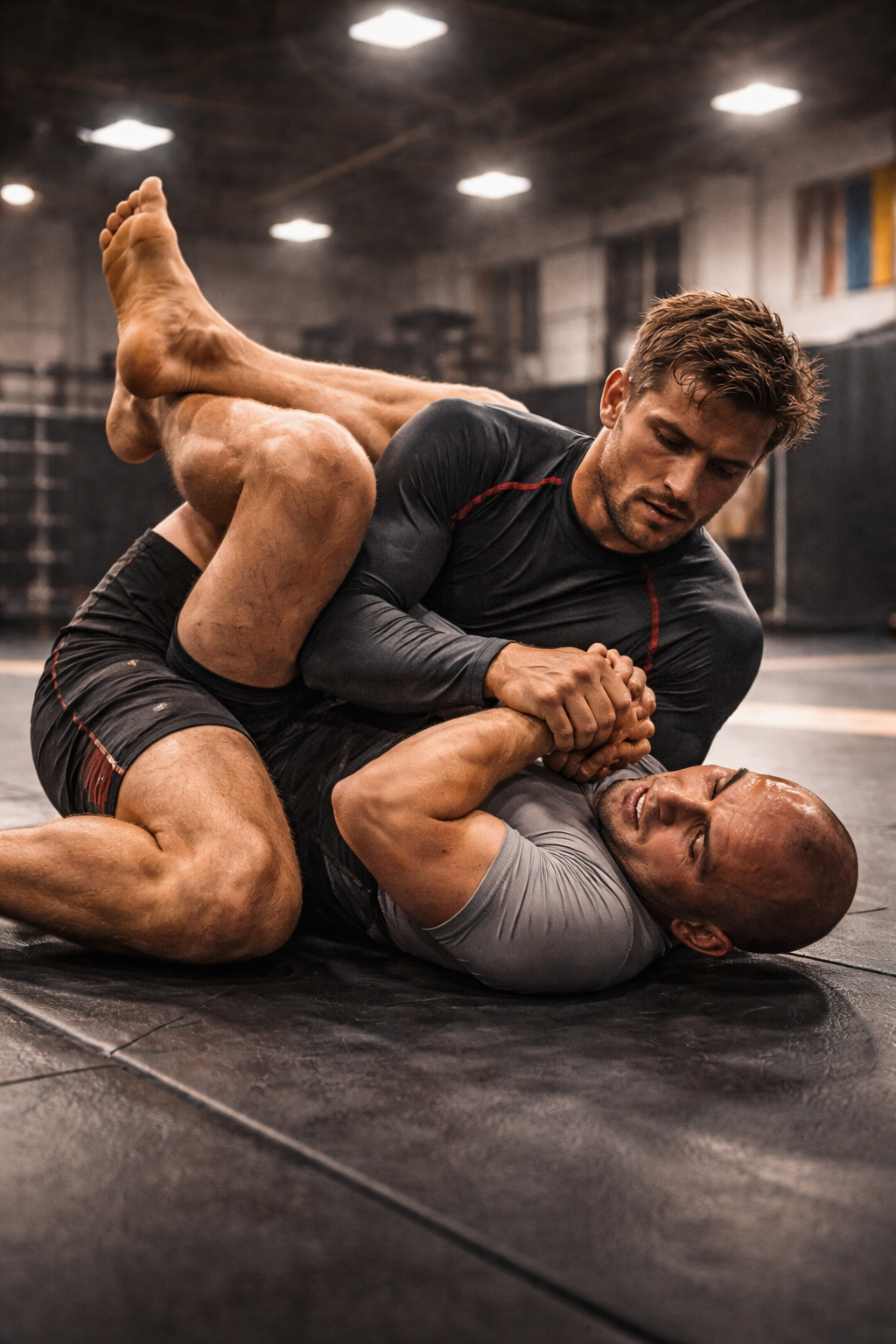
Submission Grappling
"There is no losing in jiu-jitsu. You either win or you learn." — Carlos Gracie
On the Ground
The Warrior does not have anyone roll with you today. He puts you on your back himself, sits on your chest, lays one hand flat on your sternum, and breathes.
"Get out."
You try. You push on him and he does not move. You turn and he turns with you. You bridge and he rides it. You grab at his hand, his wrist, his collar, and none of it changes anything, and somewhere around the thirtieth second you notice that you have stopped thinking and started thrashing, and that your breath is coming in short, wet pulls, and that the ceiling is very far away. He has not done anything. He is sitting on you, and breathing.
"Forty seconds," he says, when you finally go still. "That's about what a grown man has in him when he panics underneath. Then he's not fighting anymore. He's a man lying on the floor with another man on top of him, and the other man can do whatever he wants." He rolls off you and sits on the mat. "Every untrained fight ends there. Every trained one starts there. This is the floor, and the first thing the floor teaches is how not to drown on it."
This is the third range, the ground, where most fights that go past ten seconds end up whether anybody wanted them to or not. The takedown lands, or two men trip and tangle, or the floor is wet, and suddenly it is horizontal. The movies almost never go here. Reality goes here constantly, and it is the range untrained men understand least and fear most, because it is the range where all the things a strong man trusts, his speed, his reach, his power, are worth the least, and the things a trained man has built, position, leverage, patience, are worth the most. On the ground the smallest trained man in the building owns the biggest, and can end the fight without throwing a single damaging strike, and that is the whole reason this range is taught last on the mat. Once a man owns it, the fight has nowhere left to hide.
This page is the door to the floor, not the floor. The ground was learned three times over, in one city, by men who mostly hated each other, and each of the three arts has its own room. What this page does is tell you why the ground has to be trained and cannot be improvised, what a ground man is made of, what the floor under the three rooms is and why you work it alongside all of them, how the three rooms hand each other off, and why the range you are about to learn to own is not the last room on this mat.
Why the Ground Has to Be Trained
The untrained man has two instincts underneath another man, and both of them lose. The first is to freeze, to cover up and wait for it to be over, which hands the other man all night. The second is to thrash, which you just did, and which spends everything a man has in about forty seconds and leaves him lying still with a stranger on his chest. Neither instinct can be argued out of him. It has to be trained out, one uncomfortable round at a time, until being underneath stops feeling like drowning and starts feeling like an address he knows the way home from.
The second reason is arithmetic. Standing, a man who outweighs you by sixty pounds hits sixty pounds harder and closes distance faster than you can back up. On the ground, his sixty pounds are a thing he has to carry, and his speed is worth nothing, because there is nowhere to be fast to. What is left is who knows where to put his hips, who has frames and who has flailing arms, who is breathing and who is not. Every art on this floor was built by men who were smaller than the men they were fighting, and every one of them found the same thing: the ground is where the weaker man's leverage rules, if he has trained it, and where the stronger man's strength is a liability, if he has not.
The third reason is the one that matters most to a protector, and it is about mercy. The ground is the only range where a fight can be ended completely without hurting anyone. A choke does not care how tough a man is, how angry, how drunk, how large. It cuts the blood to his brain and he goes to sleep, and thirty seconds later he wakes up with a headache and a new opinion. A man held in a controlled position cannot hurt you and does not have to be hurt. The fist has no version of that. The blade has no version of that. Only the floor does, and a man whose whole reason for training is the people behind him should want the one range that lets a fight end with both men going home.
And the fourth reason is that the floor is honest in a way nothing standing is. A punch can be pulled. A takedown can be muscled. Underneath a trained man, there is no faking it. You get out or you do not, and everyone in the room can see which.
What Puts the Ground Man Underneath
The same handful of holes lose the ground, over and over, for untrained and half-trained men both.
Freezing. He gets put on his back and waits. The trained man on top of him has all night, and takes it.
Thrashing. He spends everything in the first forty seconds and has nothing left for the forty-first, which is when the fight actually starts being decided.
Chasing the finish. He sees an arm and dives at it from a position he does not own, misses, and loses the position along with the arm. The floor has one commandment and it was written in blood over seventy years: position first, and the finish only from a position that is already won.
Sitting down on pavement. He learned to fight from his back on a padded mat with a referee and a single opponent, and he does the same thing on concrete with the man's friends arriving. The guard is a recovery and a weapon, not a place to go first when shoes are on. The rooms below say it plainly and this page says it first.
Forgetting the punch. He trained ten years without anyone ever hitting him on the ground, and the first time somebody does, half his game turns out to have been built for a sport. Every position on the floor has to be asked one question: does this hold up when he can hit me?
Diving on the legs. He learned the modern leg game and now attacks a man's knees from anywhere, control or no control, and against a man who knows the counters he ends up underneath with a stranger's heel in his hands. The leg game is the sharpest weapon on the modern floor, and it is a weapon that cuts the hand that swings it wrong.
The jacket he cannot take off. He built ten years of grips on collars and sleeves and cannot hold a man who is not wearing any. The street does not issue uniforms.
What a Ground Man Is Made Of
Every coach on this floor, from the academy with the belts to the basement with the shorts to the gym on the wrong side of town, agrees on ten things about how a ground man is built, and they agree on the order.
Positions before techniques. Guard, mount, side control, back control, half guard, the knee on the belly. The positions are the map every submission and every escape lives on, and the seasoned man reads where he is before he decides what to do. A man who knows fifty moves and no map loses to a man who knows the map and ten.
Ten finishes, not fifty. The armbar, the rear naked choke, the triangle, the kimura, the guillotine, the americana, the straight ankle lock. A short catalog that works from most positions against most defenses, owned to the bone, before anything exotic is allowed in the door.
Transitions. The man who can flow from one position to the next controls the roll, and the man who can only hold one position gets stuck in it. Most of the actual fighting on the floor happens between the positions, not in them.
Leverage over strength. The smaller man who has built leverage submits the larger man who is relying on strength, and he does it by trusting the technique in exactly the moment the position feels physically impossible. Every time a man muscles a move he is paying strength for something the position would have given him free.
Escapes. The submission you can escape is the submission that does not finish you, and the bad position you can get out of is not a defeat. The trained escape from every major hold and every bad spot is the difference between a man who plays the ground and a man who survives it.
Drills, because the roll draws on them. Hip escapes, technical stand-ups, armbars from the guard, triangle setups, done a thousand times until they run without permission. The seasoned man drills as much as he rolls, and the roll is where the drilling shows.
Every kind of partner. The bigger man teaches you pressure. The smaller man teaches you precision. The different style teaches you to recognize patterns you have never seen. The man who rolls only with his favorite partner builds a narrow game, and the man who rolls with everyone builds a wide one.
Position held, then the finish. Submissions follow position. The man who establishes and keeps a dominant position has the time and the leverage to finish cleanly, and the man who attacks from a bad one usually loses both the attack and the spot.
Calm under the pressure. The moment a submission catches you is the moment to think clearly, and the untrained body does the opposite. Breath, composure, and a trained answer to the panic are built here on purpose, because the ground is where a man learns what his own fear feels like with somebody sitting on it.
A coach, and the men above you. The higher belts teach what years of mat time produce, and the brown belt at fifteen years is a different animal from the brown belt at five for one reason only: mat time with men who were better than him. That relationship compounds for decades.
The Floor Under the Rooms
Before you walk into any of the three rooms, understand that there is a floor under all of them, and it is not a room on the walk.
Grappling Modalities is the engine room: the concepts every ground man runs on whether he can name them or not, and whether he wears a jacket or shorts or nothing but trunks. The ladder of positions, worst to best, and the map of how a man climbs it, in Positions. The two families of finish, the chokes that cut blood or air and the locks that bend a joint past where it goes, in Submissions, with the modern leg game laid out in full. The hand fight that decides which techniques are even available, in Grips & Control Holds. And the thing that makes a trained man on top feel eighty pounds heavier than the scale says, in Weight Application. None of that belongs to one art. All three rooms stand on it, and the man who learns it in one room finds he already half-understands the other two.
You do not walk through the engine room and leave. You work it alongside every room on this floor, for as long as you train. The rooms teach you an art. The floor under them teaches you the ground.
The Three Rooms on the Ground
Three arts, walked in order, and the order is how the ground was actually learned, in one city, over a hundred years.
Brazilian Jiu Jitsu — the family business. The most developed ground game on earth, and the foundation. A ladder of positions from the worst spot to the best, a submission from everywhere, the grip fighting the jacket teaches, and a belt road that takes a decade and changes a man on the way. It came off a boat in Brazil in the hands of a Japanese count, was rebuilt by a frail brother who could not muscle anything and so had to find what worked without muscle, and was proven in a chain-link cage in Denver in front of the whole martial arts world. Off its hall are seven rooms: the fundamentals in order, the position that turned losing upside down, the honesty ritual of the tap, the ten-year road, the philosophy, the fork between the sport and the street, and what happened to fighting after Denver.
No-Gi Jiu Jitsu — the jacket comes off. The same machine with the uniform stripped away, and stripping it changes more than the dress code. No collar to choke with, no sleeve to trap, everything faster and slicker with sweat, and the leg game the jacket rules had locked away thrown wide open. Then the wrestlers came, and the cage came, and the art the gi academies dabbled in on Fridays filled two arenas in Las Vegas on the same weekend and had a civil war over the money. Hear this plainly, because the room will remind you the parent said it: of the three roots on this floor, this one is the closest to the fight you pray never finds you, because nobody on the pavement is wearing a gi.
Catch Wrestling — the art that never had a jacket. The oldest submission wrestling in the West, out of the mining towns of Lancashire and the county fairs of the American Midwest, where a man won by pin or by making the other man quit and every hold that did it was legal until somebody said otherwise. It had no uniform, no belts, no points for a position, and for most of its life no rulebook anyone agreed on, and every jacketless art on earth was built from it. It fathered the Brazilian rival of the family in Rio, it crossed to Japan and came back as the honest half of professional wrestling, and it hunted the family in Denver from the other side of the world and won. Beneath it hang three rooms that are its bloodline, told in order: the ancient art at Olympia it descends from, the Brazilian art it fathered on the wrong side of Rio, and the Japanese art that put its honesty back into a ring and handed the last room on this mat its two most important words.
Look at where the three rooms sit, because the floor slopes the same way every ground on this Farm does, downhill toward harder men. The first room is an academy in a good neighborhood with a uniform and a belt system and a decade-long road that anyone may start. The second is a basement and a pair of shorts and a sport that will hand a man a heel hook before he has learned to sit down. The third is a carnival tent where a man took on all comers for money and broke what he caught, and beneath it a beach in Rio with a slap in the face, and a ring in Tokyo where the fights were real and the crowd had to be told. The door is open to any man. The back rooms are not.
The Three Pillars on the Ground
TRUTH on the floor is the tap, and the room off the first door will teach you its two laws in full. What the parent adds is the third thing about it, the one nobody says out loud. The tap is the only measurement in the whole Dojo that the man being measured takes himself. Nobody scores it. Nobody can see whether you tapped a half-second early to save your pride or a half-second late to save your ego, and both of those are lies, and both of them are recorded somewhere. Learn to tap exactly when the hold is finished and not before and not after, and you have learned to tell the truth about your own body under pressure, which is rarer than it sounds. And tell yourself the truth about the tap: the man who never taps in his own gym is either the best man in it or the man everyone is being kind to, and he should find out which.
LOVE is what the ground was built for, and it shows in who built it. A frail brother who could not muscle a takedown. Boys from the favelas who could not afford a jacket. Wrestlers whose sport ended at graduation with nowhere to go. The floor is strength engineered for the man the fight picks on, and its finishing logic is shaped like mercy: control completely, end it, and walk both men home. The partner who lends you his body three nights a week so that you can learn is doing you a faithfulness the world's flatterers never will, and the care you take of his joints is the first love this floor asks of you.
LAW here is the sharpest on the mat, because the floor's weapons work in silence and finish in seconds. The choke that is held two seconds too long, the heel hook applied by a man who has not been taught to feel the knee, the roll that turns into a fight because somebody's pride got involved. The room runs on iron discipline or it stops making men and starts breaking them. And the law follows you off the mat: the choke that puts a man to sleep and the control that holds him for the police answer to the courts in a way a torn-apart knee may not, and the trained man uses no more than right requires.
"He reached down from on high and took hold of me; he drew me out of deep waters. He rescued me from my powerful enemy, from my foes, who were too strong for me." — Psalm 18:16-17
Every man who has trained the ground knows the first half of that from the inside: the deep water, the foe too strong for him, the drowning. He has spent years learning to get himself out. It is worth knowing, going in, that the man who wrote it was a fighter who could get himself out of most things, and he is not describing his own escape. Somebody reached down and took hold. The floor will teach you to survive underneath a stronger man. It will not teach you what David knew about who finally pulls a man out, and it is not supposed to.
Walked as a System
The three rooms are one floor, and the order is the teaching. The jacket first, because the gi is the best teacher of grips, patience, and control the ground has ever had, and a man who learns to hold a collar and a sleeve learns what holding is. The jacket off second, because everything the gi taught has to survive the day there is nothing to hold but the man, and because that is the day the street will hand you. The other side of town last, because it is the art that was doing all of this without a jacket before the jacket world admitted the jacket was a crutch, and because its feud is the whole lesson of the floor in one story: rivals are a gift and contempt is a poison, and the leg game the proud men sneered at was true the whole time.
Everything from the two ranges above comes down here. The composure that let you be hit is what lets you be flattened without your mind leaving the room. The grips you fought for in the clinch are the grips that control an arm long enough to break it. The base you built is what keeps you calm underneath a bigger man. Nor does the floor keep what it makes. The control goes across the yard to the Armory, where the man on top of you wants your pistol and the mount is the only reason he does not have it. The finishing game goes up the hill to the cage, where the ground is where most fights are actually decided. And the honesty of the tap goes with you everywhere, because a man who has been honestly beaten three nights a week for ten years is very hard to flatter.
After the Ground
Before you go find the first room, hear the one thing the Warrior wants you to know about this floor before you fall in love with it. The men who teach you here are going to know you, and a man who knows you helps you.
Your coach will feed you the finish. Not to lie to you, to grow you, the way a man teaching his son to drive lets him take the turn a little wide before he says a word. Your partners will roll with you at the pace you can survive. The room will slap your back for showing up, and your rank will come from a man whose own name is on your promotion and who has watched you for years. All of that is right. It is how the ground is learned. And all of it means that by the time you have walked the three rooms on this floor and worked the engine room under them, you will own a ground game that has been tested, honestly and often, by men who were on your side.
That is why this is not the last room on the mat. There is one more, and no art is taught in it. It takes everything you built on the feet, in the clinch, and on this floor, and carries it somewhere nobody knows your name and nobody is feeding you anything, and finds out whether any of it was real. The floor is where you learn to finish a fight. The last room is where you find out whether you can.