
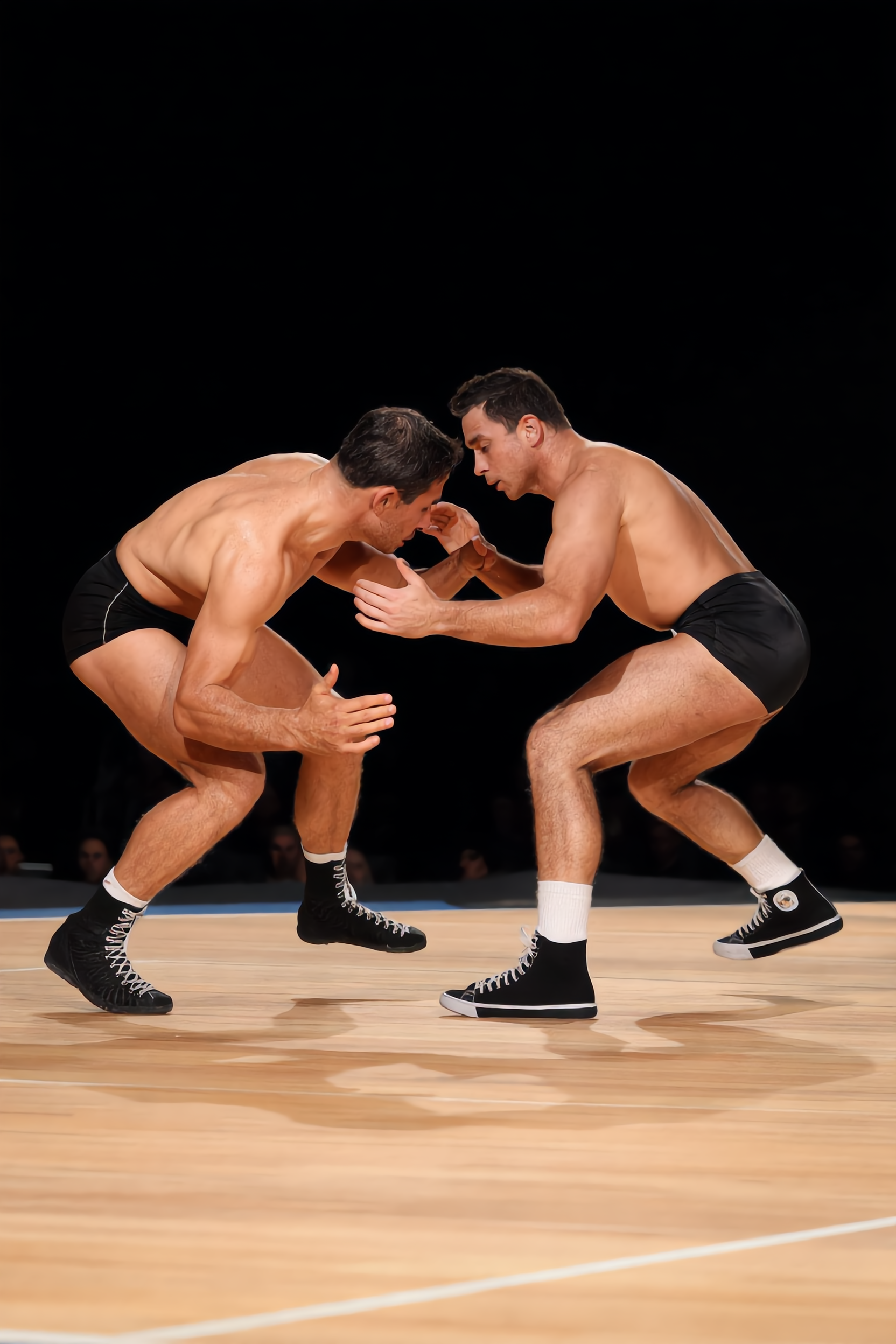
Luta Livre
"This rivalry makes no sense." — Roberto Leitão, engineer and luta livre master, on the sixty-year war he spent his life inside
The Fight on the Sand
Rio de Janeiro, 1988. A crowded beach on a hot afternoon, vendors and families and the whole city out by the water. A muscled man walks across the sand toward a kiosk where another fighter is standing with his friends, and without a word he slaps him across the face. In Brazil's fighting culture the slap has one meaning: right here, right now. The crowd pulls into a circle. No mat, no rules, no referee, no shirts, two of the best-trained men in the country barefoot in the sand, settling a war their teachers started before either of them was born.
The man who threw the slap was Rickson Gracie, the finest fighter the most famous fighting family on earth ever produced. The man who took it, and fought him then and there in front of half the beach, was Hugo Duarte, a master of the art this room is about: luta livre, the other Brazilian grappling, the one built on the wrong side of town out of the tent above this room, and the one that never learned to back down from anyone.
This is the first branch the tent grew, and the room is history and information, told once, with no Three Pillars block, because the reader carries the pillars in from the tent. It holds the art's founding, the men who kept its line, the feud with the family across town in all its set pieces, the man on the sand and why the art chose him, the cage that ended the argument, the lesson under the whole story, and where the art is kept this year.
The Other Side of Town
In the 1920s and 1930s, while the Gracie family was building jiu-jitsu from the judo a Japanese count had carried to Brazil, another system was taking shape across Rio. Its father was a stocky, quiet grappler named Euclydes Hatem, born in 1914 and nicknamed Tatu, the Armadillo. His raw material was the art in the room above this one, catch wrestling, which had reached Brazil through the traveling wrestlers of the 1920s, and he did with it what every honest builder does: tested everything, kept what worked, added the judo he could find, and bolted on whatever Brazil's fighting streets could teach him. He called the result luta livre, free fighting. In 1940 he made the whole city pay attention by beating George Gracie, one of the famous brothers, with the family's name on the line, and by winning a championship belt that the city's governor put his own name on.
Now mark the difference that defined everything after, because it was never really about technique. It was about money. Jiu-jitsu lived in private academies in Rio's wealthy neighborhoods, a uniformed art with monthly fees, taught to doctors' sons. Luta livre needed nothing. No jacket, no dues, no fine address. You trained in trunks, on whatever floor existed, and the boys who came were the boys who had nothing else: the hillsides, the beaches, the hard end of every street. The art trained without the jacket partly as philosophy and partly because its students could not afford one. One art wore fine clothes. The other came as it was. The Bible names exactly this error, the assembly that seats the man in fine apparel up front and tells the poor man to stand in the back (James 2:2-4), and Rio's fighting world ran that error for sixty years, and it bred a grudge with class in its bones.
The Line
Tatu died in 1984, and the art survived him because three men kept the line.
Fausto Brunocilla was the Armadillo's principal student, and he and his son Carlos ran the art through the 1970s, graduating most of the masters who carry it now, and the man on the sand at the top of this page came up under Fausto. Roberto Leitão, born in 1937 and dead in 2020, was the other pillar, and he was the strangest master any fighting art ever had: a university engineer who trained the art as a science, wrote down ten principles of grappling that are still taught in luta livre rooms on three continents, and trained the men who would carry the art into the cage, among them the one who would win the biggest tournament in America two years after the family did. Leitão said late in his life the thing at the top of this page. The feud made no sense to him. He was the art's engineer and he had spent his life inside a war he thought was stupid, and he was right, and it took a generation raised in the cage to agree with him.
Santana, and the Crack in the Myth
The feud's first earthquake came in 1955, and it came from inside the family's own house.
Waldemar Santana was a powerfully built young man from a poor family who spent years inside the Gracie academy as student, employee, part of the household. Then a falling-out, and the family cast him out, and Santana challenged the master himself. Helio Gracie, then in his forties, met his former student in a fight with no rules, and the two men fought for nearly four hours, the longest fight anyone could remember. The aging master refused to quit, and quitting was never Santana's idea either. Just short of the four-hour mark, Santana knocked Helio out.
Brazil shook. The invincible name had been beaten by a poor man, a discarded student, exactly the kind of fighter the other side of town claimed as its own, and the other side of town celebrated him like a flag. The family sent its young lion to answer for the house, and the wars that followed restored the family's honor, but the crack never fully closed. Every luta livre fighter for two generations walked into the gym knowing 1955. They can be beaten. One of ours proved it.
The Bad Boys
Out of that soil grew the most notorious rivalry in martial arts, and luta livre embraced its role without apology: the villains, the bad boys, the art with no uniform and nothing to lose.
This is where dojo storming enters the story. The challenge culture was always there; the family had built its name on open challenges. But in the 1980s the feud escalated past letters into something older: men from one camp walking through the doors of the other camp's academy, in numbers, demanding fights on the spot. Luta livre crews stormed jiu-jitsu academies. Jiu-jitsu men answered in kind. Champions were slapped at parties and called out on television. The beach fight at the top of this page was one battle, and it did not end on the sand: after Rickson won, Duarte gathered his men and stormed the Gracie academy itself to demand a rematch, and got it, and lost that one too, and never stopped coming.
Two set pieces a man should know. In 1991 the feud went legitimate for a night: a formal challenge, jiu-jitsu against luta livre, three matches on Brazilian television, with the family's side carried by three men who would all become world-known black belts against the other house's best, and jiu-jitsu swept it, three to nothing, a hard public defeat the no-jacket camp had to swallow. Then, in 1997, the disgrace that shamed both houses: Renzo Gracie against Eugenio Tadeu in a caged no-rules match with both camps packed into the arena, and the crowds did not stay in their seats. Fans climbed the fence, the lights were smashed, a riot swallowed the event, shots were fired, and Brazilian television and the city's authorities responded by effectively banishing no-rules fighting from the country. The feud had grown so hot it nearly burned down the sport that fed both families.
The Man on the Sand
Come back to the man who took the slap, because Hugo Duarte holds this room for a reason, and the reason is not that he beat Rickson Gracie. He did not. He lost on the beach and he lost the rematch he stormed an academy to get. Pay attention to why an art chooses a man like that as its standard anyway.
Duarte came up through the true line, under Fausto Brunocilla, and he carried the art's whole character in one body: the poor man's pride, the refusal to be disrespected, the conviction that a fight does not require a mat or a uniform or an appointment. Slapped in front of half of Rio, he did not talk, did not lawyer, did not leave. He fought the best fighter of his generation barefoot in the sand, took his beating, got up, and came looking for more. He fought in the earliest Brazilian shows of the American cage promotion, ran academies that pulled hard kids off hard streets, and grew into something his twenty-year-old self would not have predicted: the grand old man of luta livre, an eighth-degree master called the General, teaching the art around the world and honored, at last, by the grappling community on both sides of the old war, telling the feud's whole story to the next generation without bitterness.
That is the philosophy he hands you, and it is the art's. Courage is not the absence of better options. It is showing up outmatched and unashamed of where you come from. The fight happens where you are standing, so train for that. And losses do not dissolve a man who knows who he is. Duarte lost the most famous fight of his life in front of his whole city, and it made him, because he answered it the way the art answers everything: get up, and keep coming.
When the Cage Ended the Argument
Then came the 1990s, and the cage settled what sixty years of street fights could not.
When the American promotion launched in 1993 and the family's champion choked his way through the bracket, jiu-jitsu took the world's attention. But watch two years later: at the seventh tournament, in the autumn of 1995, the luta livre side sent Marco Ruas, the King of the Streets, one of Leitão's men, and he won the whole thing, chopping down a man a hundred pounds heavier with kicks to the thigh and finishing him on the ground. Ruas showed the world what neither pure art had admitted: the complete fighter strikes and wrestles and submits. Luta livre men carried the banner into the Japanese rings the room after this one is about, and one of them, a small submission fighter from the art's own line, held a world title there for years. And inside the new sport the old feud quietly lost its point, because in the cage every man needed everything. The jiu-jitsu fighter had to learn takedowns and punches. The luta livre fighter had to learn the guard. The two brothers' arts bled into each other inside fight gyms until the border between them ran through the middle of every fighter alive.
The final vindication was almost funny. For decades, jiu-jitsu culture had sneered at luta livre's beloved leg attacks: going for the feet was for sapateiros, shoemakers, men without the refinement for the real game. Then the modern no-gi revolution arrived, rebuilt the leg game into the sharpest weapon in grappling, and the whole sport rushed to learn what the shoemakers had been drilling since the 1930s, and what the tent above this room had been doing to farmhands since 1905. Today's no-gi grappling is, whether its students know it or not, the two siblings merged: jiu-jitsu's positional ladder wearing luta livre's clothes and hunting luta livre's legs.
Two Houses, One Lesson
Step back from the sand and the riots, because Scripture has been telling this story since Genesis: brothers at war. Cain and Abel, Jacob and Esau, Joseph and the ten who sold him. The Bible's first and bloodiest fights are sibling fights, and they burn hottest because brothers share a house, a craft, a father's inheritance, and every wound is personal.
Luta livre and jiu-jitsu were brothers fighting over an inheritance: the same city, the same students, the same truth about leverage and the ground. And see what the feud produced. The contempt, fine clothes looking down on no clothes, was plainly the favoritism James condemns, and the riot of 1997 showed where unkilled grudges go: both houses shamed, the sport nearly destroyed, everyone a loser. But the rivalry, the honest pressure of a brother who tests everything you do, sharpened both arts past what either would have become alone. The sin was never the sharpening. It was the hate that rode along with it, and it took a generation humbled in the cage to keep the iron and drop the hatred. Hold that for the rest of your life, everywhere men compete. Rivals are a gift. Contempt is a poison. And the strongest man in the story is the one who lost on the sand in front of his whole city and ended up, decades later, at peace with the other house and honored by it.
Where the Art Is Kept, This Year
For a documentary crew, or a man who wants to train the branch rather than read about it, as of the autumn of 2026.
Rio, where the General's own academy carries the true line, and where the art's federation grades its belts. Germany, which is the strangest fact about luta livre and the most important: the largest community of the art outside Brazil is German, seeded by Brazilian masters in the 1990s, and the international championship the German federation runs held its eleventh edition in 2025 and draws the art's competitors from across Europe. The United States, where a handful of rooms carry it, several of them the same rooms that carry catch wrestling, and where in 2025 the General taught seminars in rooms whose sign says catch on one side and luta livre on the other, the branch and the root training together in the same hour, which closes a loop that opened in a Rio gym a hundred years ago. And Japan, where the art's fighters made their names in the rings of the next room and where the line's memory is kept.
The Farm has not stood in the German rooms or the American ones and names none of them. It names where to look.
Where This Sits
Second of three beneath the tent, and the branch that fought its own brother. A man leaves it knowing the Armadillo and his line, the sixty-year war in all its set pieces, the man on the sand and why the art chose a loser as its standard, and the cage that ended the argument. The next room is the other branch, on the other side of the world: what the god of wrestling's students built in Japan when they wanted the shoot back, the promotion that ran the first fully real fights two months before Denver, and the small man in a mask who beat four members of the family with holds from the tent.