
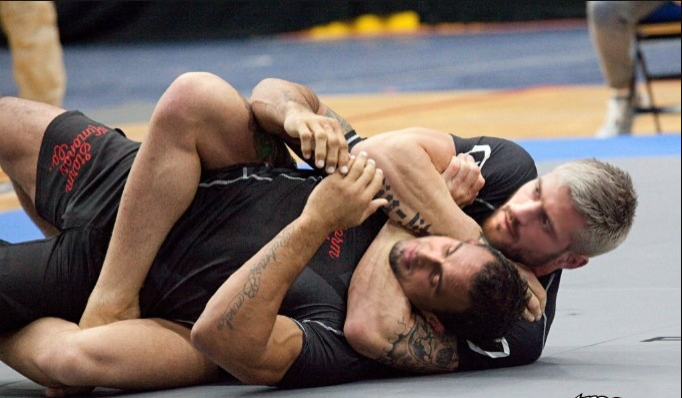
No-Gi Jiu Jitsu
Grappling Fundamentals
Old School Grappling
Modern Grappling
"If you're studying my game, you're entering my game." — Marcelo Garcia
Two Arenas, One Weekend
The Warrior was in Las Vegas in August of 2024, and he tells it standing on the mat behind the barn with his arms folded.
On the Saturday he was in the arena where the heavyweight boxing champions are crowned, and it was full, thousands of people in the seats for the world championship of grappling, an event a sheikh founded in the desert in 1998 and has held every two years since, the heaviest prize in the sport. On the Sunday he drove twenty minutes across town to a university arena that was also full, for an event a lanky Australian leg-locker had invented out of spite and scheduled on the same weekend on purpose, paying every athlete just to show up, streaming it free to the world, and handing a million dollars to each of his two bracket winners as a public protest at how little the sport's crown paid the men who bled for it.
"Two buildings," the Warrior says. "One weekend. Both sold out. And in neither one did I see a single jacket." He unfolds his arms. "Twenty-five years before that weekend this sport barely existed. It was the thing the jiu-jitsu academies did on Fridays when they didn't feel like washing a gi. And there it was filling two arenas at once and having a civil war over the money. Sit down. This is the room where the jacket comes off, and you should know how it got that big that fast, because you're going to train it."
This is the second room on the ground, and it is the first room's machine with the uniform stripped away. The jacket art you just walked taught the ground in a heavy cotton coat, and the coat taught grips, patience, and control the way nothing else can. This room takes it off, and taking it off changes more than the dress code. It tells you what changes and why, where the sport came from and who made it, the two crowns it fights over, the quiet man everyone in it bows to, and the three rooms beneath it that hold the grips, the era before the leg game, and the sport as it stands this year.
The Game With the Jacket Off
You walked the jacket hall, so you know the machine: the ladder of positions, position before submission, leverage over strength. No-gi is the same machine with the uniform gone, and the uniform turns out to have been doing more than anyone admitted.
The gi is a handle factory. Collars to choke with, sleeves to trap, lapels to weave, a whole game built on gripping cloth. Take it away and every one of those handles disappears, and what is left is the body itself: wrist control, head control, the underhook and the overhook, the two-on-one, the seatbelt on the back. Nothing to hold but the man, and the man is covered in sweat. So everything speeds up. A position the gi's friction would hold for half a minute lasts three seconds. The slow, crushing chess of the jacket becomes a scramble, fast and slippery and constantly resetting, and the grappler who waits for a position to stabilize learns that no-gi positions do not stabilize. He takes the position in the second it exists, or he watches it go. The first room beneath this one is the first class without the cloth, and it teaches every one of those holds by name.
Two more doors swing open when the jacket comes off. The first is the leg game. The heel hooks and leg entanglements that the jacket rulesets spent decades forbidding are legal and central here, and the modern era rebuilt them into the sharpest finishing weapon in grappling, a story the third room beneath this one tells with dates. The second is honesty about the street. A real scramble on real pavement runs on body grips and sweat, not collar and sleeve, and the parent of this floor told you straight: of the three rooms on the ground, this one is the closest to the fight you pray never finds you.
And before you ask: no, this is not the room at the end of the floor. There is an older art that never had a jacket to take off, and it has the third room on the ground, and its Brazilian branch, the poor man's art from the wrong side of Rio that fought the family across town for sixty years, hangs beneath it. That war ended in a merger. Modern no-gi is the jacket's positional ladder wearing the rival's clothes and hunting the rival's legs. But the merger then grew a third bloodline that neither Brazilian house supplied, and it walked in wearing a singlet.
The Wrestlers Came
Here is what actually made no-gi boom, and it did not come from Brazil. It came from American wrestling rooms and from the cage.
Be precise about which wrestling, because the word has been stolen twice. Not the scripted television product. That is stunt theater, and the tent at the end of this floor has a whole history to tell about how the real thing hid inside it. The wrestling that feeds no-gi is the wrestling of the clinch range you already walked: the folkstyle grind of high school and college rooms, the freestyle and Greco of the Olympic mat, where a boy gives his whole youth to takedowns and top pressure and learns to hate being on his back. That sport produces, every year, thousands of hard, conditioned, mat-wise men whose competitive careers end at graduation with nowhere to go.
No-gi gave them somewhere. A wrestler looks at the jacket game and sees a foreign country: coats, collars, a decade of belts. He looks at no-gi and sees home, the same shorts, the same ties and underhooks, the same scramble, with finishes bolted on. The crossover was so natural it became a pipeline. A college wrestler with about eighteen months of grappling walked into the sheikh's tournament in 2019 and took silver in the heavyweight bracket. College standouts now appear on grappling cards as a career move. The sheikh's own rulebook, which scores takedowns and punishes pulling guard, was practically engraved with an invitation to wrestlers, and they accepted it, and the second room beneath this one is the era they built.
The cage did the rest. The modern cage's ground game is no-gi, because nobody fights in a coat, so every fighter, every fight camp, and every fan the cage ever made became a customer of this sport. Between the wrestlers flooding in from one side and the cage pulling from the other, no-gi stopped being a variant the jacket academies dabbled in on Fridays and became a sport with its own athletes, its own fans, and, as Vegas proved, its own money.
The Basement
Every revolution has a garage. The family had Torrance. No-gi had a basement in Manhattan, and before the basement, a heretic with a triangle choke.
In 2003, at the sheikh's tournament, a little-known brown belt named Eddie Bravo submitted Royler Gracie, a multiple-time world champion and royalty of the jacket, with a triangle, in shorts. The grappling world lost its mind. Bravo took the moment and built a school on a then-scandalous premise: no jacket in the building, ever. A rubber guard, a spinal lock called the twister, a whole homegrown vocabulary, and the first famous academy to treat no-gi not as cross-training but as the art itself.
Then the basement. Beneath a famous academy in New York, a former philosophy student turned coach named John Danaher, a man who has never been a world champion and rarely takes off his rash guard, quietly built the most feared training room of the modern era. His obsession was the half of the body the sport had sneered at for decades: the legs. The jacket world had dismissed leg attacks as a shoemaker's tricks, an insult the room beneath the tent tells in full. Danaher systematized them: entries, controls, breaking mechanics, an entire curriculum for territory the art had been ignoring. His squad came up through Bravo's submission-only invitational, heel-hooking respected black belts out of the building in ways the sport had no answer for, and within a few years the leg lock went from peasant's trick to the center of the entire sport, and a grappler without leg-lock fluency went from purist to target.
The squad split and moved to Austin, the coach and his champion founding one academy and the Australian leg-locker and the younger men founding another a few minutes away, and Texas became the capital of a sport that had been born in a New York basement and a Los Angeles heresy. What that answer did to everyone else, and what the sport looks like this year because of it, is the third room beneath this one.
Two Crowns
Which brings you to the feud, because this art, like its parents, has a sibling rivalry of its own. No slaps on the beach this time. This one is fought over rulebooks, paychecks, and the question of what a champion even is.
On one side stands the jacket federation's world champion, the traditional crown. Gi on, points scored for every position earned, medals at stake, the sport's oldest and deepest bracket, the lineage of the family's grandson and the great heavyweights measured across a decade of brutal divisions. The catch: the medal comes with almost nothing in it. For most of its history the federation paid no prize money at all, the world champion paid his own registration fee for the privilege, and the points game at the highest level can reward the man who wins a position and holds it to the horn.
On the other side stands the superfight champion, the new crown. Submission-only formats with no points to stall on, an overtime shootout, five-man team wars, invitational cards with real purses and built personalities, and a simple creed: a grappling match should end with somebody tapping. This is the world that made the most dominant no-gi grappler who has ever lived, a man who held no jacket world title and never needed one, and whose whole ledger, including the February he walked away, is in the third room.
The two camps talk about each other exactly the way you would expect. The superfight men say points jiu-jitsu is stalling in pajamas. The federation men say submission-only breeds positionless guard-sitting and reckless leg-diving that would get a man crushed under real rules. And here is the honest read this Farm owes you: both accusations are partly true. Points without submissions drift toward safety. Submissions without positions drift toward chaos. The complete grappler trains the discipline of position and the courage to finish and lets the two correct each other, and there are men with jacket world titles and superfight gold both who prove it can be done. The rivalry, like the sixty-year war that birthed the Brazilian half of this art, sharpens everyone who refuses to pick a tribe and stop thinking.
And read the direction of the whole sport with both eyes open, the way this Farm reads everything. The money is overdue. Men who give their bodies to an art deserve to eat from it, and the Australian's million-dollar protest said out loud what a generation of broke world champions only muttered. But big lights carry a temptation this sport's older cousin already fell to, and the tent at the end of the floor will tell you how completely. When the paycheck depends on entertainment, the pressure to perform a fight instead of having one never stops knocking. The thing that makes every room on this floor trustworthy is that nothing in it is arranged. The day grappling trades the honest tap for a good show, it stops belonging on this mat.
The Quiet Man in the Loud Era
Now meet the man who holds this room, and notice who he is not. Not the loudest champion, not the richest promoter, not the king of the trash talk that the superfight era runs on for marketing. Marcelo Garcia is a round-faced Brazilian, well under two hundred pounds, whom many of the loudest men in the sport will tell you, without being asked, is the greatest submission grappler they ever shared a mat with, and the best man they met there.
His record carries the argument. Champion at the sheikh's tournament four times over, world champion in the jacket as well, famous above all for walking into open-weight brackets and submitting men sixty, eighty, a hundred pounds heavier: the frail brother's miracle from the jacket hall, replayed in shorts against giants. But his record is the smaller half of him. While his rivals guarded their innovations like trade secrets, Marcelo filmed his own training, losses and failures and experiments included, and published it for anyone to study. Asked why he would arm his own future opponents, he gave the answer at the top of this page. If you are studying my game, you are entering my game. That is not bravado. That is a man so given to the truth of his craft that he would rather raise the whole sport's level than protect his edge, the open-handed opposite of everything the hype machine teaches.
Then the ledger, in both columns, the way this Farm keeps every man's. In 2023, retired and beloved, he was diagnosed with stomach cancer. He fought it the way he rolled, calm and methodical, surrounded by the army of grapplers his generosity had made, and in January 2025 he walked back onto a competition mat in Bangkok, a man in his forties with a rebuilt stomach, and won by submission, a choke from north-south on a Japanese leg-locker older than himself. Eleven months later, in the same building, an Australian leg-locker a generation younger rolled through to a kneebar in the seventh minute, and Marcelo tapped, at forty-two, and got up and embraced him. The art he had given away had come back for him, and he had taught it to. Both nights belong to him.
Both camps in the sport's cold war claim him. Neither will hear a word against him. In an era whose business model is the loud mouth, the man everyone bows to is the humble one. Mark that. It is the oldest pattern there is.
Three Rooms Off This One
The story above is the sport from the outside. Three rooms hang beneath this one and tell it from the inside, in order, and none of them is the next step on the floor.
Grappling Fundamentals — what a man holds when there is no cloth. The first no-gi class from inside: the ties and the hooks and the seatbelt, the pace that never settles, the guards that survive without a sleeve, passing without pants to hold, and the leg entanglement the new man is shown and not yet allowed.
Old School Grappling — the sport before the leg game. The sheikh's rulebook and the era it made: the wrestlers who came for the points, the jacket men who crossed over, the near-guard game that ruled the middle years, and the one man who kept asking why everyone ignored half the body.
Modern Grappling — the sport as it stands this year. The answer to his question, the champion who retired in February, the pace the twins brought, the money and the leagues, the women by name, the old man tapping in Bangkok, and the bracket on the barn wall. The most perishable page on the Farm, rewritten as the sport moves.
The Three Pillars With the Gi Off
TRUTH — No-gi is the ground game's lie detector turned all the way up. No cloth to hide a weak grip behind, no friction to disguise a position a man does not really hold, and in the submission-only formats no points to dress up ten minutes of nothing. You hold the man or you do not. You finished or you did not. Train in that honesty, and carry the sport's own lesson about the legs with you everywhere: the technique everyone sneered at was true the whole time, and contempt is not an argument.
LOVE — Look at who this art keeps receiving. The wrestler whose sport ended at graduation. The fighter building a ground game. The smaller man giving up sixty pounds in an open bracket. And look at its best man, giving his whole game away free so the next generation could climb faster. The capacity a man builds here is for the people behind him, and the man who shares his strength multiplies it.
LAW — The faster game carries the sharper edge. A heel hook destroys a knee in the time it takes to flinch, so the no-gi room runs on iron discipline: controlled application, the tap honored instantly, leg attacks brought up under supervision and by belt, the roll kept a roll. And if it ever goes to the street, remember the proportion this Kingdom teaches: the choke that puts a man to sleep and the control that holds him for help answer to the courts in ways a torn-apart knee may not. Trained hands stay sheathed until it is right, and then use no more than right requires.
Walked as a System
Three rooms and one hall. The first room beneath this one puts the ties in a man's hands, the second tells him the era that built the positions, and the third tells him the sport he is walking into by name and by date. And the hall sits second on the floor because it is the honest middle of the ground. The jacket taught a man what holding is. This room takes the cloth away and finds out how much of his year was the jacket's, and the wrestler he walked past in the clinch range turns out to already know half of what he is learning.
What the room makes goes everywhere. Up the hill to the cage, where the ground game is this game and no other. Across the yard to the Armory, where the man on top of him wants his pistol and there is no lapel to hold him with. And down the floor to the tent, where the leg game he thinks is new was old before his grandfather was born.
After This Room
Take the jacket off and you are still rolling the family's tradition: their ladder, their positions, their history, in shorts. You have taken the uniform off an art. You have not yet met an art that never owned one.
There is one on this floor, and it has the last room on the ground. It came out of the mining towns of the north of England and the county fairs of the American Midwest, and a man won in it by pin or by making the other man quit, and every hold that did it was legal until somebody said otherwise. It never scored a position. It never handed out a belt. Its men were called hookers, for the holds they had by the hundred, and they did to farmhands in a canvas tent, for a dollar a fall, what the basement in New York did to world champions and called a revolution. The Brazilian rival of the family was built from it. The Japanese ring that put the honesty back into a fake sport was built from it. And it is the reader's own country's art, which he has never heard of, and he is about to find out why.