
Brazilian Jiu Jitsu
BJJ 101
Positions & Transitions
Submissions & Escapes
BJJ Fighting Styles
"True strength is not always shown through victory. Stand up, try again and display strength of heart." — Rickson Gracie
The Family Business
Denver, Colorado. November 12, 1993. Eight fighters from eight different arts have been put inside a chain-link cage to answer the oldest question men ask about fighting: which way actually works? There is a six-hundred-pound sumo wrestler in the building, a heavyweight kickboxer from Holland, a shootfighter built like a bank vault. And there is a quiet Brazilian named Royce Gracie, six feet tall and about a hundred and seventy-six pounds, the smallest man in the tournament, walking to the cage in what looks like white pajamas, with a single-file train of brothers and cousins behind him, each with his hands on the shoulders of the man in front.
By the end of the night the skinny man in the jacket has beaten three larger men in a row without throwing a single hard punch, and the martial arts world has been turned over so completely that it never turns back.
None of it was an accident. The tournament was built by his family, as the last move in a plan three generations long. To understand how the smallest man got there, and why his family was certain he would win, you have to go back eighty years, to a port city at the mouth of the Amazon, and meet a Japanese count coming off a boat.
The Warrior tells you that story himself, standing on the mat behind the barn, because this is the first room on the floor and the one that has an academy in your town. Every other art on this ground you will have to go looking for. This one has a sign on the highway.
The Count Who Came Off the Boat
His name was Mitsuyo Maeda, and they called him Conde Koma, Count Koma. He was one of the hardest men the Kodokan ever produced, the Tokyo school of the founder you met in the Judo room, and the founder sent his best men out into the world to prove the art. Maeda took the errand further than anyone. Years across Europe and the Americas, taking on boxers, wrestlers, and street challengers in hundreds of fights, said to have lost almost none of them. Decades before anyone said the words mixed martial arts, Maeda was living them, a one-man test of what held up when the rules ran out.
Around the time of the First World War he settled in Belém, Brazil, where a businessman of Scottish descent named Gastão Gracie helped him get established. Maeda had no money to repay the kindness. He had something better. He took Gastão's teenage son Carlos Gracie as a student and poured into him the fighting knowledge of two hemispheres.
Carlos took to it like a calling. In 1925 he opened the family's first academy in Rio de Janeiro, pulled his brothers in, and hung the family's whole reputation on a standing offer that became famous as the Gracie Challenge: anyone, from any art, any size, was invited to come and test the family's jiu-jitsu for real. It was outrageous. It was also the same plain principle Maeda lived by and the Kodokan was built on. Do not tell people your art works. Show them.
The Frail Brother
Now meet the one nobody planned around.
Helio Gracie was the youngest of the brothers, a thin, sickly boy given to fainting spells, so fragile the doctors told the family to keep him away from exertion altogether. So while his brothers trained, Helio sat at the edge of the mat, year after year, and watched. He memorized every technique he was forbidden to attempt. One day in his mid-teens, when Carlos was late for a private lesson, Helio offered to walk the student through the material himself. The student liked the lesson so much he asked for the skinny kid from then on.
Here is where the art became what you are about to study. The techniques worked when his brothers did them. Helio was too weak for some of them, and weakness turned out to be the best teacher the art ever had. He could not muscle anything, so every technique he kept had to run on leverage, timing, and position instead of strength. He adjusted angles, changed grips, learned to fight off his back with his legs, the strongest limbs a weak man owns, and let bigger men exhaust themselves against his frames. What came out the other side was a system with a strange property: it worked best for exactly the man who needed it most. The smaller man. The weaker man. The man the fight picks on.
They had inherited the name jiu-jitsu, the gentle art. Helio made the name true and terrifying at once. Gentle, in that it needs no athletic gifts and wastes no force. Anything but gentle in what it does to an arm that refuses to surrender. Soft art. Hard endings. He taught into his nineties and died in 2009 at ninety-five, still wearing the belt.
Proof or It Didn't Happen
For the next forty years the family ran the art through the most public testing program in the history of fighting, and the proving decades made the legend.
The summit came in 1951, in Rio's Maracanã stadium, before a crowd of some twenty thousand. Japan had sent Masahiko Kimura, widely held to be the greatest judo man alive, far heavier than Helio and in his prime. The story the family tells is that Kimura, seeing the size of his opponent, said that if Helio lasted three minutes he could count it a victory. Helio lasted thirteen. Then Kimura trapped his arm in a double wrist lock and began to turn it, and Helio, and this is the part to remember, refused to tap. The arm gave way before the man did, and Carlos threw in the towel to save his brother. Brazil treated the loser like a hero, and the family did something better than sulk. They honored the technique that beat them by giving it the winner's name. To this day, in every academy on earth, that lock is called the kimura.
The decades after were rougher. A cast-out student named Waldemar Santana beat an aging Helio in a marathon no-rules fight, and that story, and the sixty-year war with the rival art it fed, is told beneath the third room on this floor. The family's young lion Carlson Gracie stepped up to answer for the house and led the next generation through the no-rules proving grounds of Brazil. A brilliant nephew named Rolls Gracie widened the art, folding in wrestling and sambo and modernizing the training, before a hang-gliding accident took him young. And a son named Rickson became the family's quiet standard of perfection, the one even the other Gracies pointed to. Through it all ran one family conviction, hardening into doctrine: the art answers every question on the mat, in public, against all comers. Proof, or it did not happen.
The Garage in Torrance
In 1978 Helio's eldest son, Rorion Gracie, arrived in Southern California with the family obsession and almost nothing else. America had no idea what jiu-jitsu was. Karate had the strip malls and boxing had the television. So Rorion started over the only way a Gracie knows how. He laid mats in his garage in Torrance and taught anyone who showed up. He worked Hollywood jobs on the side, choreographed fight scenes, and the old family offer crossed the border with him: the Gracie Challenge, now issued in American garages to American black belts, many of whom left with a new understanding of the ground and a standing invitation to come and learn it.
The garage filled. Then the waiting list filled. But Rorion was not building a school. He was building a stage. Teaching one student at a time was too slow for what the family knew. America believed its martial arts worked, believed it on faith, dojo by dojo, because nobody ever tested anything. Rorion had grown up inside the one family on earth whose whole history was the test. So in 1993, with a marketing man named Art Davie and a pay-per-view partner, he co-created a tournament with almost no rules, every style welcome, winner takes all, and called it the Ultimate Fighting Championship. The world thought it was a freak show. It was the Gracie Challenge with a television deal, three generations of proof scheduled for one night in Denver.
And for the family's champion, Rorion reached past his most feared brother. Rickson was the best fighter in the family, which is exactly why he was not chosen. A muscled champion winning proves the champion. The family wanted to prove the art. So they sent Royce: young, lean, ordinary to look at, the least imposing Gracie available. On purpose.
One Night in Denver
Watch the night through the crowd's eyes, because the crowd was the whole martial arts world.
First, a professional boxer, who came out wearing one boxing glove and planned to jab. Royce Gracie changed levels, took him to the floor, and mounted him, and the boxer, feeling for the first time in his life what it is to be completely controlled by a calm man he cannot reach, gave up without absorbing a blow. Next came the most dangerous man in the bracket, Ken Shamrock, a chiseled shootfighter who actually knew submissions. It lasted under a minute. Royce gave up nothing, took the back, and used his own collar as the choking surface. Then the final, against a savate champion from Holland who had kicked a sumo wrestler's teeth into the crowd earlier that night. Royce put him down, took his back, and choked him out.
Three fights, one night, the smallest man in the building, and the damage he took added up to roughly nothing. America watched a man in pajamas calmly take apart every fighting fantasy it had been sold for forty years, and the question Maeda carried off the boat in Belém was answered in front of millions. When the rules run out, the fight goes to the ground, and the man trained for the ground wins. Royce won again at the second tournament, four fights in one night this time, and again at the fourth. Within a few years every serious fighter on earth was learning the family's art, and an academy was opening in every American city.
The Academy in Your Town
Here is what happened after Denver, and it is the reason this room has doors on it and no other room on the floor does.
The art went from a garage to a storefront in every town in America inside twenty years. The family's own schools spread first, then the great teams that grew out of them and out of the rival academies in Rio: the ones with a name over a hundred doors and a world champion on the wall of each. A federation was built in 1994 to give the sport one rulebook, one belt standard, and one championship, and by its thirtieth world championship, in Long Beach in the spring of 2026, the sport it governs was the most available martial art on the continent. Kids' classes at four in the afternoon, fundamentals at six, open mat on Saturday. A grown man can drive to a jiu-jitsu academy tonight in almost any town with a stoplight, and in most of them he can start tomorrow.
That availability is why the reader is here and not somewhere else, and it is also the thing to be told about plainly. The art that spread this fast spread as a business, and a business has good rooms and bad ones. The Warrior's three doors at the end of this hall exist to walk a man into a good one: the academy and the professor, the gi and the bag, and the year with a bracket at the end of it.
What the Art Actually Is
Strip the saga down and here is the machine underneath it, the reason the story keeps ending the same way.
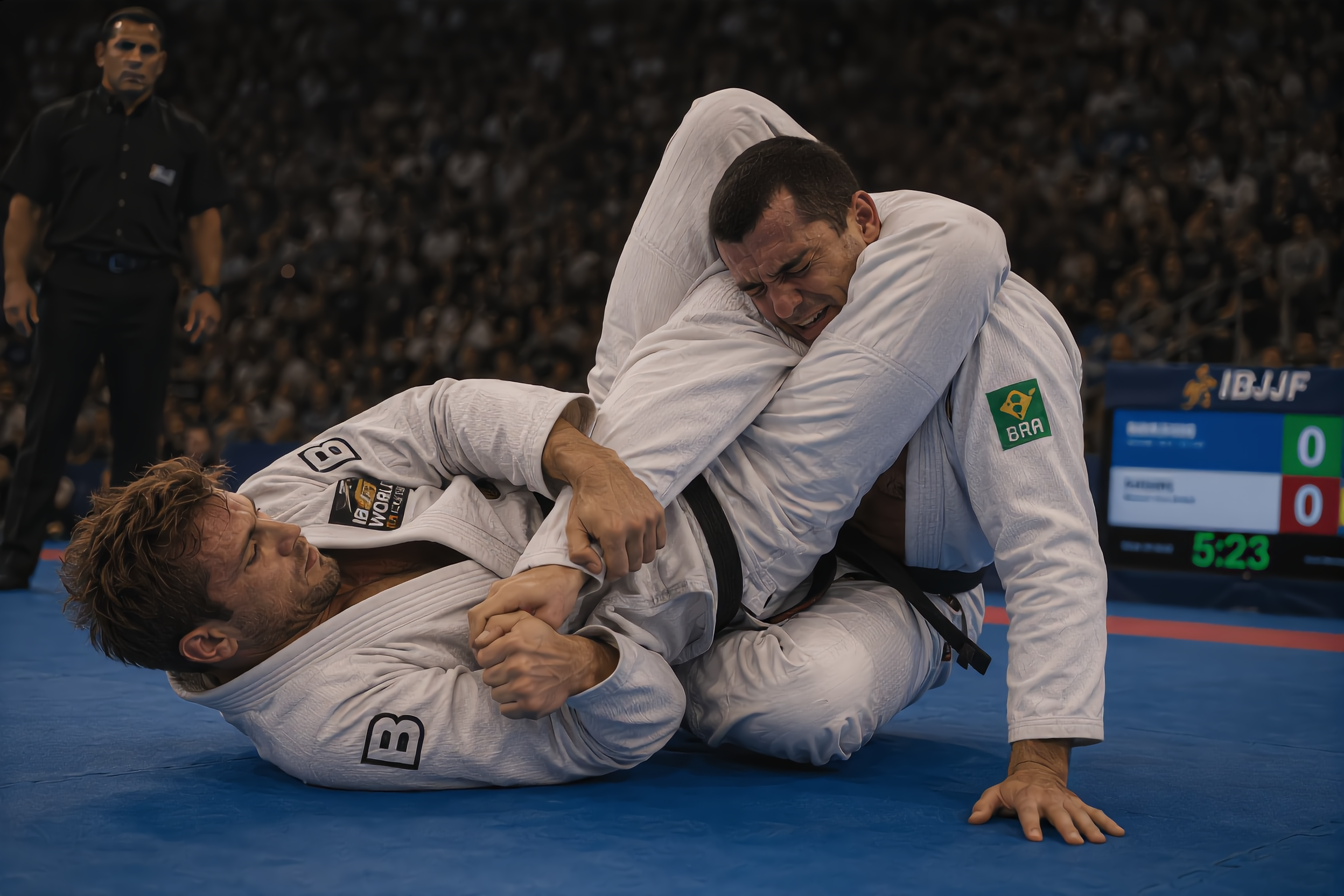
Brazilian jiu-jitsu is the science of controlling a fight on the ground. Its master map is a ladder of positions, from worst to best: trapped underneath a man, to guarding him between your legs, to sweeping him over, to pinning him from the side, to sitting on his chest, to riding his back where he cannot reach you at all. Every position has escapes downward and advances upward, and the art's first commandment, written in the proving decades, is position before submission. Climb first, control completely, and only then finish. The finishing tools come in two families. Joint locks, which put leverage on an elbow, a shoulder, or a knee until the man surrenders or the joint gives. And chokes, the quiet kings of fighting, which ignore how tough or angry or drugged a man is, because no amount of will keeps a brain awake without blood.
What makes it work against bigger men is everything Helio was forced to discover. Leverage beats strength when leverage is trained and strength is not. The legs guard and sweep so the weaker man fights from his back instead of losing there. Patience and breathing outlast fury, because the frantic man drowns himself. And what makes the art trustworthy is the way it is trained: live, daily, against full resistance, the inheritance of Maeda's thousand fights and the family's open door. Nothing you learn here is theoretical. All of it has been paid for. The full breakdown lives in the two technical subsections off this hall: the ladder, the position that turned losing upside down, and the pressure that makes a position stick in Positions & Transitions, and the finishes and the exits in Submissions & Escapes.
A First Class and Three Subsections
The story you just walked opens into a first class and three subsections, walked in that order, and the third one has the doors behind it.
BJJ 101 — the first class, and the years beneath it. The first hour from the inside: the ladder, survive-escape-control-finish, the two families of finish, and the last ten minutes of every class where the drilling stops and the tap begins. Off it hang two rooms that are the student's years: The Belt Road, white to black and what each belt is for, and BJJ Philosophy, the three ideas the gentle art runs on. Both rejoin the hall at the first subsection.
Positions & Transitions — the ladder, rung by rung. Every position on the ground from the worst to the best, how a man climbs from one to the next, the guard that turned losing upside down, the hand fight, and the pressure that makes a position stay won. The technical wing the whole floor stands on, and the rooms after this hall point back to it rather than teaching it again.
Submissions & Escapes — the finish, and the way out. The two families, the chokes and the locks, cataloged by position, the leg game and the rules that govern it, and the exit from every bad rung, because the submission you can escape is the one that does not finish you.
BJJ Fighting Styles — the game a man finds he has. The games men build by purple belt and the teams that built them, and beneath it the rooms the games are tested in and the doors a man walks through to train: Sport vs Street, BJJ in MMA, and then Coaches & Gyms, Apparel & Equipment, and Training Programs, which closes the hall.
The first class comes first because a man should feel the ground before he is handed a map of it. The ladder and the finishes come next because they are the art, and they are the two subsections every other room on the floor borrows. The games come last, with the doors behind them, because a man who knows his game reads an academy in one class, and a man who does not can be sold anything.
The Three Pillars in the Gentle Art
TRUTH — The whole history of this art is one long refusal to take anyone's word for anything. Maeda's challenge fights, the Gracie Challenge, Maracanã, Denver. Inherit that. Roll live, tap honestly, and let the mat tell you what is real about yourself, because it will tell you either way.
LOVE — Notice who the art was rebuilt for: the frail brother. Jiu-jitsu is strength engineered for the weak, the smaller man, the older man, the son you will one day teach, and its finishing logic is the shape of mercy. Control completely, end the fight, and walk both men home. The choke that protects without maiming is a more loving tool than the fist that cannot.
LAW — The tap is a covenant, and everything depends on it being honored instantly, every time, by everyone. Helio's arm at Maracanã is the lesson in both directions: hold the standard of a man who would not quit, and be wiser than he was about which hills are worth an arm. Governed training is why this art produces seventy-year-old black belts instead of forty-year-old cripples.
Walked as a System
One first class, three subsections, and one hall. The first class and its two rooms teach the art as a student lives it. The two technical subsections teach the ground itself, the ladder and the finish, and they are the wing the whole floor borrows. The styles room and the rooms beneath it take the man who now knows what the art is and what his own game looks like, test it against the street and the cage, and put him in a room where it is taught, in a jacket, on a calendar.
And the hall hands off the way the whole floor does. The composure the striking range built is what keeps a man's mind in the room when he is flattened. The grips he fought for in the clinch are the grips that hold an arm long enough to break it. What this room makes goes down the floor to the room where the jacket comes off, across the yard to the Armory where the man on top of him wants his pistol, and up the hill to the cage, where the ground is where most fights are actually decided.
After This Hall
The gi is the genius of this art and also its hidden crutch. The jacket teaches a man grip fighting, control, and patience the way nothing else can, and it hands him a hundred handles that vanish the day he grapples someone who is not wearing one. Out in the world, nobody is. The next room takes the jacket off: no collar to choke with, no sleeve to pin, everything faster and slicker with sweat, the control a man trusted suddenly sliding out of his hands. The same art underneath, stripped to what still works when there is nothing to hold but the man.