
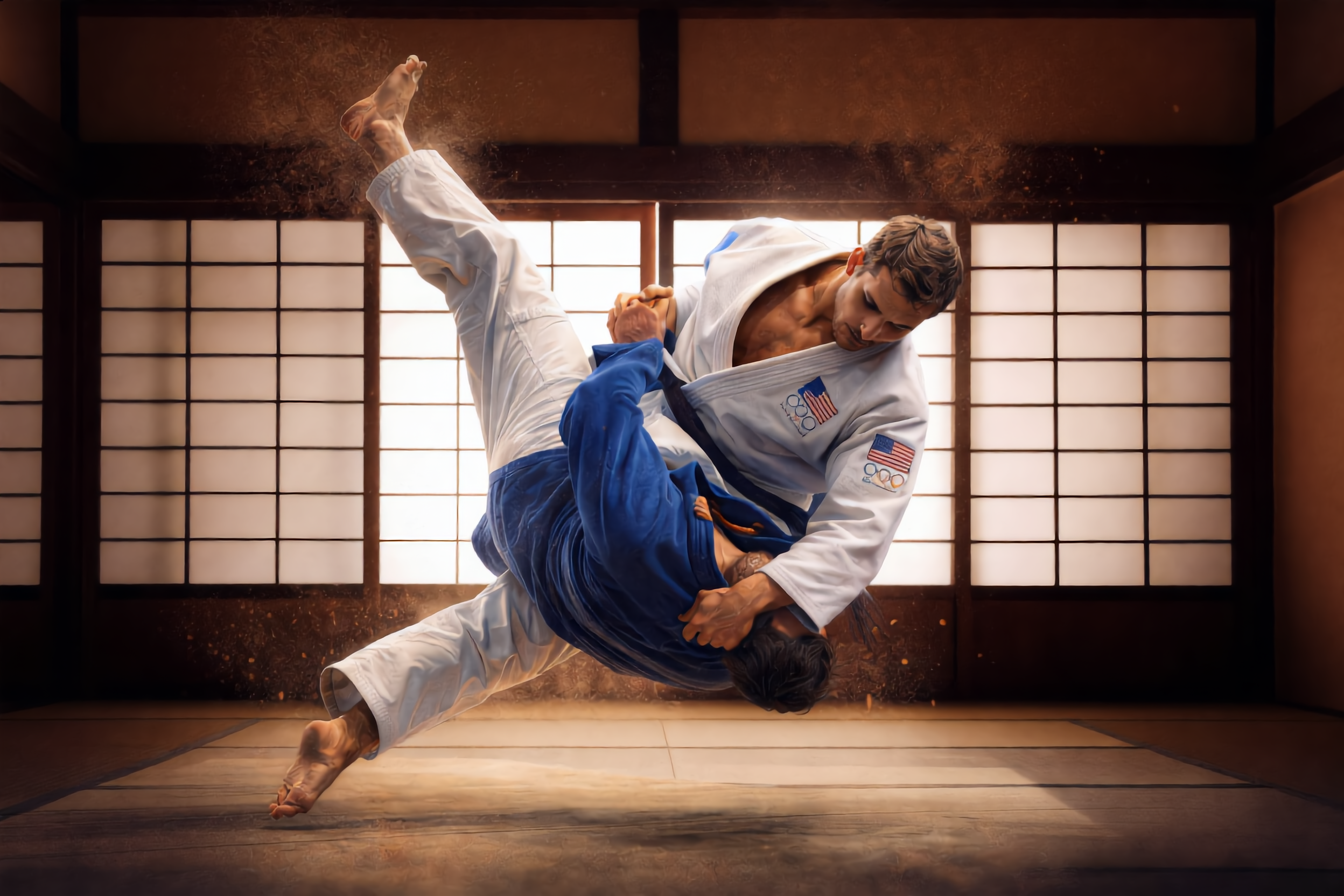
Judo
"Nothing under the sun is greater than education. By educating one person and sending him into the society of his generation, we make a contribution extending a hundred generations to come." — Jigoro Kano
A Letter Home
The jacket is on a hook by the door, and it is heavier than it looks. Before you put it on, the Warrior hands you a letter. It is a copy, the paper new, but the words are old, and he tells you to read the whole thing before you step onto the mat, because the man who wrote it crossed an ocean to learn what you are about to be taught for the price of a class.
Tokyo, Japan — Autumn, 1886
Dear Brothers,
I am writing to you from a rented room in Tokyo, by lamplight, with my shoulders aching in places I did not know a man kept muscle. The crossing took three weeks out of San Francisco, and the ocean is not the remarkable thing that has happened to me. The remarkable thing is a small man in a quiet building on a modest street, and I have come halfway around the world to be thrown to the floor by him, daily, and I count it the best bargain I have ever struck.
You will have read in the papers what is happening in this country. They call it the Meiji era, the old Japan tearing off its topknot and putting on a Western suit, and in its hurry to become modern the nation nearly threw away one of its treasures. The old samurai fighting arts fell out of fashion with the swords. The masters grew old teaching nobody. And one undersized schoolteacher's son went around finding those old men and learning everything they had left before it died with them. His name is Jigoro Kano. He runs a school called the Kodokan, founded four years ago with nine students and a dozen mats in a corner of a temple, and what he teaches there he refuses to call jujutsu. He calls it Judo, the Gentle Way, and before you laugh at the word gentle, brothers, read the rest of this letter.
I expected the master of a fighting school to be a bull of a man. Kano is the smallest grown man in his own building, slight, bespectacled, more professor than warrior, because he is a professor. As a boy he was small and he was bullied for it, and where most boys nurse that wound, he went and asked a question instead: is there a way for the weaker man to defeat the stronger? The old arts said yes. But here is what makes him singular. He did not merely collect the old techniques. He sorted them. He kept what worked under honest resistance and discarded what only worked in rehearsal, and he organized a heap of secretive tradition into a system a man can actually be taught, first things first, each skill standing on the one before it. I have watched him stop a lesson to dismantle a single throw the way Father used to dismantle a clock on the kitchen table, base, grip, stance, balance, each piece laid out and named, and then assemble it back into one motion so smooth you could not see the seams. Then he threw a man twice his size with it, and the floorboards shook.
The first week the name bothered me. Where we come from, gentle means soft, and soft loses fights. But the Japanese word means something closer to yielding, the way a willow branch sheds a snow load that snaps the proud pine beside it. My second day, Sensei Kano had me push him, everything the farm ever put into my arms. It was like pushing a fence post. Then he stepped aside a half-pace, no more, and the strength of my own shove carried me past my feet and I was on my back looking at the ceiling, defeated principally by myself. He offered me his hand and said, through the interpreter, that I had just met the foundation of everything: maximum efficiency, minimum effort. Do not oppose the stronger force. Receive it, redirect it, and let the big man's power do the work of putting the big man on the floor.
And now the part that humbled me. I came here to learn to throw men, and for my first weeks he would not teach me a single throw. He taught me to fall. Forward, backward, to either side, hundreds of falls a day, until the body learns to strike the ground without the ground striking back. I thought it beginner's drudgery until I understood the design. No man will let himself be thrown if the landing injures him, and if no man will be thrown, no man can practice throwing. The falling is what makes the whole school possible. And there is a sermon hidden in it that Sensei preaches almost nightly, in nearly the same words: no matter how hard you fall, get back up. Get back up. And that relates to life.
You will want proof beyond your brother's bruises, so here is the news of the season. This year the Tokyo police held a tournament to settle which school would train their men, Kano's young Kodokan against the old lineages with centuries of reputation. The Kodokan all but swept the hall. It was not close. Mark what that means. It was not the new fashion beating the old tradition. It was the organized art beating the disorganized one.
I asked him one evening what his art is for, expecting to hear about contests or the police. He said the purpose of Judo is building better human beings. The mat is his laboratory and character is the product. The fellow you train with is not your enemy. He is your instrument of growth, and you are his. Tell Mother I am eating well and bowing more than any Baptist ought.
Your brother at the Kodokan.
You fold the letter and the Warrior takes it back. "He came home and taught it in a barn," he says. "Everything he learned is in this room. Put the jacket on."
Judo is the throwing art with a soul. Where the wrestler drove through a man, the judoka steps out of his way at the moment his weight is committed and lets him fall through the space where the resistance should have been. It arrives with a jacket, and the jacket changes everything: every attacker a man will ever face is wearing one, and the collar and the sleeve are handles the wrestler never had. It carries a way of landing that lets a man be thrown on something harder than a mat and stand back up. And it carries a founder who thought he was building a school, and who built, without ever meaning to, the second most practiced fighting sport on earth.
The rest of this page stands at the door. It says what the jacket changes, how a judoka breaks, what the three rooms behind this one are and why they are walked in that order, and it keeps the letter on its wall, because everything in the three rooms is that letter, a hundred and forty years later, still being answered.
What the Jacket Changes
The other man has a handle. The wrestling room fought for grips on skin, and the grips slid. Here the grip is on cloth, and cloth does not slide. A hand on the sleeve owns the arm. A hand on the collar owns the posture, and posture owns the balance, and balance is the whole fight. The judoka spends years on the grip fight alone, which hand goes where and in what order, because the man who wins the grips has already decided what the next five seconds are allowed to contain. And the lesson leaves the mat with him. Every coat, every hoodie, every collar in a parking lot is the same handle, and the man who has trained it knows what to do with a stranger's shirt in a way the stranger does not.
Balance is broken before the throw is thrown. This is the thing the letter felt and could not name, and the art has a word for it. Kuzushi: the unbalancing. Push a man and he pushes back, and at the instant he commits his weight to pushing, he can be moved in the direction he is already leaning by a child. The throw is not the effort. The throw is the last thing that happens, after a man has been made to lean, turned, and fitted to a technique that his own weight finishes. A judoka who tries to throw a balanced man is a wrestler in a jacket, and a bad one. The one who unbalances first can throw a man he could not lift.
You learn to fall before you learn to throw. The letter told you why: a school where the landing injures is a school where nobody trains. But hear the second reason, because it is the reason this art is on the Farm at all. A man who has fallen ten thousand times on a mat has a body that knows how to meet the ground, and the ground he will actually meet is concrete, ice, a stairwell, a bar floor. Judo is the only art on this mat that trains the landing as seriously as the throw, and the man who owns it has been handed something every other room assumes: the ability to be put down and get up uninjured.
The full point ends the argument. A clean throw, on the back, with force and speed and control, and the referee's arm goes up and the match is over. Ippon. One act of total control, and nothing to argue about. The sport was built to reward that and nothing else, which is why the art is honest in a way most sports are not: you cannot win ugly and be respected, and you cannot win on points and call it a victory in the home country. The standard is the whole throw or nothing, and a man raised under that standard carries it into his work.
The throw is the doorway, not the room. The correspondent's journal, one door down, records the thing the sport later forgot: the ground behind the throw. Pins, chokes, the elbow, the geometry of weight that lets a small man hold a large one flat. The sport shortened that work. The art never did, and the man who trains the art rather than the sport follows the throw to the floor and knows what to do there.
Nobody buys his rank. The colored belt was not part of the founder's school and it is now part of every dojo on earth, and it is the most honest hierarchy in the fighting world: a grade earned in front of witnesses, on a mat, against men trying to stop you, and never inherited. The black belt is not mastery. It is the point where the art considers a man ready to begin. A man who has climbed that ladder knows exactly what he knows and what he was told he knows, which are different things everywhere else in his life.
How a Judoka Goes Wrong
He fights like the pine. He meets strength with strength, hauls on the jacket, tries to muscle a balanced man over his hip, and against a smaller man who has learned to yield he throws himself. The art was built for the weaker man, and the strong man who refuses to learn it that way has paid for the wrong lesson.
He will not be thrown. He resists every practice throw, stiffens in the fall, protects his ego with his elbows, and so his partners cannot train, and neither can he. A school runs on men taking turns on the floor, and he has refused his turn. It is the first trade the mat asks for, and the men who refuse it are the men who leave in three months with a sore shoulder and a story.
He wins the grip and does nothing with it. The modern sport is full of him: two men bent over, fighting for sleeves for four minutes, throwing nothing, waiting for the other man to be penalized. He has learned the fight before the fight and forgotten there was a fight. The founder would not recognize him, and neither would a parking lot.
He stops at the throw. He has been taught by a sport where the throw ends the match, and so his body stands up and looks at the referee. There is no referee, and the man he just put down is getting up with a grievance. The throw was the door. He never learned the room.
He collects throws. Forty techniques, each one drilled to the point of recognition and none to the point of ownership. The champions of every nation in this hall carried two or three throws sharpened until they worked on anyone alive. The man with forty has none.
He throws a man on concrete and calls it self-defense. The art's own genius is control, and the throw that scores on a mat can kill on a sidewalk, because the ground does not give and the other man never learned to fall. The trained judoka knows this the way a man knows his pistol is loaded, and the one who does not is the most dangerous man in the room, first to strangers and then in a courtroom.
Three Rooms, Walked in Order
Now I must tell you the part that humbled me. I came here to learn to throw men, and for my first weeks Sensei Kano would not teach me a single throw. He taught me to fall.
Forward, backward, to either side — hundreds of falls a day, slapping the mat, tucking the chin, until the body learns to strike the ground without the ground striking back. They call it ukemi. I thought it beginner's drudgery until I understood the design of it. No man will let himself be thrown if the landing injures him — and if no man will be thrown, no man can practice throwing. The falling is what makes the whole school possible. Every man on that mat takes his turn being the thrown one, and takes it without fear, and so every man gets ten thousand honest repetitions his fists-and-fury counterpart back home will never get.
And there is a sermon hidden in it that Sensei preaches almost nightly, in nearly the same words: no matter how hard you fall, get back up. Get back up. And that relates to life. I keep a journal of the whole opening curriculum — the falling, the grips, the footwork, the first eight throws, the examination for the first belt — and I will send you the pages when the post allows. Until then know this much: the man teaches falling first because life throws everyone, and he intends to graduate men who get up.
The Throws, the Ground, and the Grip
Judo 101— the first class. The bow at the door, the jacket, the month of falling, the grip, the unbalancing, the first throws, the ground after the throw, and the first rung of the ladder, taught the way a first night in a judo club actually goes. Off this room hang the correspondent's journal pages: the twelve-week curriculum as he watched it built, the ground work as he learned it, and the philosophy the founder put under both. None of those is the next step. The room says so.
Olympic Judo— the schoolteacher's art becomes the world's sport. The founder built a school and sat on the committee that runs the Games, and died on a ship coming home from securing them for his country, and never lived to see his art on the program. This room walks the road from the Kodokan to the podium: the men he sent out into the world, the day the sport arrived, the rules that were written and rewritten, and what each rewrite gave the art and took from it. It is the room that explains why the sport you can watch and the art in the letter are not quite the same thing, and why that is not a tragedy.
Judo Styles — one art, seven accents. The same rules, the same jacket, the same bow, and seven nations that made it their own, each bending the art toward what the nation already was: its wrestling, its schools, its state, its stubbornness. Japan's principle, France's schoolhouse, Korea's answer to its teacher, Cuba's strength, Mongolia's root, America's honest small room, and Russia, whose judo came from an art the next room on this range still owns. The walk ends there, on the seam between two arts, with the same jacket on.
The order is the argument. The first class comes first because a man who has not fallen a hundred times and felt his own push put him on the floor has no business with the history of the men who felt it before him. The Olympic road comes second because the sport is what the reader will actually find when he goes looking, in a gym, on a screen, on a podium, and he should know how it got there and what it cost before he judges the art by it. And the nations come last because a style is what a people does with a rulebook, and you cannot read seven answers until you know the question. The last of the seven bent the art so far that it became a different art with a different name, and that art is standing at the far door of this hall.
The Three Pillars in the Jacket
TRUTH — every throw on this mat is tested against a man who does not want to be thrown, and a rank that was not earned that way is a lie sewn into a belt. The founder sorted the old arts by one question, does it work under honest resistance, and the mat still asks it of every technique and every man. And the truth cuts the other way too: the throw that scores on a mat can maim on pavement, and a man who will not say that out loud about his own art does not know it yet.
LOVE — this is the one art in the building whose founder said, in so many words, that it exists for the other man's benefit as much as your own. Mutual welfare is on the wall of the school he built. It is felt in the body before it is understood: you cannot practice a throw without offering your own body to your partner's practice, and his skill is a thing you gave him. And the strength the art builds is the governed kind, the power to put a drunk on the floor gently and the base to keep a family behind you on its feet.
LAW — the school is governed to the inch. The bow, the clean mat, the rank that answers to a standard, the throw controlled so that the partner lands on his back and not his neck. And the art's own law is restraint written into its scoring: control is what wins, not damage. A man who has bowed to a referee's authority ten thousand times knows how to bow to an authority he cannot see, and the one who never learned it on the mat will be taught it somewhere with higher stakes.
"You have given me the shield of your salvation, and your gentleness made me great." — 2 Samuel 22:36
Three rooms of the standing game and one of the mat, and the same song has been running under all of them, the feet, the hands, the strength for battle. Here is the line the Gentle Way was named for. A king who had spent his life putting men on the ground sat down to count what had made him great, and the word he chose was not a throw or a grip or a victory. It was a gentleness, and he was careful to say whose.
Walked as a System
Three rooms, one art, and its whole history in walking order. The first hands a man the jacket, the fall, and the unbalancing, and he leaves it knowing what the letter felt. The second tells him what the world did with it, and he leaves knowing the difference between the sport and the art and how to take the best of both. The third shows him what seven nations did with the same rulebook, and he leaves knowing that a style is a people's answer to a constraint, and that he has a body, a root, and a country of his own to answer with. Walk them in order and the letter on the wall reads differently at the end than it did at the beginning: a small man's question about the weaker and the stronger, asked in a temple corner, answered by the whole earth for a hundred and forty years, and still not closed.
And the art leaves the room in every direction. The grip on cloth goes to the ground, where the jacket arts of the next range were built on this one by a man the founder sent to Brazil. The breakfall goes to the Armory, where a man thrown onto a floor with a weapon in play has to land and be up before the weapon finds him. The unbalancing goes to the cage, where the men who own the clinch against the fence learned it here or from men who did. And the bow goes home, because a man who has learned to yield on purpose, to let a push pass through him and put the pusher on the floor, has learned something about every argument he will ever be in.
Where Judo Leads
Judo throws a man by yielding, and then, for the most part, it stops. The throw lands, the referee's hand goes up, and the match is decided before anyone has finished anything. The rules that carried the art to the Olympics also drew a line around it. The legs came off the table, the ground game was shortened, and the finish was left to other men. Some of those other men were Russians. In a hard country, in a hard decade, judo's throws were taken by soldiers with no interest in a sport, married to every wrestling style the old empire held, and pointed at the one place the jacket arts had agreed not to look: a man's legs. The art they built was born of judo and would not say so for fifty years. It kept the throw, dropped the ceremony, and followed the fight to the floor.