
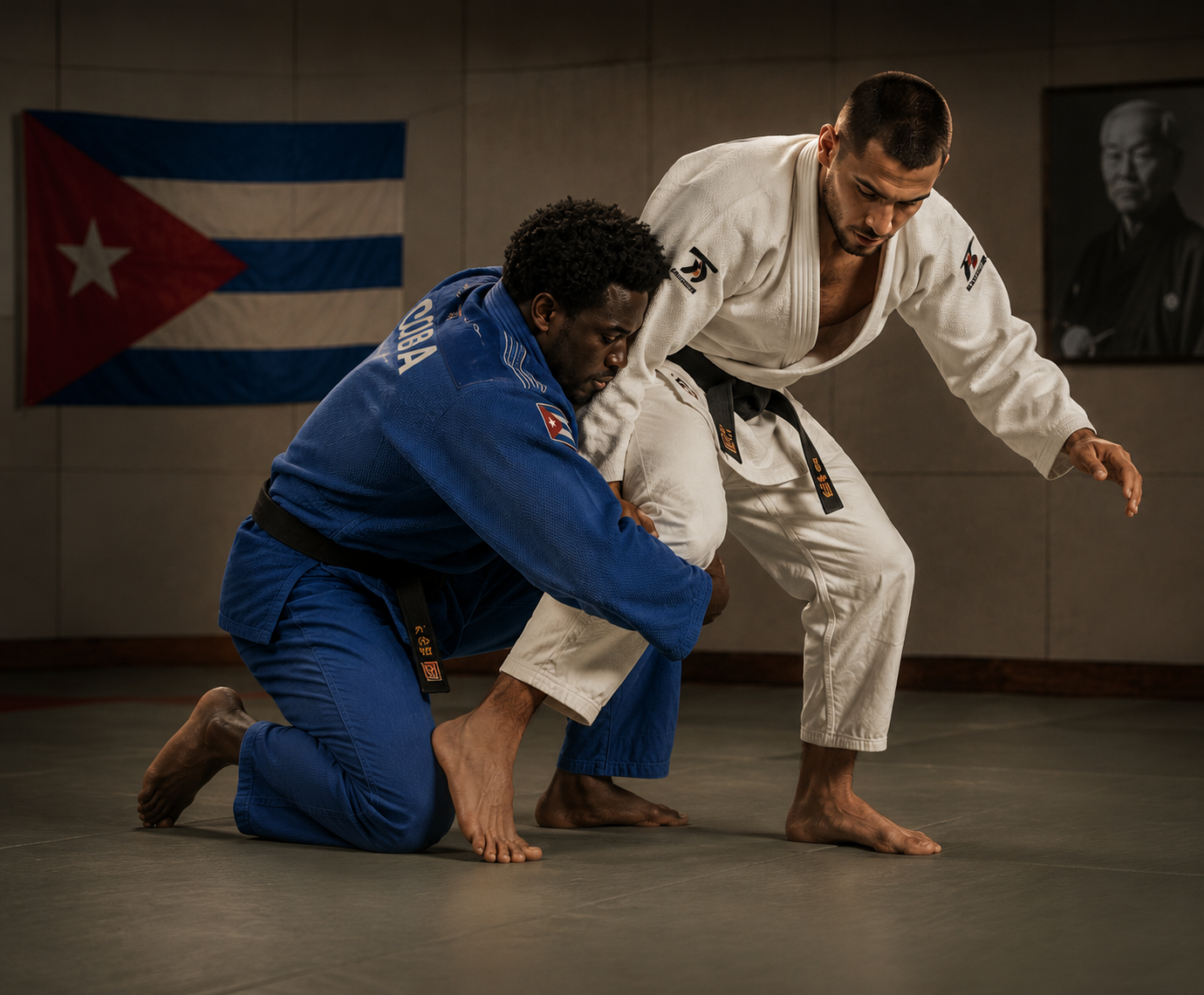
Cuban Judo
"El deporte, derecho del pueblo." — Sport, the right of the people. (motto of the Cuban sports system)
The Strong Man's Version of the Weak Man's Art
Barcelona, summer of 1992. Women's judo is a full Olympic medal event for the first time in history, and the sport's old powers, Japan, France, Korea, expect to divide the podium among themselves. Instead a young middleweight from Cuba named Odalis Revé takes her grip, and everyone watching understands within seconds that something new has walked into the building. She does not play the patient Japanese game of feint and feel. She takes the jacket like she intends to keep it, breaks her opponent's posture with raw arm strength the way you would fold a lawn chair, and attacks without pause until the throw comes. She leaves Spain with a gold medal. At the edge of the mat, a heavyset coach in a chair has been bellowing at her the entire tournament, loud enough to be heard over the crowd.
The judo world had just met Cuba. It would spend the next thirty years failing to solve what kept coming off that island, and this room tells how the island did it, what it cost, where the art is kept there today, and why the best place to meet Cuban judo may no longer be Cuba.
A Russian in Havana
Judo reached Cuba the way it reached most of the world, one traveler at a time, but Cuba's traveler carried a twist the story would need later: he was Russian. Andrés Kolychkine, an émigré with a Russian name and a European education, arrived in Havana in the late 1940s and began teaching Kano's art on the island. He built Cuba's first real judo program, and the national championship trophy still bears his name today. Mark the joke history was setting up: the Russian arrived a decade before the Russians did.
Then came 1959. Revolution. Within two years the new government abolished professional sport, declared athletics the right of the people, and built a state machine to prove the slogan: a national sports institute, boarding schools that combed every province for gifted children, and coaches empowered to take a farm boy at ten and shape his next fifteen years. The blueprint for that machine came straight from Moscow. Soviet advisers, Soviet textbooks, Soviet sports science: measure the child, project the man, plan the training year down to the week, and build the body before you polish the skill. It was the same engine that produced Teófilo Stevenson and Félix Savón in the boxing program, and later the freestyle wrestler Yoel Romero, men whose explosiveness looked like a special effect. Cuba pointed that identical engine at judo.
And the island's poverty, which should have been the program's death, became its signature instead. Mats wore thin. Jackets were patched and handed down. Travel was rationed and equipment was scarce. But strength requires no imports. A barbell, a hill to sprint, a training partner heavier than you, and a coach with no mercy; the embargo could not touch any of it. So while richer nations refined technique in comfortable halls, Cuba built bodies. Sixteen years after the revolution, at the Montreal Games of 1976, a lightweight named Héctor Rodríguez climbed the top step of the Olympic podium, Cuba's first judo gold. The machine worked.
The Order Reversed
In the Judo room you read the letter about the willow and the pine, how Kano built his art deliberately for the smaller man, so that yielding and timing could defeat size. That is the Japanese order, and the room before last showed it to you: technique first, and strength only as technique's servant. A Japanese coach will drill a boy's entry for years before he cares how much the boy can lift.
Cuba reversed the order. Build the strongest, fastest, most explosive athlete the machine can produce, then bolt the judo on.
Feel what that produces on the mat. The Cuban grip arrives like a bar fight: not a polite collar-and-sleeve negotiation but a seizure, both hands fighting for dominant holds with an aggression that makes the first ten seconds feel like the whole match. The entries do not glide; they detonate. Where the classical stylist waits to borrow your force, the Cuban makes his own, hauling opponents off balance by strength that has no business existing in his weight class, attacking with the wrestler's pickups and low attacks the Soviets had smuggled into judo from sambo a generation earlier. The pace is a weapon of its own: five minutes of carrying a Cuban's strength breaks men who were never thrown. Watch old footage and you will swear you are watching freestyle wrestling in a jacket, which is close to the truth, because the same sports schools fed both mats from the same pool of explosive boys.
Purists sneered at it. Power over finesse, they said, brute force wearing judo's clothes. But say the honest thing the sneer leaves out: the champions were never only strong. Strength was the platform; a real technique rode on top of it, chosen small and drilled endlessly. Most Cuban champions carried two or three throws instead of twenty, sharpened until they worked against anyone. Power that misses is a gift to a technician. The Cubans did not miss. And the scoreboard is a stubborn judge: the weak man's art, rebuilt around strength, kept beating the nations that invented it.
The Man in the Chair
The bellowing coach at the edge of the Barcelona mat was Ronaldo Veitía, and he is the reason Cuban judo became a dynasty instead of a curiosity. Handed the women's national team in the late 1980s, he ran it for nearly three decades and turned a poor island into arguably the most feared women's judo program on earth. Revé's gold in 1992. Driulis González, who stood on the Olympic podium four Games in a row and took gold in Atlanta. Sydney in 2000, where Legna Verdecia and Sibelis Veranes both came home champions. Idalys Ortiz, who medaled at four straight Olympics and won London outright. Around the golds, a landslide of silver and bronze, more Olympic hardware from one man's room than most entire national federations gather in their history.
Veitía was the Cuban method in a single body: enormous, loud, demanding, mat-side in his chair roaring corrections and grabbing the jacket of any athlete who gave him less than everything. His fighters trained on worn mats with rationed food and came out gripping like machinery. He had almost nothing and produced almost everything, poverty of means, wealth of will. He died in 2022, and judoka on every continent who had spent their careers trying to survive his athletes stopped to honor him.
And the last of his champions gave the room its ending. Ortiz carried the flag into Paris in 2024 beside Mijaín López, the Greco wrestler you met on the takedown range, two aging giants of the machine walking into the stadium together, and then, at her fifth Olympics, she lost in the round of sixteen on three penalties, without being thrown, and announced her retirement on the mat. The greatest heavyweight the women's sport had seen in a generation went out on a passivity call. The machine's last engine ran down in public, and the country watched.
What the Slogan Didn't Say
Now tell the whole truth, because this Farm does not hang propaganda posters.
Sport, the right of the people, was the slogan, and the medals were real, but the athlete belonged to the state. Champions who filled arenas abroad came home to a worker's wage and a government that claimed their victories for the revolution. The machine that found the farm boy at ten also owned the man at thirty. And so, year after year, Cuban athletes made the hardest throw of their lives: over the wall. Boxers, wrestlers, ballplayers, judoka, men and women who left everything, family included, to defect from the system that built them.
And the wall has come down in a way the slogan never planned for. In the spring of 2023 five members of the women's judo team walked away during a training camp in France. Three more left in Canada that fall after medaling at a continental championship, and another boarded a flight to Serbia, the route Cubans use to reach Europe. In three months the island lost nine judoka. The next spring a Pan American champion left the delegation in Brazil. The federation had planned to qualify seven for Paris and qualified four. In 2025 two more asked for asylum in Chile. A machine that ran for sixty years on a pipeline of explosive twenty-year-olds is watching the twenty-year-olds leave through every door the world opens, and some of them are now pursuing their Olympic dreams in other nations' jackets, including this one's.
Weigh that honestly. The mat never lied: the strength was real, the discipline was real, the coaching was among the finest ever assembled. The state lied around it. A training method can be excellent while the government wielding it is not, and a wise man takes the barbell without taking the ideology bolted to it.
There is a second honest ledger to read, and it is written on the body. Strength is a young man's currency. The explosion that made a twenty-two-year-old unstoppable begins leaving in the thirties, and the judoka who built everything on power faces a reckoning the technician never meets. The Cuban system's answer was the machine itself; there was always another explosive twenty-year-old coming up. You do not have a pipeline. You have one body and one span of years, which is why you take the Cuban road as a season, not a religion: build the engine while the engine is buildable, and let the craft, the part that compounds instead of fading, carry a heavier share every year. Ferocity under a referee, strength under rules, aggression that ends at the edge of the mat: the Cubans at their best were violent inside the lines and embraced you after, and that is the version of the style worth learning.
Where the Art Is Kept
The machine has an address, and a man who wants to see the strong man's version of the art at its source should know it, and know what he will find there now.
In Havana stands the high-performance center the national teams train in, a campus of halls and dormitories where the boys and girls the provincial sports schools sent up are turned into the athletes the rest of the world could not solve. Coaches from other nations have visited for decades to watch the practices, and a few foreign teams have trained there, and the judo hall inside it is where every Cuban champion of the last forty years spent the years before anyone abroad knew the name. Below it sit the provincial schools, one per province, boarding schools with a sports curriculum, where a child is measured at ten and assigned an event, the machine's roots, still running. For a few years in the middle of the last decade the world circuit came to the island itself, a Grand Prix in Havana with the sport's best on the mat and Veitía in his chair at the edge of it, and the footage of those tournaments is the best record of the style at full power that exists.
And the honest word for a man planning the trip: he will find the halls, and the coaches, and the children, and he may find the thinnest national team the island has fielded in half a century. The style is not gone. It has moved. It is in a French dojo where five women who walked away from a training camp now train, in a Canadian club, in a Chilean gym, and on American mats where a Cuban who left is chasing a Games in a different jacket, and the coaches who built it are teaching it wherever they landed. A documentary about Cuban judo in this decade is a documentary about a diaspora, and the room says so, because the Farm does not send a man to a building to film a thing that has walked out of it.
Take It Back Into the Judo Room
Three things leave this room with you.
Strength is a multiplier, not a substitute. The Cubans never proved technique unnecessary; they proved that identical technique in a stronger body wins. If you have the engine, use it without apology and let no purist shame you for it. If you do not have it yet, the barbell is part of your judo, not a distraction from it.
Scarcity is no excuse. An embargoed island with patched jackets and thin mats out-medaled wealthy nations for a generation. Whatever your garage, your budget, your schedule, the Cubans trained with less and took gold from men who had more. That argument is over.
Know which tree you are. Kano's willow bends and lets the storm defeat itself. The Cuban is the storm. Both roads end at ippon, and the honest man picks by what God actually gave him: the explosive athlete who fights like a patient willow wastes his gift, and the smaller, older man who fights like a Cuban bull donates his shoulders to the strong. The Soviet root of this whole style lives at the end of this range in Sambo, and its parent stream in Russian Judo, the last room of this hall. Before you go on, reread the letter about the willow and the pine in the Judo room, and decide, honestly, which one you are. Then meet the nation that is neither tree: a people who were wrestling on the grass seven centuries before the jacket arrived, and who put it on without ever once agreeing to fall.