
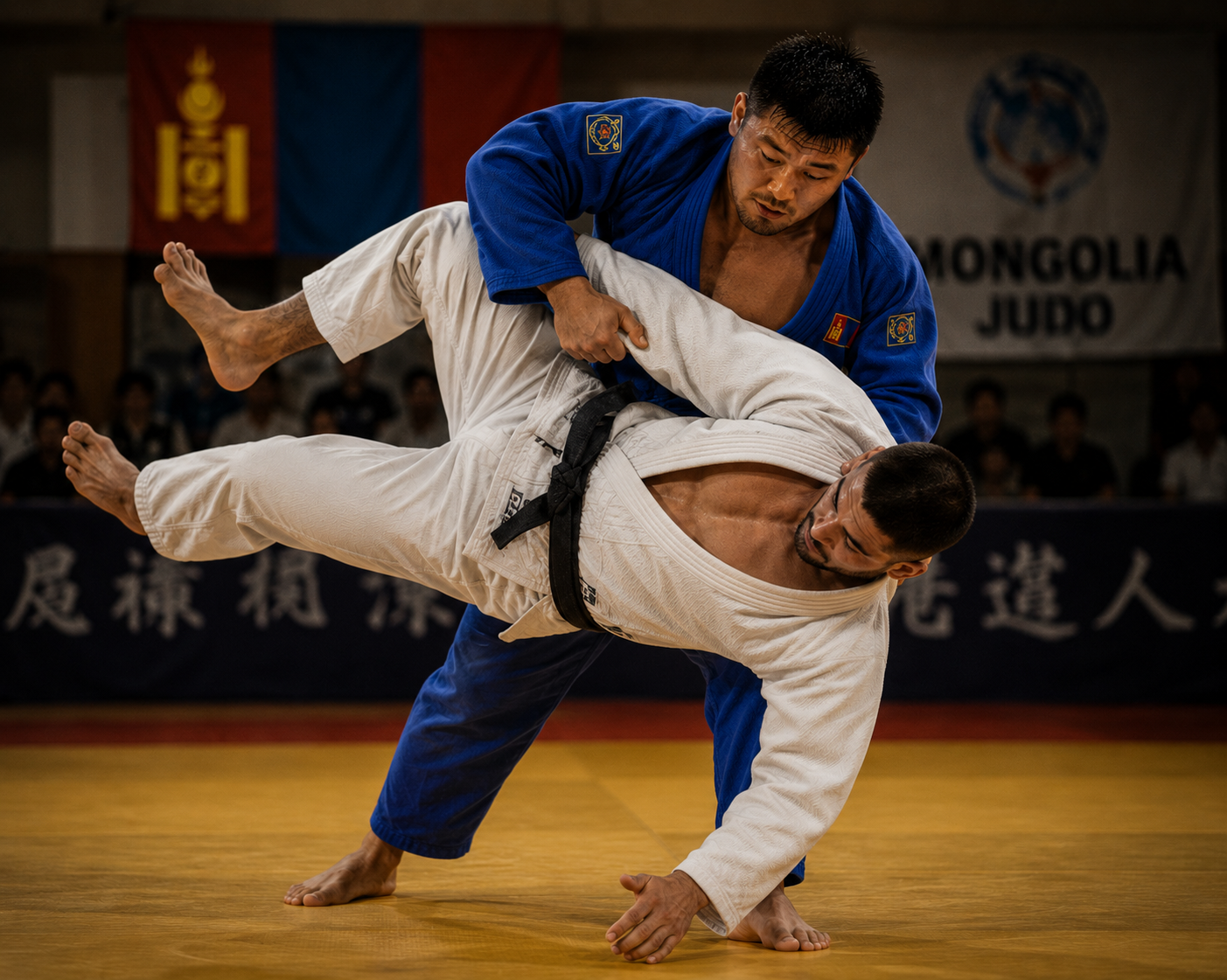
Mongolian Judo
Seven Centuries of Wrestling Put On a Jacket
Beijing, August 2008. In the judo hall, a heavyweight from Mongolia named Naidangiin Tüvshinbayar works through the bracket like a man moving furniture, and when the final ends, something happens that has never happened before: the anthem of Mongolia plays over an Olympic gold medal. Not gold in judo. Gold in anything. Forty-four years of trying, since the nation's first Games in 1964, and the drought breaks. Back home the capital erupts, strangers embracing in the streets, car horns until dawn, a country of herders and miners watching one of their own on the top step of the world.
Now mark the strange shape of the moment. The oldest wrestling culture on earth, a people who have been throwing each other on the grass since before Columbus sailed, won its first Olympic gold in a Japanese art, wearing a Japanese jacket, under Japanese rules. That is the whole story of this room: what happens when seven hundred years of wrestling walks into someone else's sport. Hold the champion's name, because this room will come back to him, and the second visit will not be pleasant. And hold the month, because the room ends on the steppe in July, where the whole thing can still be watched from a stadium seat.
The Three Manly Games
Before there was Mongolian judo there was bökh, Mongolian wrestling, and you cannot understand the judo without it.
Every July the nation stops for Naadam, the festival of the three manly games, and the wrestling is its beating heart. Hundreds of wrestlers, open weight, single elimination, the herder's son drawn against the giant, no brackets to protect him. The costume is ancient: the zodog, a tight jacket that leaves the chest bare (the story they tell is that a woman once entered in disguise and won, and the open chest made sure it never happened again), and trunks and boots built for gripping and throwing. The rules are brutally simple: touch the ground with anything other than your feet, a knee, an elbow, a hand, and you have lost. No ground fighting, no pins, no submissions. The fight is over the instant a man falls, so a Mongolian wrestler learns one thing above everything else on earth: do not fall.
The ceremony around it is as old as the fighting. The victor dances the slow, wheeling dance of an eagle, arms spread like wings. The defeated man unties his jacket cord and passes under the victor's raised arm, defeat acknowledged in the open, absorbed, and finished, no shame carried off the field. Titles climb with victories, and they are ranks a whole nation reads: Falcon, Elephant, Lion, and past Lion the rare title of Titan. This is not a hobby culture. Genghis Khan's armies wrestled to stay hard between campaigns, and the herder boys of the steppe still wrestle from the time they can walk, raised on horseback, worked by livestock, wintered at forty below. The steppe builds the body; bökh teaches it what the body is for.
Six times in the 1960s and 70s one man won the whole Naadam, a grand champion named Jigjidiin Mönkhbat. Remember him too. His family is the hinge of this entire story.
The Jacket Arrives
Mongolia spent the twentieth century as Moscow's closest satellite, and the Soviet sports machine you met in the Cuban Judo room came standard with the arrangement: coaches, methods, and the international mats of the socialist world. The nation entered the Olympics at Tokyo in 1964 and did what came naturally: it wrestled. At Mexico City in 1968, Mönkhbat himself, the Naadam grand champion, took silver in freestyle wrestling and went home unbeaten in the tournament, the finest of the young nation's very first Olympic medals. The pattern was set. Whatever the sport, Mongolia would send wrestlers, and the wrestlers would translate.
Judo turned out to be the best translation on offer. A jacket to grip, throws that score, balance as the whole currency of the fight: bökh with a foreign accent. And a nation of barely three and a half million people began beating countries a hundred times its size. Khashbaataryn Tsagaanbaatar took Mongolia's first judo world title at Rotterdam in 2009. Mönkhbatyn Urantsetseg, a forty-eight-kilo woman off the same steppe, took the nation's first women's world title in 2013 and a world sambo crown besides. Beijing 2008 delivered the gold you watched in the cold open. Even the presidency tells the story: in 2017 Mongolia elected Khaltmaagiin Battulga, a world sambo champion and the sitting president of the national judo association, to run the country for a term. The judo federation chief became the head of state, and the first Olympic golds in the nation's history came out of the program he had led. Name another country where the wrestling room and the government are the same room.
And then there is the proof that the root, not the jacket, is the power. Mönkhbat, the Naadam champion with the Olympic silver, raised a son. The boy went to Japan at fifteen, thin and unrecruited, and entered sumo, Japan's most sacred sport, the emperor's sport. Fighting under the name Hakuhō, the herdsman's son from Ulaanbaatar became the most decorated grand champion in the fifteen-hundred-year history of sumo, forty-five tournament titles, more than any Japanese wrestler who ever lived. Bökh in a judo jacket wins Olympic gold. Bökh in a sumo belt took the most Japanese throne there is. The jacket keeps changing. The steppe keeps winning.
What the Steppe Does to Judo
Put a classical judoka across from a Mongolian and watch what he reports afterward. It is not that the Mongolian was better at judo. It is that he was playing something older than judo, and the jacket was a technicality.
The Mongolian arrives as a formed wrestler, not a blank student. The stance is lower than the textbook, the rhythm is wrong on purpose, the grips come from angles Kodokan pedagogy never drew, arm drags, sudden lifts, attacks off broken timing that feel less like a judo exchange and more like being caught in weather. But the signature, the thing every opponent talks about, is what happens when you finally get your throw. You don't get it. A sport where touching the ground means instant defeat produces grown men who treat falling as an insult to their ancestors. Mongolians twist out of throws mid-air that score clean on anyone else on earth, land face-down, bridge, corkscrew, fight the landing to the last inch of altitude. Putting one flat on his back can be harder than everything else in the match combined. When the international federation banned leg grabs in 2010 and shaved away many of wrestling's entries, purists assumed the folk-style nations would fade. They adapted inside a cycle and kept medaling, because the advantage was never a rule. It was the root.
The root also carried a blind spot, and this Farm names blind spots. Bökh ends when a knee touches grass; it has no ground game at all, so the first generations of Mongolian judoka carried a hole where Ne Waza belongs, and technicians dragged them down and worked them there. Mark how the nation answered: it did not defend the gap or call it tradition. It patched it, hard. Urantsetseg, the first woman on Mongolia's world podium, built her reputation precisely on the ground, submitting opponents in the one place her ancestors never fought. An honest tradition audits itself.
Set the three platforms side by side, because they are the poles every other nation's judo sits between. Japan builds technique first and lets strength serve it, the willow of the Judo letter. Cuba builds the athlete first and bolts the judo on, the storm of the Cuban Judo room. Mongolia does neither, because Mongolia isn't converting anyone to judo. It grafts the jacket onto a wrestling that never died and never stopped being tested, every July, in the open, all comers, for seven hundred years.
The Second Visit
Now the room keeps its promise, and you learn the rest of the champion's story.
Tüvshinbayar came home from Beijing a national hero, and the honors kept arriving for a decade: flag bearer, federation leadership, president of the nation's Olympic committee. Then, in the spring of 2021, drunk, he beat a man in an altercation, not a stranger, not an enemy, but his own childhood friend, a fellow judoka. The friend died of the brain injury that December. In the summer of 2022 a court in Ulaanbaatar sentenced the first Olympic champion in Mongolian history to sixteen years in prison, and he is serving them.
Sit with that longer than is comfortable. The same hands that lifted a whole nation. A man with more proof of his strength than any of his three million countrymen, and none of it could govern him for one drunken night, and the bill was his friend's life, his own freedom, and a nation's memory of its brightest hour. The fall he spent his whole life refusing on the mat found him off it. No title, Falcon, Lion, Titan, Olympic champion, exempts a man from self-government. The stronger the man, the shorter the list of people who can stop him, until the only handler left is the one inside, and if the inside one is drunk, there is no one.
And the family that was the hinge of this story has its own second visit, smaller but real. Hakuhō retired from the ring in 2021 and became a stablemaster, and in 2024 his stable was shut down after one of his wrestlers was found to have been beating the juniors in it for years; the master was demoted for failing to see it. In June of 2025, with no date offered for the stable's return, the greatest champion in sumo's history resigned from the association altogether. He was in Mongolia when the announcement was made, and he said he would spend what came next growing the sport beyond Japan. The throne was his. What happened under his roof was his too, and the Farm tells both, because the steppe's own ceremony taught it to.
That is the truth this room refuses to launder, because the tradition itself taught you better. Bökh honors the loser: unties his cord, walks him under the winner's arm, lets defeat be public and finished. A culture that knows how to lose well knows something about pride. The man who cannot be thrown, and cannot admit he can be thrown, is the most dangerous man in the country, first to everyone near him, finally to himself.
Where the Art Is Kept
This is the one room in the hall where the art's root is still performed in public, on a schedule, in a stadium, every summer, and a man who wants to see it should know when.
Naadam falls on the eleventh of July and the two days after it, and in Ulaanbaatar the wrestling is held in the national stadium, hundreds of men in the open-chested jackets, the eagle dance, the walk under the arm, the whole ceremony this room described, in front of a crowd that can read every rank on the field. The countryside holds its own naadams in every province through the summer, smaller, closer, on the grass, with the herder's son drawn against the giant, and a visitor who wants the root without the capital's crowd will find it in any aimag center within a day's drive. It is the oldest continuously held wrestling event on earth, and it does not sell tickets to its meaning. Anyone can sit and watch.
And the jacket comes to the steppe every year now, too. The world judo circuit holds a Grand Slam in Ulaanbaatar, in a new arena in the capital, in June or July depending on the year, with several hundred judoka from fifty-odd nations and the whole Mongolian team on home mats in front of the crowd that raised them. A man who times the trip right can watch the folk wrestling in the stadium and the Olympic sport in the arena in the same fortnight, and see with his own eyes what this room has been telling him: the same men, the same refusal to fall, in two jackets. The judo halls of the capital train the year round, and the national team's rooms are where the steppe boys are turned into the men the rest of the world cannot put on their backs. Between the stadium and the arena, the whole argument of this room is on public display for two weeks every summer, and the Farm would rather send a man to see it than describe it again.
Take It Back Into the Judo Room
Three things leave this room with you.
Graft onto your living root. The Mongolian never unlearned bökh to learn judo; he carried his inheritance in and made the new art serve it. Whatever you already are, wrestler, laborer, lineman, the balance your work built into you, that is not an obstacle to the new skill. It is the rootstock. Bring it.
Audit the inheritance. Every tradition has a hole it cannot see from inside; bökh's was the ground. Loving your root means fixing its gap, not defending it. The nation that patched ne waza kept medaling, and the man who patches his blind spot keeps standing.
Refusing to fall is a skill. Refusing to admit you can fall is a disease. The first one wins matches. The second one ends in a courtroom, or in a stable shut down under a champion who did not see what was happening in it. The eagle dance and the walk under the arm are the same ceremony, strength and humility performed in public sixty seconds apart, and a man needs both halves or the missing one will be supplied to him, at a price he does not set.
The Soviet harvest that gathered folk styles like this one into a system lives at the end of this range in Sambo, Oshchepkov tested judo against exactly these wrestling cultures, and its accent on the founder's mat is the last room of this hall, Russian Judo. Read the willow and the pine one more time with steppe eyes: the Mongolian is neither tree. He is the steppe grass, flattened by wind a thousand times, uprooted never. Decide, honestly, what God planted you as, and train that. The next room is the country you are standing in, and it has no steppe, no machine, and no university, only the honest truth about where the art lives here and how a grown man finds it.
→ Continue on to American Judo