
Sambo
Sport Sambo
Combat Sambo
Freestyle Sambo
"The one who doesn't fall doesn't stand up." — Fedor Emelianenko
An Art With No Father on Its Birth Certificate
The Warrior meets you at the last door on this range with a jacket that is not a judo jacket. It is shorter, tighter, red, with a belt sewn into it, and he hands you a pair of soft boots to go with it and tells you to sit down before you put either on, because this room has a story that has to be told before the mat.
Moscow. An October night in 1937. There is a knock at the door of a judo instructor named Vasili Oshchepkov, a knock every man in Russia has learned to dread, because it comes after midnight and the men knocking do not leave alone. Oshchepkov has spent his life building something: a fighting system for a country that has been bleeding for twenty straight years. He trained in Japan under the master Jigoro Kano himself. He came home and taught the Red Army how to fight with empty hands. For this, for having lived in Japan at all, the secret police arrest him as a spy. Ten days later he is dead in a prison cell.
And here is the strange mercy of the story: his art did not die with him. His students kept teaching it. They just stopped saying his name. Within a year the Soviet state officially adopted the system its own police had orphaned, stamped a new name on it, and handed the credit elsewhere. The art survived by being erased, which tells you almost everything you need to know about the country that made it and the kind of fighting it makes.
That art is sambo, and you have been walking toward it since the wrestling room. The Russians you met at the end of the judo hall were playing the founder's sport with this art's accent, and the accent was never a style. It was a whole language, built by two wounded men from judo's throws and every wrestling style an empire could gather, pointed at the one place the jacket arts had agreed not to look, and kept, for most of a century, by soldiers who did not care whether anyone bowed. The wrestler and the judoka each stopped at the floor. This art was built by men who had no intention of stopping there, which is why the range saves it for last.
What is left of this page is the briefing before the kurtka goes on. It tells you how the art was built and by whom, what makes it different in spirit from the two rooms behind it, how a sambo man breaks, what the three rooms behind this one are and why they are walked in that order, and why the range ends here and not in the next building.
Two Wounded Men
Sambo was built in the 1920s and 30s by two men who never worked together, coming at the same problem from opposite directions, and both of them came to it broken.
Viktor Spiridonov was an officer of the old Tsar's army who went into the First World War whole and came out with a ruined left arm. A fighting man with one good arm has a decision to make: quit, or rebuild fighting itself around what he has left. Spiridonov rebuilt. The system he taught to Soviet police was made for the smaller, older, wounded man. No contests of strength, nothing that needs two strong hands, everything built on redirecting the attacker's force and ending things fast. He had learned the hard way that you do not get to choose the condition you fight in. His art assumed you were already hurt.
Vasili Oshchepkov was an orphan from Sakhalin Island, shipped to Japan as a boy, who walked into Kano's Kodokan and became one of the first foreigners ever to earn a judo black belt there, trained at the source, by the founder's own school. He came home carrying judo the way the letter-writer in the Judo room hoped to, and then he did something Kano would have recognized as his own method turned loose: he tested it. He put judo up against the wrestling styles of every people in the Soviet union, and where the old empire's reach ran, that was a lot of wrestling. Georgian jacket wrestling. Armenian, Tatar, Uzbek folk styles, each one centuries old, each one the pride of its village festivals. Whatever threw men down most reliably, he kept. Whatever existed only for tradition's sake, he cut.
One man built the art of the wounded defender. The other built the art of the relentless harvester. After the knock on Oshchepkov's door, their students, chief among them a tireless organizer named Anatoly Kharlampiev, merged the two streams and carried the system forward. In November 1938 the Soviet sports committee made it official, and the art got the name it carries today: SAMozashchita Bez Oruzhiya, self-defense without weapons. SAM-B-O.
An Engine, Not a Heirloom
Understand what makes sambo different in spirit from the two rooms behind it. Judo has a founder, a philosophy, and a temple. Wrestling has five thousand years of unbroken inheritance. Sambo has neither. It is an engineering project, built by a state that did not care where a technique came from, only whether it worked, and tested on the most unforgiving proving ground of the twentieth century.
The jacket, the shot, and the legs. The sambo man wears the kurtka, so the grips of judo are all there. He shoots at the legs like a wrestler, because the harvest kept wrestling's takedowns, and until the Olympic sport banned the hand on the leg in 2010 the whole world's judo bent over to deal with him. And when the fight hits the ground he goes where almost nobody else in the jacket arts was looking: the legs. For most of a century the jacket arts treated a man's legs as something he stood on. Sambo built a whole arsenal down there, the straight ankle lock, the knee bar, the calf crush, attacks a judoka is forbidden to attempt and a wrestler has no rule for. Read the ledger honestly, though, because the room after this one will. Sambo's own rulebooks, sport and combat both, ban the twisting attacks on the heel. The modern leg-lock game that took over submission fighting came partly down the Russian road and partly down others, and the room that finally let the twisting locks and the chokes into a sambo contest was built in New Jersey, not Moscow. That room is the last one in this hall.
The choke it refused. The strangest thing about the contest form of this art is what it leaves out. No chokes. A sport built by soldiers for self-defense without weapons forbids the one technique that ends a fight without a mark on the man, and it did so on purpose, to keep the contest fast and on its feet and to keep the throw as the crown. The military form kept the choke. The sport gave it to the referee to forbid. A man should know, walking in, which of the two rooms he is standing in, because the difference is the whole difference between a sport and a fight.
Hardship as the weather. You cannot separate this art from the century that made it. Count what Russia ate between the year Spiridonov was wounded and the year sambo got its name: a world war, a revolution, a civil war, famine, and a terror that took men like Oshchepkov from their beds. Then the Second World War, and the Soviet Union buried more of its people than any nation in the history of warfare. A boy who grew up in that country did not learn toughness as a sport. You did not train to handle suffering; you trained while suffering, because there was no other condition available. That is the soil, and it explains the flavor: no flash, because flash is for people with energy to waste; no quit, because the culture had nowhere to put quit; and a composure in bad positions that unnerves opponents, because a people that survived what they survived does not regard being under a strong man on a mat as an emergency.
The calm is the technique. Every art on this Farm teaches you its people. Thailand's heat and temples live inside Muay Thai. America's farm-town gyms live inside Wrestling. Sambo hands you the Russian inheritance in one sentence: expect the fight to be hard, because everything has always been hard, and walk forward anyway.
How a Sambo Man Goes Wrong
He hunts the leg and gives up the position. He has learned that the leg is a target and he dives for it from anywhere, from under a man, from a bad angle, from a scramble he was winning, and a grappler who has learned to defend the entry takes his back while he is still reaching. The leg attack is a finish, not a plan. The Russians who built it were on top first.
He thinks the sport is the fight. He has trained the contest form for years, with its no-choke rule and its stand-up after a few seconds on the ground, and he believes he has trained self-defense without weapons. He has trained a sport. The fight the art was built for has chokes in it and no referee to stand anyone up, and the room that carries that version says so at the door.
He confuses hardness with rigidity. He has absorbed the Russian posture, walk forward, grind, never quit, and he applies it in the wrong position, driving into a man who wants him to drive, refusing to concede an inch that would have won him a yard. The composure the art is famous for is not stubbornness. Fedor rolled through a spike onto his own head. He did not fight the fall.
He carries the state with the art. He reads the medals and the machine and the hard century and decides the system that made them must be worth admiring whole. The room tells you what the state did to the man who founded the art. Take the barbell. Leave the ideology on the floor where it belongs.
He never learned to throw. He came to the art for the leg locks, because that is what the internet told him sambo was, and he skipped the jacket, the grip, and the twenty throws the harvest kept from Georgia and Tatarstan. He is a ground man in a kurtka. The art is a takedown art first, and its founders would not have let him on the mat.
He mistakes calm for indifference. He has watched the winter-field face and copied it as a mask over a heart that is still frantic, and the mask holds until the first bad position, and then it does not. Fedor's calm was not a performance. It was the fruit of believing the result was not his to control. A man who wants that calm has to go and get the root, and the root is not on this mat.
Three Rooms, Walked in Order
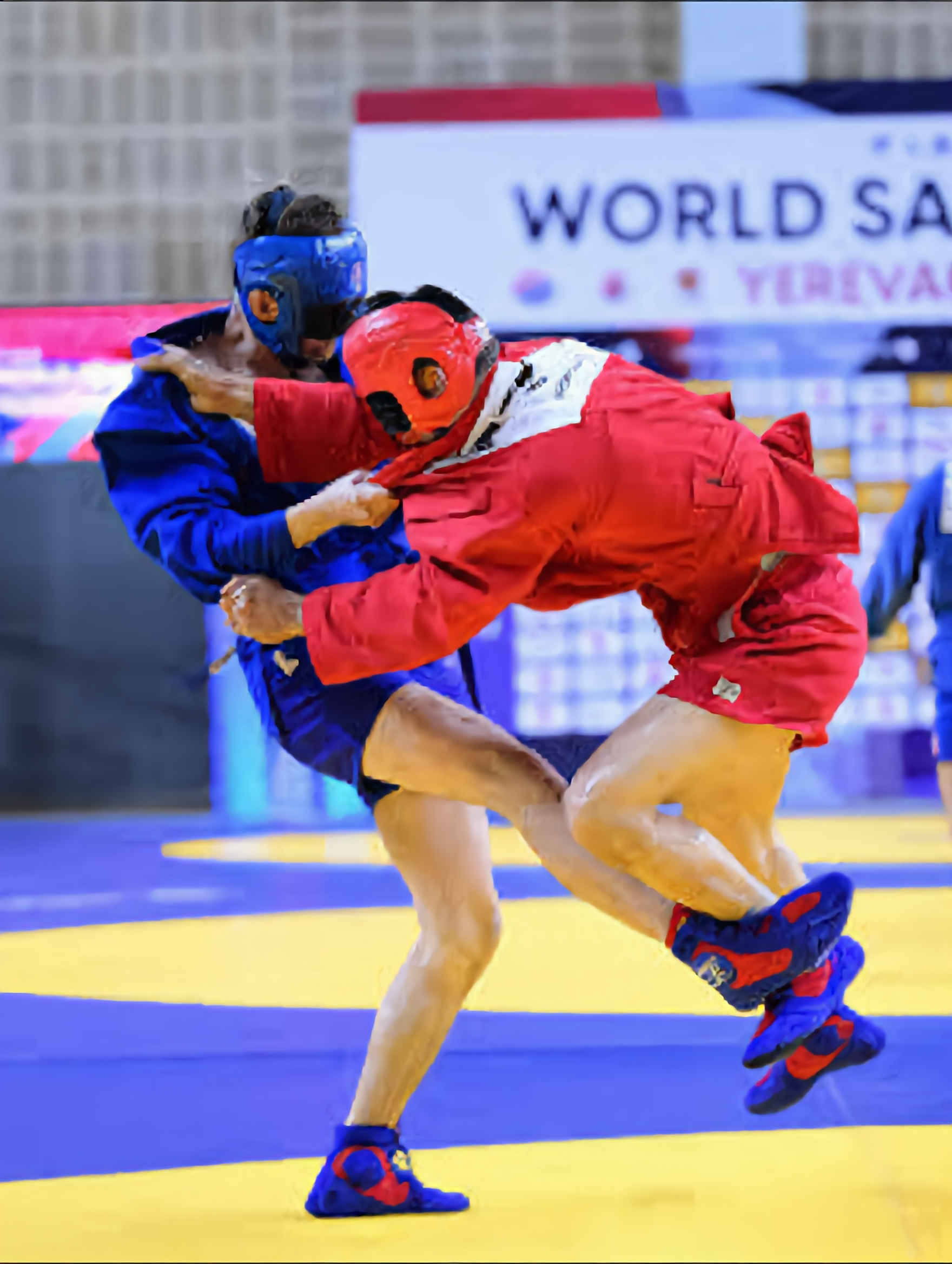
Sport Sambo — the contest. The form the world competes under and the one you will find in a club: the red or blue kurtka, the boots, the throws that score total victory when the thrower stays on his feet, the hold-downs that count, the arm locks and the straight leg locks, and the one thing forbidden. It is wrestling in a jacket with the floor briefly allowed, and it is where the art's honesty lives, because everything in it is tested against a man trying to stop it, with the referee standing you up before the ground can hide anything.
Combat Sambo — the fight. The military form, the one the army and the special services kept for themselves: everything in the sport plus strikes, chokes, headgear, and very few mercies. If sport sambo looks like wrestling in a jacket, combat sambo looks like a fight, which is precisely what it was always for. The room is held by the most famous man ever to come out of it, an undefeated champion from the mountains of Dagestan, and it reads his whole ledger, the father, the discipline, and the night he went over the fence.
Freestyle Sambo — the door. The American rewrite. In 2004 a club in New Jersey wrote a rulebook that kept the jacket and the throws, dropped the strikes, and let in everything the Russian sport had forbidden: the choke, the neck crank, the twisting attacks on the heel. It was written to invite the judo man and the jiu-jitsu man onto a sambo mat, and it did something else without meaning to. It opened the door the founders had built the art to reach and the sport had nailed shut. The hall ends on that mat, with the neck finally a legal target.
The order is the argument. The sport comes first because it is the art as you will actually find it, in a club, under a rulebook, with the throw as the crown and the choke forbidden, and because its honesty about what it tests is the foundation the other two rooms stand on. Combat comes second because it is the reason the art exists, the fight the sport was distilled from, and a man should see the sport before the fight so that he can feel exactly what the sport took out. And the American room comes last, on purpose, because it is the version that gave back the one thing the whole range has been walking toward and refusing: the finish. The takedown decided where the fight goes. The last room on this range is the first one that lets it end there.
The Three Questions in the Kurtka
TRUTH — sambo is what honesty does to a fighting system. It was built by testing every inherited technique against resistance and keeping only the survivors; no move was sacred, no tradition was protected, and the audit never closed. Train in that spirit: your style is a hypothesis, and live opponents are the experiment. And hold the deeper line the art's own history teaches. The state lied about Oshchepkov for fifty years, but the mat never lied about his system. Institutions can falsify records. Resistance cannot be falsified.
LOVE — look at what the two founders actually built. Spiridonov's half of the art exists so that the wounded, the older, the outmatched can still defend the people behind them. And look at the proof-man, fighting without hatred, honoring opponents, carrying terrifying skill with a gentle hand. The power this room builds is for standing between trouble and your family, and the moment it becomes cruelty it has left the art.
LAW — combat sambo is the most dangerous curriculum on this mat, and it survives only because it is governed: rules, protective gear, rank, and partners entrusted to each other's restraint. Fedor under the brightest lights never once let fury take the wheel, and the room that holds the other great champion of the art tells you what happened the one night one of them did. That is the standard: the more force a man carries, the tighter his self-government must be. Ungoverned strength is not strength. It is a knock on someone's door at midnight.
"For when I am weak, then I am strong." — 2 Corinthians 12:10
Half of this art was built by a man with one working arm, for men who were already hurt, and it works. The apostle who wrote that line had asked three times for his own wound to be taken away and been told no, and he was not talking about a fighting system when he called the weakness a strength. He was talking about where the strength came in. Spiridonov rebuilt fighting around what he had left. It is worth asking, on the way onto this mat, what a man does when what he has left is nothing.
The Last Emperor
Every art waits for the man who proves it, and sambo's proof was born in 1976 and raised in the steel town of Stary Oskol. His name is Fedor Emelianenko.
He came up the standard Russian road, sambo and judo from age ten, an army hitch, world combat sambo titles, a thick-bodied, soft-faced man you would walk past in a grocery store without a second look. Then he stepped into the great Japanese fighting promotions, where the largest crowds in the sport watched the best heavyweights on earth, and for nearly ten years nobody beat him. He took the heavyweight crown from the best grappler of the era and defended it against giants, strikers, wrestlers, and brawlers. They called him the Last Emperor. In one famous match a former American college wrestling champion lifted Fedor and spiked him on his own head with a throw that should have ended the night, and Fedor unfolded, rolled through as calmly as a man getting out of bed, and won moments later with a sambo arm lock. Asked about it afterward he barely shrugged. Falling is not an emergency. Remember the soil.
But the record is the lesser half of what Fedor brings to this room. Watch the man. While opponents snarled through entrances built of fireworks and fury, Fedor walked to the ring with a face like a winter field, no rage, no theater, his heart rate famously barely above resting. He never trash-talked. He spoke of his opponents with respect before the fight and embraced them after, including the ones who had mocked him. He said plainly that he fought without hatred, that anger is a weight a fighter cannot afford to carry. The deadliest man of his generation was the calmest man in the building, every single time. That is the whole philosophy of the art walking around in a body: emotion spends energy, fear surrenders position, and the man who stays quiet inside is the man whose technique stays available to him when everything goes wrong.
And now set the last piece in place, because the story of sambo ends somewhere its founders' state never intended. The Soviet Union that built this art was officially atheist, a government that demolished churches, jailed priests, and taught three generations that God was a fairy tale for the weak. It erased Oshchepkov for touching Japan; it tried to erase Christ from Russia entirely. And the greatest fighter that whole system ever produced, the proof of the art, is an open, unembarrassed Christian who crosses himself in the corner, credits God for every outcome, and speaks of his faith more readily than his victories. The state that tried to bury the faith ended up showcased to the world by a man on his knees. God writes long jokes. And Fedor's faith is not a sticker on his fighting; it is the source of the calm. A man who believes the result is in God's hands has nothing left to be frantic about. His only job is to prepare honestly and walk forward. Fedor's own line at the top of this page is sambo talking, and it is also nearly a psalm: Scripture is full of falling men whom God stands back up, and it reserves its hardest words for the man too proud to admit he is down.
Walked as a System
The three rooms are the art taken apart the way its founders took judo apart. The sport is what survives a referee. The fight is what survives without one. The American room is what happens when a third country holds the mat and rewrites the rule, and lets back in the thing the founders built the art to reach. Walk them in order and the shape of the whole range comes clear behind you: the wrestler drove, the judoka yielded, and the sambo man took both roads and followed them down, because to him the ground was never an emergency, only the next place to work.
And nothing from the two rooms behind this one is wasted here. The base and the chain from the wrestling room are the engine under every sambo throw, because the harvest kept them. The grip on cloth and the breakfall from the judo room are why a sambo man can be launched and land and keep working. And the calm this room hands you goes ahead of you into every range on the Farm, into the cage up the hill where the art's combat branch became the closest ancestor of modern fighting, into the Armory where a man on his back with a weapon in play cannot afford to panic, and into the next building, where a man is going to sit on your chest and breathe.
After the Room
Before you go find the sport, hear what this art saw that the two rooms behind it did not, so that you leave this range knowing why it ends here.
Wrestling put a man on the ground and held him. Judo threw him and, in its sport, stood up. Both of them decided where the fight goes and then stopped, because their rulebooks told them the question was answered. Sambo did not stop. Its founders were building self-defense without weapons for police and soldiers, and a man on the ground with a policeman on top of him is not a finished problem; he is a problem with a free hand. So the Russians followed the fight down, to the legs nobody was attacking and the arm locks and, in the military form, the choke, and they treated the takedown as what it actually is: a door. The sport nailed some of that door shut. The last room in this hall pries it back open. And on the other side of it the standing game is over entirely, and the men who live there have spent their lives on a question this whole range only asked in passing: what a man does once the fight is on the floor and nobody is coming to stand it up.