
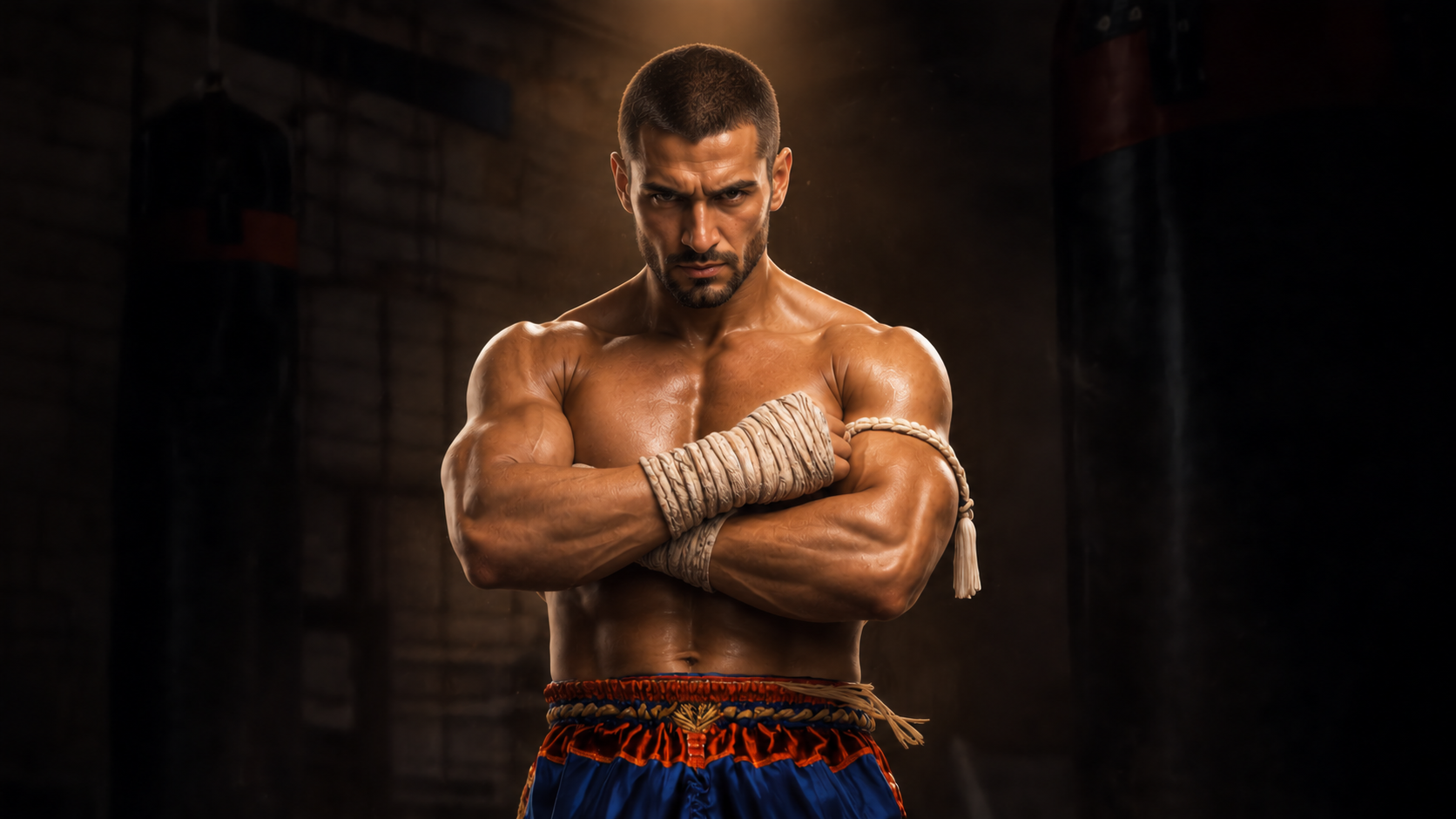
Muay Thai
The Art of Eight Limbs
The Warrior does not walk you to this corner of the Dojo. He hands you a ticket. "Some arts you can learn anywhere," he says. "This one has a home, and the home is part of the lesson."
The gym sits down an alley in Bangkok where the heat arrives before the sun does. The smell reaches you first — boxing liniment, old leather, sweat baked into canvas — and under it, the slow rhythm of shins hitting bags, like someone chopping wood. A short, dark-skinned man crosses the floor to meet you, soft-spoken, smiling like you are an old friend he has been expecting. Up close you read his face: scar tissue over both eyes, a nose set more than once, a quiet map of a hundred nights at Lumpinee Stadium. He never tells you his record. He does not have to — it is written where you are looking. He presses a pair of gloves into your hands and says, almost gently, "Today, you kick." He is the Kru — the teacher — and he will never raise his voice once in all the months he spends rebuilding you from the shins up.
Muay Thai is the art of eight limbs — two fists, two elbows, two knees, two shins — plus the clinch that binds them into one system. It is the most complete standing art on earth and the most battle-proven. But the first thing the Kru wants you to understand is that you have not joined a sport. You have stepped into something Thailand has been handing father-to-son for centuries — a war art, a livelihood, a national inheritance, and a way of life — and the fighting is only the part of it you can see.
This page is the main floor of the camp: the bags, the pads, the ring, and the old man who runs them. It tells you where the art came from and what it is to the people who own it, what the eight weapons are and why the ninth thing, the clinch, matters more than any of them, how a student here fails, and how the Kru handles the one kind of student every camp gets and most camps lose. Then it names the three doors off the main floor and the order the Kru opens them in, because the order runs from the root of the art to its crown to its hardest living cousin, and the last door is the one he opens most carefully.
Older Than the Ring
Before there was a ring, there was a battlefield. The old kingdom of Siam spent centuries at war with its neighbors, Burma chief among them, and Muay Thai began as the soldier's answer to a lost weapon — when the sword broke or the spear was gone, the body itself became the arsenal. Elbows where the blade had been. Knees where the shield had been. The art grew up alongside the kingdom's weapons, and it kept the battlefield's honesty: nothing in it was ever designed to score points. It was designed to end a man's ability to keep coming.
Every Thai schoolboy knows the story the Kru tells you over rice one evening. In 1774, a captured Siamese fighter named Nai Khanomtom was brought before the Burmese king and matched against Burma's best — and beat them, one after another, until the king let him go home in honor. Thailand still celebrates the day. That is what this art is to the Thai people: not a hobby, not a workout. A thing their nation did when everything else had been taken from it. Burma kept its own hard cousin of the art, and the whole region carries the family resemblance. This is Southeast Asia's fighting inheritance, and Thailand is the keeper of its deepest version.
More Than a Fight
In Thailand, fighters start as boys — eight, nine, ten years old — and many of them fight to feed their families. The purse from a stadium fight goes home to a mother in the provinces. By the time a Thai fighter is twenty-two he may have had two hundred fights, and he carries them the way the Kru carries his: quietly. The gym is not a business he attends; it is a family he belongs to. The Kru is a second father — he feeds his fighters, houses them, names them. Most Thai fighters fight under the name of their camp, not their bloodline. Think about what that says about loyalty.
Before every fight, the fighter kneels in the ring and performs the wai kru ram muay — a slow, deliberate dance that honors his teacher, his family, and everything that brought him to this square of canvas. On his head he wears the mongkhon, a woven headband that cannot be bought, only given — placed on him by his Kru when the Kru decides he is ready to represent the camp. Gratitude, in this art, is not a feeling. It is choreography, performed in public, before every war.
And then there is the composure. A Thai fighter does not show pain. Take his best shot and smile — not as bravado, but as currency, because in Thai scoring a man who shows damage is losing, and a man who panics has already lost. The calm you came here to find is not a side effect of this art. It is the art.
Fight Night at Lumpinee
One night the Kru takes you to the stadium, and you understand the scars. The place is concrete and smoke — cigarettes hanging in the lights, liniment and fried garlic on the air, and a wall of sound from the upper tiers where the gamblers stand. They bet with their hands, fingers flashing odds across the crowd, voices rising and crashing with every clean knee like a stock exchange built around two men in a ring. The live band sits beside the ring — drums, cymbals, a reedy pipe — playing the sarama, and the music speeds up as the fight heats, driving both men forward like weather.
The first two rounds are quiet, almost polite — two fighters reading each other while the gamblers set their lines. Rounds three and four are where the fight lives, and the whole building knows it. And at the center of all that noise and money and smoke stand the two calmest men in the province, trading shin-kicks that would fold a horse, faces flat as still water. The Kru watches the ring without expression. Forty years ago that was him — a boy from the rice country, fighting under these same lights for his family's rent. Every scar on his face paid for something. He would tell you it was worth it, but he does not talk about it, which tells you more.
The Eight Weapons
The hands box. The elbows cut — short, hard arcs at a range where gloves are too wide, the weapon that ends fights on blood. The knees are the heavy artillery, thrown from distance or driven from the clinch into ribs and sternum. The shins are the signature: the Thai round kick is not thrown with the foot but with the shin, swung like a bat through the leg, the body, the head — and a shin that can do that is built over years on bags and pads, thousands of strikes, until the bone itself has been to school. The teep — the front push-kick — is the jab of the legs, the fence that keeps a man at the distance you choose.
Then the clinch, the layer that separates this art from everything else standing. Two men tied up at the collar, fighting for inside position with hands, forearms, and balance — knees driving in, elbows slicing out, sweeps and dumps putting a man on the canvas without a single punch. The kickboxing hall you just left had an agreed distance and ended the fight when that distance closed. This camp treats the closed distance as a second fight inside the first, and the man who has not trained it loses it immediately. Patience runs through all of it — slowly, slowly. The end of a matter is better than its beginning, and patience is better than pride (Ecclesiastes 7:8). The beautiful knife takes years, and the Kru is in no hurry, and that is exactly why his fighters get sharp.
The Restless Student
Every camp gets him, and the Kru has trained a hundred of him: the boy who cannot sit still. He talks through the wai kru. He is on his third bag before the others have wrapped their hands. His mind runs ahead of the drill and leaves the drill behind, and a coach who does not know what he is looking at will call him lazy, which is the one thing he is not.
The Kru knows what he is looking at, and he wants the boy, because the art was built for him. A brain wired for stimulation walks into a room that never stops: combinations, pads, sparring, a new problem every ninety seconds. Where the calm student has to be pushed, this one has to be pointed, and when he locks in — and he does lock in, harder than anyone else in the room — he trains at a pitch the others cannot reach. He is explosive. He takes risks. He throws the spinning elbow other fighters would not try, and the unpredictability that got him sent out of every classroom he ever sat in makes him dangerous in a ring. The lock-in has a name in the yard back home, and the men who train it on purpose call it Hyperfocus. Here it simply arrives, and the Kru builds the session so that it arrives more often.
The flip side is the thing that ends most of these boys. Structure does not come easy to him. The long drills feel endless, the footwork feels like punishment, and when the novelty runs out he cuts the corner or drifts off exactly when the round needs him. Worst of all is the rollercoaster: a hundred and ten percent on Tuesday, gone by Friday, back in a month full of apologies. The Kru has watched that pattern kill more talent than any opponent ever did. So he does not fight the boy's wiring. He builds around it. Short blocks, hard and clean, with a change of problem before the boredom sets in. A day that looks different from yesterday. A routine that does the showing-up for him on the days the excitement is not there, because the fighters who make it are not the ones who felt like coming; they are the ones whose habits walked them through the door. And when the hyperfocus arrives, the Kru gets out of its way and lets the boy burn, then makes sure the fire is banked before it burns him down.
I have calmed and quieted myself, I am like a weaned child with its mother
—Psalm 131:2
The restless student is not asked to become a different man. He is asked to control the chaos instead of letting the chaos control him, and the one who learns that here carries something out of the camp that the calm student never needed and never gets: a fire, and the hand on the damper.
How a Nak Muay Goes Wrong
A student of this art is called a nak muay. Here is how he fails.
The two-week tourist. He flies in, trains a camp, photographs everything, and flies home with a story instead of a skill. The art keeps no record of his visit. Muay Thai gives itself slowly, to men who are still on the bags after the romance wears off — there is no express lane through a centuries-old inheritance.
The unconditioned shin. He learns the kick before the bone is ready and breaks himself on another man's elbow. The conditioning is not a side program; it is the price of admission to the weapon. Pay it in full, on a schedule the body can survive — punishment for its own sake is vanity in hand wraps.
The man who avoids the clinch. He drills the kicks and the hands and slides out of every tie-up, because the clinch is exhausting and humbling and there is nowhere to hide in it. So the one layer that makes this art complete is the one layer he does not own.
The fighter who shows it. He eats a leg kick and grimaces, gets clipped and panics, and announces every success his opponent has. In Thailand he loses the round; in the world, he hands the other man the only intelligence that matters. The flat face under fire is trained here, on purpose, like everything else.
The man who wants the hardest version. He has heard there is something across the border with no gloves and no points, and he wants it before he can throw a clean teep, because he thinks the hardest thing must be the truest thing. The Kru will show him that door. He will not open it for him yet, and the room behind it explains why.
Three Doors, Walked in Order
The camp is bigger than the bags you have been kicking. Off the main floor there are three more doors, and the Kru opens them in an order that carries a reason: the root of the art first, then the kind of fighter the art crowned, and last the hardest thing that ever grew from the same soil.
Muay Boran — the old boxing. What this art was before the ring put gloves on it. Rope-bound fists, four regions with four tempers, techniques the modern rules retired and a few they kept. The Kru wraps your hands in the old rope himself, once, so you understand why the gloves came. The room the whole camp grew out of.
Muay Femur — the style of the thinkers. Not a different art — a different kind of fighter. The one the gamblers trust, the one the Thais name their greatest after, the one who wins the fight's argument instead of its exchanges. For a grown man who came to this art late, it is the door that matters most, because craft is the only thing in this camp that is still climbing at an age when power is a memory.
Lethwei — the road east. Burma's answer to the same old wars. Nine limbs instead of eight, no gloves, no points, and a rule that lets a man who has been knocked out come back and keep fighting. The Kru will not send you through this door. He will sit you in front of a screen and show you what is behind it, and then he will make you do arithmetic.
The order is the teaching. You cannot understand why the gloves came until you have felt the rope, so the old boxing is first. The gloves changed what winning meant, and the ring began to crown a fighter the rope never favored, so the thinker is second, and you meet him right after you learn what made him possible. And the hardest version comes last, on purpose, after you have learned the root and the crown, because a man who watches Lethwei first sees only the courage and a man who watches it last sees the cost as well. The doors get harder as they go. The last one is the only one the Kru refuses to hold open.
The Three Pillars in the Camp
TRUTH— a Thai fighter's record is written in hundreds of honest rounds, and a Thai gym extends nobody credit: the pads, the clinch, and the ring tell the Kru exactly what you are. Honor that honesty — and bring your own to the spiritual layer of the culture. The amulets, the blessed tattoos, the spirit houses outside the gym door: respect what they reveal about a people who know fighting is more than physical, and know that your protection is not woven into a headband.
LOVE — the purest thing in this art is why the boys fight: the purse goes home. Family is the engine under the whole tradition — the camp that feeds you, the Kru who fathers you, the mother in the provinces whose roof is being earned. You did not come here to become dangerous for its own sake. You came because there are people behind you, and this art, at its roots, has always been fought for the people behind the fighter.
LAW — the camp runs on codes older than its building: bow to the ring, honor the mongkhon, never disgrace the name you fight under, protect the partner who is making you better. Give honor to everyone the tradition says is owed it — the teacher above all. And know that the eight weapons you are building here are counted by a stricter judge than any ringside table the day one of them is used outside the ropes.
"But you, LORD, are a shield around me, my glory, the One who lifts my head high." — Psalm 3:3
The mongkhon cannot be bought. It is placed on a fighter's head by another man, on the day that man decides he is ready, and he wears it into the ring knowing where it came from. A nak muay will spend years earning that headband, and it is worth knowing, going in, that the man who wrote that line had already worked out whose hand it is that lifts a head.
The Men Who Teach Here
The Kru makes you learn the names, because the art lives through them. Apidej Sit-Hirun, the golden-age king who held seven titles at once and kicked hard enough to break arms — and finished his life as a gentle old trainer handing the art to children. Dieselnoi, the knee fighter so dominant they ran out of men willing to face him. Samart Payakaroon, the one most Thais will tell you was the greatest ever — a Lumpinee champion who then went and won a world boxing title with his hands alone, and the purest example of the style the second door is named for. The great teachers like Yodtong Senanan, who built champions by the dozen out of a camp by the sea. And the moderns you have already heard named back at the Farm — Saenchai, who turned defense into play at the highest level, and Buakaw, who carried Thailand's flag into the world's rings. A few outsiders earned their way into this story too — Dutchmen and Australians who came, bled honestly in Bangkok, and were given respect the hard way. How the Thai art and the Western ring eventually collided and made the modern striking game is a story for further up the road, in Fight Sports — for now, the Kru just smiles and holds up the pads.
Walked as a System
The main floor and the three doors are one fighter. The floor builds his weapons and his face. The first door tells him what the weapons were before anyone was allowed to survive them. The second door shows him what the weapons become in the hands of a man who thinks, and tells him plainly that this is the only door in the camp where his age is an advantage. The third door shows him the weapons with every subsidy removed, and then asks him whose family, whose rice, and whose village he would be fighting for if he walked through it. A man who has walked all three knows the art's root, its crown, and its cost, and he knows which of the three he was tempted by, which is a thing worth knowing about yourself before anyone else finds it out.
And the camp leaves with him. The shin goes back to the kickboxing gym at home as the low kick thrown the way the men who invented it throw it. The elbow goes to the Armory, where it turns out to be the same weapon a blade is, thrown from the same hip. The flat face goes everywhere — into the parking lot, the negotiation, the hospital hallway — as the trained refusal to hand another man the intelligence of how badly he just hurt you. And the clinch goes down the mat to the next range, because this is the only striking camp on earth that ever treated the tie-up as a fight, and the men who live in the next room are about to show him it was theirs all along.
After the Camp
On your first morning, before you have thrown a kick, the Kru tells you where this ends, because he wants you to hear it while you still think eight limbs is the whole answer.
"Everything I teach you works at two distances," he says. "Far, where the shin and the teep live. Close, where the elbow and the knee live. Between them is the clinch, and I will teach you the clinch better than anyone in this hall can. But the clinch is a door, and it opens both ways. On the other side of it are men who do not strike at all, and they have spent their whole lives on the thing I only visit. When you tie up with a man like that, everything I gave you is one movement of his hips from being over." He picks up the pads. "I will make you the best striker you can be. Then I will send you to them, because the ground was never my art, and a man who only knows my art is a man who can be taken there."
Tools & Resources
Impak Training Bag