
Muay Femur
"Power gets tired. Craft does not." — the Kru
The Thinking Man's Muay Thai
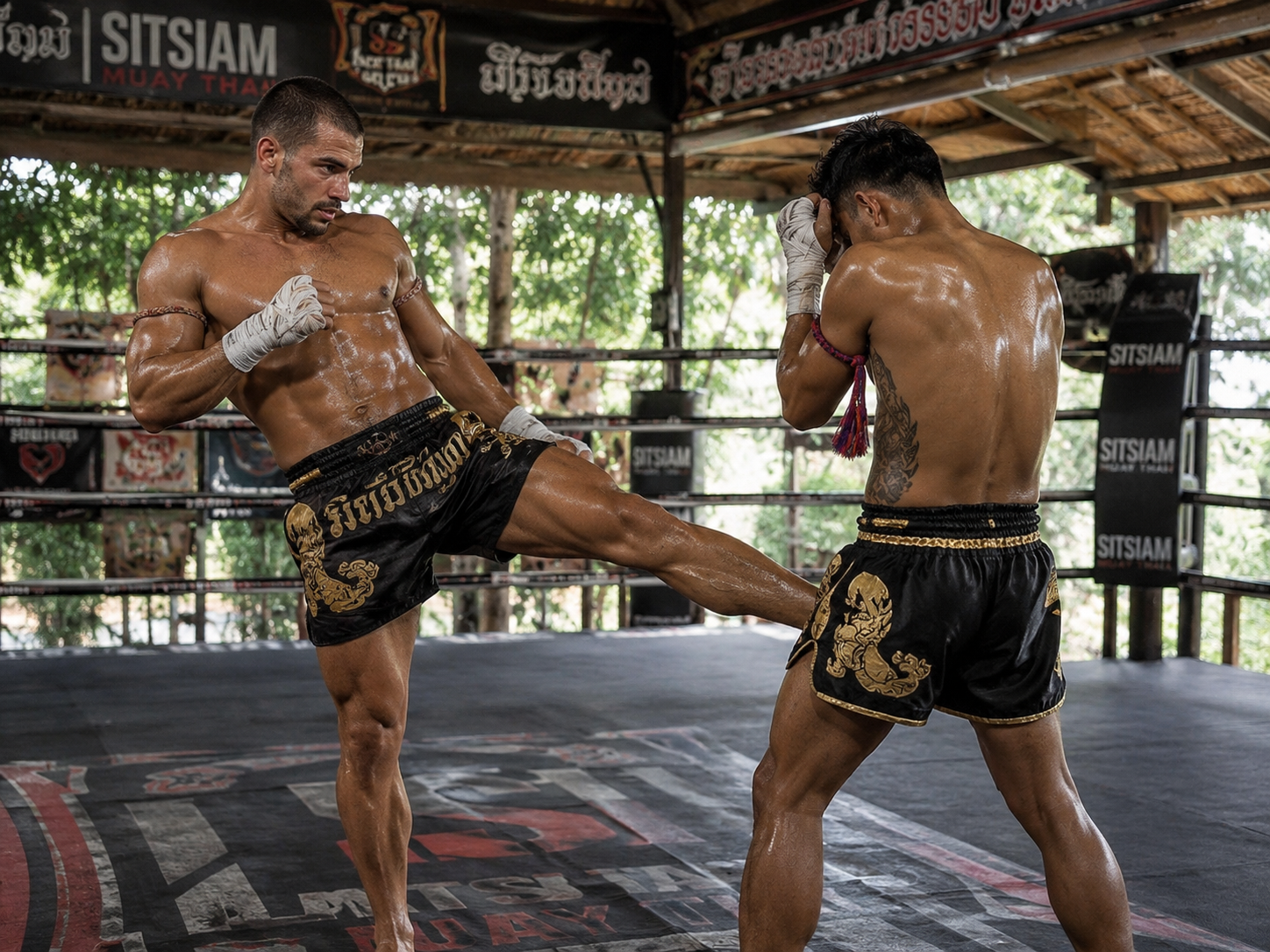
Fight night, and the Kru has you watching the undercard. In the blue corner, a unit of a man, shoulders like a water buffalo, kicks that boom off the pads all week. In the red corner, a smaller fighter with a face like he is waiting for a bus. You pick the big man. So does the crowd, early. And then, somewhere in the third round, you notice the strange arithmetic of the fight: the big man is throwing everything and landing almost none of it, and the small man, never hurrying, never trading, is a half-step outside every bomb and a half-beat ahead of every idea. He catches a kick and dumps the big man on his hip, almost politely. The gamblers' hands flash in the upper tiers; the odds have flipped. The small man wins going away without ever once looking like he was in a fight. The Kru leans over. "That one is femur," he says, like he is naming a species. "Watch him, not the strong one. Strong is common."
Muay Femur is not a separate art. It is a kind of fighter, the technician, the ring general, the one who wins with his brain, and in Thailand it is the most honored title a fighter can carry. This is the second door off the camp, and it has no rooms of its own behind it, because there is nothing to buy here and nowhere to go. What this room does is name the kinds of fighter the camp sorts men into, explain why the ring crowned this one above the rest, show how he is built, tell the honest ledger of what beats him and what the modern game is doing to him, and say plainly why, for a grown man who came to this art late, this door matters more than any other in the camp.
A Camp Full of Animals
The Thais sort fighters the way a rancher sorts stock, by nature, not by wish. Muay Khao, the knee fighter: a marcher who closes distance, ties you up, and grinds you away in the clinch. Muay Mat, the puncher: heavy hands hunting one clean answer. Muay Tae, the kicker: the man building a fight out of the shin, one chopping round kick at a time. Muay Sok, the elbow specialist: short range, sharp edges, fights that end on blood. Muay Bouk, the pressure fighter: forward on rails, pace as a weapon, drowning you in volume. And Muay Femur, the one who is none of those and can answer all of them. Femur means skillful, and the femur fighter fights with timing, feints, balance, and reading. He takes what you do and hands it back to you wrong.
The Kru sorts his own fighters the same way, silently, over months, because a man fights best from his nature, and a camp that turns every boy into the same fighter has stopped coaching and started stamping. The four old regions in the cabinet behind the first door were the same sorting done by geography. This is the sorting done by temperament, and the answer the old southern guard gave, make yourself painful to hit and then think, is the answer the femur fighter gives with gloves on and a scorecard behind him. Know which animal you are. Then learn to think like the fox anyway.
Why the Femur Is King
Thai scoring, you already know, rewards the man who shows control: balance, composure, the clean answer over the loud one. The femur fighter is what that scoring system looks like when it becomes a person. He does not win exchanges; he wins the fight's argument. By the fourth round the judges, the gamblers, and eventually his opponent all agree on the same quiet fact: one man in the ring is deciding what happens, and it is not the other one.
Ask a Thai for the greatest ever and you will mostly hear femur names. Samart Payakaroon, whom you met on the main floor, so complete he made champions look like students, then won a world boxing title on the side. Somrak Khamsing, who boxed his way to an Olympic gold with the same unbothered face he wore at the stadiums. Karuhat and Namsaknoi from the golden age, men the hardest fighters of their era did not want to look bad against. And Saenchai, who at an age when fighters are supposed to be retired was still making young lions miss and grin, the closest thing the art has to proof that craft does not expire.
But the Kru is honest with you, because the camp runs on honesty: femur is not a cheat code. The greatest knee fighter who ever lived once ground down the great Samart himself, and the lesson is older than both of them. Styles make fights, and no crown is safe from the right pressure on the wrong night. The femur is king the way wisdom is king: not because it never loses, but because it is the only advantage that compounds.
How the Femur Is Built
He is not born. He is drilled, and the drills are the ones every boy in the camp does, run longer and thought about harder.
The teep as a fence. The push kick is the femur fighter's jab and his whole distance game, and he throws it more than any other fighter in the camp, not to hurt but to place the other man where the next thing is going to happen. A femur fighter who owns the teep owns the range of the fight, and the range of the fight is the fight.
The catch and the dump. The moment in the cold open, the kick caught and the big man put on his hip, is the femur signature, and it is drilled a thousand times: the arm scoops the leg, the hips turn, the sweep takes the standing foot, and a man who was throwing his best weapon is on the canvas without having been struck. In Thai scoring that is worth more than a landed kick, because it shows control, and the femur fighter collects it all night.
The read, with the face flat. The main floor told you the calm is the art. In the femur fighter the calm is also the weapon: he watches the other man's shoulders and hips and breath from behind a face that gives nothing back, and the other man, getting no information, starts guessing, and a guessing fighter is a fighter the femur has already solved.
The feint, and the answer to it. He shows a kick to draw a check and punches into the lifted leg's imbalance. He shows a punch to draw the guard and teeps under it. Every femur technique is two techniques, the one that is shown and the one that lands, and the whole style is learning to make a man react and then living in the half-second after he does.
Craft Ages, Power Does Not
Here is why this door matters most to you, and the Kru knows it, which is why he opened it. You are not eight years old with two hundred fights ahead of you. You are a grown man who came to this art late, and the athletic gifts you have are the most you will ever have; from here, the body only negotiates downward. Power fades. Speed fades. Timing, distance, reading, composure, those compound for as long as you keep paying attention. The young man's path into this art runs through his engine. Yours runs through your eyes.
That is not a consolation prize. Watch the old Kru on the pads sometime, sixty-something, moving less than any man in the room, and untouchable, because he is standing where you are about to be wrong. Every year you train, that account grows. The femur path is the only one in the fight world where the gray-haired man holds the high ground, and it is the same law you will meet in every Kingdom of this life: what is built on strength peaks early; what is built on wisdom is still climbing at an age when strength is a memory. He gives strength to the weary and increases the power of the weak (Isaiah 40:29). The verse was written for a people who had run out of engine, and the femur fighter is the picture of a man who found there was a second kind of strength on the far side of the first one running out, and the Farm keeps the verse beside him for the question of where the second kind is issued from.
The Counterfeit Femur
Every camp has one: the young man who watched the highlight reels and skipped the invoice. He throws the cartwheel kick and the question-mark feint, spars like a showman, and calls it femur. It is not femur. It is decoration. The real femur fighter is built out of ten thousand boring rounds of fundamentals, the jab, the teep, the check, the balance, and the flash you see at the top is what fundamentals look like after they have been paid for in full. Saenchai can play because Saenchai spent thirty years earning the right; the counterfeit plays first and learns, against the first honest opponent, that cleverness without foundations is just a slower way to get hit.
There is a heart-level version of the same counterfeit, and it is worth naming because you will meet it far from any ring: the man who performs intelligence instead of possessing it, clever in front of an audience, empty under pressure. In here and out there, the test is identical. Control that shows off is vanity. Control that holds when the other man is trying to break it, that is the real thing, and everyone in the building can tell the difference by round three. Fight your fights, in the ring and out of it, so that the people you answer to are safer because you stayed calm, and win, when you can, in a way that leaves the other man beaten but not destroyed. The femur's restraint is not weakness. It is jurisdiction.
The Honest Ledger
The Kru closes this door on two hard facts, and he says them in this order.
The first you have heard: the femur loses. The knee fighter who will not be teeped away, the pressure fighter with an engine that outlasts the read, the puncher who lands the one the femur did not see coming. Every crown in this camp has been taken by a man from a different pen, and the femur's answer is not to be unbeatable. It is to be the one whose losses teach him, because he is the only fighter in the building who was watching himself while it happened.
The second is newer, and the Kru says it with something like grief. The modern game is being scored away from him. The international promotions that now pay the best purses reward aggression and the finish, shorten the rounds, and count damage over control, and a fighter who wins the fight's argument the way Samart did can lose on a modern card to a man who simply threw more and landed louder. The femur fighter is still the most honored title in Thailand. He is no longer always the best-paid, and a young man who wants both has to decide which scoreboard he is fighting for. The Kru does not decide for him. He points at the old man on the pads, still untouchable at sixty, and lets the young man count which fighters from the loud era are still standing in a gym at that age.
Where This Sits
Second of three doors, and the only one with nothing behind it but the fighter himself. You know the six kinds of man the camp sorts you into, why the ring crowned this one, how he is built, what beats him, and why his road is the only one in the fight world that gets easier to climb with gray hair. That word from the counterfeit's room, jurisdiction, is the key to the last door. The Kru has shown you the root of the art and the mind of it. What waits behind the third door is the art with everything soft removed, no gloves, no points, and a rule that lets a man who has been knocked out come back for more, and he opens it last so that you will look at it with the femur's eyes and not the counterfeit's, and count, before you admire, what it costs.