
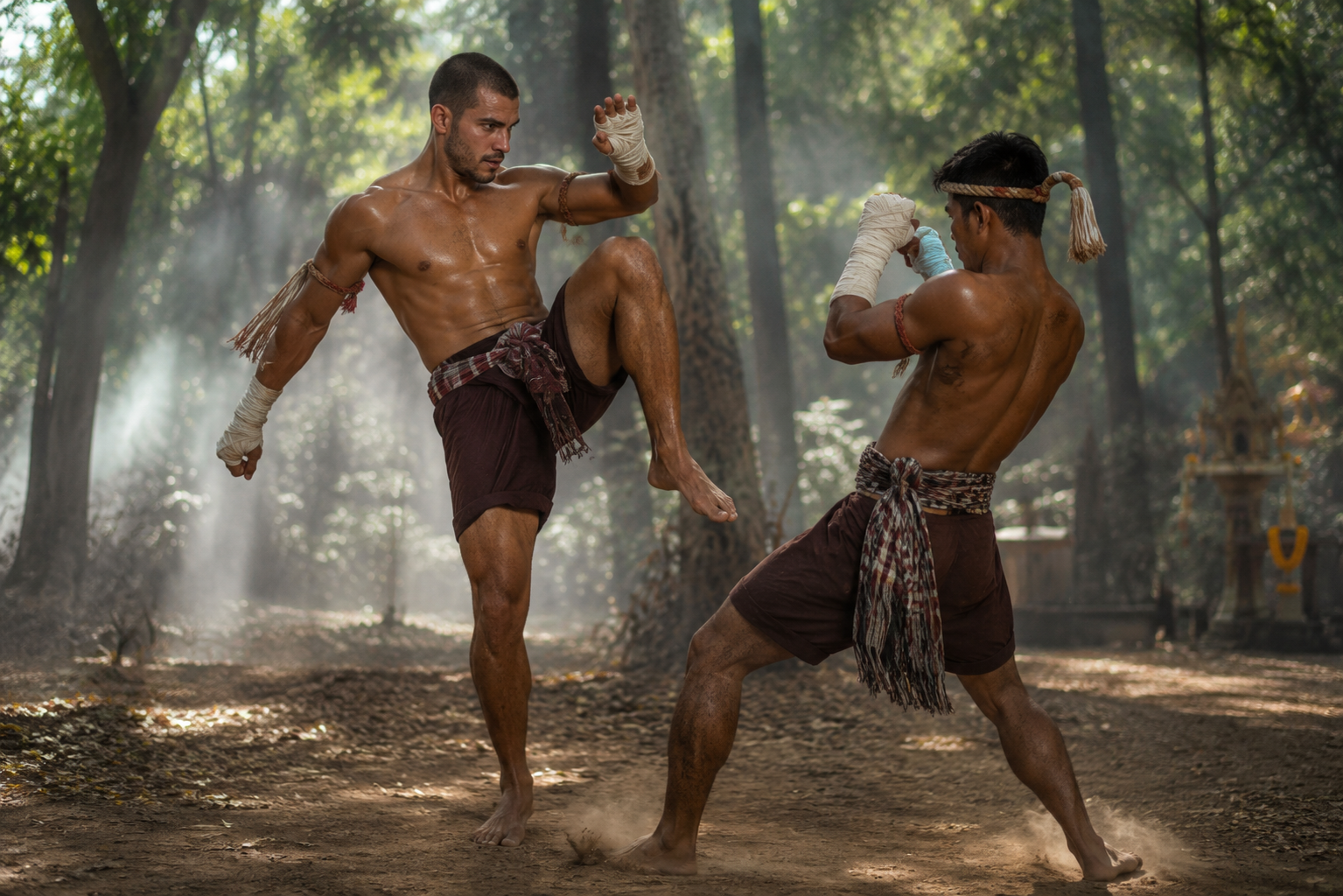
Muay Boran
Siamese Boxing
Kun Khmer
Muay Chaiya
The Old Boxing
On a rest day, when the bags hang still and the young fighters have gone home to sleep, the Kru unlocks a wooden cabinet at the back of the gym. Inside, coiled like something sleeping, are lengths of old hemp rope, dark with age and other men's sweat. He takes your hands, turns them over, and begins to wrap, knuckles, wrists, halfway up the forearms, until your fists are two knots of cord. Then he walks you to the heavy bag. "Hit it," he says. You do. Once. The rope bites your own skin as hard as it bites the bag, and every ridge of it announces itself to the man on the other end. The Kru nods at your face. "Now you know what your great-grandfathers in this art felt every time they fought. And now you know why we invented gloves."
Muay Boran means the ancient boxing. It is not one art. It is the family name for everything Thai fighting was before the ring, the rounds, and the gloves arrived, and everything you have been learning on the main floor grew out of this room. This is the first door off the camp, and behind it are three more, walked in an order that carries a reason: the old art under the name the outside world first knew it by, then the cousin across the other border who claims the same root, then the one regional style that survived with a living hand still teaching it. The walk through them rejoins the camp at the second door, where the ring's new rules crowned a new kind of fighter.
When the Art Wore Ropes
Before the stadium, there was the festival ground and, before that, the battlefield. The old fighters bound their fists in hemp rope, kard chuek, not to protect the hand but to harden the strike, and they fought without rounds, without weight classes, and mostly without referees who could save you. A match ended when one man could not continue. Nai Khanomtom, the captured fighter whose story every Thai schoolboy knows, was not doing what you saw at Lumpinee. He was doing this, the rope-fisted, no-quarter version, when he beat Burma's best in front of their king.
The old art also carried weapons the modern ring retired: throws that planted a man on his head, attacks on the joints, strikes to a downed opponent, and the headbutt. It was a soldier's system pressed into peacetime, and it never fully forgot where it came from.
Four Regions, Four Answers
Old Siam did not train one style. Each region raised its own answer to the same question, shaped by its own land and its own men, and the old-timers kept a saying that sorts them like a scouting report.
Muay Korat, from the northeast: power. Big, swinging blows built on farm-strong bodies, famous for a punch said to fell a buffalo. Muay Lopburi, from the central plains: cunning. Straight, clever punching, feints, a fighter who wins the exchange before it starts. Muay Chaiya, from the south: defense. A tight, folded guard of elbows and knees that turns the fighter's whole frame into something painful to hit, like grabbing fruit with a spiked shell. Muay Thasao, from the north: speed. Light feet, fast kicks, first to arrive and gone before the answer comes.
Hold that list up against your own reflection. The old masters understood something the modern gym sometimes forgets: the art bends to the man, not the man to the art. A thick-shouldered farm boy and a whip-fast featherweight should not fight the same way, and in old Siam they didn't. Part of the Kru's job, the part he does with his eyes, in silence, for months, is figuring out which region lives in you. Three of the four are mostly memory now. The fourth has a door of its own behind this room.
Why the Gloves Came
In the 1920s the old art walked into the modern world and men started dying in it. Fights had moved from festival grounds into permanent rings, crowds and purses grew, and rope-bound fists at full commitment did what they were designed to do. After deaths in the ring, the government stepped in: gloves in place of rope, timed rounds, weight classes, a referee with the power to stop it, the framework borrowed from British boxing and bolted onto the Thai weapons. What survived that surgery is the art you train on the main floor.
Understand what was actually lost and what wasn't. The elbows survived. The knees, the clinch, the shin all survived. What got retired was mostly what killed and maimed: the throws to the head, the downed-man strikes, the headbutt, though what Siam retired, Burma kept, and that story waits behind the camp's last door, Lethwei. Siam traded a battlefield art for one its sons could fight two hundred times and still walk away from, the trade that made the family economy of the camps possible at all.
And the gloves did one thing nobody ordered them to do: they changed what winning meant. When a fight no longer ended when a man could not continue, someone had to judge it, rounds, points, watching eyes deciding who controlled the argument. The moment a fight could be won without breaking a man, it could be won by out-thinking him, and the ring began to crown a kind of fighter the rope had never favored. The old art rewarded the man who could end you. The new one made room for the man who could read you. Thailand gave that fighter a name, and his door is the next one on the main floor, after the three behind this room.
Museum or Armory
Today Muay Boran lives a double life. One life is the museum: demonstration teams, tourist shows, and the movie screen. A generation discovered the old art when Thai films sent it flying across the world, beautiful and acrobatic, techniques named for the monkey king and the characters of old Siamese epic. Honor the culture in that. But be honest about it too, the same way you were honest about the amulets on the main floor: a technique with a poem for a name still has to work against a man who is trying to take your head off, and much of the demonstration art would not survive the first honest round. Beauty is not the test. Contact is the test.
The other life is the armory, and this is the one the Kru cares about. Pieces of the old art still work and still get trained: the Chaiya guard shows up in modern defensive frames, the old throws survive quietly in the clinch, and Thai soldiers kept their own hard descendant of the battlefield version. When the Kru teaches you an old technique, he teaches it the old way, against resistance, for a reason, and he tells you plainly which cabinet it belongs in.
One more thing he will not let you leave with: nostalgia. Young men fall in love with the idea that the old ways were harder, purer, more real, that the rope was honest and the glove is soft. The Kru, who has actually worn the rope, does not romanticize it. The old days were not better; they were just earlier, and they buried more of their fighters. Take what is proven forward. Leave the rest in the cabinet, respected and retired.
Three Rooms, Walked in Order
The Kru does not open these three the way he opens the doors on the main floor, one at a time when he judges you ready. He opens all three on the same rest day, because they are one story told from three sides, and he walks them in the order the story happened.
Siamese Boxing — the art under its old name. What the outside world called this art when it first saw it, the rope era from the festival ground to the first permanent ring, and the single fight in 1929 that ended the rope and began the glove. The root, told plainly, without the poem.
Kun Khmer — the cousin who says the root is his. Across the eastern border, Cambodia trains an art that looks like the main floor's and insists it came first, and the argument has cost real fighters real fights. The room tells the claim honestly, the temple walls and the empire and the four years when the art was nearly murdered, and then it tells you why the Kru does not take sides.
Muay Chaiya — the one that survived. Of the four regional answers, three are mostly memory. The southern one is not. It has a lineage that can be named, a guard that still shows up on the main floor, and a living hand teaching it, and its whole philosophy, defense first and then the answer, is the bridge to the fighter the ring would crown.
The order is the story's own. The rope and the name come first because the other two rooms are arguments about what the rope-era art was and whose it was. The cousin comes second because his claim is on the root, and a man should hear the claim right after he has seen the root for himself. And the survivor comes last because it is the only one of the four regions a man can still walk into, and because its answer to the old question, make yourself painful to hit and then think, is the answer the next door on the main floor is built on.
The Three Pillars in the Cabinet
TRUTH — the old art comes to a man wrapped in poems and film, and the Kru's first job in this room is to unwrap it. The rope was real and it killed men. The monkey-king techniques are beautiful and most would not survive a round. The cousin's claim and the Thai claim are both older than the paperwork that would settle them. A man who wants the old art has to want it as it was, not as the poster paints it.
LOVE — the old boxing was handed down father to son through festivals and wars and a century of gloves, and the three rooms behind this door are each a picture of what it costs to keep an inheritance alive: a name that changed, a border that argued, a lineage that survived because one old man in the south kept teaching. Honor the men who carried it. Then carry it.
LAW — the gloves were law, and the law saved the art by taking its deadliest tools away, and a man who trains the old techniques trains them under the new rules or he is not training, he is reenacting. The Kru teaches the old throws against resistance and inside the ring's mercy, and the cabinet stays locked on the rest.
"The boundary lines have fallen for me in pleasant places; surely I have a delightful inheritance." — Psalm 16:6
Two countries are about to argue, in the second room, over whose inheritance this art is, and the man who wrote that line had a country too and did not name it as the inheritance. He named where the lines fell, and Who drew them. A fighter wrapping his hands in his great-grandfathers' rope should know, going in, which inheritance the old men were actually pointing at.
Walked as a System
The three rooms are one question asked three ways: what was this art before the gloves, and whose was it? The first room answers the first half with a name and a date. The second room shows what happens when the second half is argued with flags. The third room answers both by showing a style that did not need a flag to survive, only a teacher and a student in a southern town. A man who has walked all three knows the root of the art he trains, knows the argument over it and why to stay out of it, and knows that the only piece of the old boxing that lived was the piece somebody kept handing down.
And the cabinet leaves with him. The rope goes back to the main floor as respect for the glove. The four regions go into the Kru's eyes as the question of which one lives in you. The cousin's claim goes into every argument a man will ever have about who owns a thing that was given to both. And the survivor's guard goes into the next door, where the man who made himself painful to hit learned to think behind the shield.
After the Cabinet
The Kru locks the cabinet and tells you where the walk goes when the three rooms are done.
The gloves did more than save lives. They changed who wins. When a fight could be judged instead of finished, a kind of fighter the rope had never favored began to take the stadiums, and the Thais gave him a name and put him above the puncher and the kicker and the knee man in their own ranking. He is the fighter the southern guard was always pointing at, the one who makes you miss and then reads you, and the second door on the main floor is his.