
Lethwei
Burma kept the wild version. This is the one door the Kru shows you and refuses to hold open.
The Art of Nine Limbs
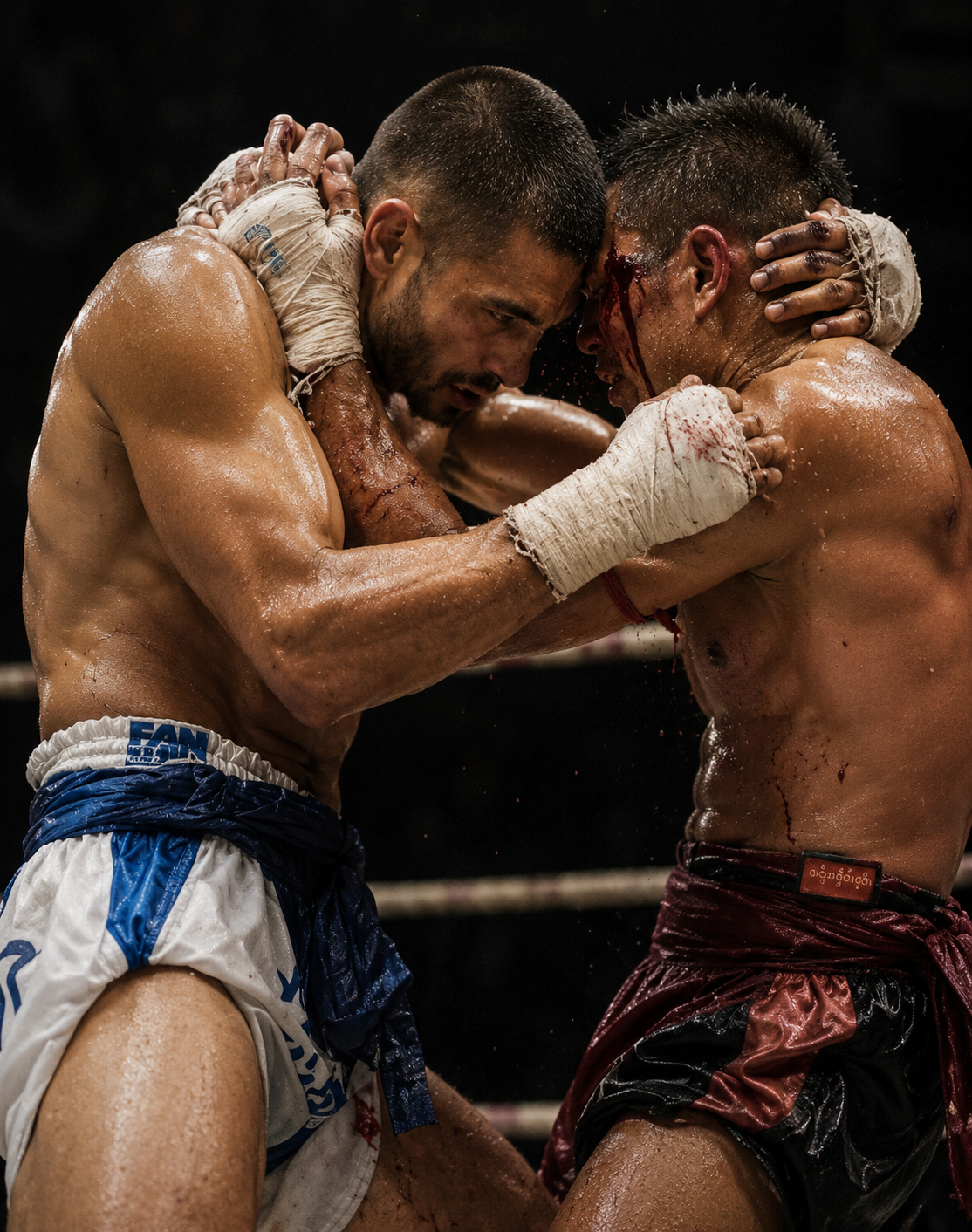
The Kru does not hand you a ticket for this one. Instead, one evening after training, he sets up an old screen and shows you a fight from across the border. Two Burmese fighters, hands wrapped in nothing but thin gauze, no gloves anywhere in the building. Before the fight each man raises his left arm and slaps it three times with his right hand, a sound like a door being knocked on, the lekkha moun, the traditional challenge: I am here, come and fight me. Then they do, and within a minute you see the thing that makes you sit forward: one fighter grabs the other behind the neck and drives his forehead into him like a hammer. No foul is called, because it is not a foul. It is a weapon. The Kru watches your face instead of the screen. "Eight limbs here," he says, tapping the floor of his own gym. Then he nods at the screen. "Nine there."
Lethwei is Burma's fighting art, Muay Thai's older, harder cousin, born of the same centuries of war, on the other side of it. Where Siam domesticated its battlefield art into a sport a boy could survive two hundred times, Burma kept the wild version. This is the last door off the camp, and the last room in the whole standing range, and the Kru opens it last for a reason he will make plain before you leave: a man who sees this first sees only the courage, and a man who sees it after the root and the crown sees the cost as well. What this room does is show you the art honestly, tell you what it survived and what it has become, make you do the arithmetic the Kru makes every fighter do, and then, because the standing game ends here, walk you to the edge of the one thing every striking art on this Farm has been treating as the place where the referee says break.
The Ninth Limb
Everything you learned on the main floor is here, the fists, the elbows, the knees, the shins, the clinch, plus the headbutt, thrown from the tie-up at a range where no other weapon fits. That ninth limb changes the geometry of everything: the clinch you learned as a knee-and-elbow fight becomes a place where the skull itself is live, and a fighter can never fully rest his head against another man's the way Thai boxers do all night.
The bare hands change the fight just as much. A boxing glove is not armor for the head. It is armor for the hand, and it is what makes the modern high guard possible: gloves are wide enough to hide behind. Strip them off and the whole game tilts. Fighters throw hands more carefully, because knuckles break on skulls. Guards open up, because two bare hands cannot wall off a face. Cuts come early and often. Every choice costs more, which is the whole character of this art: Lethwei is what striking looks like when nothing is subsidized.
No Points, No Mercy
Traditional Lethwei has no judges to persuade. If you knock your man out and he stays out, you win. If the final bell rings and both of you are standing, it is a draw, no matter how one-sided the beating was. Think about what that single rule does to a fight: there is no jabbing your way to a safe decision, no coasting on an early lead, no version of winning that does not run through finishing another man. Every round, both fighters are hunting, because the scoreboard offers them nothing else.
And one rule stranger still: in the traditional format, a fighter who is knocked out can be revived in the corner. He is given a short window, once in the fight, to come back to his senses and choose to continue. A man can be rendered unconscious, brought back, and walk forward into the same fists that just turned his lights off. The crowd honors it as the deepest kind of heart. Hold that thought; the Kru is going to make you look at it straight before you leave this room.
The Other Side of the Old Wars
Remember the story from the main floor: Nai Khanomtom, the captured Siamese fighter, beating Burma's best before the Burmese king in 1774. Understand now that Burma's best were not doing Muay Thai. They were doing this. Lethwei's lineage runs back through the same centuries of border wars, pagoda festivals, and soldier's training as its Thai cousin, sand pits instead of rings, village champions fighting for local honor, an art handed down as national inheritance. Thailand and Burma spent centuries trying to conquer each other, and each carried out of those wars a fighting art it still refuses to let die. Respect that. You are not looking at a crude version of your art. You are looking at a brother who never left the old house, and the cabinet behind the first door told you there is a cousin on the other border who says the house was his to begin with.
The modern era has its own names. Tun Tun Min, the young champion built like the fights he wins. Too Too, the technician who shows there is craft under the savagery. And the story you would not believe if it were fiction: Dave Leduc, a Canadian who crossed the world, took up the traditional rules that most foreign fighters avoid, won Burma's golden belt, and became the art's loudest ambassador, an outsider carrying a nation's inheritance to the world, with the nation's blessing. The pattern is one you have seen before in these rooms: arts open their doors to the outsider who honors the house.
The Honest Ledger
Two things about the modern art the Kru will not let the screen hide.
The first is that Lethwei is changing, and not all of it in the direction the poster suggests. The promotions that carried the art to a world audience in the last decade added the thing traditional Lethwei never had: judges, and decisions, and a way to win without a knockout. The traditional bouts still run to a draw and still allow the revival. The televised ones increasingly do not. So a man who says he fights Lethwei may be fighting the oldest striking rules on earth or a bare-knuckle kickboxing card with a scorecard, and the honesty this Farm asks of every sign on every door applies across the border too.
The second is the bill. The revival rule means a man fights on after his brain has already been switched off once that night. The bare knuckles and the ninth limb mean the head is the battlefield. The no-points rule means nobody is ever coasting to safety. Every one of those rules builds something real, a breed of toughness and finishing instinct that eight-limb fighters honestly envy, and every one of them is paid for in the same currency: the fighter's future self. The Kru has known men from across the border. He speaks of them with respect and he never once suggests you follow them. Whoever quarries stones may be injured by them; whoever splits logs may be endangered by them (Ecclesiastes 10:9). The verse does not say stop quarrying. It says know what the stone does to the man who cuts it, and the Kru's respect for the men on the screen is exactly that knowledge, held without flinching and without envy.
Count the Cost
Now the Kru turns off the screen and gives you the talk he gives every fighter who watches Lethwei with shining eyes. He does not mock the art. He honors it, and then he makes you do arithmetic.
"Their reasons are theirs," he says. "A man fights like that for his family's rice, for his village's name, because it is the water he was born in. You would be fighting like that to prove something. That is the one reason that is never worth it."
Here is the discernment this room exists to teach, and it reaches far past fighting. The hardest version of a thing is not automatically the truest version, and choosing maximum danger to certify your courage is not bravery. It is vanity wearing bravery's clothes. You have people behind you: a family that needs your mind intact at sixty, work that needs your judgment, a household that needs its head. Toughness is a tool in their service, not a shrine you sacrifice yourself on. Learn from Lethwei what a man can endure. Let it recalibrate what you call a hard day. Honor the men who walk into that ring. And then choose your own battles like a steward instead of a gambler, because the courage to walk toward danger and the wisdom to know which dangers are yours are not two virtues. They are one, and it is incomplete without either half.
The Clinch, Walked to Its Edge
The screen is off, and the Kru does one more thing before the last lesson, because this is the last room standing and there is a piece of the standing game he has been saving for the door.
Every striking art on this Farm treats the clinch as the place where the fight pauses. The boxing gym taught it as an emergency. The kickboxing hall stopped short of it. Only the camp taught it as a second fight inside the first, knees and elbows and the collar tie, and even the camp has been teaching you the clinch as a place to strike from. Tonight the Kru shows you what else it is. He ties up with you, hands behind your neck, and instead of driving a knee he turns his hips, pulls your head one way and your body the other, and you are stumbling. He resets. This time he catches your kick, steps across your standing leg, and turns you over his hip so gently that you are on the mat before you have decided to fall. Again: he swims his arm inside yours, takes the inside position, and simply walks you off your feet. "Thai boxers have been dumping men from the clinch for as long as there has been a clinch," he says. "In the stadium it scores. In the street it ends the fight, because the man on the floor is not striking anyone. And on the far side of that door it is not a trick we do between knees. It is the whole art."
That is the seam, and the Kru wants you to feel it in your own balance before you walk through it. The sweep from the clinch, the leg catch and the dump, the off-balancing that puts a man down without a punch, these are the Thai art's own takedowns, and they are the last thing the standing game knows how to do. The Burmese clinch has them too, shorter and meaner because the head is live in it. The men in the next room have spent their lives on nothing else, and the boy who was taught the dump as a stadium point is about to meet the man who was taught it as the reason to stand up in the morning.
The Last Lesson
The months go on, and one day the Kru sees the change before he says a word. Your kicks land on the pads like gunshots now, that flat, cracking report a shin makes only after a thousand rounds have turned the bone to hardwood. Your elbows come short and mean, razor-sharp, the kind that end rounds early. You have walked all three doors, and you know the root of this art and its crown and its cost, and you have become a striker, and you feel it. So when the old man opens his arms for the clinch, you step in carrying something you have never brought to it before: confidence. Your hands fight for the collar. You are sure you can hang with him here too.
The ceiling fan is the last thing that makes sense. One moment you are tying up; the next you are watching the fan spin, from below, upside down, the whole room knocked off its hinges, and then your back meets the mat and the air leaves your chest in a single sound. Flat. Blinking. Out of breath. Wondering, honestly, what just happened.
The Kru stands over you, shin pads and Thai pads still in his hands, not even breathing hard. He is almost smiling. "Your hands, your shins, your elbows, all good now," he says. "But I spent years fighting San Shou, the Chinese style that strikes the way we do and is allowed to sweep and throw on top of it, and those men taught me what a pure Thai boxer only ever learns the hard way: the moment the fellow across from you can put you on the ground, all your beautiful stand-up is one sweep away from over." He nods down at the mat that just swallowed you. "That is what I just did to you. Not a better kick. The ground, where your hands cannot save you." He reaches down and pulls you to your feet. "And the ground was never my art. It is time you learned takedowns, and not from me. From the men who live down there."
Where This Sits
Last door of the camp, and last room of the range. Walk it back once from the floor you are lying on. A ticket to an alley in Bangkok and an old man who never raised his voice. The rope in the cabinet and the three rooms behind it, the old name, the cousin's claim, the guard that survived. The thinking man's door, and the honest word that it is the only road up for a man your age. And this room, the hardest version of the thing, watched with your eyes and not your body, with the cost counted out loud. You are a striker now. Boxing gave you the hands, the kickboxing hall gave you the legs, and the camp gave you the elbows, the knees, the clinch, and the calm, and the last thing the camp gave you was a view of the ceiling fan and the reason for it.
The next room is not a striking room. Everything you have built since the eyes-open drill on the first morning has assumed that the fight happens on your feet, and the next room is where a man stops assuming that and starts deciding, himself, where the fight goes.