
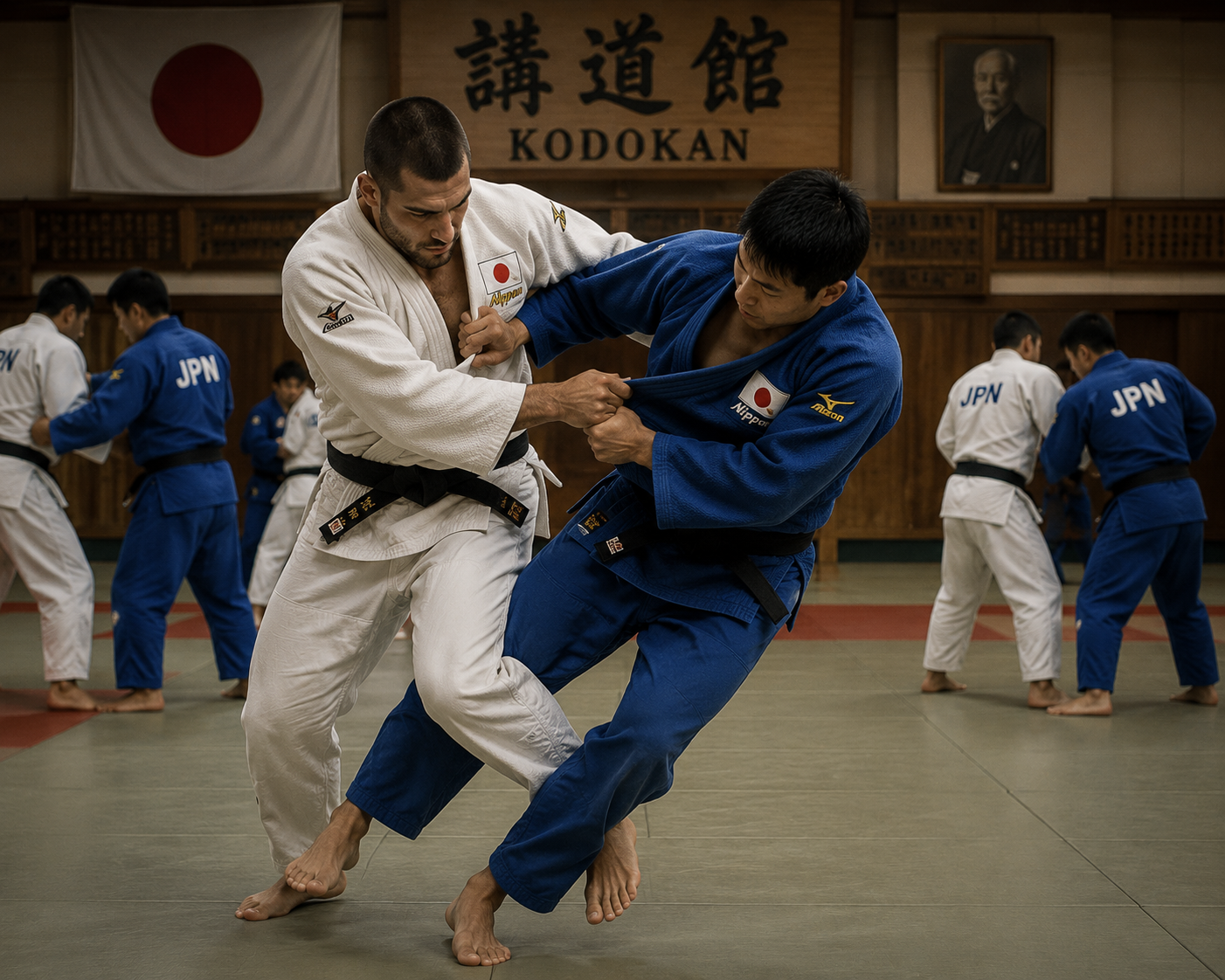
Japanese Judo
"A chance to try your technique is in one instant never to be regained, so try it without hesitation." — Kyuzo Mifune, 10th dan
The Day Japan Lost Judo
Tokyo, October 1964. Japan is hosting the Olympics, and judo, its art, its gift to the world, is on the program for the first time. The nation has built the Nippon Budokan, a temple of a hall, largely for this debut, and through the early days the plan unfolds perfectly: Japanese gold in three of the four divisions. Then comes the open category, the crown, no weight limits, the division that answers the founder's original question about the smaller man and the stronger one. In the final, a colossal Dutchman named Anton Geesink takes hold of Japan's champion, Akio Kaminaga, drives him to the mat, and pins him in front of fifteen thousand of the quietest people on earth.
Then the moment the country never forgot. A Dutch official, overcome, comes running onto the mat to celebrate, and Geesink, without releasing a drop of his composure, halts him with one raised arm. No dancing on the home nation's grief. He rises and bows to Kaminaga first. The hall, watching its own defeat, was left in awe of the man who had inflicted it, because the foreigner's conduct was more Japanese than victory would have been. Japan lost the match. The art had already conquered the winner.
That afternoon poses this room's question. When the world takes your art, outgrows your borders, and finally beats you with it, at home, what do you do? Every nation in this hall gave its answer. This is the first room, and it is Japan's, and it ends where the art is still kept, in a building in Tokyo where anyone can climb to the eighth floor and watch.
The Answer Was Never More Muscle
Two of the rooms ahead will show you the other platforms. Cuban Judo builds the athlete first and bolts technique on, power as the platform. Mongolian Judo grafts the jacket onto a living folk wrestling, inheritance as the platform. Japan's platform is neither strength nor root. It is principle: the founder's maximum efficiency and minimum effort, taken not as a slogan but as an engineering constraint that no victory is allowed to violate.
Feel the difference in the training hall. A Japanese coach does not ask first whether the throw worked. He asks whether it was clean, whether the balance was truly broken before the entry, whether the entry needed no strength it should not have needed, whether the finish controlled the man or merely dumped him. A boy may spend years on a single throw, ten thousand repetitions of the entry alone, before anyone cares what it does in a contest. The scoring culture says the same thing out loud: ippon or nothing. A match won on penalties and wrestling scrambles counts on the scoreboard, but in the home country an ugly win is carried like a half-loss, and the champions the nation actually reveres are the ones whose judo you could film for a textbook. Where the Cuban will ask did it work and the Mongolian did I stay up, the Japanese asks a harder question: was it true, true to the principle the art was built on. That question is the whole style.
The Titan of Judo
If technique-over-strength were romance, it would have died its first hard contest. Japan keeps its proof on film, and the proof stands five feet two.
Kyuzo Mifune walked into the Kodokan a few years after the letter in the Judo room was written, a tiny, quick-tempered young man from the north, around a hundred and forty pounds with his gi soaked. He stayed sixty years and became what the country itself called the god of judo, the finest technician the art has produced after the founder. Too small to overpower anyone, he was never once tempted to try, and out of that permanent disadvantage he refined the principle until it did things that look, on the old film, like a trick of the camera. He became the master of the counter, using the attacker's own throw as the door to his, and built techniques of almost pure principle, among them his famous air throw, where nothing but his hands touch the opponent and the man's own motion does the falling. At forty, challenged by a sumo wrestler a foot taller and a hundred pounds heavier, Mifune put him on his back with it. The legend, and the Kodokan let it stand, is that in six decades of daily randori no one ever threw him.
In 1945 he received the tenth dan, only the fourth man in history to hold it. And the footage that matters most was shot near the end: Mifune in his seventies, a small old man in a worn gi, calmly dismantling national champions in their twenties, young men at the peak of strength he never had at any age. Watch it once and the Japanese wager stops being philosophy. Strength has a shelf life measured in years. Principle, refined long enough, does not appear to have one at all.
The Shocks That Sharpened It
Now trace the century, because Japanese judo was not preserved under glass. It was hammered, and every hammer blow is part of its shape.
The first shock you already watched: Geesink, who had announced himself three years before Tokyo by taking the 1961 world title in Paris, the first non-Japanese champion in the art's history. His answer to Japan was not foreign at all; he had simply out-Japanesed them, training with a monk's discipline at classical technique in a giant's body. After Tokyo, the sport accepted what his size proved and adopted weight classes across the board, the founder's open question fenced into divisions. That same 1964 tournament carried the second shock inside it: the Soviets arrived with sambo wearing judo jackets, the strange grips, the leg attacks, the wrestler's pickups, and took four medals on debut. The last room in this hall is theirs. Then the decades brought the rest: European power judo built in barbell rooms, the Cuban detonation, the Mongolian bökh men who refuse the fall. The international game turned into gripping wars and bent-over wrestling exchanges that the founder would not have recognized, and for stretches the home island lost in it, sometimes badly, whole Games where the men's team came home to a country in mourning.
Mark carefully what Japan did each time, because it is the transferable lesson of this whole room. It did not convert. It did not rebuild its judoka into Cubans. It absorbed each shock as information, tightened its grip fighting, answered the leg attacks, studied the foreign entries, and then re-sharpened the same blade it had always carried, betting again and again that a purer technique beats a stronger crudeness over time. When the international federation banned leg grabs in 2010 and the sport straightened back up, the game came home to the upright, classical exchange Japan had never stopped drilling, and the medal tables have shown it since.
Two men bracket the era of proof. Yasuhiro Yamashita ran up two hundred and three consecutive victories, had his 1980 Olympics stolen by boycott, and at Los Angeles in 1984 tore a calf muscle in an early match, a heavyweight on one leg. He limped through the bracket anyway and won the final in sixty-five seconds, by pinning ippon, with technique that required nothing of the ruined leg. He retired the next year unbeaten. A generation later, Shohei Ono, a lightweight with perhaps the most beautiful judo of the modern era, won two Olympic golds and three world titles almost entirely by ippon, classical uchi-mata against the best gripping-and-scrambling era the sport ever produced, then walked away at his peak to teach. Different centuries, same wager, same result. The standard holds.
The Weight of the Standard
Now the honest ledger, because a standard that high has a price, and this Farm reads price tags out loud.
Watch a Japanese judoka take silver at the Olympics, the second-best result on planet earth, and you will see a man bow, weep, and apologize to his country on live television. The standard that produced Mifune and Ono also produces that: a culture where anything short of perfect is experienced as debt, where a man's worth rides on the last match, where the pursuit of the flawless throw can quietly become the pursuit of being beyond reproach. The standard kept the art honest for a century, because ippon does not lie and ten thousand repetitions cannot be faked, and it gave the world Geesink's raised arm, which was the art's own manners protecting a beaten man's dignity in his worst minute. And it has a shadow the nation itself has had to read out loud.
In 2012 Japan made the martial arts compulsory in its junior high schools, and nearly every school chose judo, and the parents of the country had a reason to be afraid that had nothing to do with the Olympics. Between 1983 and 2011, more than a hundred children died in school judo classes and clubs, and hundreds more were left with injuries that did not heal, most of them in rooms run by teachers who were not judoka, under a culture that had learned to treat a boy's exhaustion as a test and his complaint as weakness. The families organized, the government wrote safety rules it had never bothered to write, and the numbers fell. The Farm tells it because the same standard that made the art great had, left ungoverned in a school gym, killed the children it was meant to build, and a man who admires the Japanese way should know what the way costs when nobody is watching the price.
Hold the ledger to the light. A standard of perfection is a magnificent servant and a crushing master. The man who serves it grows sharper every year, like Mifune. The man owned by it is never done, never enough, one silver medal from worthlessness, a strong man being quietly broken by a law he can only fail. Every serious man eventually builds something in his life to that standard, a craft, a body, a business, a name, and discovers the same thing the weeping medalist knows: the standard can measure him, but it cannot pardon him. File that discovery. It matters beyond judo, further up the road than this room can take you.
Where the Art Is Kept
Now the part of this room that is an invitation, because the art is not only in the archive. It is in a building, on a street, with a door.
The Kodokan stands in the Bunkyo ward of Tokyo, an eight-story building on the site the founder's school moved to after the temple corner and the rented rooms, and it is the home of the art the way no other building on this Farm is the home of anything. The ground floor has an international department with a desk for foreigners. The upper floors hold the practice halls, and the main hall is a field of tatami large enough to lose a small town's worth of judoka in, and every weekday and Saturday evening it fills, with children first and the adults after, and the sound of five hundred breakfalls at once is a sound a man does not forget. And the eighth floor is a gallery, open to anyone, free, where a visitor can sit and watch the evening practice for as long as he likes. The founder's school, a hundred and forty years on, still lets a stranger climb the stairs and look.
A man with rank and experience can do more than look. The Kodokan's randori class takes trainees from abroad who can show they have trained, and the halls on any given night hold judoka from thirty countries, thrown by Japanese university students and old men with red belts who have been coming since before the visitors were born. It is the one room in this hall a reader can actually walk into, and the men who have done it describe the same thing: the first night is humbling past anything a home club can arrange, and the second night the same old man throws you again, and by the end of a week you have been given something by the building itself.
Around the Kodokan sits the rest of the nation's judo, and a man planning to see it should know its shape. The universities, where the champions are made, and the corporate teams that employ them afterward as company men who train full-time under the firm's name. The police, whose judo halls have been the hardest rooms in the country since the founder's men won the tournament in 1886. The school gyms, with the ledger above attached. And once a year, on the twenty-ninth of April, the All-Japan Championships at the Budokan, the tournament that has been held since 1930 and that still refuses weight classes, the last great open-weight bracket in the sport, where a lightweight can draw a heavyweight and the founder's question is asked out loud in public. Yamashita won it nine times. Kimura, the man who broke the arm in Brazil, won it four. To sit in that hall on that day is to watch the art argue with itself about what it is for, in front of the people who made it.
Take It Back Into the Judo Room
Three things leave this room with you.
Technique is the only version of your strength you get to keep. The Cuban engine fades in a man's thirties; Mifune was untouchable in his seventies. Whatever you train, this art, your trade, your shooting, your hands, the refined-principle version compounds for life, and the muscled-through version retires when your body does. Train like a man who plans to be old.
Let rivals sharpen you, not convert you. Japan took a century of shocks, the giant, the Soviets, the power nations, and answered every one by becoming more itself, not less. When a competitor beats you, take the information without taking his identity. Absorb, adjust, and re-sharpen your own blade.
Serve the standard; never let it own you. Held as a servant, the pursuit of clean work builds Mifunes. Enthroned as a master, it builds men who weep over silver and school gyms that bury boys. Know which one is happening in you. The difference is whether a failure instructs you or indicts you.
This is the source, and every room after it is an answer to the question Geesink asked on that afternoon in Tokyo. The ground the Japanese standard mostly left waits in Ne Waza and Submission Grappling, and the founding letter is still in the Judo room. Read the willow once more on your way out, and notice it was never a metaphor for weakness. It was a metaphor for purity: a principle so clean the storm defeats itself against it. Then ask what principle you are refining to that purity, and what you would still have at seventy. The next room is the first foreign nation to take that principle and build a school system around it, a country that now has four times as many judoka as this one.
→ Continue on to French Judo