
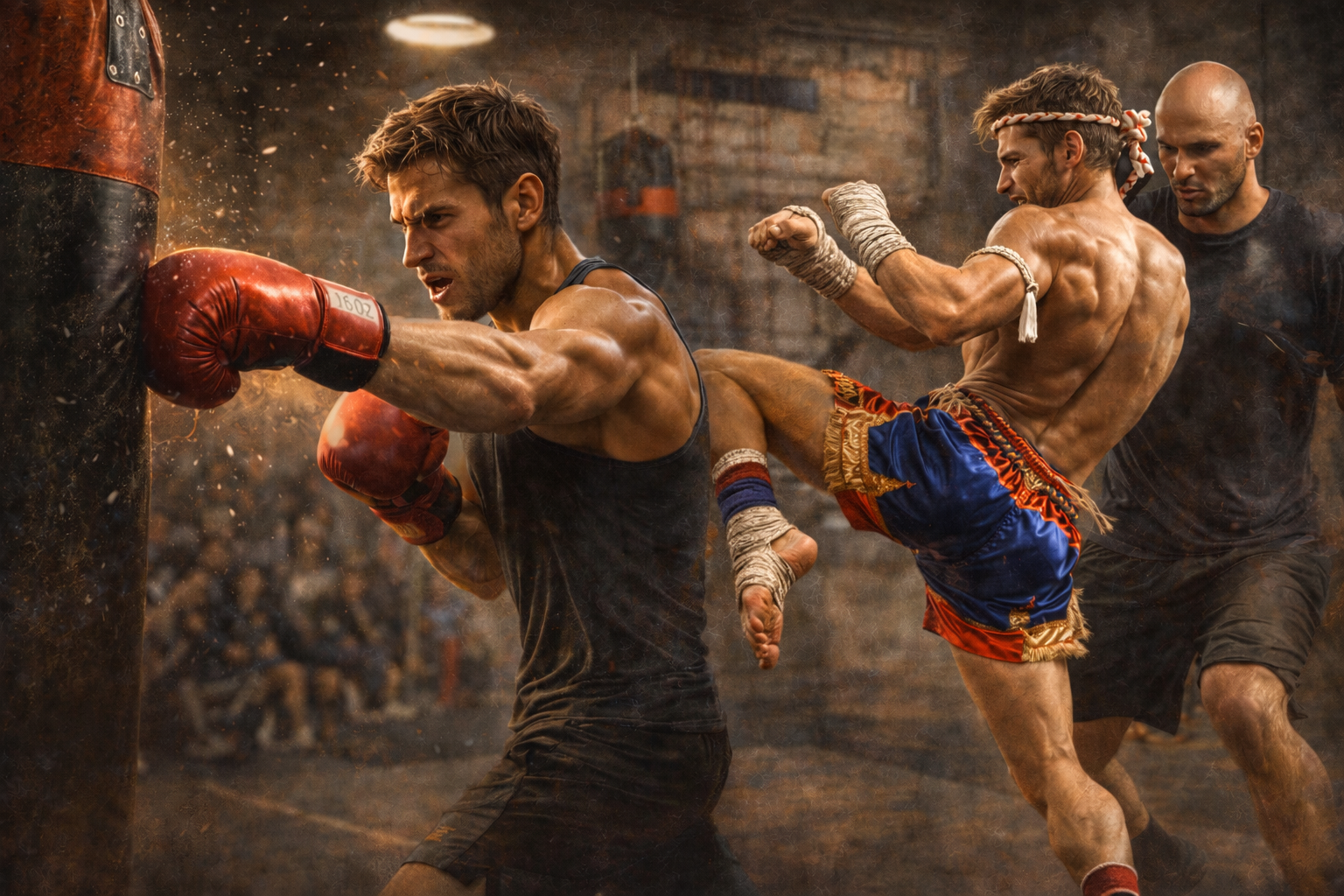
Striking
"Everybody has a plan until they get punched in the mouth." — Mike Tyson
On the Feet
The Warrior gloves you up on the first morning and does not teach you a punch.
He puts you in front of a man about your size, has him pull on a pair of sixteen-ounce gloves, and tells him to tap you on the forehead. Not hard. Just enough to feel. "Eyes open," the Warrior says to you. The glove comes and your eyes slam shut and your head turns and your hands fly up in front of your face like a man surprised by a bird. He does not laugh. "Again." The glove comes. Your eyes close. "Again." Twenty times. Thirty. Somewhere around the fortieth tap your eyes stay open for the first time and you see the glove the whole way in, and something in the back of your skull that has been screaming since the first one goes quiet.
"There," he says. "That's the whole first year, right there. Everything else is technique."
Striking is the first range of a real fight, the place almost every encounter opens, and the place a great many of them are already decided before anything hits the floor. It is fighting on the feet: hands, elbows, knees, shins, the feet that carry them, and the eyes that read the man in front of you. But the thing you just did against a glove that could not hurt you is the thing the whole range is built on. The untrained man does not lose a standing fight because his punches are bad. He loses it in the half-second after the first clean shot lands, when his eyes close and his head turns and his hands go to the wrong place and every plan he had leaves through the top of his skull. The adrenaline hits, the vision narrows to a tunnel, the ears quit, the breath stops, and he is standing in the middle of a fight with nobody home. Trained men have felt all of that a thousand times, in a room where it cost them nothing, and it has stopped meaning anything. That is what the first year buys, and it is worth more than every technique that comes after.
This page is the doorway to the standing game, not the gym. Each of the three striking arts has its own room and its own teacher, and they are walked in an order that carries a reason. What this page does is tell you why the fight is learned standing first, what a striker is actually made of and how he gets built, how the three rooms hand each other off, and why the range you are about to spend two years in is a range you will not be allowed to keep.
Why You Learn to Stand First
Most fights open on the feet. The shove, the grab, the first wide punch thrown by a man who has never thrown one that landed. The man who has trained reads that opening and answers inside a pattern he has drilled ten thousand times, and the answer is often that he is simply not there when the punch arrives. The man who has not trained answers with whatever panic and adrenaline throw together, and it is almost never the right thing. So the fight is learned standing because that is where the fight is, most of the time, for the first few seconds that decide most of it.
There is a second reason, and it is about the eyes. A striker learns to see a punch before it exists. The weight settling onto the back foot. The breath a man holds for a quarter-second before he commits. The glance to the target that untrained men cannot help. The hand that drifts an inch lower because he is about to need it for something. Two years of that and a man reads intent the way other men read print, and the read does not stay in the gym. The stranger who is about to swing at him in a parking lot has all the same tells as the sparring partner, and he has never been taught to hide one of them. The trained man is somewhere else, or already answering, before the untrained man has finished deciding.
And the third reason is a debt the whole Farm owes this range. Every other ground assumes that a man can be hit and keep thinking. The clinch assumes it. The ground assumes it. The Armory assumes it with a pistol in the hand. None of them can build it, because none of them is a place where a man gets hit in the face cleanly, often, and safely, by someone who means it a little. Only this range does that. So this range comes first, and everything above it stands on what it installs.
And it pays interest. Two decades of Tuesday nights on the pads put something in a man that no weekend course can install in a latecomer, and the first six months of those decades are the humbling ones, when a teenager who started at nine makes a grown man miss all night. Stay through the six months. The bag does not care how old you are.
What Puts the Striker on His Back
The same handful of holes drop untrained and half-trained men every time, and a man who knows their names can catch them in himself before a stranger does.
The telegraph. The untrained punch is visible from across the room. The wind-up, the shoulder drop, the eyes locking onto the target before the hand moves. The trained man reads it and is somewhere else, or is already on the way back with an answer, before it arrives.
Power with no structure. He swings with everything and no alignment, so the force he meant for the other man arrives in his own shoulder and wrist instead, and he breaks his hand on the one punch that landed. The trained striker hits harder with less effort because the whole body is behind the fist and the fist is behind the right two knuckles.
Offense with no defense. He builds a combination and forgets that the other man is also throwing. He commits wide open and eats the counter in the middle of his best sequence. In a trained man, defense is woven into every strike: the head is moving while the hand is out, the hand is coming home while the next one leaves, the feet are already resetting.
One story of the building. He trained hands and never the legs, or legs and never the hands, and the man across from him lives in whatever floor he never built. A leg kicked enough times quits, no matter how good the hands above it are, and the whole American sport learned that in public one night. The room that owns the story will tell it.
The gas-out. He has gym strength and no round strength, and he is finished by minute two. A fight that runs past a minute finds him unable to hold his hands up, which is why the roadwork done on the Proving Ground is part of standing up, and not a separate hobby.
Hiding from the sparring. He drills the bag, which agrees with everything he does, and avoids the round, which does not. So he owns a library of moves that have never once been tested against a man trying to hit him back. The Dojo's last room exists for him, and it will not be kind.
How a Striker Is Built
Every coach on this Farm, from the boxing corner to the Thai camp, agrees on ten things about how a striker is made, and they agree on the order.
Fundamentals before anything. Jab, cross, hook, uppercut. Four punches, and then the kicks stacked on top of them. Every flashy technique a man ever learns is built on those four, and every flashy technique layered over weak fundamentals collapses the first time somebody leans on it. The seasoned striker is not the man with the most moves. He is the man whose four are sharpest.
Form, because the body is a chain. Force runs from the floor through the feet, through the hips, through the shoulder, out the hand, and a broken link anywhere in that chain bleeds power and invites injury. A coach corrects form across thousands of repetitions because every rep with bad form teaches the body the wrong thing a little more permanently.
Footwork, because strikes land from position. Position comes from the feet. The man who has trained his footwork creates angles, controls range, and leaves cleanly. The man who fights with his feet planted is fighting one floor below his own ceiling. You provide a broad path for my feet, so that my ankles do not give way (Psalm 18:36) is a line written by a man who had been in fights, and any coach would recognize it.
Speed and precision together. Fast enough to land, accurate enough to count. The fast wild striker misses. The precise slow striker gets countered. The two are trained as one thing, and the snap that turns muscle into impact is speed and accuracy arriving at the same instant.
Hands and wrists conditioned. The hand is the tool, and the untrained hand breaks. Wrapping, glove selection, progressive load on the bag, and the years it takes to make the bones and the small joints ready. The striker who has never broken his hand is not lucky. He was built.
Defense trained as hard as offense. Blocking, slipping, parrying, head movement, the management of distance. The striker who trained defense gets hit less across a career, and the damage a striker does not take is the damage that would otherwise have compounded for thirty years into the man he becomes at sixty.
Combinations, because single shots are predictable. One strike gets read. Three to seven that flow, each setting up the next, produce the opening the single shot never does. The combination is the grammar of the range.
Conditioning, because the fresh man wins. The striker who gasses at minute three loses to the striker who is still sharp at minute twelve, whatever their skill. Wind, the ability to go hard and recover, and the stamina to hold structure when tired are built on the road and in the rounds, and there is no shortcut.
Every tool in the gym, for a different reason. The heavy bag for power. The mitts for precision and combinations. The speed bag for rhythm. The double-end bag for accuracy and head movement. And the sparring partner for the only thing that matters, which is whether any of it works on a man who is trying to make it not work.
A coach, because a man cannot see himself. The seasoned coach sees what the student cannot. The trained partner shows him what the technique actually produces. That relationship compounds across years in a way no amount of solo work ever duplicates, and it is the reason this Farm walks you to a gym and not to a video.
These ten sit under all three rooms of the standing game. They are what the Homestead's plain principles of Practice & Repetition, Speed & Power, and Reaction Time look like once a man has gloves on.
The Three Rooms on the Feet
Three arts, walked in order, and each adds a story to the building the one before it framed.
Boxing — hands first. The foundation, and the deepest hole on the Farm. The four punches, the footwork under them, the head movement, and the linked combinations that beat a man who can only defend one shot at a time. No art builds more skill per hour in the gym, and no art carries further, because every striking art a man touches afterward is built on the same floor of distance, timing, and hands that come home. Inside the room there is a corner most men never earn their way into, where a shoulder does the work of a glove, and a hall of the national styles, the American, the Mexican, and the Russian, that put three different countries into the same four punches.
Kickboxing — hands and feet together. Boxing with the legs turned on. The round kick, the front kick, the low kick that changes whole fights, and a defense that now has to cover two stories at once. The room keeps a name on its wall, and it keeps the story of the night the whole American sport learned the low kick in public and went and trained it. Behind it stand the Dutch, who built the most feared kickboxing school on earth, and the French, who were kicking in the streets of Paris before anyone thought to put it in a ring.
Muay Thai — eight limbs. Fists, elbows, knees, shins, and the clinch that binds them into one system. Nothing else standing has more weapons in it, and nothing else standing has been proven in more fights. The Warrior does not walk you to this room. He hands you a ticket, because the art has a home and the home is part of the lesson, and the teacher who receives you there has a face that tells you his record before he says a word. Off the camp's main floor are three more doors, the old rope-bound boxing, the thinking man's style, and the road east to a harder cousin the teacher will show you and will not lightly send you through.
The Three Pillars on the Feet
TRUTH is honest sparring, and it has a very specific meaning on this range. You spar men who can hit you. You do not pull your shots to look better than you are, and you do not ask your partner to pull his so that you can feel better than you are. You take the contact you need to build the read and no more, and you log the rounds that went badly with the same care as the rounds that went well. The pads flatter. The bag flatters. The man in front of you is the only honest instrument in the gym.
LOVE is who the hands are for, and it starts with the man across from you. He is lending you his head so that you can learn, and the rounds you give him are a debt you repay by taking care of the new man the way somebody once took care of you. Then it reaches past the gym to the people the hands were built for, who will never see the room that built them and should never have to.
LAW is what the room agreed to before the bell, and what the street will hold you to after it. You honor the agreed pace. You do not hunt a partner's head to win a round that does not count. You keep the sparring a laboratory and not a fight. And you carry the hard fact out the door with you: trained hands are held to a higher standard than untrained ones the day they are used, and the striker who cannot keep his hands holstered on the street did not finish his training.
"Because the Sovereign LORD helps me, I will not be disgraced. Therefore have I set my face like flint, and I know I will not be put to shame." — Isaiah 50:7
The Thai fighters call it the flat face, and they train it on purpose: take the shot, show nothing, keep working. The man who wrote that line had just described offering his back to the men who beat him and his face to the men who spat on it, and the flint was not his own hardness. He tells you where it came from in the first five words. A striker will spend years learning not to flinch, and it is worth knowing, going in, that the deepest version of that composure was never built in a gym.
Walked as a System
The three rooms are one fighter, and the order is the teaching. Hands first, because hands build the most skill in the least time and because the man who learns to be hit learns it fastest with gloves on. Legs second, because the striker who owns one story of the building is beaten by the man who lives on the other, and because the kick changes the arithmetic of distance in a way the boxer's eyes have to be retrained to read. Eight limbs last, because the elbow and the knee are the weapons that end things at the range where the punch and the kick have lost their room, and because the clinch, which every other striking art treats as the place where the referee says break, is the door to the next range on this mat.
Everything built here travels. The read goes down to the ground as the calm the ground demands. The hands go across the yard to the Armory as the empty-hand base a fight inside arm's reach lives or dies on. The whole of it goes up the hill to the cage, where the test is honest and public. And the composure, the eyes that stay open when the glove comes, is the thing every ground on the Farm quietly assumed you had before you arrived, and the thing this range exists to make true.
After the Feet
Before you go find the boxing corner, hear the one thing the Warrior wants you to know about the range you are about to spend two years falling in love with. You do not get to keep it.
Standing is where the fight starts. It is not where the fight agrees to stay. The other man has a vote, and the most common thing he does with it, once your hands have taught him that standing in front of you is a bad idea, is to close the distance, swallow your reach, and drag the whole thing into a tangle where punches have no room and kicks have no leg to stand on. Every striker meets that man eventually. The one who trained only the feet meets him and discovers that two years of beautiful stand-up were one grab away from over, and that the man who grabbed him did not need to be a better striker. He only needed to change the question.
So build the standing game knowing who is waiting for it. The eyes you train on this range are the eyes that will read the level change before it comes. The balance you build under your punches is the base that will keep you on your feet when a man tries to take them. And the composure that lets you be hit and keep thinking is the same composure that will let you be grabbed, lifted, and turned upside down without your mind leaving the room, which is the only reason the next range can be learned at all.
The next room on this mat is where a man stops hoping the fight stays standing and starts deciding, himself, where it goes.
Tools & Resources - Striking
Impak Training Bag