
CQB & CQC
Close Quarters Combat
Less Lethal & Non-Lethal Weapons
"Be a fighter who happens to carry a gun, not a gun-handler who happens to be in a fight."
Inside Arm's Reach
The Armorer walks you past the gun rack and the blade bench to the far end of the shed, where there is a square of mat on the floor that you had not noticed, the only mat in the building. He hands you the training pistol and the holster and a timer. "Draw," he says. You do. Clean, under a second, and you are proud of it, and he does not say anything. Then he steps onto the mat, puts one hand flat on your chest, leans his weight into it, and says, "Again."
You cannot. His weight is on you, his other hand is fighting your hand at the holster, and the draw that took a second a moment ago takes three, and then it does not happen at all, because he has the gun. He holds it up, still fighting you with the other arm, and hands it back. "Now the knife." He gives you the training blade and goes for the holstered pistol on your belt, and you find out that a man with a blade in his hand and a stranger's fingers around his gun has two problems and one body. He lets go. "Out at the range you're a shooter. On the mat behind the barn you're a fighter. In here you're a man in a wrestling match who happens to own a gun, and the gun is the thing being wrestled over. This is the room where the three of them have to be one thing, and it's the room almost nobody trains."
This is the close range, the third room of the Armory and the door back to the Dojo. Most gunfights happen inside seven yards. Most attacks happen inside arm's reach, where there is no time to draw cleanly and the man who trained only the tool discovers that the body was the part the moment needed. Here the gun, the blade, and the empty hand stop being three skills and have to work as one, and here a man learns which fight he is in before he learns to fight it. This page is the door to the close range, not the range. It tells you why the close range is its own skill, what beats the man who never joined his skills, what the five rooms hold and in what order they are walked, why that order, how the rooms hand each other off, and why the last thing a man learns on this rack is the thing that sends him up the hill.
Be clear about what this rack is not. It is not where the encounter itself gets met. The street fight, the home invasion, the night it all actually happens, are met at The Homestead, where every skill from the Dojo, the Armory, and the War Room comes home to a man's real life, his household, and the law he answers to. What gets built here is the close-range skill those nights demand, and the read of which night it is. The encounter lives at the Homestead. The mechanics live here.
Why the Close Range Is Its Own Skill
A man can spend years building striking in one gym, grappling in another, and shooting at a third, and discover the first time he tries to put them together that they do not combine on their own. The boxer cannot draw inside the clinch. The jiu-jitsu man cannot keep his pistol while a man fights him for it on the ground. The shooter cannot tie up and make space when a man crashes inside his draw. The three skills were trained apart, and their joining is a fourth skill, and almost nobody trains it, and at this range the whole thing is decided in seconds, so the only edge is having drilled the seconds in advance.
There is a picture of the close range with no skill in it, and it is in the record. Two captains met at a pool with twelve men each, and the twelve went out against the twelve, and each seized his opponent by the head and thrust his dagger into his side, and they fell down together, and the place was named the field of daggers (2 Samuel 2:16). Twenty-four men, arm's reach, no read, no retention, no angle, and everybody died. That is what the close range does to men who arrive at it with a weapon and nothing else, and it has not changed in three thousand years.
And hear the thing the Armorer says about the men who look like they trained all of it at once. There is no real-life Bourne. The men the vault was built for are not masters of everything. They became what they are by mastering one thing at a time, over years, and the professionals who make it look effortless invested more hours in the fundamentals than the man watching them will ever believe. There are no shortcuts on this rack and no secret program. There is one skill, then the next, then the seam between them, drilled until the seam is gone.
What Beats the Man Who Never Joined His Skills
Three skills, never joined. He trained them separately and assumed they would merge. The first real attempt finds the seam, and the seam is where he loses.
The gun taken away. He draws inside the tangle with no retention training, and the man fights it out of his hands, and now the attacker has his gun. Keeping the weapon is its own trained skill, and the first room on this rack has a whole course on it.
The draw that will not come. His range draw is a second. His draw with a man crashing into him is never, because he never trained the empty-hand work that buys the space to draw at all.
The doorway. He walks an entrance at the speed the entrance was built to punish, instead of working the angle from outside it before he ever crosses. The man inside has the angle he never checked.
The disarm fantasy. He practiced taking weapons off compliant partners in a studio and believes he can do it for real. Against a live, resisting man with a real weapon the success rate collapses, and the trained man treats a disarm as the last of five choices, never the first.
The wrong door. He met a robbery like a fight, a fight like an ambush, and a street shooting like an active killer, because he never learned that the eight doors have eight different men behind them and that the read comes before the hands.
The two-rung man. He owns empty hands and a gun and nothing between them, and the night that needed a third option got the fourth.
The Five Rooms, Walked in Order
Close Quarters Combat (CQC) — the first class: the body and the tool as one thing. The individual skill, before any encounter is named. The empty hand inside weapons distance, in Hand-to Hand Combat, with the Israeli system built for men who have weeks and not years, the redirection art whose survivable parts are the off-line step and the wrist, and a Victorian gentleman's mixed art that a detective story kept alive, all three read with a filter for what survives honest testing. Keeping the weapon, in Weapons Retention, where the rule is to move the body and not just the gun, the frameworks are retain-angle-transition and angle-control-timing, and the course beneath it runs twenty-eight modules from footwork to the ground with one line over the door: self-preservation before weapon presentation. Taking the weapon, in Weapons Disarmament, where the disarm is the last of five choices and a half-committed one fails catastrophically. The edged-weapon control course, Edged Weapons - Close Quarter Control Tactics, with its nine angles of attack, its eight danger signs in order, the knife in the rear hand and the shove with the lead in seven of ten attacks, and its honest objective, to survive the encounter despite being cut. And 7 Misconceptions That Can Get You Killed, the short list of beliefs that get men hurt at this range, with the one every man should carry to the range: he will be half as good on his best day.
Altercations & Confrontations— the eight doors. The catalog of the encounters themselves, not the techniques. Eight named situations, sorted by the one question that decides everything, what does the other man want: your property, you, your pride to answer his, or the man in the mirror. The master read that runs before the body does anything, and the line a man draws on an ordinary afternoon about which things are property and which things are him. A second location is never an improvement. The man who agrees to the fight has handed back his shield. Never leave the car, never follow, never escalate. And the deadliest thing on any street is the pavement a man's head lands on.
Active Shooters & Mass Casualty Events— the worst three minutes. The one door where the threat is aimed at a room full of strangers and a man happens to be standing in it, with his family three feet away and no badge. Four questions answered cold: armed right now, trained or a square-range shooter, the engine for it, and where the exits are. Run, hide, and then fight, in that order, even for the armed man, and his own people first. Three kinds of event that look identical in the first three seconds and demand three different answers, and three real afternoons, a church in Texas, a mall in Indiana, a field in Las Vegas, where the trained man was the whole difference, the thin margin, and no answer at all.
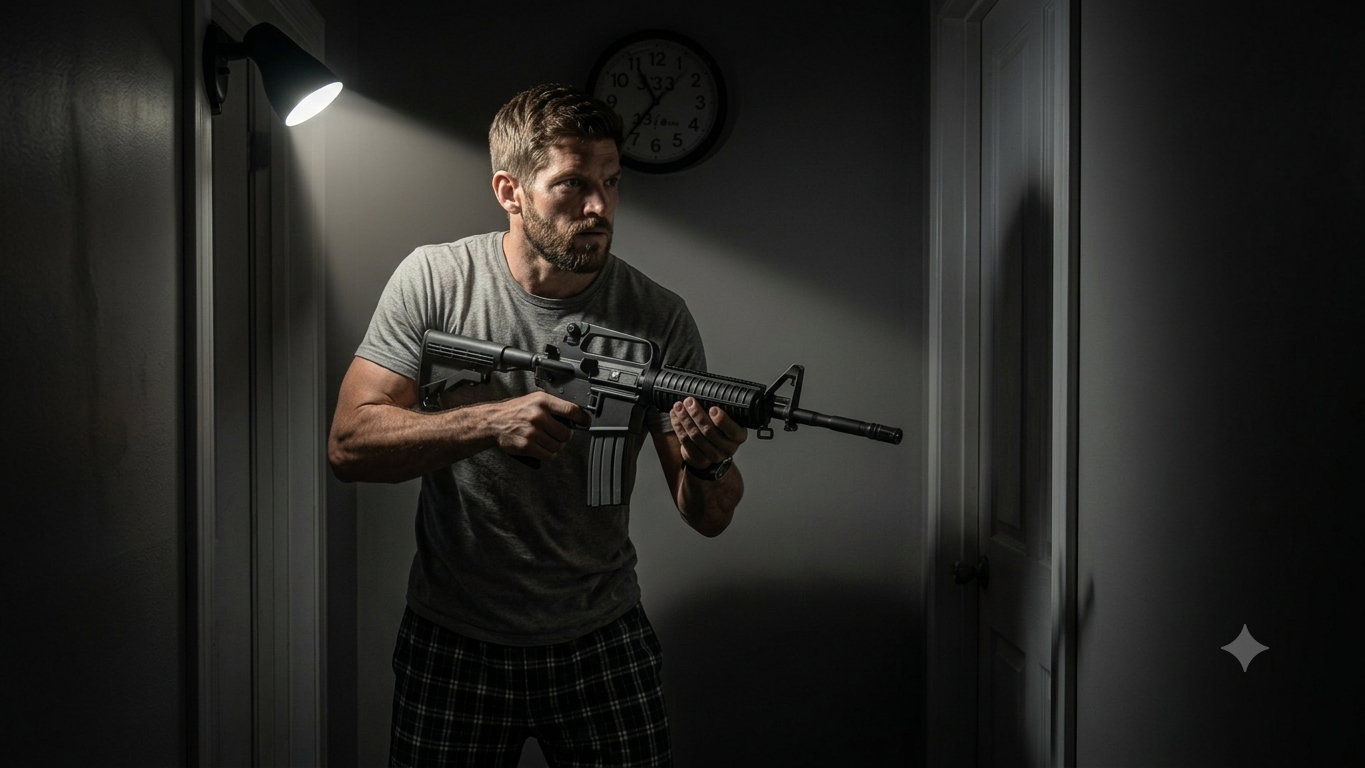
Building Clearing — one man, in the dark, in his own house. The threat already inside the structure, and the first rule against every instinct: do not go hunting. Stop, arm, light, barricade, and hold, and move only to reach the people who cannot reach you. The slow one-man protocol of Static Search and the team's fast version in Advanced Building Clearing, read for the principles that survive the translation down to one man. And beneath it the room-and-corner craft of Close Quarters Battle (CQB): the four principles run at once, movement, distance, cover, concealment; the corner sliced a sliver at a time with the weapon leading; the doorway that is a funnel the defender has already rehearsed against; and the wall that stopped the first round and may not stop the tenth.
Less-Lethal & Non-Lethal Weapons — the middle rungs. The last room on the rack, and the one the whole rack has been climbing toward. Most men own two settings, empty hand and gun, and a ladder with two rungs is not a ladder but a cliff with a step at the bottom. The room builds the rungs between words and the bullet: the spray that is an inflammatory and not a tear gas, effective in seconds and useless on one man in ten; the electrical tool that locks the muscles instead of arguing with the pain; the impact tools and the walking stick that is legal nearly everywhere the baton is not; and the improvised. Every rung comes with the standard the courts hold a man to, that he can say why the lower option would not have worked. And beneath the room, the drawer the whole Armory keeps as a mirror, Mall Ninja & Spy Gadgets, for the man whose kit is louder than his training.
The order is a teaching order. The skill first, because a man who cannot keep his gun in a clinch has no business reading about which clinch he is in. Then the encounters, from the most common to the rarest: the eight doors a man will actually stand in front of, the one door he prays never opens, and the night inside his own walls. And the rungs last, because the final lesson of the close range is that most of the nights it trained a man for need less than the tool he trained, and the room that decides which rung is not on this rack. It is up the hill.
The Three Pillars Inside Arm's Reach
TRUTH on the close range is force on force. A calm rep in a studio with a partner who lets go is a rumor. The integration is tested against a man fighting back, with a training gun that can be taken and a training blade that leaves a line, and the man who has never had his own pistol pulled off his belt by a stranger on a mat does not know whether he can keep it. And the read is tested the same way: the honest audit, on an ordinary afternoon, of which of the four questions a man would have to answer no to.
LOVE on the close range is the order of duties, and it runs the same through all five rooms. The household behind a man, first. The people he can reach, second. The stranger across from him, who is somebody's son, third, and the middle rungs exist so that a night can end with him on the ground and breathing. The urge to be seen as the hero, last, and the room about the worst three minutes says it plainly: getting his own children out the side door may be the whole heroism the day asks.
LAW on the close range is the highest-stakes legal ground in the Armory. The encounter is decided in seconds and the law runs across years. The man who agreed to the fight has thrown away his shield. The man who fired into a crowd owns every round. The man who cannot articulate why the lower rung would not have worked has climbed the ladder into a courtroom. And the man with a gun in his hand when the police arrive looks exactly like the man they came for, and has to plan for that before he ever draws.
"The men said, 'This is the day the LORD spoke of when he said to you, "I will give your enemy into your hands for you to deal with as you wish."' Then David crept up unnoticed and cut off a corner of Saul's robe. Afterward, David was conscience-stricken for having cut off a corner of his robe. He said to his men, 'The LORD forbid that I should do such a thing.'" — 1 Samuel 24:4-6
That is the close range with everything in it. Inside arm's reach of the man hunting him, unnoticed, with a blade, with his own men telling him the moment had come, and he took a corner of a robe and was sick about even that. The whole rack teaches a man to be that close and that capable. The verse is about the thing the rack cannot teach, which is what he does with it, and the last room on the ground before the hill is about the rungs that let him do less.
Walked as a System
Five rooms and one seam. The first class joins the body to the tool and finds out, on a mat, whether the joining holds. The eight doors teach a man which fight he is in. The worst three minutes teach him the one fight he may not be able to win and the order of his duties in it. The dark house teaches him the ground he sleeps on and the rule against hunting in it. And the middle rungs hand him the options between the soft answer and the shot, so that the decision the hill is about has more than two outcomes to choose from.
And the rack runs in two directions, the way a stream does. When the close fight exposes a hole, a draw that will not come, a grip that fails, footwork that quits under a man's weight, a man flows back upstream and sharpens the rack that failed him: the gun, the blade, the empty hand of the Dojo. Then he comes back and tests the seam again. The clinch from the takedown room is the clinch a man fights him in for his pistol. The floor he learned in the jacket hall is where a knife fight ends up, and the retention course's whole instruction for it is to get up and go home. The composure from the whole mat in the barn is what lets him read a doorway instead of filling it. When the seam holds, the current carries him forward, to the one ground that aims all of it.
After the Close Range
One man who can fight at every range with every tool, keep his weapon, read the door, hold his own hallway, and choose a rung is formidable. He is still one man, and the close fight is where he first feels the want of a second: someone to cover the corner he cannot see, a voice when his hands are full, a team that turns a desperate solo scramble into something deliberate.
And he has learned the thing every room on this rack was quietly teaching. The retention course said it, the disarm room said it, the eight doors said it, the mall said it, the dark house said it, and the middle rungs said it loudest: the hardest question at arm's reach is never how. It is whether. Whether to draw, whether to move, whether to engage, whether the man in the hallway is a threat or a son, whether the night needs the spray or the shot or the door. The Armory built the how in three rooms and put it in his hands. The whether is not in this building. It is at the top of the ladder, in a room with a chair in it, and the Warrior is already standing at the foot of the ladder the way the Armorer said he would be.