
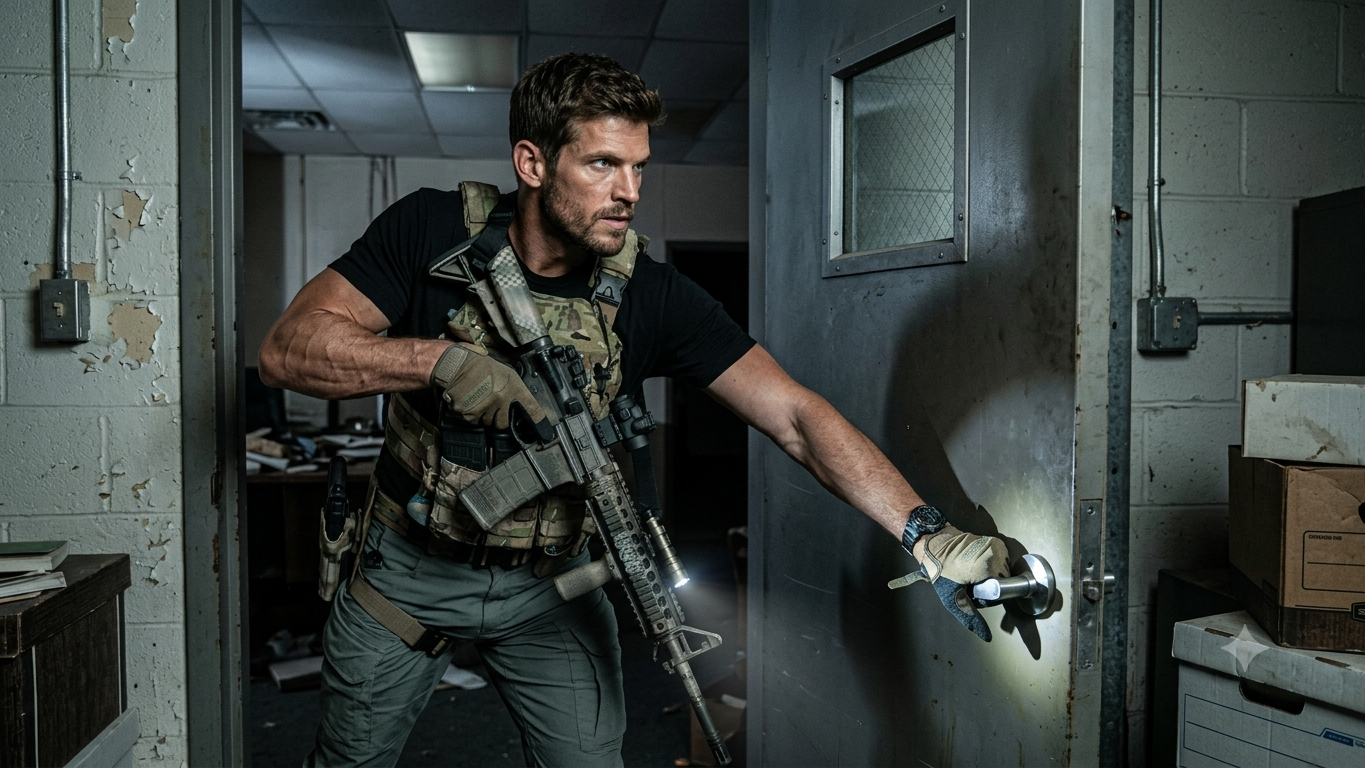
Altercations & Confrontations
Reading the Encounter
Ego Fights
Violent Crimes
Domestic Violence
"You don't get to pick the fight. You only get to pick whether you were ready for the one that came."
The Names on the Door
The Armorer walks you out of the shed and down a hallway you had not noticed, with eight doors on it, and tells you to read the names before he opens any of them.
Armed Robbery. Assault. Domestic Violence. Home Invasion. Mutual Combat. Neighborhood Dispute. Road Rage. Street Fight. "Every man thinks a fight is one thing," he says. "It isn't. Behind each of these doors is a different man who wants a different thing, and the read that keeps you alive behind one of them gets you killed behind another. The robber wants what's in your pocket. The invader wants what's in your house. The man at the bar wants your pride to answer his. And one of them is you." He taps the last door without opening it. "They are not the same animal, and you do not meet them the same way. The mat and the rack taught you how to fight. This hallway teaches you which fight you're in, and that has saved more men than any technique in the building."
This is the second room of the close range, and it is the catalog of the encounters themselves, not the techniques and not the tools. The mechanics of fighting at this range live one room back at the empty hand, the retention, and the blade. What lives here is the situational read: what each encounter is, who is across from you, what he wants, and the one decision that decides most of it before a hand is raised. This page is the door to the hallway: why most of it is decided before contact, the one question that sorts the eight doors into three families, the rooms in the order they are walked and why, the master read that runs behind every door, the mistakes a man makes in the hallway, and why the last door on it opens onto a room full of strangers.
Most of It Is Decided Before Contact
The hardest thing for an untrained man to accept is that the physical encounter is the small, ugly tail end of a process that started long before the punch. The man robbed in a parking garage was selected on a sidewalk. The road-rage fight that ends in a manslaughter charge began with a horn and a finger that could have been let go. The street fight that put a man in prison was a fight he agreed to.
Almost every encounter on this hallway is won or lost at two layers that sit above the fist. The awareness layer: predators select a target the way a coach reads a roster, looking for the man who is not looking, and the disciplines that take a man off the menu are taught at the Homestead, in the Awareness and Color Code rooms and the Gray Man. A huge share of the doors on this hallway never open for the man who saw the setup coming and changed his route. The verbal layer: of the encounters that do reach a man, most resolve at the voice and the posture before they reach the hand, and De-Escalation is the trained discipline that breaks the loop instead of feeding it, the soft answer used on purpose, the departure that refuses the bait, and the read that says the man across from you is not negotiable and the window is closing.
The physical layer, the rack of skills in The Armory and The Dojo, is what a man has left when the first two failed or never had a chance. It is real and it has to be trained, and a man with no answer there is making promises with his mouth he cannot keep with his hands. But it is the last layer, not the first, and the whole hallway is built on knowing the order.
The One Question, and the Three Families
Eight doors sort by the one question that decides everything: what does the other man actually want?
He wants your pride to answer his. The ego fight in all its costumes: the bar, the sidewalk, the highway, the fence line. The most common door on the hallway, the most avoidable, and the one that ruins the most otherwise good men, because the law does not care that he started it once you chose to finish it.
He wants what you have, or he wants you. The predator: the man with a gun and a demand, the man who closes on your blind side, the men who come through the door knowing you are home. The read is built on telling those three apart in seconds, and on the one line none of them may move you across.
He is the man in the mirror. The encounter inside the walls the whole Kingdom was built to protect, where a man holds two jobs at once: the guard at the door, and the audit of himself so that he is never the thing the household needs guarding from.
Three families, and the hallway is walked in that order, with a class in front of them.
The Hallway, Walked in Order
Reading the Encounter — the class. The three layers laid out as a method, the master read as three questions asked cold on an ordinary afternoon, the tells a body gives before a fist arrives, the lines the law draws between defense and a crime, and the cost list a man carries into every door. Every room after it assumes the class.
Ego Fights — he wants your pride. The subsection, with four rooms beneath it walked from the fight both men agreed to, to the brawl on the sidewalk, to the stranger at seventy miles an hour, to the neighbor a man will see every morning for ten years: Mutual Combat, Street Fights, Road Rage, and Neighborhood Disputes.
Violent Crimes — he wants what you have, or you. The subsection, with three rooms beneath it walked from the transaction at gunpoint, to the hit a man did not see, to the door at three in the morning: Armed Robberies, Assaults & Threats, and Home Invasions.
Domestic Violence — the man in the mirror. The last door, and the only one that opens inward. The room closes the hallway and hands the walk to the one encounter that is not on it.
The order is the Armorer's. The class first because every door on the hallway is met with the same three questions and a man should have them before he meets any of the eight. The ego fights first among the families because they are the encounters a man is likeliest to have and the ones most in his own control, and because a man who has learned to walk out of a parking lot has learned the hallway's whole first lesson. The predator second because the read there is harder, the control is less, and the lines are sharper. The mirror last because it is the hardest door in the building and a man should reach it having learned restraint on every other one. And then the ninth door, which is not on this hallway because the man behind it wants nothing from you at all.
The Master Read
Behind every door the same three questions run before the body does anything, and the hallway names them here only so that a man recognizes them when the class hands him a pen: what the man across from him wants, and whether it can be given without giving up himself; whether the door is still avoidable, which most of the first family's are and few of the second's; and who pays if the read is wrong, which is never only the man in front. The class puts the three on paper and has a man answer them for every door before he walks one. The hallway only insists that they run in that order, and that the third one is the reason the first two exist.
What the Man in the Hallway Gets Wrong
The close range's parent named the man who never joined his skills. These are the hallway's own mistakes, and every room beneath it has one of them at the center.
He thinks a fight is one thing. He has one answer and eight doors, and the answer that would have saved him behind one opens the wrong one.
He decides at the door instead of at the kitchen table. The property line, the second-location line, the rule about the car: every one of them was available to him on a calm afternoon, and he is meeting it for the first time with adrenaline in his blood.
He agrees. To the fight outside, to the exchange of gestures on the freeway, to the argument over the fence, to the second location. Most of the hallway's dead men said yes to something.
He mistakes restraint for cowardice. He cannot walk away without losing something he thinks he has, and so he stays, and the phones come up.
He fights the encounter he imagined. The one-on-one, the unarmed opponent, the soft ground, the fight that ends when it is won. The rooms beneath this page bury each of those in turn.
He never read the law. He knows what he can do and not what he may, and the fight lasts seconds and the aftermath lasts years.
He forgot who was standing behind him. The whole read is for them, and he made it as if he were alone.
He never turned the light on himself. The last door, and the one he was surest did not apply to him.
The Three Pillars at the Door
TRUTH at the door is the honest read: refusing to inflate the threat into a fight a man wanted, or to deflate it into a danger he talks himself out of seeing. A man tells himself the truth about which door he is standing in front of, and the truth is usually less flattering and safer than the story.
LOVE at the door is who the read is for: the household behind a man, the bystanders around him, and the restraint he extends to the fool across from him who is somebody's son. The trained man is the calm in the room and not the heat, and the calm is not for his own sake.
LAW at the door is the envelope every encounter happens inside. The fight lasts seconds and the legal aftermath lasts years, and a man who fights without knowing what the law permits him, and what it will do to him for crossing the line, has won the encounter and lost the war. Legal Defense is not an afterthought on this hallway. It is part of the read.
Walked as a System
A class and three families, and the hallway is one read applied eight ways. The class gives a man the three questions. The ego fights teach him to refuse an invitation. The violent crimes teach him to tell a transaction from a predator and to hold the one line. The mirror teaches him that the hallway runs through his own house.
And the hallway hands off in three directions. Back to the close range's first room, when the read says the encounter is real and physical and the empty hand, the retention, and the blade have to work as one. Out to the Homestead, where the encounter actually gets met in a man's real life and where the upstream work, the awareness and the de-escalation, would have kept the door from opening at all. And forward, to the ninth door.
After the Hallway
A man who has walked this hallway honestly stops asking whether he could win a fight and starts asking the better question: which fight is this, and does he have to be in it at all. Eight doors, and every one of them opened on a man who wanted something from him.
There is a ninth, and it is not on this hallway, because the man behind it does not want anything from you at all. He wants the room, and you happen to be standing in it, with your family three feet away and no badge.