
Kickboxing
"As iron sharpens iron, so one man sharpens another." — Proverbs 27:17
Hands and Feet Together
The Warrior holds the pads for you himself today. He feeds you a jab-cross, nods at the snap, then drops one pad and slaps it flat against his own thigh. "Now," he says, "what happens when a man takes your best weapon away from you?" You wait. "In 1988 the best kickboxer in America stepped into a ring with a Thai fighter most of this country had never heard of. Fast hands, world titles, magazine covers. He dropped the Thai man twice with those hands. And the Thai man never panicked. He just kept chopping the champion's lead leg, low and hard, over and over, until the leg quit and the fight was over." He picks the pad back up. "Two brothers came out of that night, and instead of complaining about the rules, they went and learned the kick. Then they spent the rest of their lives teaching it to everybody else. That's this room."
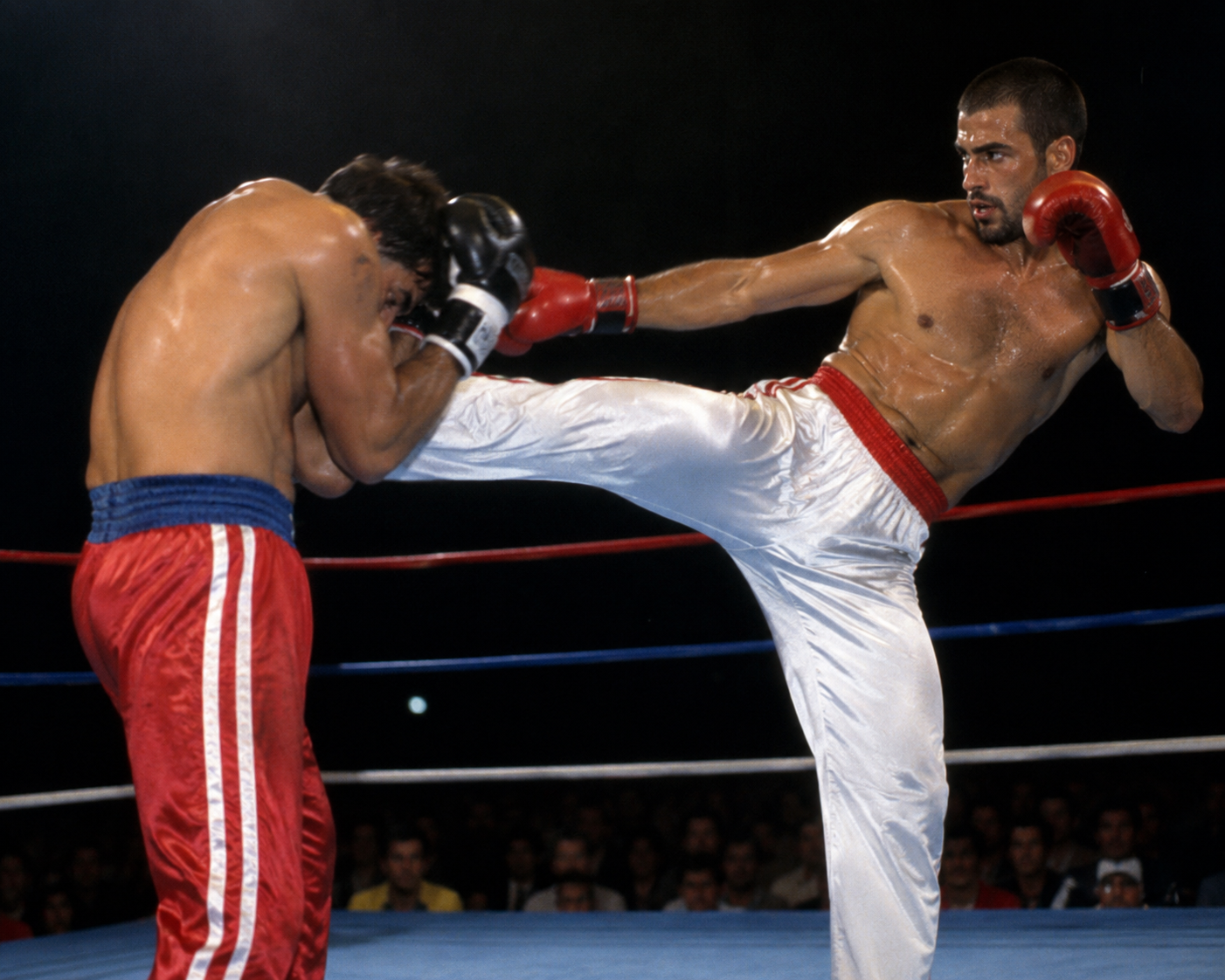
Kickboxing is what happens when the boxer's legs are finally allowed to vote. Everything the hands learned next door comes with you, the four punches, the head movement, the feet that carry them, and a second story gets built on top: the round kick swung through a man like a bat, the front kick that fences him off, the low kick that ends fights nobody thought a leg could end, and a defense that now has to guard a building instead of a floor. It stops short of the elbows and the clinch the Thai art carries, which makes it the honest middle of the standing game, more complete than boxing alone and more available than the real thing from Bangkok. In most American towns this is the most complete striking a man can find within driving distance, and it is more than enough to build a standing game that holds.
This page is the door to that gym and the reason for the order of the rooms behind it. It tells you what the legs change, how a kickboxer breaks, what the four rooms are and why they are walked the way they are, and it keeps one name on its wall, because the man it belongs to is the whole lesson of the room walked out to the end.
Why the Legs Change Everything
The boxer who has never trained kicks meets a leg-kicker and discovers the problem in about ninety seconds. Every kick lands on a leg he has no idea how to defend, and by the second round he cannot move, which means he cannot box. The kicker who never built real hands gets walked down and out-punched in the phone booth. Neither man is wrong about what he knows. Both are wrong about what he is missing. This room exists to close that gap, hands and feet as one system, each covering what the other cannot.
The distance is not what the boxer thinks it is. A kick outranges a punch by two feet, so the kickboxer fights at ranges the boxer never has to read, and his eyes have to widen accordingly. Hips and shoulders for the hands, the step and the turn for the kicks, all at once. A man a year into this art reads the whole body. That is a different education than reading hands alone, and it transfers to everything that happens standing.
The low kick is a different kind of weapon. A punch to the head can be slipped, blocked, or eaten, and a man who eats one usually gets to keep fighting. A low kick to the thigh cannot be slipped, is only blocked by a leg that has been taught to lift, and is never eaten for free. The thigh does not recover between rounds the way a head clears. It swells, the nerve quits, and the man's whole game leaves through his knee, because everything he does starts from the leg he can no longer stand on. It is the slowest knockout in fighting and the most certain, and every one of the four rooms behind this door learned it the hard way, in public, from somebody who already knew.
The kick has to come home too. The boxer learned that a hand left out is a door left open. The kicker learns the same lesson with a limb he is standing on. A kick thrown without the return is a leg in the other man's hands, and the next thing that happens is that he is on the floor. So the kicking game is built the way the punching game was, snap and return, and the leg lands back under the man before the eye can see that it left.
The stance moves. The boxer's bladed stance is built to hide the body behind a shoulder. A kickboxer stands squarer, weight a hair further back, lead leg light, because the lead leg has two new jobs: it has to lift to check a kick and it has to fire one. A man who plants his lead foot the way he did in the boxing gym is a man whose leg gets chopped, and the first month of this room is mostly the Warrior kicking that foot until it learns to be somewhere else.
The rules you fight under decide what you never learn. This is the deepest thing in the room and the reason one of the rooms behind it exists. A man's blind spots are not chosen. They are issued to him by whatever rulebook he trained inside, and a rule that says nothing below the waist counts produces, after ten years, a champion who has never once thought about his own leg. That champion is real. He has a name. The room that owns his story will tell you what he did about it.
How a Kickboxer Goes Wrong
The cardio class in fight clothes. Bags, fast music, a good sweat, no sparring, no defense, no pressure. Nothing wrong with the workout. Everything wrong with believing it built capability. If nobody in the room is allowed to hit you back, you are not training a fighting art, and the last room on this mat will say so the first time it matters.
The name on the door. The sign says Muay Thai and the teaching is kickboxing without the elbows and the clinch. The art is fine. The label is wrong, and the man who believes the label owns capacity he does not have. Name what you actually train. Honesty about the system is part of the discipline.
He never learned the low kick. Above-the-waist rules, pretty high kicks, and no answer when a man starts chopping the lead leg. The whole sport made this mistake once, in front of a paying crowd. There is no excuse left for making it privately.
All gas, no guard. He stacks offense on two stories and defends neither, hands down when he kicks, legs unchecked when he punches. The kickboxer's defense has to cover high and low at once, woven into every strike, or the holes he leaves get found by the first man who looks.
The head-hunter. He fell in love with the high kick because it is the one that gets replayed, and he throws it at men who have not been set up for it. The high kick is the last thing on the card, not the first, and the men who land it landed a hundred low kicks and body punches first to bring the hands down.
The kick that stays out. He throws and admires. The leg hangs in the air an extra half-second, the other man catches it, and the beautiful striker is hopping backward on one foot toward the floor. Every kick comes home. The room says it as often as the boxing gym said it about the hands, and for the same reason.
Four Rooms, Walked in Order
Kickboxing 101 — the first class. The Warrior runs it himself. The stance that moves, the push kick that fences, the round kick thrown with the hip, the low kick and the leg that learns to lift, and the two-story defense, taught the way a first night in the gym actually goes, warm-up to cool-down, with the card he hands every new man on the way in. Nothing exotic. The legs turned on, one at a time.
American Kickboxing— the karate men who put on gloves. The country that invented the sport by accident, when tournament karate fighters got tired of pulling their punches and went looking for a ring. The rulebook they wrote made a magnificent fighter and issued him a blind spot, and the night the blind spot was found is the night this room's story turns. What the champion did the next morning is the reason the American gym down the road teaches the low kick in week one.
Dutch Kickboxing— the system. A flat country with no fighting art to its name that imported three, braided them into one, and then owned the hardest striking tournament on earth for two decades. The Dutch did not invent a single strike. They invented a sequence and a room, and the room turned bankers and immigrants' sons into kings. It is the proof that capability is manufactured, and it is honest about the man the system built and could not govern.
French Kickboxing (Savate)— the oldest room. The street art of Paris, named after a worn-out shoe, fought in boots, and older than every other room in this hall by a century. A Frenchman lost an exhibition to an English boxer in the 1830s and did the thing the American and the Dutchman would each do again a hundred years later, which is the whole secret of the standing arts. The walk ends here, on the discovery that the newest lesson in the hall was also the first one.
The order is the argument. The first class comes first because the legs have to be turned on before the history of the men who turned them on means anything. America follows because the story you heard at the pads is its story and you are standing in its gym. Holland comes next because it is what the American lesson looks like when a whole country takes it seriously instead of one family. France is last, and last on purpose, because a man who has just watched two modern nations learn the same lesson needs to find out that the oldest room in the hall learned it before either of them, and that all three of them, the hot one and the cold one and the old one, have spent their whole histories measuring themselves against the same art. That art is the next room after this one.
The Three Pillars in the Ring
TRUTH— name your training honestly: the format, the rules, the holes. Spar men who can find what you are missing. And when the truth arrives as something that beats you, a kick you cannot check, a range you cannot read, train it. That is the whole lesson of this room, and the men who learned it fastest are the men whose names are on the walls of the rooms behind it.
LOVE — this art is handed down two men at a time, one holding the pads and one throwing, and the room only works if you are willing to take both jobs. Your partners get your honest rounds and your care. The new man gets what somebody once gave you. And the people at home get the man the rounds built, which was the point of the rounds.
LAW — every format has its rulebook and you fight inside the one you agreed to. The man who throws an elbow in a kickboxing spar is not tough. He is untrustworthy, and every partner in the room just learned it. You honor the pace, the corner, and the other man's career outside these ropes. And the shins you condition here are held to the same account as the hands you built next door, the first day either one is used on a man who did not agree to the rules.
The Coach Who Went Home
This room keeps a name on its wall: Duke Roufus, 1970–2025.
The younger of the two brothers in the Warrior's story. They came up side by side in Milwaukee, and Duke became a world champion in his own right, thirty-six wins against eight losses, twenty-six of them by knockout, with belts from three world sanctioning bodies. Then he did the harder thing. He hung up the gloves and spent the rest of his life building men. The gym he founded in Milwaukee in 2006 turned out world champions in the cage, Anthony Pettis and Sergio Pettis and Tyron Woodley and Belal Muhammad among them. But the men who trained there will tell you the champions got the same Duke as the hobbyist with a day job: patient, generous, glad you walked in the door.
He died in his sleep in October of 2025, fifty-five years old. The fight world mourned him not as a record but as a corner, the man standing three feet outside the ropes telling you the truth and meaning you well. That is the full arc this Farm exists to teach: build the capacity, use it honestly, then hand it down with an open hand and go home. Duke walked all of it. His brother is still teaching.
Walked as a System
The four rooms are one striker with a story. The first room turns his legs on. The next three show him the same thing happening to three countries, and the thing is always identical: a man built inside one set of rules meets a man built inside another, loses, and then either protects his pride or goes and trains what beat him. Walk the rooms in order and you watch that choice get made in Milwaukee, in Amsterdam, and in Paris, and by the fourth room you know it is not a fact about kickboxing. It is a fact about you, and the next time something beats you at work or at home you will recognize the morning after, and know what the men in this hall did with theirs.
And the legs leave the room. They go up the walk to the camp where the elbows and the knees are waiting, as the two-story defense the Thai art assumes a man already owns. They go down the mat to the clinch as the balance that lets a man be grabbed on one leg and not fall. They go to the Armory as the distance a man keeps from a blade, because the kick is the only empty-hand weapon that reaches a knife hand before the knife reaches you. And the honesty about rules goes everywhere, because every ground on this Farm is a rulebook of some kind, and a man who knows what his rulebook never taught him is the only man on it who can be trusted with the gaps.
After the Legs
Hear the Warrior on the way out of this gym, because it is the last time he will be the man teaching you anything on the feet.
Kickboxing has an agreed distance. Two weapons at the end of the arms, two at the end of the legs, and a range where all four of them work, and everything in this hall is built to fight there. That is its strength. It is also a promise the other man never made. Step inside that range, past where a punch has room and a kick has a leg to stand on, and the kickboxer has nothing, and the man in front of him has two weapons he was never shown and a way of holding him that no referee in this hall would allow. The whole standing game has been measuring itself against that man for as long as any of these rooms have existed. The Dutch flew to his stadium to be tested. The American champion lost his leg to him. The French had already been kicking for a century when they found out he had elbows. Lets explore the art of eight limbs.
Tools & Resources - Kickboxing
Impak Training Bag