
French Kickboxing (Savate)
Coaches & Gyms
Apparel & Equipment
Training Programs
Named After a Shoe
The first fight in the history of the Ultimate Fighting Championship lasted twenty-six seconds. November 1993, Denver: a lean Dutchman named Gerard Gordeau stood across the cage from a four-hundred-pound sumo wrestler, and when the sumo charged, Gordeau met him with a kick to the face that sent teeth flying into the front rows, one of them lodging in Gordeau's own foot, where it stayed while he fought his way to the final against Royce Gracie. Next to Gordeau's name on the broadcast sat a word most of the audience had never heard: savate. A French street art. Named, literally, after an old shoe. The newest fighting spectacle in America had opened with one of the oldest kickboxing systems in the world.
Most men your age met savate a different way, two years earlier, without knowing it. In 1991 Jean-Claude Van Damme played a French Foreign Legion soldier fighting through an underground circuit in Lionheart, and the film put savate's name and flavor, the sweeping kicks, the low-line attacks, in front of the video-store world. Be clear about the record, though, because this Farm keeps records straight: Van Damme is Belgian, not French, and he is not a savate man. His fighting style is rooted in Shotokan karate, where he holds a second-degree black belt, and in full-contact kickboxing; his trainer Claude Goetz came out of the European full-contact scene, which carried savate elements in its bloodline, and Van Damme blended those hard, snapping, linear kicks with the fluid movement of his ballet years. So the man who made savate famous never practiced it. That is how fame usually works, and it is why this room exists: so you can meet the real thing behind the movie poster.
The real thing is worth meeting. A two-hundred-year-old art that went from Paris alleys to the Olympic stage, nearly died in the trenches of the First World War, and then walked into the first UFC and drew first blood. It is the last room in the kickboxing hall and the oldest, and because it is also the rarest of the four to find on this side of the ocean, it has the same three doors behind it that the other rooms had, walked in the same order and honest at every one about what a man can actually find, wear, and run.
Born in the Streets, Named After a Shoe
Savate is old French slang for a worn-out boot, the kind of thing you'd say about a beat-up shoe you should have thrown away. The art earned the name honestly, because it began at the bottom: the streets of early-1800s Paris, where working men and street toughs settled matters with their feet, and the harbor of Marseille, where sailors developed a kicking game called chausson, legend says because a man on a rolling deck learns to kick while holding the rigging, and because in the ports a kick raised fewer legal problems than a closed fist, which French courts of the day were inclined to treat as a weapon. Whatever the mix of truth and sea story, the raw material was real: Frenchmen had built a fighting method that lived below the waist and in the boot.
Then a man did for savate what men on this Farm keep doing for every art you've toured: he took something wild and gave it a discipline. Michel Casseux opened the first proper savate school in Paris in 1825, stripped out the gouging and the thuggery, wrote down a method, and made the street art respectable enough that gentlemen, eventually even French nobility and writers like Alexandre Dumas, came to train. A fighting style born in alleys had acquired a syllabus. But it still had a hole in it, and the hole was about to be exposed.
The Humbling of Charles Lecour
Charles Lecour was Casseux's student, began his savate study young, grew into one of the finest fighters in Paris, feet like a surgeon's hands. In the late 1830s he shared a ring with a visiting English prizefighter for what was meant to be a friendly exhibition, and he discovered what every specialist eventually discovers: the Englishman's boxing hands worked at a range where Lecour's kicks could not, and the best foot-fighter in France couldn't answer him there.
Mark what Lecour did next, because you have seen this move twice before in this hall of rooms and it is the whole secret of the standing arts. He did not protect his reputation. He did not write rules to ban what beat him. He went and studied English boxing, trained it seriously, under Englishmen, and then wove the punches into his native kicking art, hands and feet as one system, and called the marriage la boxe française. French boxing. A Japanese karate man would do the same thing in Bangkok a century later and give the Dutch their style; a Milwaukee kickboxer would do it after 1988 and grow the American one. Lecour did it first, in the 1830s. Savate is arguably the original answer to the question this whole hall keeps asking, what happens when boxing and kicking stop being rivals and become one art. The Frenchmen got there before everybody.
The art Lecour built kept climbing. Joseph Charlemont and his son Charles systematized it into an academy science in the late 1800s; in 1899 the younger Charlemont fought a celebrated style-versus-style match against an English boxer and won it with a kick, the argument settled, at least in Paris. Savate men trained alongside canne de combat, the French art of the walking-cane, as the gentleman's answer to the street gangs of the era. And in 1924, when the Olympics came to Paris, French boxing was demonstrated on the Games' own stage. An old shoe, polished to a shine.
The Art That Almost Died Twice
Then the twentieth century nearly killed it, twice. The generation of savateurs who should have carried the art through the 1920s and 30s marched into the First World War, and a horrifying share of them never came home; the academies that survived the first war were hollowed out again by the second. By 1945, one of Europe's great fighting systems was a handful of aging masters and memories. It survived because a stubborn few refused to let it die, above all Count Pierre Baruzy, a many-time champion from the old school who spent the postwar decades rebuilding savate salle by salle, and is honored as the father of the modern art for it.
Sit with that lesson a moment, because it is bigger than France. An art, like a faith, a trade, or a family's story, is never more than one untaught generation from extinction. Nothing you build is durable because it is excellent; it is durable because it is handed down. Every art on this Farm lives by the same rule, and so does everything else you will ever love.
The Elegant Weapon
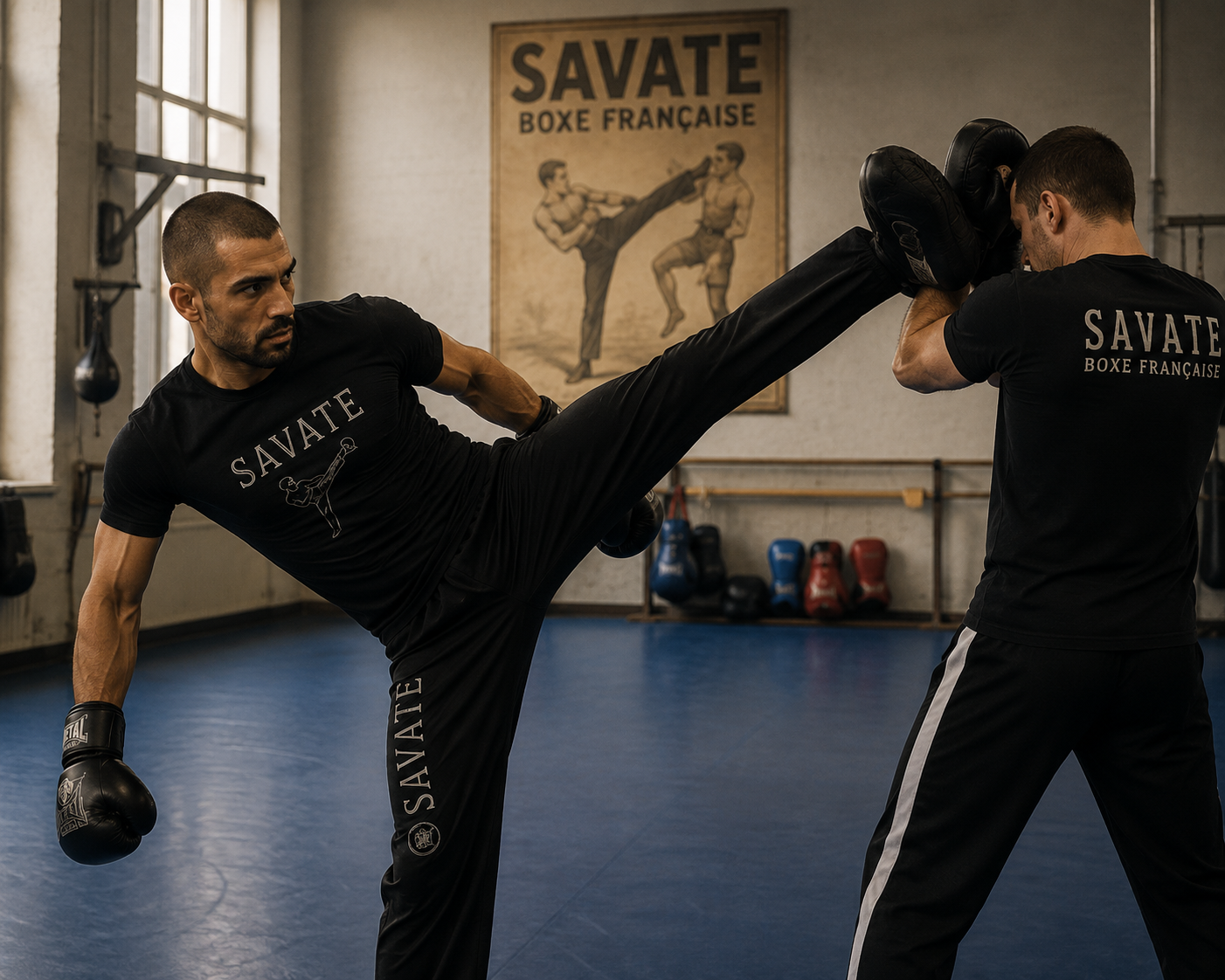
Walk into a savate salle today and you will know within a minute that you are not in a Dutch gym. Savate is the fencer of the kickboxing family: upright, mobile, precise, in and out on angles rather than walking through the fire. Its kicks have names like fouetté (the whip), chassé (the piston), revers (the reverse sweep), and the coup de pied bas, the low, chopping shin-and-ankle kick that predates the Thai low kick's arrival in the West by a century. The hands are proper boxing, Lecour's inheritance. And one detail makes savate unique among all the world's major kicking arts: it is fought in shoes. The striking surface is the toe and blade of the boot, not the bare shin, which changes everything about the mechanics; savate kicks are thrown for precision and placement, a blade rather than a club, which is why the art prizes accuracy and timing over raw collision. It even ranks its fighters the way the belts rank men next door in the grappling rooms, except in gloves: colored glove grades climbing toward the silver glove of the proven man.
There are two ways to compete: assaut, the light, technical form scored on touch and control, and combat, the full-contact form where the questions get honest answers. Both run on the same idea, the thinking man's kickboxing. If the Dutch style is a hammer swung in combinations, savate is a rapier, and the fencer, remember, gets to choose when the fight happens at his range.
Proving It in the Modern Era
An elegant theory is worth nothing on this Farm until somebody proves it against resistance, so meet the proof.
François Pennacchio spent the 1990s doing the hardest thing in striking: taking savate out of savate. A hundred professional bouts against the champions of the rival schools, Muay Thai men, karate men, Dutch-style kickboxers, winning world kickboxing titles in 1993, 1997, and 1998 and forcing the professional kickboxing world to take the French art seriously as a fighting system rather than a museum piece. He is counted today among the greatest savate fighters who ever lived, and his career is the answer to the man who sneers at the shoes and the French names.
Gerard Gordeau you met in the opening, the Dutch world-champion savateur who drew first blood in UFC history and fought through to the final of UFC 1 before Royce Gracie's jiu-jitsu caught him, teeth in his foot the whole way. Note the poetry: the French art entered the modern era's biggest proving ground on a Dutchman's foot, the two great European kicking cultures braided together in one man. And the line runs on into the cage: Christian M'Pumbu, a savate-bred fighter who won a Bellator light-heavyweight championship; Karl Amoussou, who carried savate into world-level MMA; Cheick Kongo, the Parisian heavyweight whose long, precise kicking game gave a generation of UFC and Bellator heavyweights fits. Modern mixed martial arts quietly absorbed savate's gifts, the bladed side kick, the oblique low-line kicks to the knee and thigh, the fencer's in-and-out distance game. The old shoe is in the arsenal of fighters who have never heard its name.
Three Rooms, Walked in Order
The three rooms behind this one are walked in the hall's order, and they are the most honest three in the hall, because savate is the rarest of the four arts to find on this side of the ocean and the Farm will not pretend otherwise.
Coaches & Gyms — the salle, and the near cousin. What a savate hall is and how it differs from every gym you have stood in, the courtesy and the glove grades and the teacher's title, where the salles are on this continent and how thin they are spread, and the honest map for the man who cannot find one: which of the other rooms in this hall carries the most of savate in it, and how a savate man trains in a kickboxing gym without losing the art. The first door, because in this art more than any other, the room decides whether the thing can be learned at all.
Apparel & Equipment — the boot. The only kicking art on earth fought in shoes, the boot told as the weapon it is, the one-piece suit, the gloves that are also the ranks, and what a man wears on the day he is finally in a room where nobody takes their shoes off. The second door, because the shoe is the whole difference, and a man who trains savate barefoot has trained something else.
Training Programs — the fencer's road. The glove-grade curriculum that climbs from the first blue glove to the silver, the assaut-to-combat progression that lets a man compete on touch before he competes on contact, the precision block that puts the toe where the other three rooms put the shin, and the honest version of all of it for a man with a kickboxing gym and a pair of shoes. The last door, and the last room in the kickboxing hall.
The order holds here for the oldest reason in the hall. Casseux opened a salle before he wrote a syllabus. The boot was on the foot before anyone named the kicks. And the glove grades that are the art's whole program only mean anything inside a room that awards them. Room, kit, plan, as always, and in the order the art itself was built.
The Three Pillars in the Salle
TRUTH — savate has a museum in it, the demonstration art and the movie poster, and it has an armory, Pennacchio's hundred bouts and Gordeau's foot, and a man who trains it has to know at every session which one he is in. The rooms behind this door are honest about it, and about the harder truth for an American: the art is rare here, and the near cousin down the road is not the same thing, however much of the French is in it.
LOVE — the art almost died twice and was carried through both deaths by men who refused to let the next generation grow up without it. Baruzy rebuilt it salle by salle for the boys who would come after him, and every savate teacher since has been handing down something that nearly wasn't there to hand. A man who learns it owes the same debt forward, and in an art this thin on the ground, the debt is not a figure of speech.
LAW — savate is the most rule-bound of the four arts in this hall, with its grades and its two competitive forms and its courtesies, and the rules are the reason a two-hundred-year-old street art can still be trained by gentlemen without anyone losing an eye. Honor the form you agreed to fight in, assaut or combat, and honor the older law that runs under all of them: a foot in a boot is a weapon the day it is used where there is no salle.
"Wisdom is better than strength." — Ecclesiastes 9:16
The verse goes on to say that the poor man's wisdom is despised and his words are not heeded, which is savate's whole modern history in one line: the rapier the world sneered at while the hammers took the prizes, and the art that kept being right about distance and precision whether anyone was listening or not. The Farm keeps the verse for the rapier, and for the thing the verse's writer had already worked out, which is that the wisdom was not the fencer's own invention either.
Walked as a System
The three rooms are the fencer's kit for a man who may never stand in a salle. The room tells him what he is looking for and what to do if it is not there. The boot tells him what makes the art the art, so that he can keep it in a gym that does not know its name. And the program gives him the glove-grade ladder as a shape to climb even where nobody is awarding the gloves, because a curriculum is a curriculum whether or not the certificate exists. A man who has walked all three has the French answer to the hall's question in a form he can carry into any kickboxing room on earth.
And the old shoe leaves with him. The precision goes into the Thai camp, where the Kru's push kick is a cousin of the chassé and has been for longer than either art knew of the other. The in-and-out distance goes down the mat as the footwork that keeps a man out of the clinch until he chooses it. And Lecour's move, and Baruzy's charge, go home, to every room in a man's life where something has beaten him and something has to be handed down.
After the Salle
This is the last door in the hall, and the Warrior has saved one thing for it.
You have walked four rooms and three countries, and every one of them was Western, and every one of them, in its own century, went east to be humbled. Lecour's humbling came from England, but his great-grandchildren in the French salles have spent a hundred years measuring their kicks against a different country's, the one where the low kick was never a discovery because it was never absent. The next room is not another nation's answer to the hall's question. It is the art the question was about. It has two weapons none of these four rooms taught and a range none of them fought at, and the Warrior does not walk you into it. He hands you a ticket.