
Dutch Kickboxing
Coaches & Gyms
Apparel & Equipment
Training Programs
"Doe maar gewoon, dan doe je al gek genoeg." — Dutch proverb: just act normal, that is crazy enough.
The Style the Lowlands Built
The Tokyo Dome, December. Seventy thousand Japanese fans have filled the biggest arena in the country for the K-1 World Grand Prix final, one night, eight of the best heavyweight strikers alive, single elimination until one man is left standing. And year after year after year, when the confetti falls, the man standing in the middle of Japan's greatest stage is from somewhere else: a small, flat, rain-soaked country in northern Europe with no fighting tradition to its name, half of it sitting below sea level, most of it reclaimed from the ocean by men with shovels and a system. Of the first nineteen Grand Prix tournaments, fighters from the Netherlands won fifteen.
Sit with that number. The United States, with its boxing history and its karate boom, never dominated a striking sport like that. Thailand, with six centuries of Muay Thai in its blood, never sent a wave like that through K-1's heavyweights. A country of fifteen million, where the national sports are soccer and speed skating, owned the hardest striking tournament on earth for two decades. That does not happen by accident, and it does not happen by talent. It happens by system. This room is the story of how the Dutch built one, and, because the system was the point and the system travels, three doors behind it that hand a man the parts of it he can carry into his own gym: the room it runs in, the gear it runs in, and the method that made bankers and immigrants' sons into kings.
The Braid
The Netherlands had no native fighting art. What it had was the same thing it used against the sea: engineers. In the 1970s a handful of Dutchmen went looking for the real thing, men like Jan Plas, who traveled to Tokyo and trained under Kenji Kurosaki, a hard old karate man who had fought the Thais in their own stadium, lost, and then done the humble thing almost nobody does: studied the art that beat him and built a gym around the answer. Plas carried that gym's name home and opened Mejiro Gym in Amsterdam in 1978. Around the same years, Thom Harinck was building his own hard school in the city, Chakuriki. Between those rooms and the ones they spawned, the Dutch style was born.
And it was, from the first day, a braid of three cords. From Western boxing: the hands, real combinations, head movement, the jab that starts everything. From Japanese karate: the spirit of the hard schools and the low kick as a weapon of destruction. From Muay Thai: the round kick, the knee, and the proof that shins win fights. The Dutch did not invent a single new strike. They invented a sequence, and the sequence fit the men throwing it. The Dutch are the tallest people on earth, long-levered and rangy, and the style plays to that frame: long punching combinations that force the opponent's guard and eyes up high, chained without a seam into a low kick that arrives while he is still worried about the hook. Punches in bunches, and the kick hides at the end of them. Watch any Dutch fighter for one round and you will see the signature. The hands are the question, the leg is the answer.
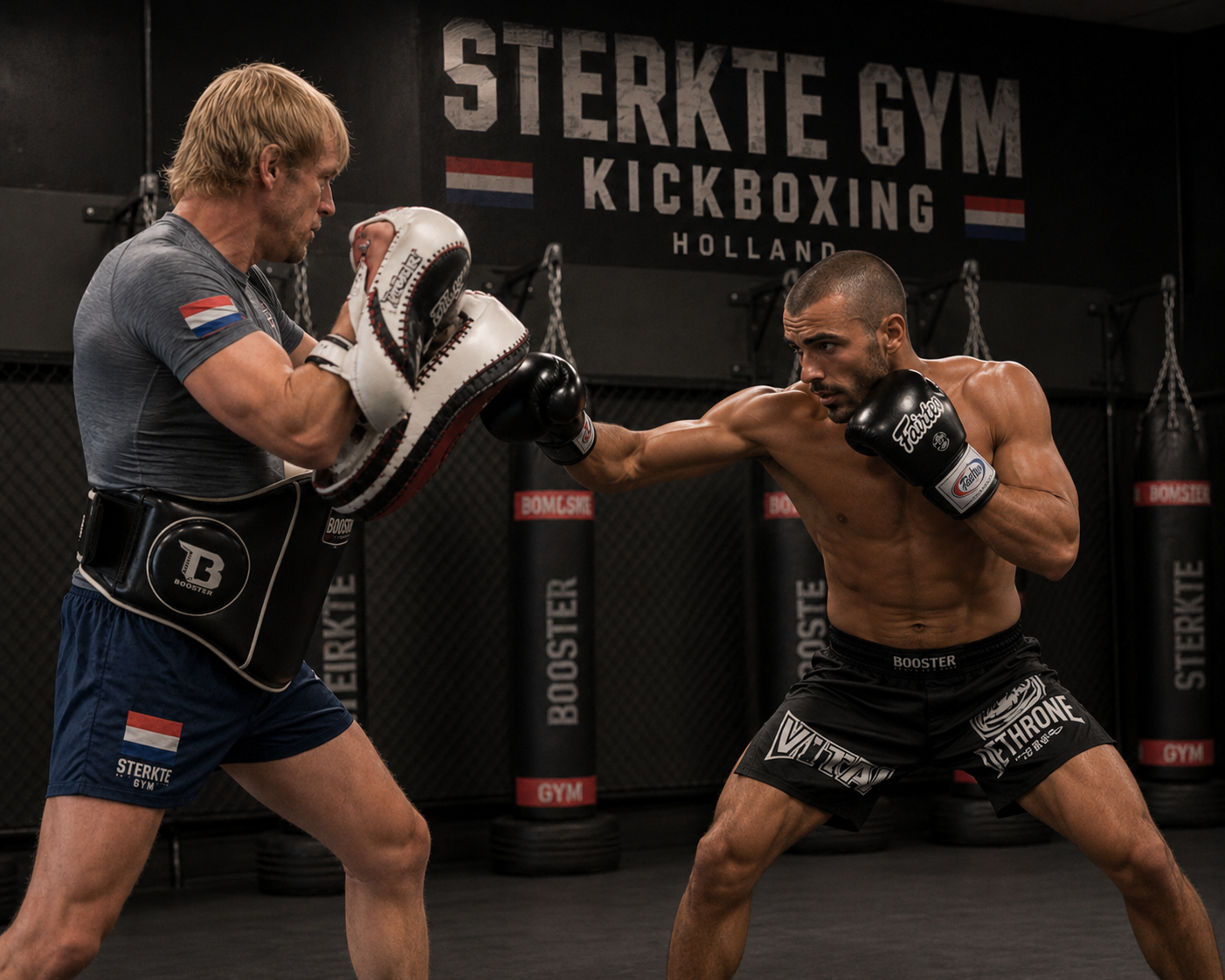
But the technique was only half the system. The other half was the room. Dutch gyms became famous, infamous, for their sparring culture: everybody works, everybody spars, the champions take rounds with the newcomers, and the truth about your abilities gets delivered several nights a week with sixteen-ounce anesthesia. It was a brotherhood that ran on honesty, and it manufactured toughness the way the country manufactured land, deliberately, incrementally, and against all natural odds.
The Pioneers Who Proved It
A system is theory until somebody bleeds for it in public. Two men, above all, took the Dutch style out of Amsterdam and made the world respect it.
Rob Kaman they called Mr. Low Kick, and the nickname was a scouting report. Through the 1980s, Kaman took the Mejiro system abroad and won world titles nine times over, chopping down opponents in France, Japan, and Thailand itself. If the Dutch style has a single defining highlight reel, it is Kaman's: the beautiful boxing, and then the leg kick landing like a felled tree. He was the proof of concept, the first great export.
Ramon Dekkers, the Diamond, is the heart of the whole line. A quiet kid from Breda, raised in the gym by his trainer and stepfather Cor Hemmers, Dekkers did the most audacious thing a Western striker has ever done: he flew to Bangkok in his early twenties and fought the best Thais in the world, in their stadiums, under their rules, at their weight, no soft matchups, no protection, over and over for years. He won some and lost some, and it did not matter, because he fought every one of them like the ring was on fire, walking forward, trading, refusing to be handled. The Thais, the proudest fight culture on earth, fell in love with him. They honored him as one of their own, a foreigner celebrated in the home of the art. Eight world titles. And in 2013 he was gone at forty-three, his heart giving out during a training ride, and two countries mourned him. Every Dutch fighter who came after walked through a door the Diamond kicked open.
The Grand Prix Years
In 1993, Japan built the stage the Dutch system was waiting for: K-1, a tournament designed to answer the oldest question in the standing arts, which style is best, by putting karate men, boxers, kickboxers, and Muay Thai fighters in one ring under one set of rules. That full story, one of the great sagas in fight sport, belongs further up the road in Fight Sports. What matters in this room is what happened next: the Dutch showed up, and it stopped being a debate.
Peter Aerts, the Dutch Lumberjack, out of Harinck's Chakuriki school, three-time Grand Prix champion with a high kick that ended nights in one swing, and a career so long he was still beating top men twenty years after his first title. Ernesto Hoost, Mr. Perfect, four titles, and the nickname told the truth: nobody in the sport's history made fewer mistakes, round after round of flawless Dutch fundamentals, the low kick accumulating like compound interest. His 2002 tournament is one of the great lessons in a fighting life: knocked out of the bracket by the 350-pound Bob Sapp, Hoost re-entered as the injury replacement when Sapp could not continue, and won the whole Grand Prix that same night. Beaten, given a second chance, and perfect when it came. Remy Bonjasky, the Flying Gentleman, three titles, a banker by day in his early years who became the most spectacular aerial striker the heavyweights ever saw. Semmy Schilt, nearly seven feet of him, four titles behind a front kick nobody solved. Fifteen of nineteen. The country that had no fighting art fifty years earlier now taught the world what one looked like.
And notice something about that roll call, because it is part of the lesson: Hoost and Bonjasky were sons of Surinamese families; the next wave would be Moroccan-Dutch and Turkish-Dutch. The Dutch gyms took every boy who walked in and ran him through the same method, and the method worked on all of them. That is what a real system means. It is not bloodline, not birthright, not talent scouting. It is a room, a sequence, and honest rounds, available to whoever shows up. Including you.
The Wild Ones and the Crossovers
The line kept producing, and it produced some warnings along with the champions.
Badr Hari, the Bad Boy of Amsterdam, may be the most gifted heavyweight striker the system ever built: speed, power, and violence that made him the biggest draw of K-1's late era. He is also the room's cautionary tale, and this Farm does not skip those. In the 2008 Grand Prix final, with the sport's biggest prize in front of him, Hari lost his temper and stomped a downed Bonjasky, disqualified on the spot, the title thrown away by his own hand. The years after brought an assault conviction and a prison cell. All that capability, and the one opponent he never trained for was himself. Hold him next to Hoost and learn the whole lesson in one comparison: the gym can build your weapons, but it cannot govern your spirit. That discipline is a separate training, and no referee enforces it for you.
Gökhan Saki, the Rebel, Turkish-Dutch, gave the heavyweights the fastest hands they had ever been hit with, a fan favorite who fought giants and made them look slow. Alistair Overeem did what no man had done before or since: won the K-1 Grand Prix in 2010 while simultaneously holding world heavyweight titles in mixed martial arts, the only fighter in history to reign at the top of both sports at once. And before all of them, Bas Rutten, El Guapo, had already carried the Dutch style into the cage in the 1990s, a karate and Muay Thai man from the south of Holland who became a champion in Japan's Pancrase and then heavyweight champion of the UFC, finishing his career unbeaten across his final twenty-two fights and making the liver shot famous to a generation. Then he did the Dutch thing: became a teacher and a voice for the sport, handing it down. Today Rico Verhoeven holds the heavyweight crown of kickboxing's modern era and has held it for over a decade, the system, half a century old now, still producing kings.
What This Room Hands You
Every excuse a man carries into the question of training, the Dutch story dismantles. My country, my family, my background has no fighting tradition: neither did theirs; they imported one and out-built the founders. I'm not a natural athlete: the Dutch method was never about naturals; it was combinations drilled ten thousand times and sparring rounds that told the truth, a conveyor belt that turned bankers and immigrants' sons into world champions. I'm too tall, too lanky, built wrong for fighting: the Dutch built an entire style around exactly that frame, and it conquered the world. The lesson of the Lowlands is that capability is manufactured the way land is reclaimed from the sea: a method, honest pressure, and years of showing up.
So steal the method whole, and the three doors behind this room are where the stealing gets specific.
Three Rooms, Walked in Order
The American room's three doors handed you a gym that learned its lesson, a bag for the legs, and the block that installed the check. The Dutch room's three doors are about a system rather than a lesson, and each one hands you a piece of it you can carry out.
Coaches & Gyms — the room where everybody spars. What a Dutch gym is and why the room was half the system, the famous ones named as history, how the Dutch style crossed the ocean into American fight gyms without the Dutch name on the door, how to recognize one in ten minutes, and what a grown man learns in a room where the champion takes rounds with the newcomer. The first door, because the Dutch method without the Dutch room is a set of drills, and the room is what made the drills into champions.
Apparel & Equipment — the gear of a room that spars every week. Nothing exotic, and one thing the Dutch understood better than anyone: how to spar hard, often, for years, and keep the men in the room. The kit that makes the sparring culture survivable, and the honest word about the shin guards the Dutch never take off in training and the pads they barely use. The second door, because the sparring culture the first door described has to be paid for in equipment or it is paid for in men.
Training Programs — the conveyor belt. The partner drill that is the whole Dutch method in one exercise, the sequence drilled until the hands and the leg are one sentence, the weekly sparring at volume, and the twelve-week block that runs a man through the same belt that ran Hoost and Bonjasky. The last door, because the belt only works on a man who has a room to run it in and the gear to survive it.
The order is the same as every school's, and here it has the plainest reason of all: the Dutch system is a room first, a kit second, and a method third, and the Dutch themselves would tell you that a man who buys the method off a screen without the room has bought nothing. The champions were made by the room. The gear kept them in it. The drills were what they did while they were there.
The Three Pillars in the Lowlands
TRUTH — the Dutch room ran on honesty delivered with gloves on. A man who spars every week with men who can hurt him cannot lie to himself about what he can do for longer than seven days, and the whole system was built on that clock. A room that tells the truth several nights a week produces men who have stopped needing to be told.
LOVE — every champion in this room was built by other men holding pads and taking shots, and the gym only worked as a brotherhood. The Dutch put the champion in with the newcomer not to humble the newcomer but to teach him, and the champion took the rounds because somebody had once taken them for him. That is the debt the room runs on, and the man who walks into a Dutch-style gym owes it forward from his first week.
LAW — sparring at volume is only possible inside rules that every man in the room keeps, and the Dutch kept them: the pace agreed, the gear worn, the partner's career protected. Hari's stomp in Tokyo was a law broken in public, and the whole sport saw what it cost. And what the room builds in gloves is answered for without them, the first time it is used on a man who never agreed to the whistle.
"One who is wise can go up against the city of the mighty and pull down the stronghold in which they trust." — Proverbs 21:22
Japan built the strongest city in the striking world and trusted it, and a small wet country with no fighting art walked in with a method and pulled the stronghold down fifteen times in nineteen years. The verse credits wisdom, not strength, and the Dutch would agree, and the Farm adds the thing the proverb assumes and the Dutch did not always say: the wisdom was found, in Tokyo and Bangkok, by men humble enough to lose first.
Walked as a System
The three rooms are the Dutch system taken apart so a man can carry it. The room is the honesty. The gear is what lets the honesty be survived. The method is what the honesty gets applied to, and a man who has walked all three has the whole braid in his hands: the room to spar in, the kit to spar in it for years, and the sequence to spar with. He also has the lesson under the lesson, which is that a system is not a secret. The Dutch never hid theirs. They wrote it on the wall, and the world lost to it anyway, because the world would not spar every week.
And the system leaves the room with him. The partner drill travels to Bangkok, where the old man on the pads has been running his own version of it for fifty years. The sparring culture goes down the mat, where the grappling rooms already run on it and will assume he does. And the manufactured toughness, the thing the Dutch built the way they built land, goes home, as the knowledge that capability is not found in a man. It is installed, by a room, over years, and a man who knows that has stopped waiting to discover what he is.
After the Lowlands
At the door, the Warrior tells you about the room after these three, and it is the oldest one in the hall.
The Dutch did the humble thing in the seventies. A Milwaukee fighter did it in 1988. The room after this one is a Frenchman who did it in the 1830s, a century before either of them, after an English boxer's hands found his face in a friendly exhibition and the best foot-fighter in Paris went and learned the punches that beat him. Everything this hall has taught you about learning the thing that beat you was done first in a pair of worn-out boots, and the last room is where you find out the newest lesson in the hall was also the first.