
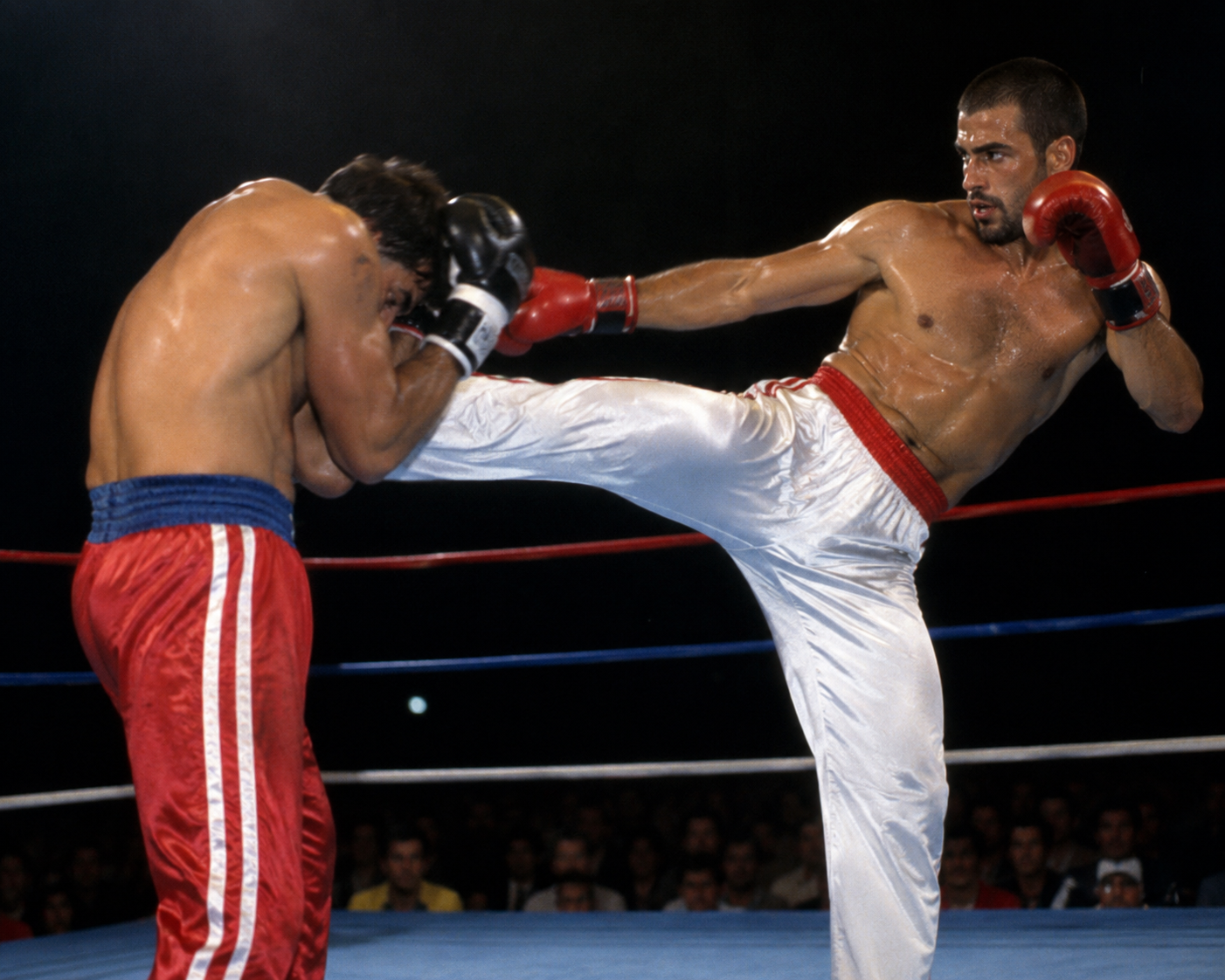
Kickboxing 101
"Strengthen your feeble arms and weak knees. Make level paths for your feet, so that the lame may not be disabled, but rather healed." — Hebrews 12:12-13
The First Class
The Warrior runs the first class himself. He hands you a card on the way in, a single sheet with the night written on it in five lines, and tells you to keep it, because in a year you will read it and see everything that was hidden in it. Then he tells you to find a spot on the mat, and the hour starts.
Five minutes of stretching that is not really stretching, a knee stretch and then an axe kick that folds into a runner's lunge, over and over, because the hips have to be told what they are about to be asked for. Five minutes of jumping, squats and high jumps and lunge jumps and bear crawls, until the legs are warm all the way through and a little afraid. Ten minutes of shadowboxing in three gears, loose and technical and then fast, with twenty seconds of rest between rounds that are not long enough. Then the Warrior stops the room and teaches four things. A half step. A push kick off the lead leg. A left hand to the body. An overhand right. He lets one elbow onto the card too, thrown once, slow, so the body has met the weapon before the room that owns it. Then five rounds of five minutes, each a different kind of round, and then the mat, and then the parking lot, and your legs shaking on the pedals on the way home.
That is Kickboxing 101, and it is the only room in this hall that the Warrior teaches with his own hands. The three rooms after it are history, the countries that took the legs and made them their own. This one is the legs themselves: how the stance changes when the feet become weapons, how the kicks get stacked on the punches you already own, how a man defends two stories at once, and what the first year actually feels like from the inside. Everything in the hall behind this door assumes you walked through this one.
The Stance Moves
You came in from the boxing gym with a stance that hides the body behind the lead shoulder, weight even, lead foot planted, and the first thing the Warrior does is kick that foot. Not hard. Enough to show you that a planted lead leg is a target, and that the boxer's stance was built for a world where nobody was allowed to hit it.
So the stance opens up. The shoulders come squarer, because a bladed man cannot lift his lead leg without falling over, and a man who cannot lift his lead leg cannot check a kick or throw one. The weight settles a hair further back, so the front foot is light enough to come off the floor in the time it takes a kick to arrive. The hands stay where the boxer left them, high and home, but the elbows drop a little closer to the ribs, because there is now a weapon that arrives at rib height from four feet away. And the half step, the first thing on the card, is the whole stance in motion: a short slide of the rear foot that closes or opens six inches of distance without the feet ever crossing, so the man is always standing on a base when the kick comes and never standing on one foot when it does not have to be.
The stance is not a position. It is a set of permissions. The boxer's stance permitted him to punch and slip. This one permits him to kick, to check, and to be kicked without falling, and it costs him a little of the shoulder he used to hide behind. Every stance in the standing game is that trade, and knowing what yours gave away is the beginning of defending it.
The Kicks, Stacked on the Punches
The push kick first, because it is the jab. The lead-leg push kick is on the card before anything else for the same reason the jab was the first punch in the boxing gym. It measures. It fences. It stops a man walking in and it tells you how he reacts to being touched. The foot goes out flat, the hip drives behind it, the ball of the foot or the whole sole lands on the hip or the belly, and the man on the other end is two feet further away than he meant to be with his breath gone. A kickboxer who owns the push kick controls where the fight happens, and the man who does not own it fights wherever the other man decides.
The round kick is a bat, not a foot. Beginners kick the way they punched on the first day in the boxing gym, with the end of the limb. They swing the foot. The Warrior turns it around the same way he turned the punch around next door: the kick is a turn. The support foot pivots until the heel points at the target, the hip comes through first, the leg follows the hip like a bat follows the hands, and the shin, not the foot, arrives on the man's thigh or ribs with the whole body turning behind it. The American gyms have long taught the kick to land with the instep and the shin both, in a foot pad, and the Thai camp up the road will move the contact to the bare shin entirely. Either way the lesson is the same one the bag taught with the hands. The limb is the last thing to move and the least of it.
The low kick, and the leg that learns to lift. This is the weapon that changed the sport and it is taught in the first month here, not the fifth year, because the men who ran this room learned what it costs to leave it for later. The round kick, thrown low, into the meat of the lead thigh, just above the knee, with the shin. And its answer, the check: the lead leg lifts, knee up and turned out, so the kick lands shin on shin instead of shin on thigh, and the man who threw it is the one who feels it. Checking hurts. Not checking hurts worse and for longer, because the thigh keeps the bill and pays it out in the third round when the leg quits. A month of checking, on pads and then on partners at half speed, and the lift becomes a reflex that fires before the eye sees the kick.
The switch and the return. A kick thrown off the rear leg is powerful and slow. A kick thrown off the lead leg is fast and light. The switch, a small hop that trades the feet in place, turns the lead leg into the rear leg for one kick and gives it the power without the wind-up the other man was watching for. And every kick, off either leg, comes home the way every punch did: the leg lands back under the hips before the man has finished admiring it, because a kick that hangs in the air is a leg that gets caught, and a caught leg is a man on his back.
The hands do not go on holiday. The left to the body and the overhand right are on the card next to the kicks for a reason. A kickboxer is not a kicker who sometimes punches. He is a boxer who can also kick, and the punches are still what most fights get finished with. The body shot brings the hands down and opens the head. The overhand comes over a guard that has been raised against the kicks. The card is teaching a sentence, not four words: step, fence, dig, drop.
Two Stories to Defend
The boxer defended a floor. You are now defending a building, and a building is defended differently.
Low, the answer is the check, already described, and the step back that takes the leg out of range without giving up the position. Middle, the answer is the arms: the elbows drop to catch a body kick on the forearm and the bone of the elbow, which hurts the kicker more than it hurts you, and the hand that used to be at the cheek learns to come down six inches without the head becoming naked. High, the answer is the one the boxing gym gave you, hands up and the head off the line, with one addition: the long guard, the lead arm extended straight into the other man's chest to jam the kick before it has room to get up to speed.
And there is the catch. A kick that hangs gets caught, and when you are the one catching, the fight changes shape in a second. The arm scoops under the leg, the other hand fires, and a sweep of the man's one standing leg puts him on the floor without a punch. The catch is the first place in this hall where the striker gets a taste of what the next range on the mat does for a living, and the Warrior points at it when he teaches it. That is the floor introducing itself. The boys in the takedown room do that on purpose.
Two stories mean twice the reading. The boxer's eyes watched shoulders and hips. The kickboxer's eyes watch shoulders and hips and the support foot, because the foot that pivots is the foot that tells you a kick is coming before the leg has moved. It takes a year for the eyes to widen that far. The first month they will be on the hands, and the leg will find you, and that is what the first month is for.
The Five Rounds
The back half of the card is five rounds of five minutes, and the Warrior wrote a word beside each one, because the rounds are not five doses of the same thing.
The first round is slow. Low intensity, every technique on the card thrown clean and repeated until the body has it without the mind. He wrote brain beside it. The second round is faster. Moderate intensity, the same techniques with the heart rate up and the breath short, and the word beside it is heart, because this is the round that finds out whether the roadwork was done. The third round is hard. High intensity, the last minute of it thrown when the arms have nothing left and the legs are asking to quit, and the word beside that one is spirit, because what is being trained in the third round is not a kick. It is the man who keeps kicking. Then a round for the core, because every strike on the card runs through the middle of the body and a soft middle bleeds power on the way through. And then the last round is the cool-down, stretching the legs that were just asked for everything, because the class that skips it is the class that loses its students to their own hamstrings by March.
Brain, heart, spirit. The Warrior does not say much about the three words, but they are on the card in his own hand, and a man who trains long enough will notice that every hard thing he ever learned came in that order. The mind gets it first, cleanly and slowly. Then it has to be done tired. Then it has to be done when everything in the body has voted to stop, and that is the only round where a man finds out what he has.
The First Year From Inside
Be told honestly what the year is like, because most men quit inside it and the ones who stay are not tougher. They knew what was coming.
The shins hurt. For the first three months every round kick on the bag rings up the bone, and the bruises stack on top of each other until the shin is a color that alarms your wife. This is the bone going to school. It does not toughen because you beat it; it toughens because you load it, in a volume the body can rebuild from, week after week, and a man who tries to shortcut it with a broom handle or a bottle is a man with a stress fracture and a story. Kick the bag. Kick the pads. Let the shin learn at the rate the shin learns.
The lead leg gets found. For the first month you will check nothing, because the eyes are not yet wide enough to see the kick before it lands, and every partner in the room will chop that leg and watch you limp. Around week six a check fires that you did not decide to throw, and the man who kicked you winces instead, and the room changes.
Sparring starts around month three, in shin guards and sixteen-ounce gloves and headgear, light, with a partner who is allowed to kick you and told not to hurt you. This is where the boxer in you has to be humbled again. Your hands are better than everyone's and it does not matter, because the men in this room have been kicking your legs since the first bell and by the third minute your hands have nowhere to stand. Stay through it. Somewhere in month four a body kick lands off your own hip with the turn behind it, the pad-holder grunts, and you understand for the first time that you have two more weapons than you walked in with.
And the roadwork does not stop. A kick costs far more wind than a punch, and a kickboxer who cannot run three miles cannot fight three rounds, whatever his technique. The Proving Ground was never a separate program. It is the reason the third round on the card is survivable.
Every man in this hall bought the year the same way, and every one of them will tell you the same thing about it: the first class is the hardest, and the card is the whole art in five lines, and you will not know that until you can read it.
Where This Sits
This is the first of four rooms, and the only one without a country's name on it. The legs are on now, and the card is in your pocket. The three rooms ahead are the story of three nations that took the same weapons and found out, each in its own decade and each the hard way, what happens when the rules you train inside decide what you never learn. The first of them is the one you are standing in, the country that invented the sport by accident and got its education one night in a Las Vegas ring.