
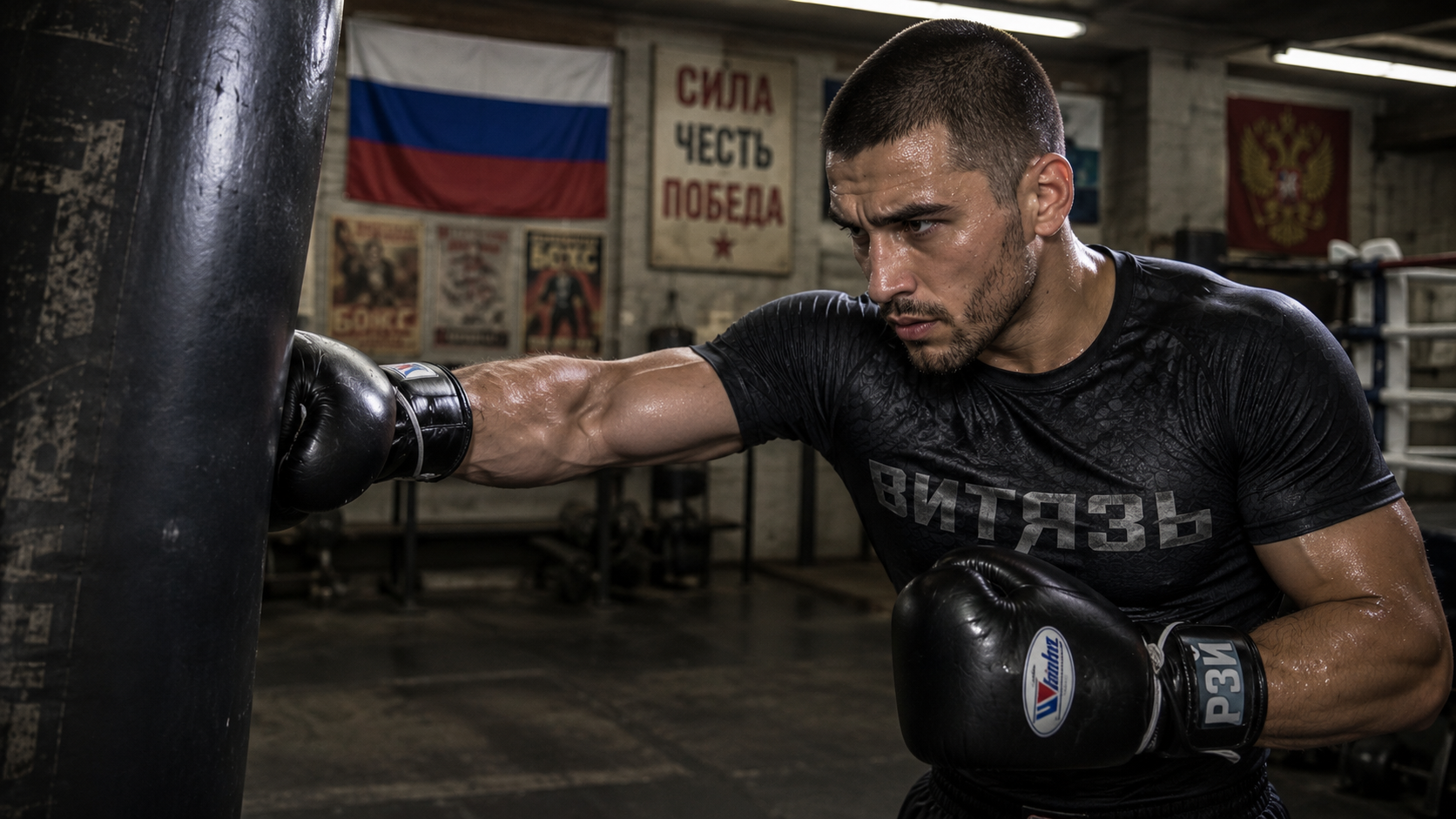
Russian Boxing
Coaches & Gyms
Apparel & Equipment
Training Programs
"Терпение и труд всё перетрут." — Russian proverb: patience and work grind through everything.
The State Machine in Gloves
The Warrior does not take you to a gym for this one. He puts on a tape of an amateur bout, two boys in headgear and vests, red corner and blue, three rounds of three minutes, and tells you to watch the boy in red and count his backward steps. You count none. He does not retreat. He does not advance either. He hangs at the very edge of the other boy's reach on a small, constant rocking of the feet, forward and back, forward and back, and every time the other boy commits, the boy in red is two inches further away than the punch, and his jab is already on its way back down the line. Three rounds. He is touched perhaps four times. "That boy is sixteen," the Warrior says. "That was his two hundredth fight. Nobody in America has two hundred fights at sixteen. Nobody in America has a country that arranges it."
Every fighting nation puts its own stamp on boxing. The American throws his punch to be seen throwing it. The Mexican throws his to start a war. The Russian throws his off a longer education than either of them ever got, a childhood of amateur bouts, a system that measured everything, and a temperament that treats a fight as a problem to be solved coldly, on points, with the fewest mistakes. This room is the Russian hand: where it came from, what built it, the names that turned a national program into a generation of world champions, and, because a man from the West cannot walk into that program and should know what he can take from it anyway, three doors behind it, walked in the same order as the other two schools and honest at every one about what is and is not available to him.
Boxing in Russia was never just a sport a kid wandered into. It was a department of the state. Under the Soviet system the country built physical-culture schools the way other nations build armies, and boxing was one of its proving grounds: talent spotted early, drilled in the same method from one end of the map to the other, fed through hundreds of amateur contests before a man ever thought about turning professional. When the Soviet Union fell and that machine's products were finally free to fight for money, they walked out of the East and took division after division. The same system seeded the whole region, Ukraine, Kazakhstan, the Caucasus all grew their own giants from it, but its capital was Russian, and its character is the coldest, most calculated answer to the four punches the sport has ever produced.
The Russian Style
If the American style is variety, the Russian style is the opposite, a single disciplined model stamped onto thousands of fighters until they look like cousins of one another. And that is on purpose.
It was bred in the amateur ranks, where the contest is won on clean scoring punches and lost on the ones you walk into. So the Russian fighter is taught, before anything else, not to get hit. He manages range like an accountant manages a ledger. He lives behind a long, educated jab, steps in to score, and steps back out before the answer arrives, on the rocking step you just watched, which the Russians call the pendulum and drill from the first week. He fights off angles and pivots rather than standing in the pocket to trade. He throws at a high rate but a low risk, banking the round point by point, refusing to gamble what he does not have to. Where the brawler asks can I hurt him, the Russian asks what is the percentage, and he plays the percentage every time.
It can look cold from the outside, even joyless, next to the Mexican's blood-and-honor war. It is not built to thrill the crowd. It is built to win, repeatedly, against every style the world can send, and the record says it works. The system produced craftsmen who could box a mover into frustration, out-think a pressure fighter, and grind down a puncher by simply never being where the big shot landed. The man across from a well-schooled Russian is not in a brawl. He is in an exam, and the other man wrote the test.
The Machine
In America the maker is a man, a single trainer who rebuilds a single fighter's soul on a folding chair. In Russia the maker is a system, and that is the deepest difference between the two schools.
The Soviet sport apparatus treated athletic development as a science to be engineered, not an art to be discovered. It ran specialized boxing schools that pulled in promising boys young and put every one of them through the same curriculum. It backed them with sport scientists who studied how a body peaks and built the training calendars to make it peak on the right day; the periodization methods the whole world later borrowed came out of that laboratory. And it fed them volume no Western amateur ever saw: a Soviet-schooled fighter might log several hundred amateur bouts before turning pro, an education in live problem-solving that simply cannot be bought in a commercial gym.
The result is a fighter who arrives complete. When the post-Soviet wave finally turned professional, many of them hired Western trainers to sharpen the pro game, but the foundation those Western coaches were sharpening had already been poured, years deep, by the machine. That is the Russian contribution to the craft: proof that you can manufacture excellence at scale, deliberately, the way a country builds anything else it has decided to be the best at. The trade still comes down to a real room and a real coach, the Farm's law everywhere, but here the room was an institution, and the coach was a country.
The Bloodline and the Hard Country
The Russian bloodline is a roll of cold, efficient champions and a few warriors who broke the mold by choice.
Kostya Tszyu carried the Soviet amateur education into the professional ranks and reigned over the light-welterweights with a jab and a straight right thrown like a man closing a door. Sergey Kovalev, the Krusher, ruled the light-heavyweights with a chilling, methodical power that wore the violence of a brawler over the patience of a technician. Dmitry Bivol turned the percentage game into an art, out-boxing far more famous men by simply being more correct than them for thirty-six minutes. Artur Beterbiev stands as the rarest thing the system ever produced, a fighter who keeps every ounce of the technical schooling and ends nearly every fight by knockout anyway. And men like Ruslan Provodnikov, the Siberian, proved the mold could be broken from the inside: a Russian who chose the Mexican's war over the system's caution, and bled for the crowd because he wanted to. The machine's cousins hang on the wall in the hall of fighters too: the Ukrainian with the dance-class feet and the Cuban with three gold medals were both built by the same kind of state, and their rooms tell what it built and what it could not.
Behind the names is the land. Russia makes hard men because it is a hard country, and boxing has always been one of the trades a tough kid from a tough region could ride out of the cold. From Siberia to the mountains of the Caucasus, the gym was warm, the path was clear, and the reward was real. Sport was also national pride; through the Cold War, a Soviet champion was a statement the whole country stood behind, and that weight never fully left. The Russian fighter carries his nation's seriousness into the ring with him: this is not play, it is work, and you do the work whether or not anyone is entertained.
It is worth saying plainly, the way the Farm always does: a system can build a nearly perfect fighter, and it still cannot answer the question the fighter was built to dodge. The percentage game wins belts. It does not tell a man what he is for once the belts are gone. The most schooled hands in the world still leave that question standing, and a man either faces it, or spends his life out-pointing it.
Three Rooms, Walked in Order
The other two schools walked you to a gym you could drive to, a bag you could buy, and a plan you could run. This school cannot. The Russian room was a state institution and the Russian kit was state-issued and the Russian program was written by scientists for boys the state had already chosen, and a grown man from the West is not going to be one of those boys. What he can do is take what came out of the machine, and the three doors are honest about how much of it that is.
Coaches & Gyms — the room you cannot walk into, and the ones you can. What the state school was, why it cannot be joined, and what came west when the wall fell: the coaches and fighters of that school who now run rooms in Brooklyn and Los Angeles and a dozen other cities, what those rooms look like, and what a man learns in one that no American or Mexican gym will teach him.
Apparel & Equipment — the amateur kit. The vest, the headgear, the ten-ounce glove, the red and blue corners, and the scoring that shaped the whole style. The Russian fighter owned none of it; it was issued. What it means that you will own yours is the room's whole subject.
Training Programs — the program the scientists wrote. Periodization, technique before power, the pendulum drilled until it is a reflex, the volume of bouts, and the twelve-week amateur block a Western man can actually run, toward a first sanctioned fight, with the calendar built the way the machine built it. The last door, and the last room in the boxing gym.
The order holds here for the coldest reason of the three. In Russia the room came first because the state assigned it, the kit came second because the state issued it, and the program came third because the state wrote it, and the boy had no say in any of them. A man from the West has a say in all three, and the three doors are where he exercises it: choosing a coach from that school, buying a kit that was handed to the boy in red, and running a program that was calculated for him by men who never knew his name. The machine's gift to the outsider is that its methods do not care who uses them.
The Three Pillars in the Exam
TRUTH — the machine measured everything, and the measuring was its honesty. Bouts logged, rounds scored, peaks calculated, a boy's ceiling estimated at nine and re-estimated every year. The Farm honors that, because a man who refuses to measure himself is lying by omission. And the Farm adds the measurement the machine never took: what the boy was for, once the measuring was done.
LOVE — the Soviet fighter fought for the state and was told it was love of country, and some of it was, and the honest ledger in the hall of fighters tells how much. The Farm's word is simpler. A man fights for people with faces, and a system that replaces the faces with a flag has taken something from him that the belts do not return. Keep the faces. Use the method.
LAW — the amateur road that built the machine runs on a rulebook, a scoring system, a passbook, and a medical, and the Russian school's whole genius was in taking those rules more seriously than anyone else did. A man who wants the school's results fights inside the school's rules, and carries the oldest one out with him: the hands are held to account the day they are used where there is no scorer.
"It was not by their sword that they won the land, nor did their arm bring them victory; it was your right hand, your arm, and the light of your face, for you loved them." — Psalm 44:3
The machine would have called that verse unscientific. It had the swords counted, the arms measured, the victories on a ledger, and it was the most successful system for building fighters the world has seen. And the man who wrote the verse had also won, and had also counted, and had decided the count did not explain the winning. A fighter built by a machine should know, going in, that the best-measured men in history said the measurement was not the reason.
Walked as a System
The three rooms are the outsider's share of the machine. He cannot have the childhood, the two hundred bouts, or the state. He can have a coach who was raised in it, the kit it fought in, and the calendar it wrote, and the honest word at each door about which of those is really his. A man who has walked all three schools now has the whole boxing gym in him: the American's speed and science, the Mexican's heart, and the Russian's refusal to be hit, and he has learned at the last door that the thing he could not buy from the machine, the volume, is the thing he can still go and earn, one sanctioned bout at a time.
And the machine's methods leave the room with him. Periodization goes across the whole Farm, into every ground where a man has to peak on a day. The pendulum follows a man into the tie-up as the rocking base that makes him hard to time and harder to hold. The percentage goes into the Armory, where a man who plays the odds rather than his pride is the man who walks away. And the measuring goes home, as the habit of counting honestly what a man has done and not what he meant to.
After the Exam
The Warrior stops you at the last door of the boxing gym with one thing to say about the hall on the far side of it.
The Russian never gets hit because he has measured the distance to the inch, and everything in his ledger was written for a range of about thirty inches, the length of a man's arm. The men in the next hall throw a weapon two feet longer than that. Every distance the machine calculated is about to be wrong, the pendulum that kept the boy in red two inches outside every punch is going to keep him two inches inside every kick, and the most schooled hands in the world are about to find out that the school had walls. That is not a criticism of the school. It is why the walk does not end here.