
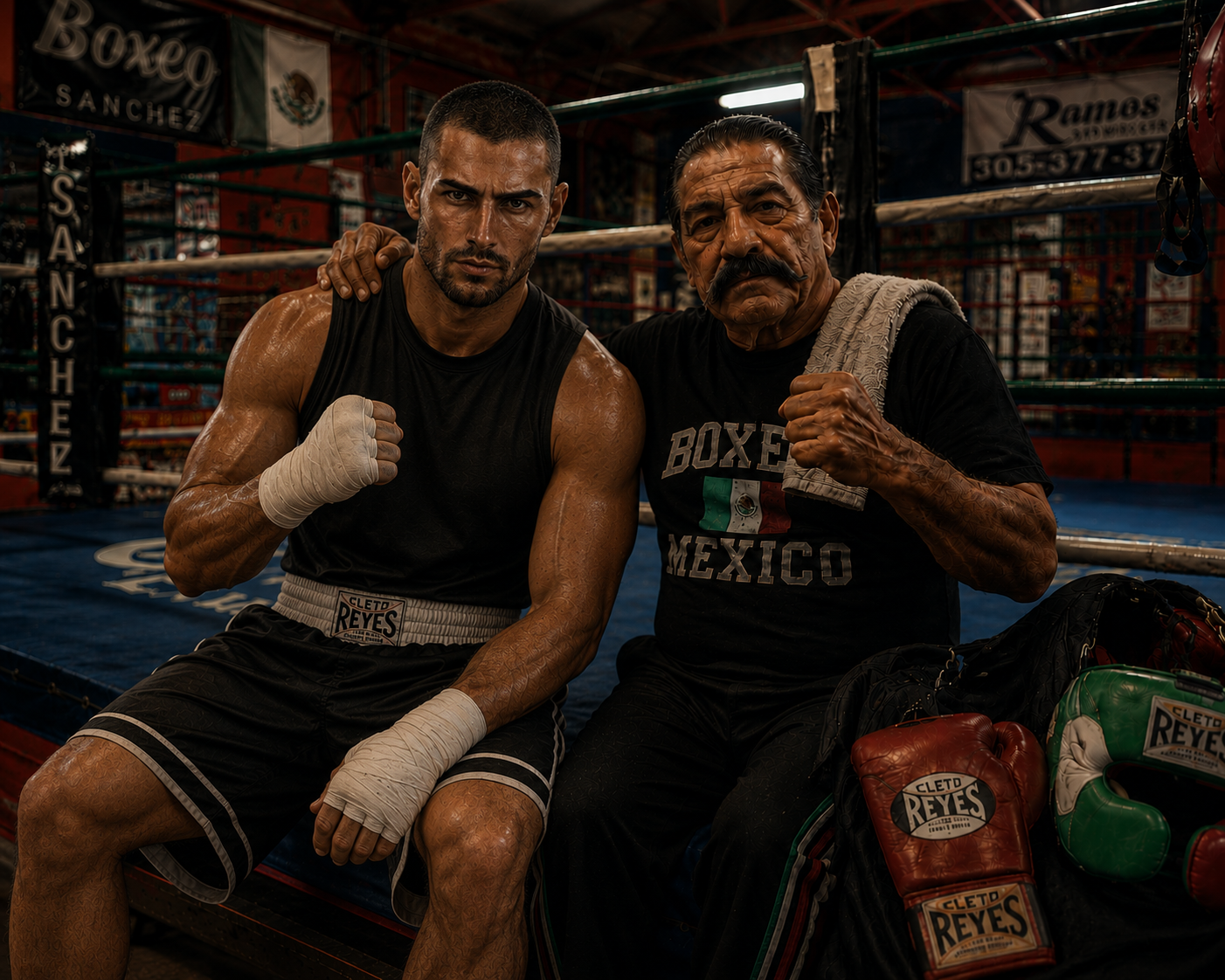
Mexican Boxing
Coaches & Gyms
Apparel & Equipment
Training Programs
"Al que madruga, Dios lo ayuda." — Mexican proverb: God helps the man who rises early.
Heart in Gloves
The Warrior takes you to a gym in East Los Angeles on the Saturday of Mexican Independence Day weekend, and nobody is training. Forty men and boys are packed around a television on a milk crate, the fight from Las Vegas on the screen, and when the Mexican fighter takes a right hand flush and walks through it the whole room makes one sound, low, like a church. The Warrior does not say anything until it is over. Then he says, "Be here at seven tomorrow." At seven the same room is full of boys hitting the heavy bags low, at the ribs, at the height of a man's liver, over and over, while an old man in a body pad walks the floor and takes their hooks in the gut and says nothing but otra vez. "That's the whole country," the Warrior says. "Last night was why. This morning is how."
Every fighting nation puts its own stamp on boxing. The American throws his to be seen throwing it. The Russian throws his off a cold education in not getting hit. The Mexican throws his to start a war: forward, to the body, willing to take one to land one, certain that the man who refuses to take a backward step is the man who wins in the end. This room is the Mexican hand, where it came from, who forged it, and the names that made Mexican style two words every fight fan understands. And because the gyms that carry it are down the road from you too, on both sides of the border, this room has three doors behind it, the same three the American gym had, walked in the same order and teaching a different thing at every step.
No country loves boxing the way Mexico loves boxing. It is not a sport there. It is woven into the calendar, the family, the faith, and the national idea of what a man is. The fights land on Independence Day weekend and Cinco de Mayo because the fight is the celebration. A poor kid in Mexico does not stumble into the gym by accident. He grows up knowing the ring is one of the few honest roads up, and that the men who walk it carry the whole barrio's name with them. Out of that love and that hunger came not a varied school like the American one, nor an engineered one like the Russian, but a single unmistakable creed: come forward, go to the body, and never, ever quit.
The Mexican Style
Where the Russian fights not to be hit, the Mexican accepts that he will be hit, and decides the man who hits him will pay more. That trade is the whole style.
He marches forward behind a high, tight guard, cutting off the ring, refusing the other man room to breathe. He digs to the body. The Mexican left hook to the liver is one of the most feared punches in the sport, the shot that takes a man's legs and his will one floor at a time, because the body does not recover the way the head does. He throws in combination, he throws late into rounds when other men fade, and he is conditioned to keep throwing when his own face is a ruin. He will give blood to take blood. He fights as if going backward were a kind of shame.
This is the style the crowd loves, and that is no accident. The Mexican fighter has always understood that the people in the cheap seats paid to see a war, and he gives them one. But underneath the spectacle is a hard logic. Pressure breaks the technician's rhythm. Body work cashes in late even when the early rounds were lost. A man who will not stop coming forces every opponent to either stop him or drown. It is the riskiest answer to the four punches and the bravest, and at its best it produces fights that are remembered for fifty years.
Its one shadow is the thing that makes it great. The refusal to quit is a virtue right up until it becomes the thing that gets a man hurt for nothing. The heart that wins wars also keeps a beaten man standing in fire when wisdom would pull him out. The greatest Mexican fighters learned the difference. The tragedies are the ones who never did.
The Gym and the Barrio
In America the maker is a single trainer rebuilding a single soul. In Russia the maker is the state. In Mexico the maker is the family gym and the street it sits on, boxing handed down like a trade, father to son, old champion to neighborhood kid, in rooms that have produced world titles for generations on almost no money.
The dean of them holds a chair in the hall of coaches, and you have sat in it: the calm one, the surgeon of the cut, whose Mexico City gym turned out a long line of champions who could counter as well as they could march. Before him stood men like Cuyo Hernández, who built champions out of the mid-century Mexico City fight scene when the trade was rougher and the money thinner. In the modern era a father and son carry the same tradition out of Guadalajara, raising a stable around the country's biggest star. These are not celebrity trainers in the American mold. They are craftsmen of a local trade, and the trade is everywhere. In Mexico the neighborhood gym is as common as the church, and many a boy's first lesson came from a father or an uncle who had once laced gloves himself.
What the gym hands down is not only technique. It is the creed, the body attack, the forward march, the honor of fighting hurt, passed so consistently from one generation to the next that a Mexican fighter from any decade is recognizable in the first round. That is the Farm's law in its purest form: the art comes down man to man, in a real room, in a real place, from someone who carried it before you. In Mexico the room is the barrio, and the place never lets the fighter forget who he carries it for.
The Bloodline and the Banner
The Mexican bloodline is a parade of warriors, and the country knows every name.
Julio César Chávez is the patriarch, nearly ninety fights without a loss to begin his career, a body puncher who broke men methodically and became, for a time, the most beloved athlete in the nation; his photograph is the first one on the wall in the hall of fighters, and his fall is told there beside his titles. Salvador Sánchez was a genius taken in a car crash at twenty-three with the whole sport at his feet. Rubén Olivares and Carlos Zárate ruled the lighter weights with terrifying punching power. Then the golden era of the trilogies, Erik Morales, Marco Antonio Barrera, and Juan Manuel Márquez, three Mexican greats who fought each other and the world in wars that defined a decade. And the modern banner-carrier, Canelo Álvarez, who married the old body attack to a counterpuncher's patience and became the face of the sport. Standing between two nations is Oscar De La Hoya, the Mexican-American Golden Boy who carried the tradition into the mainstream.
Behind the bloodline is the banner. Mexican boxing is national identity in glove form. The fighter crosses himself on the way to the ring, carries the flag and often an image of the Virgin of Guadalupe, and understands he is fighting for more than himself. The great rivalry with Puerto Rico turned cross-border pride into some of the fiercest fights the sport has seen. The faith is real and woven through all of it; you cannot tell the story of Mexican boxing without the church the fighters were raised in. And the ethic underneath, give everything, hold nothing back, lay your body down rather than be shamed, is the most spiritually loaded creed of the three schools.
It is worth saying plainly, the way the Farm always does: the willingness to lay it all down is close to the highest thing in a man, and it is also one step from a cheap death. The cross the Mexican fighter wears on his way to the ring points at the difference. There is a laying-down of one's life that is glory, greater love has no one than this, and a throwing-away of it that is only pride refusing to bend. The heart that makes these fighters great is built to find the first. A man learns here which one he is carrying, or he learns it later, harder.
Three Rooms, Walked in Order
The American gym walked you through the room, the kit, and the plan for the first time, and gave you a coach, a bag, and a calendar. The Mexican gym walks the same three doors, in the same order, and teaches at each one the thing the American gym could not: what a room looks like when it is a family, what gear looks like when it was built for a puncher, and what a program looks like when its whole purpose is the last three rounds.
Coaches & Gyms — the family room. What a Mexican gym is, on either side of the border, how to recognize one in the first five minutes, what the boys in it are being built for, and what a grown man from the other kind of gym learns the day he walks into one. The first door, because in Mexico the gym is the family, and a man does not buy gloves before he has one.
Apparel & Equipment — the puncher's kit. The Mexican glove, the most famous in the sport and the most honest about its trade-off, what goes under it, the body pad the old trainer wears, and the flag and the faith on the trunks, told straight. The second door, because the Mexican glove is a decision a beginner should not make alone.
Training Programs — the last three rounds. The body-attack program, the conditioning that makes it possible, the altitude and the hills, and the twelve-week block a man adds on top of the base the American gym gave him. The last door, because the Mexican program is not a beginning. It is the block a boxer takes on when the science is in him and the question left is whether the heart is.
The order holds for the same reason it held next door, and for one more. Room, kit, plan is how a man meets the sport anywhere. In Mexico it is also how the sport meets him: the barrio gym claims the boy first, hands him the puncher's glove when the coach says his hands can pay for it, and only then puts him on the program that will decide whether he becomes one of the names on the banner or one of the names nobody remembers. Reverse it and you have a man in expensive gloves marching forward into fire with no engine under him, and the Mexican gyms have buried that man.
The Three Pillars in the War
TRUTH — the crowd wants a war and the fighter wants to give it one, and between those two wants the truth about a man's condition can get lost for eleven rounds. The Mexican corner that is worth anything tells the fighter the truth he does not want: that the leg is gone, that the eye is closed, that the war is over whether or not he agrees. And the faith on the trunks is honored for what it says about a people who know a fight is more than physical, and read honestly: the protection is not in the image. It is in the One the image points at, and the two are not the same.
LOVE — the barrio's name goes into the ring on a man's back, and the men in the cheap seats are the reason he refuses the backward step. That is love, real and fierce, and it is also the thing the Farm asks a man to aim correctly. The people behind the fighter need him alive and clear at sixty more than they need him upright in the twelfth. The corner that throws the towel is not betraying the barrio. It is loving the man more than the night.
LAW — the referee's stoppage and the corner's towel are the two mercies the sport built into a style that has none of its own, and the Mexican fighter who curses them has misunderstood what they are for. A man fights inside the rules that keep him alive to fight again, and the oldest rule holds here as it holds everywhere: the hands that were trained to walk through fire are held to account the day they are used where there is no referee.
"You armed me with strength for battle; you humbled my adversaries before me." — Psalm 18:39
The verse is a warrior's, and it sounds at first like the Mexican creed: strength, battle, the other man brought low. Read who is doing the arming. The man who wrote it had the heart the barrio prizes, and he did not think the heart was his own doing, and a fighter who walks forward through fire should know, going in, where the men before him said the fire-walking came from.
Walked as a System
The three rooms are one fighter's second education. The American gym built a boxer. The Mexican gym asks whether the boxer can also fight, which is a different question, answered in a different room, with different gloves, on a program with a different purpose. A man who has walked both has two things the man who walked one does not: the science that wins the first nine rounds and the heart that wins the last three, and the wisdom, if he was listening at the last door, to know which one the night in front of him is going to require.
And the heart leaves the room. It goes north into every American gym as the forward step the American fighter had to learn from the Mexican across from him. It goes into the kickboxing hall as the willingness to eat a kick to land a hand. It goes down the mat into the clinch, where a man who has already decided not to quit is a man who cannot be broken by fatigue. And it goes home, to the barrio or its equivalent, as the thing a man carries into the night his family needs him not to take a backward step, which is a night every man on this Farm is being built for.
After the War
At the door the Warrior turns back once, because the country after this one deserves a warning.
You are about to leave the hottest gym in the sport for the coldest. The men in the next room do not walk forward. They do not give blood to take blood. They were built by a state that measured everything and taught them, before any punch, how not to be hit, and they will make the heart you just learned to prize look, for nine rounds, like a foolish thing. It is not. But the Mexican who marches into a Russian has to know what he is marching into, and the Russian room is the only place he can find out.