
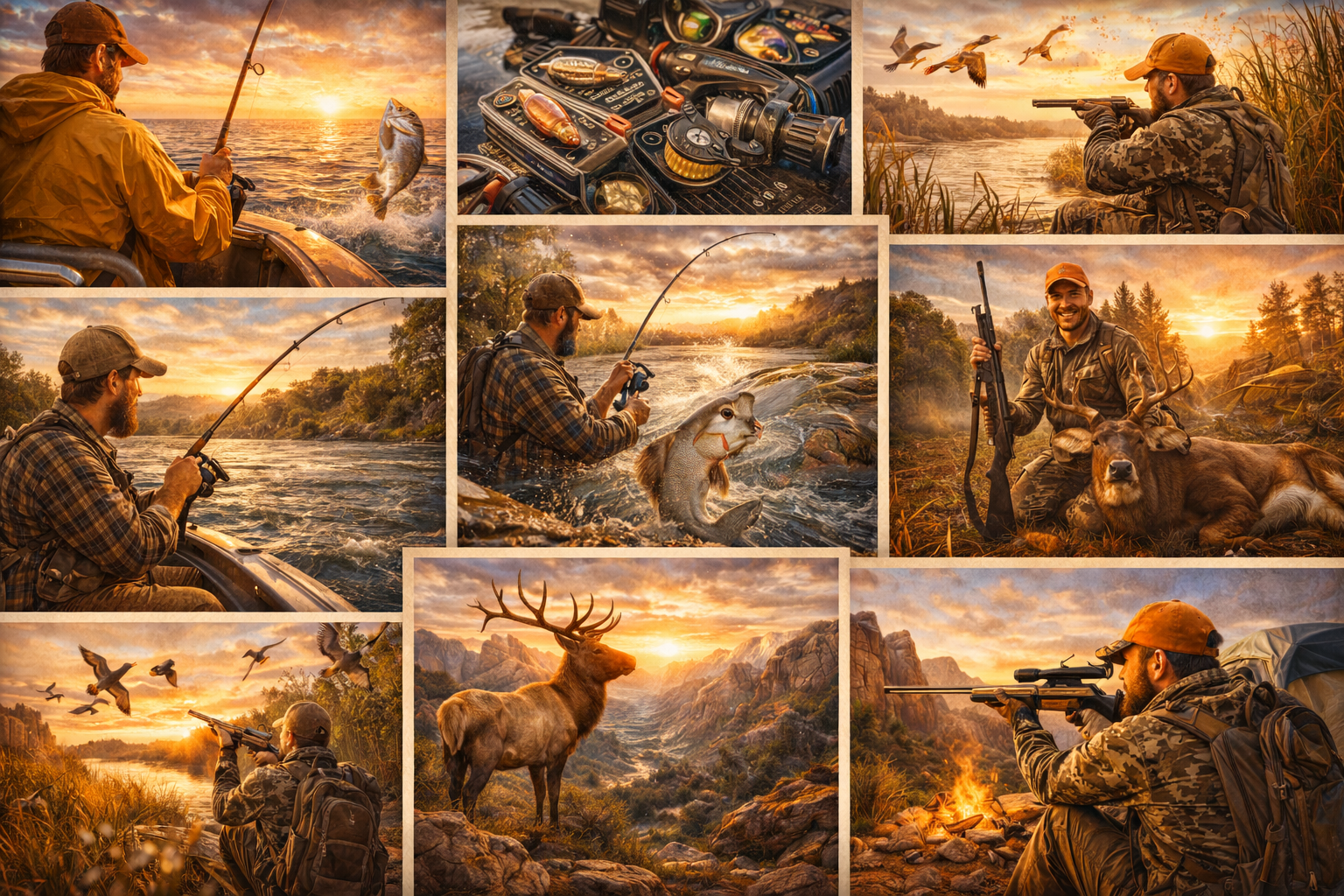
Fishing & Hunting
Big Game Hunting
Bird & Fowl Hunting
Fresh Water Fishing
Salt Water Fishing
A boy taken fishing at six is in the boat with his father at sixteen, on his own water at thirty-six, and out on the lake with his own son at forty-six. That is the whole thing in one sentence. The trip is the surface. The handing-down is the depth, and there is nothing else in the FUN Kingdom that runs as deep.
The Adventurer takes you to the oldest place there is. Not the trailhead, not the campsite — the water's edge in the gray before sunrise, or the timber in the cold dark with the blind already set. He doesn't say much out here; the country does the talking now. A man is already there ahead of you, kneeling on the gravel bar with a fish, working a knife along its belly with the ease of ten thousand repetitions, talking low about what it ate and where it was holding and how it's going to taste tonight. He looks up. "People think hunting and fishing are about the kill," he says. "It's about everything else. The kill's just the part that makes the rest of it honest." That man is Steven Rinella, and this ground is the one he has given his life to.
This is Fishing & Hunting — the oldest pursuits a man has, and the beating heart of the whole Backcountry. Fishing is the patient pursuit of fish across the seasons; hunting is the patient pursuit of game. But they are not really hobbies in the way the rest of the Open Country holds hobbies. They are the originals — the thing a man did to eat before he did anything else, the work that built the country, and the place where, more than anywhere on the journey, a father hands his whole self down to his children one quiet morning at a time. Every other outdoor pursuit is good. This one is deep.
Why These Are the Oldest Things a Man Does
Start with what's been lost, because the loss is the whole reason this ground matters. The average modern man has no contact with his own food. The meat shows up under plastic wrap; the fish arrives at the restaurant already a filet on a plate. He has never seen the animal alive, never seen it die, never had blood on his hands for the dinner he's about to eat. He has been handed the cleanest, most convenient relationship with food in human history, and it has quietly made him the most disconnected from it that any people has ever been. He thinks of himself as too civilized to kill an animal — while paying, three times a day, for animals to be killed for him out of sight by someone else. That is not innocence. It is just distance.
The hunter and the fisherman close that distance, and it changes a man. Rinella has spent twenty years making one stubborn point: the most honest meat a man can eat is the meat he killed himself. No factory, no feedlot, no hidden cruelty — a wild animal that lived a wild life and died one clean afternoon by the hand of the man who's going to eat it. The man who has knelt on a gravel bar and cleaned his own trout, or field-dressed his own elk with his breath fogging in the cold and miles of pack-out ahead of him, knows something true about the world that the man ordering the elk medallion has never touched. He knows what his life costs. He knows that something dies for him to eat, every single day, and he has stopped pretending otherwise.
And the pursuit teaches a patience the modern world has nearly bred out of men. The fish does not come when you want it. The deer does not appear on your schedule. A man can sit in a blind for six hours and go home with nothing but the cold in his bones — and come back the next morning anyway, because the country owes him nothing and he knows it. That kind of waiting is a dying skill. The screen trained a generation to expect a reward every few seconds; the blind trains a man back into the older rhythm, where you give the day your full attention for hours and accept whatever it gives you. A man who can sit still and watchful in the dark for a whole morning has an attention the rest of his life is starving for.
Then there is the death, which is the part that separates this ground from every other and demands the most of a man. To hunt is to take a life. Not an abstraction, not a unit of protein — a living animal, here and then not. A man who does it right does not flinch from that and does not glory in it either. He learns the weight of it. He makes the shot clean because a clean kill is the one mercy he can offer. He uses the whole animal because waste is an insult to the life he took. The strange thing — the thing the man who has never hunted cannot believe until he's done it — is that the hunter who has cleaned a hundred animals ends up more reverent toward life, not less. The gravity does that. You cannot take life seriously and stay casual about it. The man who has never killed his own food is not more reverent than the hunter. He has just never had to look at it.
The Man Who Carries This — Steven Rinella
Bear Grylls' name is over the whole Backcountry, but when the trail reaches the water and the timber, the man who knows this exact country is Steven Rinella. He grew up in Michigan hunting and fishing and trapping with his brothers and his father, went off and got a writing degree, and then did something almost no one else managed — he became the man who could explain the whole bloody, ancient, misunderstood world of hunting and fishing to people who'd never touched it, without softening it and without apologizing for it. Through MeatEater — the show, the podcast, the books, the whole thing he built — he became the most trusted voice for the working man who wants into this world and has no father left to teach him.
His ethic is the one this ground runs on, and it comes down to a few hard, clean ideas. Eat what you kill. The meat is the point; the antlers on the wall are a memory of the meat, not the reason for the hunt. Use all of it. Waste is the real sin out here — the animal gave its life, and the least a man can do is not throw any of it away. Do it yourself. Rinella's whole posture is against the outsourced hunt where a guide scouts the country, sets the stand, ranges the animal, and hands the client a rifle for the last ten seconds so he can buy a trophy he didn't earn. Learn to read your own country. Plan your own route. Butcher your own animal in your own garage. The competence is the thing. Know what you're doing to the world. Rinella is a genuine naturalist — as curious about why the buffalo nearly vanished and how the elk came back as he is about filling the freezer — and he never lets a hunter forget the truth that the anti-hunter refuses to believe: the hunters and fishermen are the people who pay for and protect the wild. Their license money funds it. Their conservation built it. The man who loves the game most is the man who has the most reason to keep its country healthy.
And under all of it is the part that makes him the right man over this particular ground: he takes his kids. He wrote a whole book about getting children outside — catching crayfish, counting stars, the small wonders that hook a young heart before the big trips ever can. He hands it down, on camera and off, the way it was handed to him, because he understands that the deepest thing this ground produces isn't a freezer full of meat. It's a child who spent a thousand quiet hours in the country beside their father, and became the kind of person that makes. The grocery store can sell you protein. It cannot sell you that.
What project7 adds to Rinella's ethic is the thing he points toward without always naming: that the dominion a man exercises out here — the right to take a life to feed his family — was granted, not seized. It came from the One who made the animal, the country, and the man, and handed the man stewardship over all of it. The reverence Rinella has for the life he takes is, underneath, reverence for the Author of that life. Run the gift all the way up the beam and you find the Giver.
The Father, the Boy, and the Water
This is the soul of the whole FUN Kingdom, so slow down here.
A father takes his boy fishing at six. The boy catches nothing worth keeping and loses interest by ten in the morning, and it does not matter even a little, because what's actually happening has nothing to do with the fish. The boy is learning the smell of the lake at dawn, the sound of his father's voice when there's no one else around to perform for, the patience of a man who isn't in a hurry. At sixteen the boy is in the boat as something closer to a partner — running the trolling motor, tying his own rigs, talking to his father about things a sixteen-year-old will only say to a man sitting beside him looking at the water instead of at him. The boat becomes the one place the hardest conversations of those years can actually happen, because nobody has to make eye contact and there's all the time in the world.
At thirty-six the man is on his own water now, his father older or gone, and he feels the absence of him in the quiet the way you only feel it in the places you shared. And at forty-six he is back at the beginning of the loop from the other side — a small boy beside him in the boat, catching nothing, losing interest by ten, and the man finally understanding what his own father was doing all those mornings. He wasn't teaching a kid to fish. He was building a person, one trip at a time, in the silences as much as the action — the long drive, the cold morning, the hours of nothing, the fire at the end of a long day when a tired boy will say true things he'd never say at the dinner table.
That is the arc this Kingdom is built around. It is invisible at any single moment inside it — any one trip looks like just a trip — and it is decisive across the cumulative weight of dozens of them. The father who walks it gives his children something that no money, no school, and no screen can manufacture: the unshakable knowledge that their father chose, over and over, to spend his scarce free hours with them in the country. The man who hunts and fishes alone for forty years and never takes the next generation has built real skill and left the deepest thing this ground offers entirely unbuilt. The trip is the surface. The inheritance is the depth.
What This Ground Holds
The pursuit runs two ways, and each opens into the country a man can spend a lifetime learning.
Fishing — the patient pursuit of fish across the seasons. Its children divide by the water itself: Fresh Water Fishing, the rivers and lakes and ponds and reservoirs — trout, bass, walleye, pike, catfish, the inland water most men learn first and fish their whole lives; and Salt Water Fishing, the surf and the inshore flats and the deep blue water — striper, redfish, tarpon, tuna, the bigger and saltier pursuit. Fishing is usually the door a man walks through first, because a kid can do it, the stakes are gentle, and the water forgives a beginner the way the timber does not.
Hunting — the patient pursuit of game across the seasons. Its children divide by the quarry: Big Game Hunting, the deer and elk and moose, the multi-day backcountry pursuit that asks the most of a man's legs, lungs, and patience; Bird & Fowl Hunting, the upland birds and waterfowl — quail, pheasant, duck, goose — the world of the bird dog and the cold dawn blind, where the dog is half the joy; and Bear Hunting, the specialized pursuit with its own country, gear, and heavy ethics. Hunting asks more than fishing — more skill, more conditioning, and more from a man's conscience, because the death is bigger and closer.
How a Man Gets This Ground Wrong
The oldest pursuits have the oldest traps, and most of them are ways of taking the trophy while skipping the substance.
The Trophy Chaser. He hunts only for the rack on the wall and treats the meat as an afterthought, or worse, as garbage. He has inverted the whole thing — turned a way of feeding his family into a way of feeding his ego. Eat what you kill, and let the trophy be the memory of good meat honestly taken, never the reason you took it.
The Man Who Outsourced the Hunt. He pays an outfitter to do every part of it except the last ten seconds — the scouting, the stand, the ranging, all done for him — and buys an animal he can't honestly say he hunted. Guided trips have their place, especially in country a man doesn't know. But the man who only ever does it this way never builds the competence, and the competence was the whole point. Scout your own country. Plan your own route. Butcher your own animal. Earn it.
The Catch-and-Photograph Man. His fishing exists for the feed. The fish gets hoisted for the camera, held out of the water too long for the perfect shot, then either released half-dead or kept for status instead of the table. Keep the photo short or skip it. The fish is food or it goes back fast and unharmed — it is not a prop.
The Absent Father. He hunts and fishes for decades and never once takes a child into the country. The skill is real and the deepest inheritance this ground offers goes unbuilt. Take them young, take them often, walk the long arc on purpose.
The Man With No Gravity. He kills without weight — mocks the animal, mistreats it, wastes it, treats the life he took as nothing. This is the failure that gives hunting its bad name, and it is a failure of the man's soul, not his marksmanship. Clean shot. Full use. Real respect for the creature and the country it lived in.
The One Who Bites the Hand. He hunts and fishes while sneering at conservation, as if the game were infinite and his license fee a tax instead of the thing that funds the wild he loves. The truth runs the other way: the working hunter and fisherman is one of conservation's oldest and most foundational supporters. The land ethic is not somebody else's politics — it is the plain creed of every serious outdoorsman the country was built by. Leave it better than you found it.
The Three Pillars on the Water
The Open Country's three questions follow a man into the blind and onto the boat. TRUTH. LOVE. LAW. Always in that order.
TRUTH — Am I worshipping the Creator out here, or just myself? The pursuit moves a man, and the honest question is where it points him. The reverence a man feels with a clean-killed animal in his hands, or standing in a river at first light, is meant to run all the way up to the One who made the animal and the river and the man. And there's a plainer truth too: be honest about the pursuit itself. The fish was the size it was, the hunt was as hard as it was — the man who inflates his story is lying about the one thing the country never lets you lie to yourself about.
LOVE — Am I out here living it, or performing it for strangers? This is the cut the modern outdoors fails most. There's the father whose hunt is for his family — the meat on their table, the boy in the boat beside him — and there's the man whose every cast and every kill is staged for an audience of people who aren't there, who experiences his own day through the lens he's holding up. Bring the people your life is actually inside. The son's first fish, the daughter's first hunt, the grandchild on the lake — that is where this ground pays out its whole inheritance.
LAW — Am I honoring the season and the country, or taking more than my share? The law pillar out here is the oldest code there is. Keep the season — buy the license, follow the regulations, never take more than is right. Make the kill clean and use the whole animal. And leave the country better than you found it, because the land is loaned, not owned, and the man who trashes the water or the timber is stealing from the next father trying to bring his own boy out here. The serious hunter and the serious conservationist are the same man.
The man with all three feeds his family from country he honors, with the people he loves beside him, and points the whole ancient business back up at the One who handed him dominion over it.
How This Ground Feeds the Rest
Nothing out here stands alone. The hunter is also a hiker, because he walks the country he hunts, and a camper, because he sleeps in it across the multi-day trips — this ground sits right on top of the trail-and-camp foundation and could not exist without it. It reaches into the DEFENSE Kingdom too: the firearms competence a man builds across decades of hunting — the safe handling, the marksmanship, the respect for the weapon — is the same competence DEFENSE trains, built in the one place where it is never theoretical. And it reaches deepest into the LOVE Kingdom, because the father-and-the-boy-and-the-water arc is not a generic outdoor trip. It is the picture project7 holds up of how a man hands himself down to his children. The freezer is provision. The child beside him is the legacy.
But the patient work of fish and game is the oldest way into this country, not the deepest. There is ground past where any game trail leads — the vertical rock, the black mouth of a cave, the white water that gives no second chances, the country off the edge of every map the park service ever drew. The provider's pursuit put a man deep in real wild and taught him to read it cold. The last ground of the Backcountry takes the man who can read it and points him at the wild's hardest edges — the places most men are content to photograph from the overlook and never actually enter.