
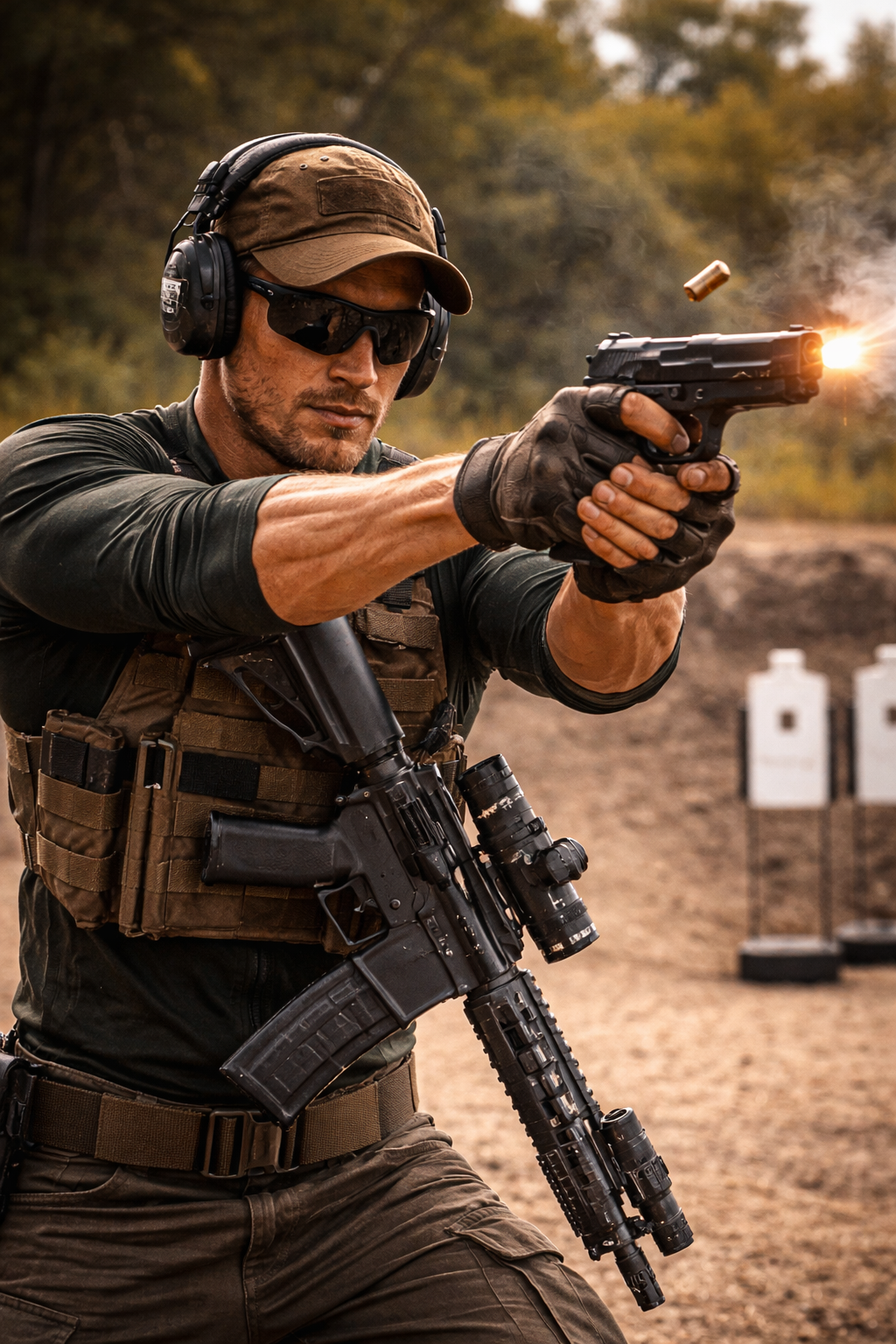
Firearms
Firearms 101
"Remember, the weapon is only a tool. It is the hard heart that kills."
— Jeff Cooper
The Gun Rack
The Armorer stands you in front of the rack and asks which one you would take home tonight.
You point at the rifle, because everyone does. He nods like a man who has heard the answer a thousand times. "That's the gun you'd choose," he says. "Now tell me where it is." You say the safe. "And where are you, at nine o'clock on a Tuesday, in the parking lot of the grocery store, when the man who's been watching you decides?" You do not answer. He taps the pistol. "That's the gun you'll have. It's the worst gun on this wall to shoot well and it's the only one that comes with you, and that's why it's first." He taps the rifle. "That's the gun that hits. Easiest thing on the wall to shoot, hardest to outgrow, and it holds the house and reaches past it. Second, because a man learns to hit on it." He taps the shotgun. "And that's the gun this whole country already owns and understands least. Everything the counter tells you about it is backwards. It's last because by the time you get to it you'll know what easy actually means, and you'll know it isn't."
He picks the pistol off the pegs, drops the magazine, locks the slide, shows you the chamber, and hands it to you empty. "But before any of the three, the bench. Nobody in this building fires a round until his hands know the four rules better than his mouth does."
This is the gun rack, the first room of the Armory and the primary one, the tool most men who walk this Farm will own, train with, and, in the rare and terrible case, use. It is the protector's answer to lethal force and the most honest test in the building of the difference between owning a thing and being able to do a thing, because nothing exposes that gap faster than the day. This page is the door to the rack, not the rack. It tells you why the gun takes a lifetime, how the hall is laid out and why in that order, what is actually kept in each of its four rooms, what the untrained owner gets wrong that the workshop was built to fix, how the four rooms hand each other off, and why the rack is not the last thing in the building.
Why the Gun Takes a Lifetime
This is the highest-consequence tool a man handles routinely, and the consequence cuts both ways: the force it can deliver, and the danger it becomes in hands that cannot run it under stress.
The truth most owners avoid is the arithmetic. Almost no legally owned gun is ever fired in defense across its owner's whole life. That is not a reason to skip the training. It is the reason the training has to be banked in advance, because if the day comes there will be no time to learn, and the day does not send notice. A man trains not because the day is likely but because it is consequential, and because the skill takes years to build and seconds to need.
And the gun never works alone. The pistol on the belt is one piece of what a man carries every day. The rifle in the house is one layer of a perimeter with a plan around it. Every shot fired is the first sentence of a legal reckoning that runs for years. And every encounter that closes to arm's reach stops being a shooting problem and becomes the problem the far end of this building exists for. The rack is the beginning of the armed man, and a man who thinks it is the whole of him has confused a room for a house.
The Hall, Walked in Order
Four rooms, and the order is the Armorer's, and he explained it at the rack.
Firearms 101 — the bench, and the workshop under it. The first class: the four rules taught as law and not as a poster, the grip and the press and the draw with an empty gun, dry practice as the thing that actually makes a man better, the first range day and its commands and its noise, the stoppages and the one that does not clear with a tap and a rack, and the cleaning that is really inspection. Under the class sits the workshop, fifty rooms of handling, ammunition, training, gear, and care, and the three bays after it point back to the workshop rather than teaching the fundamentals again.
Handguns — the gun you will have. The hardest gun on the rack to shoot well: a two-pound machine with a five-pound trigger at arm's length, where every flinch testifies on the target. And the only one that lives on a man's belt through an ordinary Tuesday, which is the whole reason it is first. The bay is held by the fastest man who ever fired a revolver, who put twelve aimed rounds through one with a reload in the middle in under three seconds and will tell you the gun was never the limit. Beside it the Revolver, the simpler answer that is still the right one for some men and some hands, and a shelf of Handgun Reviews for keeping up with the platform.
Rifle — the gun you would choose. The gun that wants to hit: four points of contact where the pistol gives two, a stock and a cheek and a sighting plane, and a new shooter ringing steel at a hundred yards before lunch. The deepest tradition in American hands and the highest ceiling a civilian shooter can reach, held by a man who wore a Ranger's uniform through four deployments before he wore a hat for a living. Three roads run out of the bay: the AR-15, which the room calls a rifle system more than a rifle; the Tactical Rifle (SBR), with its federal form and its stamp and the one cartridge that will chamber in the wrong barrel and destroy it; and Precision Shooting, where the notebook outranks the rifle. And beneath all three, Rifle Cartridges & Calibers, where the .22 is the schoolteacher and ballistics turn out to be a moral matter.
Shotgun — the gun America already owns. The most misunderstood gun on the rack: easy to fire, hard to run, heavy in recoil, low in capacity, slow to reload, and utterly dependent on the shell in it. The bay kills the myth first, that the spread aims the gun for you, because at hallway distance a buckshot pattern is the size of a fist, and it is held by a butcher who broke a clay at a hundred and thirty yards to prove it. Beneath it, Gauges & Shotshells, where gauge is backwards arithmetic and the patterning board is truth with a staple gun, and The Defensive Shotgun, the gun's duty at the doorway, and a shelf of Shotgun Reviews.
The order is the Armorer's and it is a teaching order, not a ranking. The bench first because nobody fires a round until his hands know the rules. The hardest gun first among the three because it is the one a man carries, and a man who learns the pistol first learns humility about his hands. The forgiving gun second because it is where marksmanship is actually built, and where a man finds out what hitting feels like. And the deceptive gun last, because its whole lesson is that the easy gun is not, and the lesson lands on a man who has just learned what easy really means on a rifle. There is no fourth gun. When the shotgun bay closes, the rack is finished, and the building goes on.
What the Untrained Owner Gets Wrong
The Armory's parent named the men who end up in the ditch. These are the gun rack's own, the mistakes the workshop was built room by room to fix.
The flinch he never cured. His group has been low and left for two years and he blames the sights. The workshop has a room for the diagnosis and a bench for the cure, and he has visited neither.
The draw he has never done. He has fired a thousand rounds and never once cleared his own shirt from a holster on a clock. The gun is on his belt and the belt is where it will stay on the day.
The man who has never heard a click. He has never set up a stoppage and cleared it, so the first time the gun goes quiet in his hands, he stares at it, and the workshop's room on the three kinds of stoppage was written for that stare.
The man who has never fired in the dark. Every round of his life was fired under range lights, and the hallway he bought the gun for has none. The workshop has a room for the light on the gun and the rule that governs it, and he has never switched one on.
The owner who has never patterned. He runs a shotgun with a load he chose from the box and has no idea whether it throws a fist or a basketball at his own hallway's length.
The man who has never zeroed. His rifle hits where the factory said, or where it did two years ago, and the notebook that would have told him is empty.
The man who cannot say the law. He does not know what his state says about the blade, the baton, or the pistol in the building he works in, and he will be told.
The wrong target. He can hit the center of a paper man and has never once trained the decision not to fire, or the identification that comes before it, and the rack's most terrible failure is not a miss. It is a hit.
The Three Pillars at the Rack
TRUTH at the rack is the target and the clock, and neither cares what a man believes about his shooting. The group is where the group is. The draw took what it took. The pattern on the board is the size it is. Everything the workshop teaches is a way of asking the gun an honest question and reading the answer without arguing, and the man who argues with a target has learned nothing from it.
LOVE at the rack is who the gun is for, and the rack is honest that it is for two people. It rides for the people behind the man, the ones he would be answering to on the day. And it is trained so that the man on the other end of it, who may be a threat and may be a neighbor's son, meets a hand that has done the identification before the press. One question governs every draw: who is this for, and what does it cost them if I get it wrong?
LAW at the rack is the statute on the gun, the ammunition, the holster, and the door a man walks through with it, read before it is needed, and the plain fact that the fight is not over when the fight is over. Every round fired is the first line of a reckoning, and a man carries inside the law or he carries a liability that looks like a gun.
Walked as a System
Four rooms and one rack. The bench makes a man's hands safe and then makes them competent, with an empty gun and a clock, before he touches a platform. The pistol bay teaches him the gun he has and how hard it is. The rifle bay teaches him what hitting is and how far it reaches. The shotgun bay teaches him what the whole country thinks it knows and does not, and closes the rack.
And the rack hands off in three directions. Down the building, to the blade, which goes where the gun cannot, and to the close range, where the draw the workshop timed gets fouled by a man's weight and the gun becomes the thing being fought over. Out to the Homestead, where the pistol is one piece of what a man carries, the rifle one layer of a perimeter, and every shot the first line of a legal reckoning. And up the hill, to the War Room, where the platform skill the rack built is only the tool and the decision is the subject. The rack makes the shooter. Nothing on it makes the man who decides.
After the Rack
The gun is the primary tool and it is not the only one, and it is not always the available one.
A gun jams. A gun runs dry. There are buildings, cities, and whole countries where the law will not let a man carry one, and there are moments too close and too sudden to clear leather at all. The next room holds the oldest fighting tool the race ever carried, the one in every kitchen and every pocket, the one that goes where the firearm legally cannot and never runs out of ammunition, and the one that teaches the lesson the rack could not: that when steel comes out everybody bleeds, and the man who understands that is the last man who wants to be there.