
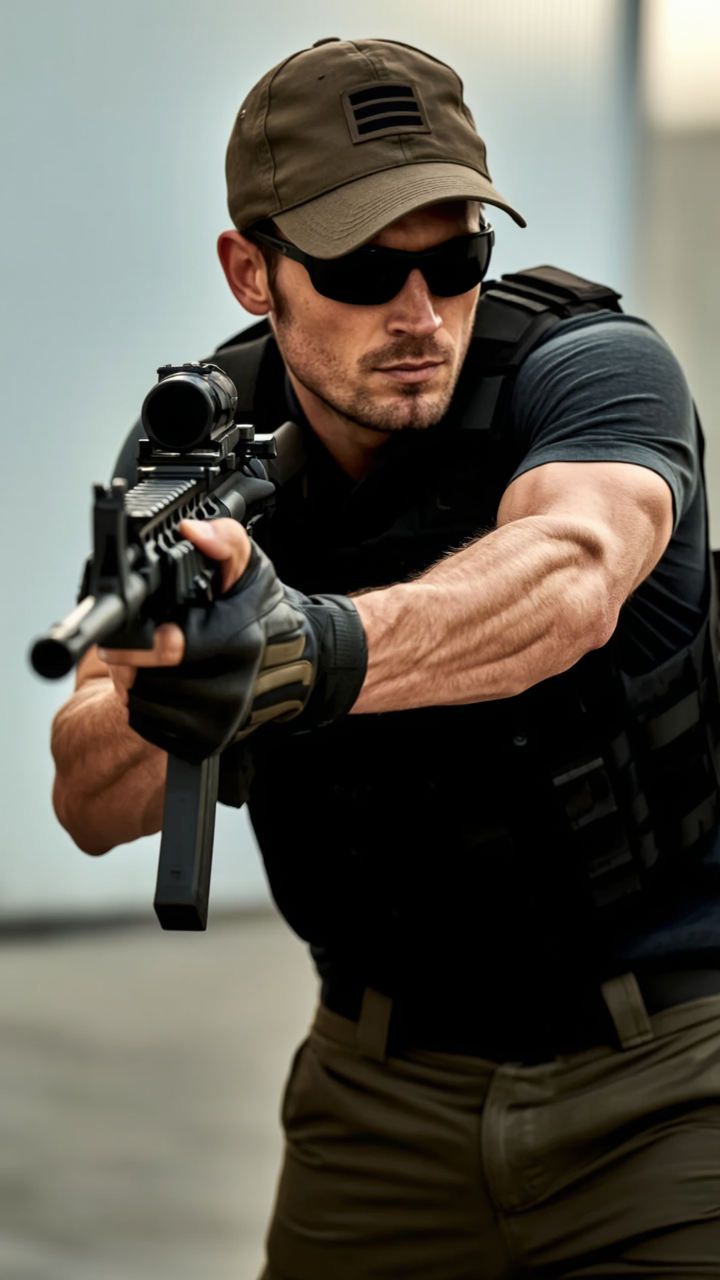
Rifle
The gun a man chooses when he can choose — the easiest firearm in the rack to shoot well, the hardest one to outgrow, and the deepest tradition in American hands.
There's a man at the rifle bay who looks like he walked in off the back pasture, because he did. Boots, hat, a rifle slung like it weighs nothing. Before he ever wore the hat for a living he wore a different uniform — Army Ranger, four deployments to Afghanistan — and before that he was a boy on his grandfather's place, learning the rule that would carry him through all of it: measure twice, cut once. His grandfather meant lumber. The grandson found out it meant everything. They call him the Tactical Cowboy, and the Farm could not have ordered a better man for this bay if it had written the job posting itself.
In the pistol bay you learned the gun you'll have — the compromise that rides your belt through an ordinary Tuesday. This bay holds the gun you'd choose. When a man knows trouble is coming, when distance matters, when the shot has to land — nobody reaches for a pistol if a rifle is in reach. The Armory already gave you the four rules, the handling, the marksmanship fundamentals, the cleaning bench; that work stands underneath everything here. This room is about the long gun itself: what it is, the families it comes in, the glass that aims it, the cartridge that defines it, and the three roads that lead out of this bay into the deepest skill a civilian shooter can build.
The Tactical Cowboy
Devin Soto built his training company on the back of two inheritances, and he will tell you the ranching one came first. The Western life his grandfather handed down — the stock, the land, the do-it-right-or-do-it-again standard of men who fix their own fences — gave him the rule. The Ranger Regiment gave him the proof: four combat deployments' worth of evidence that the men who survive are the ones whose preparation was finished before the day arrived. Out of the two he made Tactical Cowboy Training Solutions, and out of the family rule he made a doctrine: measure twice, cut once. Prepare deliberately, drill rigorously, so that if life ever forces the cut, one is all you need.
What that looks like at the rifle bay:
Repeatable and consistent, or it isn't skill. Soto's standard for a marksman is blunt: every time you send a round downrange, you know exactly where it is going. Not hope. Not usually. Know. A good group fired once is luck; the same group fired on demand, cold, on a bad day, is marksmanship. Everything in his method drives toward repeatability — the same mount, the same cheek weld, the same trigger press, ten thousand times, until the rifle stops being a thing you operate and becomes a thing you wear.
The body is the shooting platform. Soto took a degree in human physiology and a strength-and-conditioning credential into the gun business, and it shows. The rifle doesn't hold itself; bone structure, breath, and position do. He trains shooters the way the Proving Ground trains anything — the platform first, then the tool on top of it. A man's fitness and his marksmanship are not separate projects; the steadiest rifle in the world is useless mounted on a trembling man.
Zero ego, full mentorship. TCTS calls its environment zero-ego, and runs on mentorship rather than performance theater — Rangers, Green Berets, and Marines who would rather fix your position than impress you with theirs. That is the Farm's own ethic wearing a different hat: the strong man building the next man up. Their motto is the Regiment's — Lead The Way — and the way they lead it is by being better teachers than they are showmen.
The cowboy is not nostalgia. Mind the name. The cowboy was never a costume; he was a working man whose tools had to function because his life ran on them, who maintained his own equipment, knew his own country, and did dangerous work calmly because he had done the preparation. Tactical cowboy just means that man, trained to a modern standard. That's the figure this whole Farm has been pointing you toward all along.
The Gun That Does the Work
Everything that makes the pistol hard makes the rifle willing. A stock against your shoulder. Your cheek welded to the comb. Two hands spread along its length. A long sighting plane — or better, a scope. Four points of contact where the pistol gave you two, and a platform that holds still while you do your one job: press the trigger without disturbing it. A new shooter who struggles to keep pistol rounds on a paper plate at ten yards can be ringing steel at a hundred with a rifle before lunch. The rifle wants to hit. That is why every serious instructor will tell you the same thing: the pistol is what you fight with on the way to the rifle.
And the rifle carries a weight in this country that no other tool does. The American story opens with riflemen — farmers who could shoot to feed a family and shot the same way when the militia mustered. The rifle over the door was never decoration; it was the household's reach, its meat, and its answer. A man taking up the rifle today steps into that line whether he knows it or not. Better to know it. The tradition asks something of him: not the costume of a rifleman, but the competence of one.
The rifle's gifts are reach and authority. Its cost is honesty of a different kind than the pistol's — because a rifle this capable exposes the shooter who never learns to run it past a hundred yards, never zeroes his own glass, never knows what his cartridge does at distance. The gun will outperform its owner for years. The work of this bay is closing that gap.
The Families of the Long Gun
Walk the rack and the whole rifle world sorts into a handful of actions — the machinery that loads, fires, and ejects:
The bolt action is the oldest of the modern designs and still the king of pure accuracy. One round at a time, cycled by hand, with a locked breech so rigid and simple that precision shooters and hunters have never let it go. Slow on purpose; every shot a decision.
The lever gun is the American original — the Winchester that won the West, the saddle rifle, the .30-30 over a million farmhouse doors. Outdated on paper, beloved in fact, and quietly back in fashion as a handy, unthreatening, deeply effective working rifle. The cowboy's own gun, and he'll defend it.
The semi-automatic reloads itself with each shot and owns the modern era — the AR-15 above all, the rifle around which all current training, parts, and argument revolve. Speed, capacity, and ease, at the price of more machinery to understand and maintain.
The single-shots and rimfires round out the rack — and don't skip past them, because the humble .22 is the finest teacher in the building: nearly free to feed, almost silent, recoil-less, and merciless about fundamentals. Soto's measure-twice doctrine loves the .22; ten thousand cheap perfect repetitions beat five hundred expensive flinched ones.
The bolt-versus-semi argument the gun counter loves has a boring answer: they're different tools. The bolt gun teaches deliberateness and owns the precision world; the semi-auto owns speed, defense, and volume. The trained man usually ends up with one of each and stops arguing.
Glass and Zero
The rifle earns its reach through its sights, and the modern rifle wears glass. The scope world has its own language — magnification, objective size, reticles, MOA and mils, parallax — and it rewards a man who learns the vocabulary before he spends the money. Two rules from the cowboy cut through most of it. First: glass quality matters more than magnification numbers, and the mount matters more than owners ever believe. Second: a scope's price should be in honest proportion to the rifle's — a thousand-dollar rifle under hundred-dollar glass is a thoroughbred wearing a feed-sack saddle.
The zero is where measure-twice becomes literal. Zeroing — adjusting the sights so the bullet's arc crosses your aim at a known distance — is the covenant between a man and his rifle: when I do my part, you strike where I look. It is not a gunsmith's mystery; it is an hour of careful work every owner must learn to do himself, and re-verify any time the rifle travels hard, the mount is touched, or the ammunition changes. The man who has never zeroed his own rifle doesn't know where it shoots. He knows where it shot, once, for someone else.
The deeper optics room — red dots, magnifiers, lasers, the whole sighting bench — lives in the Armory at Sights & Optics.
The Cartridge Decides the Reach
A pistol is a platform with one real caliber question. A rifle is its cartridge. The same bolt gun chambered in .22 LR is a squirrel rifle, in 6.5 Creedmoor a thousand-yard target rifle, in .300 Winchester Magnum an elk rifle. Capacity, recoil, reach, cost per trigger press, what game it may ethically take, what it does downrange in a defensive shot — the cartridge sets all of it before the rifle ever leaves the rack. No part of the rifle world rewards study more, and no part collects more myth at the gun counter.
That study earned its own room: Rifle Cartridges & Calibers — the trainer rimfires, the great American center-fires, the modern precision cartridges, and the honest reading of ballistics that hunters and defenders both need. The bullet-anatomy bench (grain, construction, types) sits underneath it in the Armory at Ammo - Ammunition.
Three Roads Out of the Bay
Past the rack, the rifle discipline forks into three distinct roads. Men constantly blur them — the gun counter sells all three as one camouflaged whole — so walk them separately and know which one you're on:
AR-15 — the generalist. America's rifle: the modular, semi-automatic carbine that is at once the standard home-defense long gun, the entry point to rifle training, the most customized machine in the country, and the most argued-about object in American politics. This road is about capability across the board — a rifle for the household, learned to competence. Most men's rifle journey starts and rightly centers here.
Tactical Rifle (SBR) — the specialist. The short-barreled rifle: the compact, federally-registered configuration built for tight spaces, vehicles, and suppressors, with the .300 Blackout cartridge as its companion and a stack of federal paperwork as its price of admission. This road is about a specific tool for a specific problem — and about a man operating squarely inside a regulatory framework he is responsible for knowing cold.
Precision Shooting — the discipline. The long-range road: marksmanship fundamentals compounded with ballistics, wind reading, and recorded data until rounds land at distances most shooters can't even estimate. This is the rifle's deepest skill ceiling and its most patient classroom — and it is also the road that walks straight out of the Farm and into the field, because precision work is the backbone of ethical hunting. The man who can put one round exactly where he intends at distance is the man who fills the freezer cleanly and owes the animal no apology. The same discipline, worn as work on the Farm, becomes the joy of the Backcountry.
Three roads, one rifleman. The generalist carbine for the home, the specialist configuration if his problem genuinely calls for it, and the precision discipline as the lifelong climb. The blur is the error; the map is the cure.
The Three Pillars at the Rifle Bay
TRUTH at this bay is the zero and the data. A rifle either hits where you look or it doesn't; the target at distance is arithmetic, not opinion. Measure twice is a truth discipline — the man who verifies his zero, records his shooting, and knows his cartridge has replaced belief with knowledge, which is the only honest ground a marksman can stand on.
LOVE is the reach used rightly. The rifle is the household's long arm — the tool that defends the family at the distance trouble starts instead of the distance it ends, and that fills the freezer with meat a man harvested himself. And it is the great teaching gun: a .22 at a quiet range is where fathers have handed discipline, patience, and respect for consequence to sons and daughters for a hundred years.
LAW runs heavier on this road than any other in the Armory. Barrel lengths, configurations, registrations, state lines — the rifle world is mapped with legal boundaries, some of them felony-grade, and the short-barreled road most of all. The trained man knows the law before he buys, builds, or modifies — not after. Legal Defense is the bay where that reading gets done.
Take It Further
Reading about rifles makes a man informed. Only rounds downrange under correction make him a rifleman. Soto's outfit — Tactical Cowboy Training Solutions — runs one-on-one mentorship, group courses, and online training built on the measure-twice doctrine, staffed by special-operations veterans who teach in a zero-ego room; that, or any of the serious instructors named at the gun rack, is the next honest step. Before the high-dollar gear, buy in this order: a .22 trainer and bricks of ammunition for it, quality glass properly mounted on whatever center-fire you choose, and a notebook — because the cowboy's rule is worthless unwritten. Then take the discipline somewhere it gets tested: a local match through Competition Shooting, or a hunt planned through the Backcountry, where the rifle stops being practice and starts being provision.
Guiding Word
"He trains my hands for war, so that my arms can bend a bow of bronze."
— Psalm 18:34
David's bow was the rifle of his age — the weapon of reach, the one that demanded trained strength and rewarded nothing else. Notice who does the training and who supplies the strength. A man brings the repetitions; God builds the man. The rifleman's road is long, technical, and patient, and that is precisely its value on this Farm: it cannot be faked, bought, or rushed. Measure twice. Cut once. And pray the cut is never needed.