
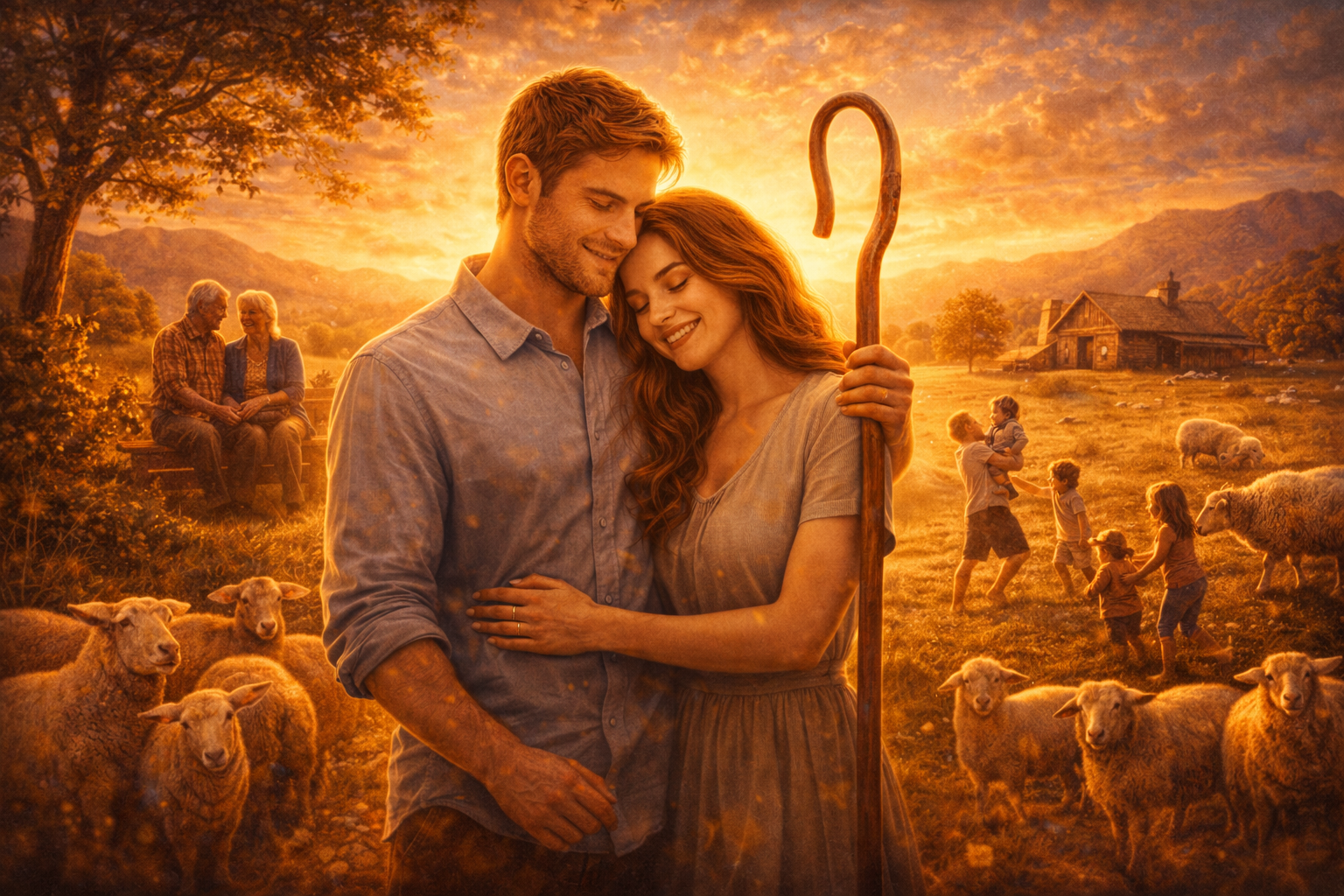
LOVE
"Many waters cannot quench love; rivers cannot sweep it away."
— Song of Songs 8:7
The Estate
You walk the last mile alone. The Warrior stopped at the edge of his own ground and turned back toward the tower, and the road past it was yours. Maybe it was the ring, maybe the cage, maybe a war with a real name and real graves. The gear is still in your hands and the adrenaline has not finished leaving your blood. You smell like canvas and iron. Somewhere behind you is a brother who did not walk off that field, and you carried what is left of him out on your back with everything else. You are alive. He is not. And nobody on the road home is going to understand what that costs.
The road ends at an iron gate. There is a name worked into the scrollwork, a family name, and you do not read it yet. You will. Over the gate, on the crossbar, three words have been set in the iron, and you read those without meaning to.
LAY IT DOWN.
A man is standing under them. He is not what you expect. He is older, ordinary, soft-spoken, not imposing but not weak either. Average. He gives a nod and a warm smile to the men filing past, and he looks every one of them dead in the eye like he is glad to see them. "Hello, young man." You are in no mood. "What do you want," you say, short, because you just had a war and the last thing you need is small talk. He does not flinch and he does not pull rank. He holds your eyes, smiles, and asks one thing.
"Rough day?"
And it lands. It lands harder than anything anyone said to you on the Farm, and the other men did not get the attitude you just handed this one. You realize, a beat too late, that you were short with a master and never saw it coming, and that he let you, because he had nothing to prove to you and no need to win the exchange. That is the first lesson of this place, before he has taught you anything on purpose. "Go get changed," he says. "Dress comfortable. I'll be waiting for you." You clean up, and when you come back he is mounted on a steed with a second one saddled beside him. He nods at it. Hop on. We're going to my estate. Giddyup.
This is LOVE. This is the Estate, and the man riding beside you is the Shepherd, and behind him stand all the men like him, the ones who keep the people the rest of the world forgets. The wife. The children. The aging parents. The sick, the lame, the lonely, the friend in the worst week of his life. The Warrior on the Farm learned to lay his life down for a brother in a single decisive instant. The Shepherd learns the harder version. He lays it down a thousand quiet times, across forty years, for people who will rarely thank him and sometimes will not even understand what he carried home. There is an old song about a bridge over troubled water, and the man in it says he will lay himself down. That is the whole song of this Kingdom. The bridge does not get to cross to the other side. The bridge stays put so everyone else can.
Five Kingdoms stand behind you now: the quiet rooms, the Proving Ground, the Library, the Exchange, the Farm. A soul, a body, a mind, a living, and a guard. Here you learn what all five were for. A man can win every war and lose his own house. He can be the hardest man on the street and a stranger at his own dinner table. The Estate is where the capacity comes home, where the same strength that ended fights learns to hold a crying child, sit with a dying father, and stay married to a real woman across decades that will test every vow he ever made.
The Estate has three grounds. You will ride them in order, and then you will work all three until they bury you on the third one.
Why a Man Builds This
Here is the thing the other Kingdoms cannot teach you, because their material will not bear the weight of it. The people closest to you are the people you are most defenseless against. You can train your body until no man can touch it and still be leveled by a sentence from your wife. You can build a mind that solves problems for a living and have no idea why your teenage son stopped talking to you. You can fund a household and be a ghost inside it. The strength you built everywhere else does not transfer here on its own. Loving the vulnerable, and being vulnerable yourself, to a wife, to children, to parents, to a brother, asks for something the ring and the trading floor and the gym never asked of you. It asks for selflessness. It asks you to be the strong one for people who cannot be strong back. It asks you to build a home soft enough to be safe and a man hard enough to keep it that way.
The Estate keeps two kinds of people, and you have to see both to understand the place. The first kind is the vulnerable population. The child who cannot feed himself. The parent who is starting to forget your name. The sick, the disabled, the widow at the end of the road, the boy at school nobody picks. They cannot pay you back and most of them cannot even ask. The second kind is harder, because they are the ones you are vulnerable to. Your wife. Your children. Your mother and father. Your brother. The one friend who knows the whole story. These are the only people alive who can put you on the floor without lifting a hand, and the Estate asks you to give them the knife anyway, and to be the kind of man who never hands them a reason to use it. Every other Kingdom made you harder to hurt. This one teaches you who to let close enough to do it.
The returning warrior is the picture of it. The Vietnam veteran came home from horrors no civilian could picture and got called a baby killer at the airport by people who had risked nothing. He had every right to go bitter. The ones who made it, really made it, did something almost no one talks about. They swallowed what they saw, refused to bleed it onto the people who loved them, and quietly rebuilt a life worth the sacrifice. That is the Shepherd's burden and the Shepherd's glory. To know exactly how dark the world is and choose, on purpose, to build a warm room inside it for people who never had to see what you saw. The man who can go to war, understand its atrocities, and then come home poised enough to raise children who feel safe has done something the medal could never measure.
The culture trained you into two opposite mistakes here, same as it did on the Farm, and you throw out both.
The first mistake says love is a feeling. It worships the spark, mistakes intensity for substance, and turns men into addicts chasing a chemical that was never going to last. It produces the man who leaves a good marriage because it got quiet, and who cannot tell the difference between being in love and being in withdrawal. That is idolatry wearing the costume of romance. Love is not a feeling you fall into. It is a verb you choose, on the mornings you feel it and the mornings you do not.
The second mistake comes from the other direction and empties just as many houses. It says vulnerability is weakness, that the strong man is the unreachable one, that emotional distance is masculinity, that the way to never get hurt is to never let anyone close enough to do it. It produces the cold father whose children grow up hungry for a warmth he was too armored to give, and the husband whose wife is lonely inside an intact marriage. That is cowardice wearing the costume of strength. It takes more nerve to be tender on purpose than to be hard by default.
The Shepherd refuses both. He holds love with an open hand, choosing it without needing it to feel a certain way, giving it without keeping score, staying close without losing himself. And he knows exactly who it is for. Not the audience. Not the anniversary photo. The wife asleep beside him, the children down the hall, the parents in their last years, the friend who calls at two in the morning, the people whose whole sense of safety in this world rests on whether one man decided to be steady. He is the bridge they cross. He does not need to be thanked for it. He needs only to hold.
What You Walked In Carrying
Before the Shepherd shows you a single room, understand something about the man on the horse next to him. You walked through that gate already holding a way of loving, and you did not choose it.
It was handed to you by the way your father looked at your mother in the kitchen. By the silence at the dinner table after something hard had just been said. By the apology that never came, or the one that came every time. By affection that was either rationed like a wartime commodity or poured out without measure. By the way your house handled a fight, or refused to have one. Long before you chose a wife, held a child, or buried a parent, all of that had already set inside you like concrete, and most men marry, father, and bury on top of it without ever once looking down.
The Shepherd looks down first. That is the whole of the first lesson on the Estate, and there is no room for it, because it happens on every ground at once. Before a man builds a bond he names the posture he brought to it. Is this how I love, or is this how I was loved? The two are usually the same, and the man who has never separated them is not choosing anything. He is replaying a tape somebody else recorded.
Some of what you carried in is gold. A man whose father stayed knows in his bones that staying is possible. Some of it is poison, and the poison hides best in the parts that feel most natural. The reflex to go quiet when your wife cries came from somewhere. The urge to fix a child's grief instead of sitting in it came from somewhere. The Estate does not ask you to hate the house you came from. Above all, love each other deeply, because love covers over a multitude of sins (1 Peter 4:8), and the first sins that love has to cover are usually your parents'. It asks you to see the house clearly, keep what was true in it, and set down the rest before you build on top of it, because a home built on unexamined ground repeats the crack in the foundation one story higher.
If there is heavier work than that in you, the grief and the guilt and the wound that still bleeds when it is touched, it does not get done here. It gets done in the quiet rooms where you started this journey, in private, before God. The Estate needs the man. The people on it should never have to meet the reaction.
The Three Grounds of the Estate
The Estate is not one skill. It is three grounds walked in order, and the order is not decoration. You cannot father well from a marriage you neglected, and you cannot leave a legacy worth inheriting if the people meant to inherit it never knew you. The Shepherd rides you to the fire first, then to the fenced ground, then to the far edge of the property, and each ground stands on the one before it.
Relationships — the Hearth. The fire everyone gathers around, and the ground the other two are built on. Here you learn to build and keep the bonds that hold a whole life together. Friends & Family, the bond you did not choose and cannot quit, and the bond you built by hand and can lose by neglect, both of which were there before your marriage and will be there after. Pets & Animals, the quiet stewardship of a creature who depends on you completely and can never speak for itself, and the cleanest mirror a man will ever look into, because the dog reports on a man's character and the family photos do not. Romance & Intimacy, the deepest fire at the center of the Hearth, the chosen woman, how a man courts her, vows to her, and stays. And Toxic Relationship Dynamics, the patterns that burn down everything the Hearth builds, learned so a man can name them and refuse them before they cost him the house, and so he learns that forgiving someone and standing next to them are two different decisions. Start here. The man who has not tended the Hearth has nothing to parent from and nothing worth leaving behind.
Parenting — the Nursery. The raising ground, the most protected acre on the Estate, the one piece of it that cannot defend itself. This is the Shepherd's first and fiercest fight, and the one the world most wants him to hand to somebody else. Family Planning, the decisions made before the child is ever conceived. Child Development, who your child actually is at each age instead of who you wish he were. Domestic Leadership, the roof over the ground, the home culture a child is shaped inside, raising sons, raising daughters, running a household with a steady hand. Parenting Styles, the hand a man tends with, too tight or too loose or the one that grows straight trees. Single Parenting, holding the line when the covenant did not, because a decree can ration a father's hours and cannot revoke him, and the playbook for the father whom the system itself has turned on. And Toxic Parenting, the rot that travels down a bloodline until one man decides to absorb the cost and stop it in his own yard. A father's faith, his ethic, his whole picture of the world either get said out loud in this yard or get buried with him. The Nursery is where a man finds out which.
Legacy — the Grounds. The old acreage at the tree line, the stone wall, the orchard, the plot with names cut into it. Here you build the one thing on the Estate that keeps working after you are in it. Marriage & Divorce, the oldest tree on the property, honored across decades or split at the base, and what a man does when the trunk comes down and the roots are still alive. Making Memories, the orchard, planted now for a harvest the man sits down to thirty years later with his grown children. And the Family Manifesto, the deed and the stones, the creed, the crest, the heirlooms, the genealogy, the will, the values written down so that a grandson knows what his grandfather stood for without having to guess. The man who builds the Grounds arrives at his own death with a household that knows what to do without him. The man who refuses it leaves chaos for his widow and an argument for his children.
The grounds are not a sequence you finish. You walk them once in order to learn the place, and then you work all three at the same time for life, because a home is not a project with an end date. It is a fire you keep feeding until the day you hand someone else the match.
Six Pages Men Keep Coming Back To
The walk is the walk, and nothing here replaces it. But every ground on the Estate has a few pages that men wear the edges off, because they answer the questions that come up at two in the morning, and a man does not always have time to ride the whole property to get to them. Know where they are before you set out. Not one of them is a step on the road. Every one of them will be waiting when you need it.
Love Is a Verb, Not a Feeling is the page the whole Estate leans on. Read it first, whatever your season. If you walk in thinking love is weather, everything else on the property will read as a way to manage weather, and none of it will hold.
The Five Stages of Marriage tells a man what season his marriage is actually in. Infatuation, the power struggle, acceptance, building, knowing. The second stage is the graveyard, and most marriages that end are buried there by a man who mistook a season for a verdict. A child does not fix that season, either; children reveal a marriage, they do not heal one. The page exists so a man reads the map before he reads the exit sign.
Choosing a Wife refuses the oldest false choice a young man is handed, the good mother or the beautiful wife, and gives him the order to choose in instead: faith, then character, then fit, then the pull. The married man reads it anyway, because it tells him what his wife was choosing when she chose him and what he is supposed to keep becoming so the choice still makes sense at fifty.
Why She Misses the Wrong Man answers the question that eats good men alive. Why does she go back to the one who hurt her, and what does it actually take to be the man who breaks the pattern instead of losing to it.
Happy King, Happy Kingdom turns the oldest piece of bad advice a married man gets inside out. The house does not take its weather from the wife's mood. It takes it from whether there is a man at the head of it who is at peace with himself, and a wife who married a king does not stay long with a courtier.
Rules to Teach Your Son is the fathering page, and a man without sons reads it anyway, because the rules describe the man the Estate is trying to make of him. Its measure of success is the only one that matters here: whether the children come around when they are grown and no longer have to.
Six pages. Read them when the road is dark. Then get back on the road.
The Shepherds Who Came Before
The man riding beside you is not the first of his kind. He is the latest link in the oldest chain there is, older than the warrior's, because before a man ever had to defend a home somebody had to build one worth defending. This Estate was laid out so that every shepherd worth learning from could teach in one place, and the chain is longer than you think.
The ancients ride at the front. Boaz, the landowner who saw a foreign widow gleaning at the edge of his field and chose to cover her rather than use her. Spread the corner of your garment over me, she said to him on the threshing floor, since you are a guardian-redeemer of our family (Ruth 3:9), and he did, at real cost to himself, and landed for it in the bloodline of the Messiah. The kinsman-redeemer is the Shepherd's oldest portrait: the man with means who spends them on the vulnerable woman no one else would claim. David, who was a shepherd boy with a staff long before he was a warrior with a sword, and who learned to guard a flock in the dark before he ever guarded a kingdom. Joseph, who fed the brothers who sold him. The other Joseph, who married a pregnant girl on the word of an angel and raised a son who was not his by blood. And the One they all point to, who called Himself the Good Shepherd and then proved the title with His life. He tends his flock like a shepherd: He gathers the lambs in his arms and carries them close to his heart; he gently leads those that have young (Isaiah 40:11). The Estate runs straight back to Him, because every act of laying yourself down is a small copy of the original.
Behind the ancients come the moderns, and the Estate will introduce you to all of them, in the rooms where they actually work. There was a shy, sick, bullied boy from a steel town who grew up, trained as a minister, and never took a pulpit, because he decided the most frightened people in the country were the children in front of a television set, and he spent his whole life talking to them, quietly, about death and divorce and war, as if each one were the only person in the room. There are the men who spent forty years in counseling offices learning why marriages that should have held did not, and writing it down so yours might. There are the fathers who wrote the books on discipline and the heart of a child. There are the elders who keep households together in the churches nobody films, the widowers who kept their dead wives' standards alive at the dinner table, the men who took in the nieces and nephews the system would have lost, and the ones who are still doing it today and will meet you face to face.
Not one of them is over the gate, and the reason is in the next room. Nobody teaches from the gate. The Estate exists to walk you to the door of the man who can actually help you build, and that door is always inside.
The Word Over the Gate
There is no name on the crossbar. There is a family name in the ironwork under it, and you will learn whose, but no face hangs in the great room and no portrait watches the table. That is not an oversight, and the reason should be in you before you sit down at the fire.
Think about the houses you have admired. Almost every one had a picture on the wall of the couple who made it, and almost every man who grew up under that picture spent his own marriage measuring himself against it. A face on the wall does that. It quietly converts a gift into a scoreboard, and the people the gift was for end up watching a man compete with a dead one. This Estate will tell you about more good men than you can hold in your head, and it will put you in the room with some of them. It hangs none of them, because a man who loves toward a portrait has stopped loving toward his wife.
The iron says three words instead, and they are not a motto. They are an instruction.
LAY IT DOWN.
Not feel it. Not fall into it. Not find it. Lay it down. It is the same order the Warrior carried off the Farm, from the same verse, and it means something different here. On the Farm a man lays his life down once, fast, on the worst night of somebody else's life, and there is a medal for it, and there should be. On the Estate he lays it down slow. The sleep he gives up for a sick child. The career he does not take because it would cost his family the town they are rooted in. The argument he does not win because winning it would cost his wife something she cannot afford to lose. The Saturday, the second Saturday, the hundredth Saturday. Nobody hands out a medal for the hundredth Saturday. The house just stands, and the people inside it never find out what it cost, which is the point.
For who is greater, the one who is at the table or the one who serves? Is it not the one who is at the table? But I am among you as one who serves (Luke 22:27). The Man who said that had a table full of men arguing about which of them was the greatest, and He answered by picking up a towel. That is the standard over the gate. Not the man at the head of the table. The man who made sure there was a table, and food on it, and a chair for everyone, and who nobody thought to thank.
And the order is harder than it reads, which is why it is over the gate and not on a plaque inside. A man can be brave for a minute. Most men can. The Estate asks whether he can be brave on a Tuesday in the fourteenth year of a marriage, when the feeling has been gone since spring and nobody would blame him for going with it. Every morning the iron puts the same question to a man, and it is never how much do you love them. It is what did you set down for them yesterday, and what will you set down today.
The Three Pillars on the Estate
Three questions filter every relationship a man builds and every decision he makes inside his own home. TRUTH. LOVE. LAW. Always in that order.
TRUTH is honest seeing. The Shepherd sees the people in front of him as they actually are, not as the romance script trained him to want, not as the corrections of his own childhood, not as an audience for the version of himself he is performing. He sees his wife as a real woman with real limits instead of the fantasy he married. He sees his children as the people they are instead of the do-over he needed. He sees which friends are loyal and which are convenient. A man cannot love what he refuses to look at, and most of the harm done inside a house is done to a person the man never actually saw. TRUTH on the Estate is the discipline of looking.
LOVE is the spirit the whole thing is delivered in, named here in the Kingdom that carries its name. The man who builds real relational skill and then uses it to control his wife, manage his children into performance, or keep a friend orbiting on his terms has failed this pillar no matter how impressive the household looks from the street. Everything the Estate teaches is meant to be spent on people, never spent against them. The same home built from love produces a different generation than the same home built from control: children who run toward the father instead of away from him, a wife who softens instead of bracing, a name people are glad to carry. Every relational move on the Estate passes through one question. Am I serving this person, or using them?
LAW is the vow outlasting the feeling. Feeling comes and goes with the weather. A vow is what a man built so that the weather would not get a vote. The marriage that went cold in the spring and was still standing in the fall. The teenager who was contemptuous for a year and had a father the whole time. The aging parent honored after the man was old enough to see his faults plainly. The Shepherd's word in a relationship is the same as his signature and the same as his outcome, and that kind of reliability is the rarest asset in the modern world, because almost no one stays inside anything long enough for it to compound. The vow is what holds when the feeling lets go.
The man with all three builds a home people can rest inside. The man with the skill and none of the pillars builds a beautiful house that no one in it feels safe.
How the Shepherd Goes Wrong
Every archetype has a shadow, and the Shepherd's shadows are quiet. They rarely make a scene, which is exactly why they do their damage for decades before anyone names them. Know them by sight, because the quiet ones move in without knocking.
The Sentimental — the man who confused the feeling with the work. He cries at the wedding and vanishes from the actual marriage. He posts the Father's Day tribute and is unreachable to his son the other 364 days. He is generous with the language of love and stingy with the practice of it, and he is genuinely shocked when the household he narrated so warmly finally cracks, because he never noticed how thin the practice was underneath the words.
The Provider-Only — the man who reduced his whole family to the paycheck. He works the long hours, pays for the big house and the good school, and is a stranger inside both. He believes the money is the love, and he keeps being surprised that the bigger house did not fix his wife's loneliness and the better school did not reach his withdrawn son. His coworkers would tell you he is the finest man they know. His children could not tell you what he is like.
The Performer — the man building a marriage for the audience. The anniversary post is more carefully constructed than the anniversary. The family photo is staged more thoughtfully than the family is parented. He optimized his relational life for the feed, and the feed will not hold his wife's hand at her father's funeral or sit with his son through the failure season.
The Trader — the man who runs his family like a ledger. What is she bringing. What am I getting. Would the next one be better. He picked the frame up from men who sell divorce as wisdom, and he may not even know he is holding it, but the woman across the table can feel herself being appraised whether or not she can name it, and children can feel it from the next room. A covenant is not a contract with an exit clause. The Trader will spend his whole life waiting for a better deal and never once be at home in the one he has.
The Controller — the man who confused leadership with domination. His wife's preferences get overridden as a matter of course, his children get managed instead of formed, his friendships dissolve the moment they stop running on his terms. He often quotes scripture to justify it and produces grown daughters who flee the faith he weaponized and grown sons who either copy him or react into the opposite ditch. A man who has to enforce his authority every day never had it. He had fear, and fear wears out.
The Avoider — the opposite sin, and just as destructive, and the one the Shepherd's own temperament leans toward. His love has no spine. He keeps the peace at the cost of the truth. He says yes when he means no, enables the people he loves because he cannot stand their discomfort long enough to let them grow, and calls it gentleness, calls it respecting his wife, calls it not repeating his father's mistakes. Underneath the nice words sits plain cowardice. His household runs on his wife's anxiety because somebody has to make the decisions and he handed her the job. The disciplined Shepherd refuses the control and the avoidance both, and leads with the seriousness the people depending on him deserve.
The Wounded-Reactive — the man whose whole relational life is a reaction to the home that broke him. He is parenting against a ghost instead of toward a child, asking a new marriage to pay for an old one's failures, fighting battles in his living room that were really lost in his childhood. The disciplined Shepherd takes that wound upstream into SPIRIT and works it there, in private, so the people downstream get the man instead of the reaction. The wound is handled where it happened, in the man, and not where it is easiest, on the family.
No Shepherd Stands Alone
The Estate is not a Kingdom that stands on its own. It is the reason the other six exist, and it owes them as much as they owe it.
To SPIRIT, the household a man comes home to from prayer. The Saint with no family to return to becomes a hermit. The Shepherd gives the inner life somewhere to land. To HEALTH, the reason the body is kept. The Champion who trains for no one is training for his ego. The Shepherd is training to carry his wife's groceries at seventy and wrestle his grandchildren at seventy-five. To SMARTS, the home order that makes deep work possible, the wife who guards the reading hours, the children who learn to honor a father's study. To MONEY, the people the wealth is for. The Provider with no one to provide for drifts into hoarding. The Shepherd gives the money somewhere to go. To DEFENSE, the people the training protects. The Warrior trained for himself is a danger. The Warrior trained for the family asleep down the hall is a guardian, and the Shepherd is the entire reason the Warrior's hands are worth training. To FUN, the people the seasons are worth walking with. The Adventurer alone is a tourist. With his wife on the road and his children at the campfire he is living the design.
And the Shepherd does not stand alone either. The lone patriarch white-knuckling it without a brotherhood is as much a myth as the lone wolf on the Farm, and the bench you sat on there, the cop and the two soldiers and the roasting that never gets old, was the beginning of the thing this Estate finishes. God sets the lonely in families (Psalm 68:6), and He sets families inside a company of keepers: the husbands who chose well and stayed, the fathers who showed up every single day across the long arc, the friends who held the line when other friendships dissolved, the brothers who carried weight they did not have to carry, the single parents who kept the house standing through what the divorce did to it, the sons who tended parents the rest of the family forgot. It is one man, answerable in seven directions, and the people behind him sleep soundly because they know exactly who is at the head of the table.
Where LOVE Stops and Scripture Continues
The Estate develops a man's power to build, tend, and keep the bonds a life is made of. The power is real, the work is decisive, and a good Shepherd's competence compounds across decades. What the Kingdom cannot supply on its own is the answer to the deepest question underneath all of it. What is the love finally for, and where does a man find enough of it to keep laying himself down when there is nothing left in the tank.
Scripture answers with a pattern and a supply. The husband's love is patterned on Christ's love for the church, the One who gave Himself up for her, and that pattern is sacrificial and covenantal, not driven by how a man feels on a given Tuesday. The father's love is patterned on the Father's. As a father has compassion on his children, so the LORD has compassion on those who fear him (Psalm 103:13). Neither harsh nor soft, but compassionate and firm in the same breath. The friend's love is the verse the Warrior carried off the Farm, a life laid down for friends, now carried into the living room and made daily. And the love is meant to spill past the property line, to the neighbor and the stranger, which forbids the closed-circle home that hoards its warmth for its own.
But hear the thing under all of it, because it is the thing the gate does not tell you and the Estate will not tell you until you have worn yourself out trying. God does not describe Himself as the one at the head of the table. He describes Himself as the one who carries. I led them with cords of human kindness, with ties of love. To them I was like one who lifts a little child to the cheek, and I bent down to feed them (Hosea 11:4). There you saw how the LORD your God carried you, as a father carries his son, all the way you went (Deuteronomy 1:31). In all their distress he too was distressed... in his love and mercy he redeemed them; he lifted them up and carried them all the days of old (Isaiah 63:9). The man who lays himself down for a household is not the bridge. He is standing on one. He will find that out on the night the tank is empty and the child is still sick and the wife is still crying and he has nothing left, and something holds him up anyway, and he does not have a word for it. In peace I will lie down and sleep, for you alone, LORD, make me dwell in safety (Psalm 4:8). The man who lays himself down is himself laid down, in safety, by Someone. That is the whole Estate in one line, and a man does not get to understand it at the gate. He earns it in the fourteenth year.
The Estate is honored when a man builds it the way it was designed, choosing covenant over feeling, keeping faith when the weather turns, laying himself down for the vulnerable, and drawing his supply from the One who laid Himself down first. It is dishonored when the household becomes the man's god and he ends up serving the very moods and patterns he was meant to lead. The Shepherd's summit is the day he finally understands that the building was never the point. The people were, and the One who gave him the strength to love them was. And an empty bridge that let a whole household cross to the other side is not a sad thing. It is a finished one.
Where the Full House Goes to Play
Hear this before you ride to the fire. It will not make full sense yet, and it will make more sense here than it would at the end.
A man can spend himself for the people he loves and slowly forget why he was keeping them. He can lay it down so faithfully, for so long, that the laying down becomes the whole of him, and the house he built to be warm turns into a post he stands. The bills are paid. The doors are locked. The children are raised right. And nobody in it has heard him laugh in a year. The Shepherd who only tends and never plays hardens, over the decades, into duty with no joy in it, and a household can feel that difference through the walls. That is not what the love was for. Enjoy life with your wife, whom you love, all the days of this meaningless life that God has given you under the sun (Ecclesiastes 9:9). Enjoy, the wisest man who ever lived said. Not endure. Not guard. Enjoy.
The whole psalm of the household ends at a table. Your wife will be like a fruitful vine within your house; your children will be like olive shoots around your table (Psalm 128:3). Read where it lands. Not at a wall. Not at a gate. At a table, with food on it and people around it and noise. A man builds the Estate so that there is a table. The next Kingdom teaches him to sit down at it.
So tend every ground here with the end of the road in view. The bonds you keep at the Hearth are the people who will be in the truck. The children you raise in the Nursery are the ones who will be at the campfire, and one day at the table with their own children, telling a story about you that you thought they had forgotten. The Grounds you build are the orchard, and an orchard is not for looking at. Everything you lay down on this Estate is buying you a life that is actually lived, with the very people you laid it down for, out where the pavement quits and the road goes wherever it goes.
He is waiting at the end of the Estate road, leaning on the hood of something with mud on it, and he is going to look at the settled, full, unsmiling man you have become and ask you the only question the Shepherd never did. The Shepherd taught you to carry a household. The next man will teach you it was always allowed to be a joy.