
Tactical Operations
Tactical Operations 101
Recon & Intel
Comms & Load Out
Actions & Objectives
Tools & Resources
"Though one may be overpowered, two can defend themselves. A cord of three strands is not quickly broken." — Ecclesiastes 4:12
The Team
The Warrior does not take you up the ladder this time. He takes you out past the barn after dark, to the tree line at the edge of the property, where five men are already standing in the dark and none of them says hello.
"Don't talk," he says, quietly, before you can. "You don't know them. They don't know you. Everything you did in the cage, they didn't see, and nothing you did in the cage tells them whether you'll be where you're supposed to be in forty minutes when it matters." He hands you a headlamp with a red lens and walks you back to the barn, where the floor has been cleared and there is a house drawn on it in blue painter's tape. Rooms, doors, a hallway, a stairwell, all of it life-size, walls a strip of tape wide. The five men are already standing at the front door of it in a line, and one of them has a hand on the shoulder of the man in front of him.
"This is the house," the Warrior says. "Real one's three miles from here and you'll never see it. Tonight you walk it here, slow, until the six of you can do it in the dark with your eyes shut, and then you'll do it in the dark with your eyes shut. Nobody in that stack is the best fighter on this Farm. Doesn't matter. The best fighter on this Farm loses to those five, every time, because they know where each other is going to be." He points at the empty place at the back of the line. "Number six. Rear security. You look backward the whole time so they don't have to. Nobody will see what you did. If you do it wrong, everybody will."
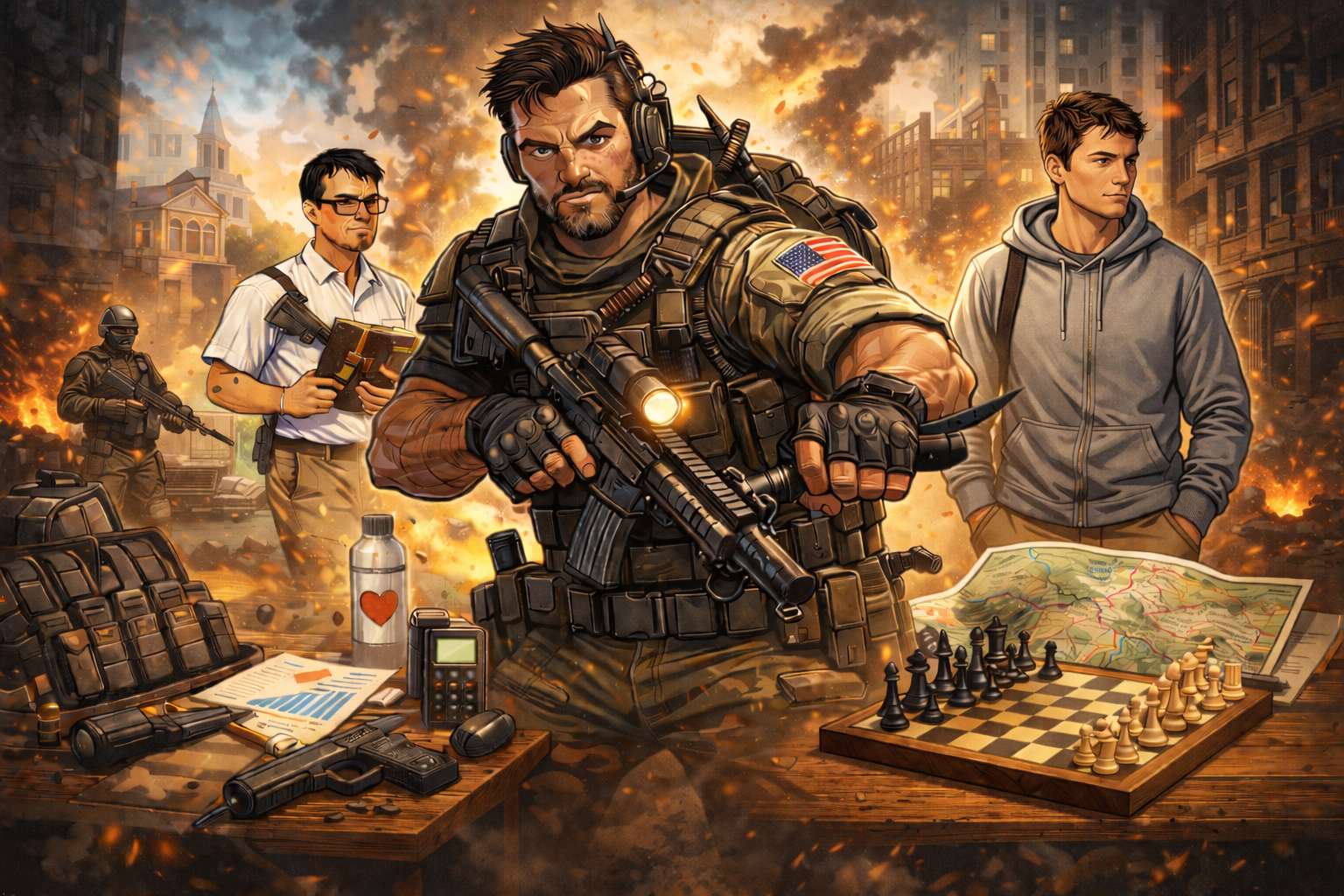
Tactical Operations is the second arena of the War Room, and the first ground on the Farm where the unit is not a man. It is built first for the men in the profession, the officer, the soldier, the security operator, whose work happens in a team, on a clock, where a mistake is not a loss on a record but a man who does not come home. And it is read by the serious civilian for the thing it teaches that no other ground does: how several men become one thing that moves, knows, talks, and holds, and how a household under threat is a very small version of exactly that. The ground is walked the way an operation is run, in three phases: the planning, where most operations are won or lost before anyone moves; the preparation, where the team gets its voice and its kit; and the execution, where the team moves, gets through the door, and keeps its wounded alive. And it exits, as every end of this Farm now does, through a shop, because a man who has walked this ground has a list, and the Farm would rather he buy the right thing than the thing on the billboard.
Why a Man Learns to Be Part of Something
Because the lone fighter is a story the movies told, and the men who believed it are the reason the Farm keeps a ledger. Every real operation in the history of the profession was done by a team, and the ones that went wrong went wrong at the seam between two men, not inside one. The intelligence was good and the man who had it did not tell the man who needed it. The shooter was excellent and the man behind him did not cover the door he walked past. The medic was ready and nobody had told him where the casualty collection point was. A team is a set of seams, and the whole craft of this ground is sewing them shut before the night they are tested.
There is a second reason, and it is the one the cage could not teach. In the cage a man's capacity was the point. Here it is not. The best-trained man on a team is worth exactly what he adds to the men beside him, and a man who cannot be told where to stand, cannot say what he sees in six words, cannot carry his own kit without borrowing from the man next to him, and cannot be trusted to look backward for forty minutes while five men look forward, is a liability with a good record. If the owner of the house had known at what hour the thief was coming, he would not have let his house be broken into (Luke 12:39). The verse is about watchfulness, and the shape of it is the shape of this whole ground: the operation is decided by what was known, said, carried, and rehearsed before the hour, and the man who is only good in the hour is the one the thief is counting on.
And a third, which the civilian is here for. A father whose house is entered at three in the morning is the leader of a team of four with no training, no radio, no plan, and a hallway. Everything on this ground scales down to him. Who goes where. What the words are. Where the kit is. What the plan is if the plan fails. How to keep a bleeding child alive for the eleven minutes before the ambulance. He is not training to kick doors. He is learning what the men who kick doors know about being several people at once, because one night he may have to be.
What Beats the Team
One strong link. The team has a great shooter and is average at everything else, and the night finds the average. The whole stack has to work, because the operation is decided by whichever piece is weakest, and it is never the piece the team is proud of.
Skipping the knowing. They move without the picture, and meet the dog, the second door, the man who was not supposed to be home. An hour of reconnaissance would have shown them all three. The casualties were avoidable, which is the worst kind.
Comms that die when it starts. The radios worked at the vehicle. Then the shooting started and men stopped talking, or talked over each other, and two of them worked the same threat while a third door went unwatched. Communication under stress is a trained skill, not a personality trait, and the team that has not trained it does not have it.
The kit that was wrong. The wrong tool, the missing tourniquet, the plate carrier that was in the truck, the radio battery at twenty percent. Loadout is a discipline with a checklist, and the man who packed by feel finds out at the door what feeling is worth.
The doorway. The entry point becomes the casualty point, taken at the speed it was built to punish, by a team that had not rehearsed the one place a defender knows they are coming. The whole craft of the breach is reading that funnel before standing in it.
The wounded man nobody could help. Six trained men, one gunshot wound, and not one of them has put a tourniquet on a real leg or packed a real wound. The casualty bleeds out in the four minutes it takes a man to remember a video. Nothing on this ground is more valuable than the room that fixes this, and nothing is skipped more often.
Cosplay. The look of the professional with none of the trained substance underneath. The Junk Drawer's warning back in the Armory applies up here just as hard, and the shop at the exit of this ground is built specifically so a man does not leave dressed as something he is not.
Bad translation home. He drags the operational mode into his living room, runs a family argument like an interrogation and a marriage like a movement problem, and his wife learns to flinch at a voice that was built for a stack. The trained man keeps the registers separate. The one who cannot pays for it at his own dinner table, and the Estate down the road will have something to say about it.
What an Operator Knows Before He Is Trusted
The Farm has kept a short list on the wall of the barn since before the tape house was laid down. It is not a curriculum. The rooms below have those. It is the ten things a man is expected to have before any team lets him stand in its line, and half of them were built on grounds behind this one.
Cover, concealment, and how to move between them. The basic tactics of a body in a space where somebody may be looking for it. What stops a bullet and what only hides a man, and why the difference is the first thing a team leader checks in a new man.
The room. He has been through the close-quarters ground in the Armory, has stood in a doorway and learned why it is called fatal, and can move through a structure with another man without crossing his muzzle. That ground was built for this one.
The words. He can say what he sees in a sentence a stranger can act on, over a radio, under stress, and he can shut up when the net needs to be quiet. Most men cannot. It is trained here.
The door. He knows the three ways a door is opened without a key, what each one costs in time and noise, and why the breacher is never the first man through.
Movement as a unit. Bounding, the danger area, the formation that changes with the ground, the stack that flows instead of bunching. Rehearsed until it does not need to be thought about, because thinking is what a man will not have time for.
Medicine. He has taken a course, with a real tourniquet, on a real leg, from a real instructor, and he carries what he was trained on. This is the item on the list most often lied about and most often the one that would have mattered.
The gear, understood. Armor, helmet, light, optic, the pack. Not owned. Understood: what it does, what it weighs, what it costs him in speed, and when it is the wrong thing to be wearing.
Rehearsal. He has walked the plan on a tape house or a sand table or a parking lot before walking it for real, and he treats the rehearsal as the operation, because the men who treat it as a formality are the ones who are surprised.
The weapon, cold. Primary and secondary, handled with the four rules in his hands and not just his mouth, fast enough to matter and safe enough that the man in front of him does not have to wonder. The Armory built this. The team checks it.
The debrief. After every drill and every operation, honestly, with the failures named by the men who made them. The team that cannot debrief cannot improve, and the team that punishes honesty in the debrief has taught its men to lie in the one room where lying gets people killed.
The Three Phases, in the Order an Operation Runs
An operation has a shape, and it is the same shape at every scale, from a raid to a father getting his family out of a house. The ground is laid out in that shape, with a first room that teaches the shape itself.
Tactical Operations 101 — the operation, from the top. The first room is not a phase. It is the whole thing seen at once: what an operation is, the cycle it runs on from the moment a mission exists to the debrief afterward, the roles on a team and why a team without named roles is a crowd, the warning order and the brief and the rehearsal, and the chain that runs through all of it. A man reads it before the phases so that each phase has somewhere to sit.
Recon & Intel — the planning. The first phase, and the one most operations are decided in. Knowing before acting: the reconnaissance that goes and looks, the intelligence that turns what was seen and heard and read into a picture, the counter-intelligence that keeps the other side from building the same picture of you, the risk assessment that turns the picture into a decision, and the menu of plans that decision chooses from, from the one where nobody moves at all to the one where everybody does at once.
Comms & Load Out — the preparation. The second phase, between the plan and the door. The team gets its voice, the radios and the words and the plan for when the radios die, and it gets its kit, chosen for the mission and not for the catalog, carried by the man who will need it and not the man who owns it. Preparation is the phase nobody films and every failure traces back to.
Actions on the Objective — the execution. The third phase, the one the whole ground exists for and the only one the world ever sees. Moving as one thing, on foot and in vehicles, from the vehicle to the door. Getting through the door. And keeping a man alive when the door was harder than the plan said, which is the last room on the ground and the one the Farm would keep if it could keep only one.
Tools & Resources — the shop at the exit. Not a phase. The place the walk leaves through. Everything the three phases told a man he needs, on a shelf, with the evidence for why this one and not the one on the billboard, and the door out of it opens onto the last arena.
The Chain
One thing sits on this page rather than in any phase, because every phase runs on it.
A team is a chain of command, and the word is not decoration. Somebody decides. Somebody else carries the decision to the men who execute it. Every man in the stack knows who he answers to and who answers to him, and when the man above him is down, he knows who he answers to next without asking. Select capable men from all the people, men who fear God, trustworthy men who hate dishonest gain, and appoint them as officials over thousands, hundreds, fifties and tens (Exodus 18:21). Moses was told this by his father-in-law, who had watched him try to be the whole chain himself and had seen what it was doing to him and to everyone waiting in line. The advice was not about efficiency. It was about the fact that a man who will not be part of a chain is a bottleneck, and a bottleneck in the profession this ground serves is a place where men die waiting.
The chain runs both ways. Orders come down it, and truth goes up it, and the second is harder. A team leader who cannot be told he is wrong by the man at the back of the stack has a chain with a broken link at the top, and the operation will find it. The civilian reads this and thinks of his own house, where somebody has to decide in the dark, and somebody has to be able to tell him the decision was wrong.
Walked as a System
The ground assumes the cage behind it and does not repeat it. What it adds is the other men.
A man goes first to the top room and learns what an operation is, so that the word means something specific to him and not the thing it means on television. Then he walks the three phases in the order an operation runs them, and in each he meets the rooms that hold the craft: the recon and the intelligence and the counter-intelligence and the assessment and the plan; the radio and the kit; the movement and the breach and the medicine. At the end of the third phase he is standing in the room where the wounded are kept alive, and from that room he walks out through the shop, where the things the ground told him to own are on the shelf with the evidence beside them, and from the shop he walks up the ladder to the long study.
Under all of it runs one question the cage never asked. Not what can you do but where will you be. Every room on this ground is answering it. The recon man will be where he can see. The radio man will be on the net. The breacher will be at the door and not through it. The medic will be where the wounded are going to be, which he decided before anyone was wounded. And the sixth man will be looking backward, the whole time, so five men do not have to. A man who has learned to be where he said he would be, when nobody could see whether he was, has learned the thing this ground was built to teach.
After the Team
What the team teaches goes down the ladder and home. It goes into the close range as the reason those rooms exist, into The Armory as the purpose of every tool on the wall, into the Proving Ground as the reason a man carries weight up hills, and for the men in the profession it goes straight into the career this ground was built to serve. For the civilian it goes into The Homestead as a plan for the hallway, with roles, with words, with a kit on the shelf and a way out, and into The Estate as a man who knows the difference between leading a stack and leading a family, and does not confuse the two at his own table.
But the ground teaches one thing by omission, and the last arena exists to supply it. Everything here is how. How to know, how to talk, how to carry, how to move, how to breach, how to keep a man alive. A team that does all of it flawlessly can still be moving toward the wrong door, in the wrong house, on the wrong night, for the wrong reason, and nothing on this ground will tell it so. Tactics answer the question of the room. They are silent on whether the room was ever yours to enter, and a man who has only tactics will eventually enter one that was not, with a team that trusted him.
Unless the LORD watches over the city, the guards stand watch in vain (Psalm 127:1). The verse is not against the guards. The Psalm assumes there are guards, and that they are awake. It is about what the guards cannot do, which is guarantee the thing they are guarding, and every man who has stood a real watch knows the feeling of that verse at four in the morning. The team can do everything right and the night can still go wrong, and the man who has not made peace with that will either quit the profession or become the kind of man the profession is ashamed of.
There was a king in Jerusalem who did everything this ground teaches. He blocked the springs outside the walls so the enemy would have no water, rebuilt the wall and built a second one outside it, made weapons and shields in quantity, and organized the men under officers. Then he gathered them and said the thing the last arena exists to teach a man to say. With him is only the arm of flesh, but with us is the LORD our God to help us and to fight our battles (2 Chronicles 32:8). He did the work. All of it. And he knew what the work could not do, and said so out loud to men who were about to stand on a wall. That is the mind the long study builds, across a lifetime, off the pages of every man who ever thought hard about war and wrote it down, and the Warrior is already reaching for the shelf.