
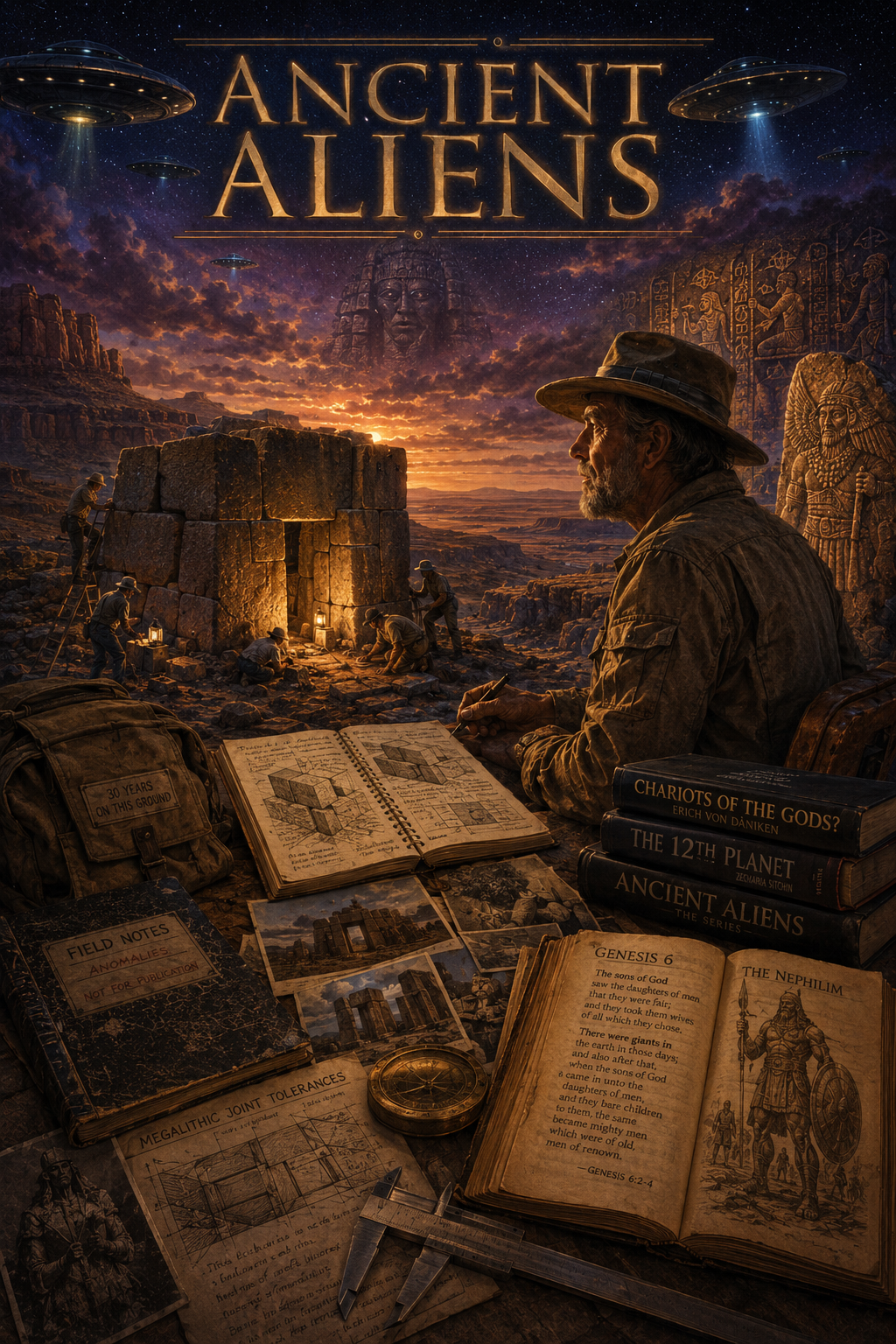
Ancient Aliens
The Watcher File
The Pyramid Texts
The Gilgamesh Track
The Vedic Sky Vehicle
The Megalithic Trail
The Meso-American Witness
The Modern Continuum
"The Nephilim were on the earth in those days, and also afterward, when the sons of God came in to the daughters of man and they bore children to them. These were the mighty men who were of old, the men of renown" — Genesis 6:4
Chapter 1: The Frequency
The last real summer any of them had began on the ninth of June, 1995, and not one of the four boys standing in the gravel on Prosser Road that evening had the first idea that it was the last one. That is the whole mechanism of being twelve. You are handed something enormous and you spend it like pocket change, and you do not find out what it was worth until you are forty and it is a long way behind you.
School had let out on a Thursday. By Friday they had already burned through the plan they had been making since March, which was to ride out to the quarry, and the quarry had turned out to be a hole with brown water in it and a dead carp on the bank. So they stood on Prosser Road at twenty to nine with the corn going black on both sides and the sky the color of a bruise, and they had nothing to do and eleven weeks to do it in.
That is the exact condition under which everything that followed became possible. Not curiosity. Boredom. Nobody ever tells you that the two are the same thing wearing different shirts.
The radio was in the Scribe's garage, though nobody called him that yet.
His father had built it from a Heathkit in the winter of 1988, soldering it at the kitchen table over four weekends with the instruction booklet held flat under a coffee cup, and for one year afterward the two of them had gone out to the garage on Saturday nights and talked to a man in Manitoba and a woman in Puerto Rico and, once, memorably, a freighter somewhere in the Gulf of Mexico that had come through so clean it might have been across the street. His father would let him hold the microphone. His father would say go ahead, say your name, and he would say his name, and a voice would come back out of the dark two thousand miles away and say it back to him.
Then his father stopped.
There was no argument and no announcement. He came home later. Then he came home later than that. The garage got cold in November and nobody turned the heater on, and sometime around the following spring the set went under an old bedsheet, and the bedsheet got dusty, and the boy who used to hand him the solder learned not to bring it up.
It had been six years. The bedsheet was still there.
They pulled it off on the second night of summer. It came away with a sound like a held breath letting go, and there was a moment — maybe half a second — where the Scribe almost said wait, and did not, and has thought about that half second on and off for thirty-one years.
Here is a thing about 1995 that nobody understood at the time, including the four of them.
That equipment was already obsolete. Everybody who wanted to talk to strangers was starting to do it some other way, and the shortwave bands had gone quiet the way a downtown goes quiet when the highway moves. There were still people out there — there are always still people out there — but between them were long empty stretches nobody bothered with anymore.
And empty stretches are not monitored. If you had something to say in 1995 and you did not particularly want it heard, that is precisely where you would put it.
What they found at first was what anyone would find. Truckers arguing about a weigh station outside Terre Haute. A church station out of Fort Wayne running hymns on a tape loop with a hiss in it. A man in Cincinnati reading the extended forecast in the identical flat voice he had used the night before and would use the night after.
The Brain had the dial. He had it between two fingers the way you hold something you are afraid of breaking, and he was walking it up through a stretch of nothing, and the static changed.
It thinned. That is the only word any of them ever found for it. It thinned out and pulled back the way a curtain pulls back off something that has been standing behind it the entire time, and underneath the thinning there was a voice.
Slow. Deep. Unhurried in a way that nothing on the radio in 1995 was unhurried, because by 1995 everything on the radio was selling something and knew it had four seconds. This did not sound like it was selling anything. It sounded like a man reading aloud in an empty room to see how the words went.
"This is project7."
Nobody moved. The Believer's hand was halfway into a bag of chips and it stayed there.
"The year is 2027. Something has gone terribly wrong. Egypt. Giza. Older than they —"
And the static came back over it like water closing over a stone.
The Scribe had a spiral notebook in his backpack, ninety-eight cents at the drugstore, bought for a summer reading log he had been avoiding for eleven days. He got it out with hands that did not feel like his and he wrote three words in block capitals.
EGYPT. GIZA. OLDER.
He underlined it twice, hard enough that the impression came through onto the next three pages, which is how he could still read it in the dark forty minutes later when the bulb burned out and nobody had a spare.
"What time is it," the Captain said. His voice came out wrong and he cleared his throat and it did not help.
The Believer looked at the clock radio on the shelf, the cheap kind with the plastic numbers that fell over one at a time.
"Eleven eleven."
It came back the next night, and the night after that, and every night after that for the rest of the summer. Always at eleven eleven, never a minute either side. Some nights it was one word — Antarctica, or Paperclip, or Watchers — dropped into the static like a stone into a well, and then nothing. Some nights it ran a full minute of something none of them could follow. It never gave a call sign. It never identified a station or a city. And it never once, in eleven weeks, acknowledged that anybody was listening.
By the fourth night they had a rule about not telling anybody, and by the sixth they had names.
The Captain got his because he was the one who kept saying okay, so what do we actually do about it, which nobody else was saying and which turned out to be the only question that ever moved them off a spot. The Brain got his in the obvious way and did not enjoy it nearly as much as the other three assumed he would. The Believer got his because of a thing that had happened in May, and because none of them knew how to say the real reason out loud, so they gave him a name instead, which is how boys handle that.
The Skeptic named himself.
He said if they were going to do this then somebody had to be the guy who did not believe any of it, and he volunteered on the spot, and he was twelve and he was showing off, and it turned out to be the most important job in the garage. Everything they got right that summer, they got right because he was in the room being difficult about it.
The Scribe got his because he had the notebook. He wrote down what the voice said, and what they said about what the voice said, and the dates, and eventually the arguments. He is the only one of the five who never stopped.
The File — What Somebody Had Been Selling for Twenty-Seven Years
They did not know it that June, but they were arriving extremely late to a conversation that had already made a great deal of money.
In 1968, a Swiss hotel manager named Erich von Däniken published Chariots of the Gods, which argued that the architecture, the religion, and the inherited know-how of ancient peoples had been handed to them in deep antiquity by visitors from somewhere else — beings the witnessing populations took for gods because they had no other category available. It became one of the most-translated nonfiction books of the postwar era. By 1995 it was a swollen mass-market paperback in the back of every used bookstore in America, and the copy the Brain eventually turned up cost seventy-five cents and had somebody else's underlining in it in three different colors of ink.
In 1976, Zecharia Sitchin published The 12th Planet and supplied the specifics the first book had been careful not to supply: a hypothesized twelfth planet on a long elliptical orbit, a race called the Anunnaki, and modern humanity engineered out of earlier stock to work as a labor force.
Everything after that has been elaboration. A cable series would eventually run the material continuously from 2010 forward and put a face on a T-shirt, but that was fifteen years past the end of the summer and none of them ever saw it coming.
That is the ancient-aliens thesis, and the honest framing belongs here, at the front, before a single piece of evidence gets examined:
The thesis is correctly noticing real data. It is wrong about what the data was.
Chapter 2 — Get the Name
The county library opened at nine and the four of them were on the step at ten of, which the librarian noticed on the first morning and did not remark on, and noticed again on the fourth.
Inside it was twenty degrees cooler than the parking lot and smelled like paper and floor wax and the particular mildew that lives in any municipal building with a basement. There were two computers by the reference desk running an index, with a laminated sign that said THIRTY MINUTES PER PATRON, and neither of them was connected to anything at all. If you wanted the world in the summer of 1995, in a county of nine thousand people, you got it out of a drawer with your hands.
The microfiche reader was the size of a washing machine and the Brain ran it for three weeks like a man at a loom.
"Bolivia," he said, the second week. "There's a place called Pumapunku. The blocks fit together and there's no gap in the seam. You can't get a piece of paper in it."
"Says who," the Skeptic said.
"Says the book."
"Says the book who." The Skeptic had his arms crossed. He had his arms crossed for most of 1995. "Who measured it. Who went down there with a thing and measured it and wrote it down."
The Brain stopped cranking. He looked at the page. He looked at it for a while.
He did not know. The paperback had said it the way paperbacks say things — in the passive voice, with nobody's name attached, as if the fact had assembled itself out of the air and floated over to the reader.
From two carrels down, not looking up, the Captain said: "So go get the name."
The Scribe wrote it in the notebook underneath the three words from the first night. Not a fact this time. A rule.
GET THE NAME.
It is still in the notebook. Of everything that came out of that summer it is the single most useful thing any of them carried off, and it had been invented by a twelve-year-old in a bad mood who mainly wanted to be difficult in a library.
The librarian came up the aisle on the Thursday of the third week without any of them hearing her, which was a thing she did.
"Egypt's four-ten through four-thirty-two," she said. "Ancient history's the next bay over."
"Thanks," said the Captain.
She did not leave. She stood there with one hand on the cart, and she looked at the four of them for slightly longer than an adult looks at four boys.
"Some of it's out."
"Out like checked out?"
"Out like the card's not in the drawer anymore," she said. "There's a difference."
And then she pushed the cart around the end of the stacks and was gone, and the four of them stood in the aisle looking at each other, and it was the Believer who finally said the thing all of them were thinking, which was: "How does she know that?"
Nobody had an answer. They went to four-ten through four-thirty-two and found the shelf and there were gaps in it, the way there are gaps in a mouth.
The File — What the Crew Had Right
They spent three weeks on it and got considerably further than any of them realized. The thesis registers three real things, and a serious man concedes all three before he argues with any of it.
The stonework is real. At Pumapunku in Bolivia, interlocking H-blocks of andesite carry internal channels and joint tolerances measured in millimeters, cut and seated by a culture the record assigns a bronze-age toolkit. At Baalbek in Lebanon, three foundation megaliths exceed eight hundred tons apiece and sit where no ancient crane anyone has ever described could have set them. At Göbekli Tepe in Turkey, a pre-pottery temple complex dates to roughly 9600 BC — some four thousand years ahead of the agriculture and social organization that should have been required to build it. None of that is fringe. All of it is in the published record, and the standard framework absorbs it with visible strain.
The recurrence is real. Cultures separated by oceans and by millennia, with no plausible contact between them, describe strikingly similar things: beings that came down, that taught, that produced offspring, that imparted knowledge which should not have been imparted, and that were followed by catastrophe. The materialist reading calls this convergent psychological archetype. It may well be. It is still a pattern that requires an explanation rather than a shrug.
The texts say what they say. The Sumerian, Akkadian, Vedic, Mesoamerican, and Hebrew witnesses describe encounters with non-human intelligence in specific, detailed, internally consistent terms. Filing all of it under mythology-as-fiction is a methodological decision, not an obvious reading. At minimum these are records of what the witnessing populations believed had happened.
They may be records of what happened.
Chapter 3: The Night It Answered
On the nineteenth of July the Captain asked a question out loud in the garage.
They had been arguing about the megaliths for an hour and getting nowhere, and it was late, and he leaned back on his milk crate and said, mostly to the ceiling, "Okay, but who was here first. Like actually first. Before the Egyptians."
Nobody answered him. The Skeptic said something about how you cannot be first if you cannot prove it, and the Brain said something back, and the argument moved on the way arguments do, and they turned the radio off at midnight and went home.
The next night the voice came up at eleven eleven and said, without any preamble at all:
"You asked who was here first."
Every one of them heard it. That is the part the Scribe underlined three times and circled and then, years later, went back and drew a box around. Four boys, four separate accounts of that night, and no daylight between them.
The signal ran nine more seconds — something about a name none of them caught, a word that might have been Watchers again — and then the static came over it and it was gone.
Nobody said anything for a long time. Somebody's bike fell over in the driveway and all four of them came up off the crates.
The Skeptic was white. Whatever else you want to say about him, he did not pretend it had not happened, and he did not pretend he had an explanation. He sat back down and he put his hands on his knees and he said, "There's a reason. There's a reason and we don't have it yet."
Which was, in fact, the correct thing to say, and it is worth pausing on, because a lesser boy would have done one of the two easy things — decided it was proof, or decided it was a trick — and he did neither. He held it open. He held it open all summer.
Two weeks later, on a Tuesday, the county sheriff came down Prosser Road while the four of them were riding back from the library and he slowed and looked at them and did not wave. He had waved at those boys every week of their lives. He did not wave that day and he did not wave again for the rest of the summer, and none of them ever found out why, and there is a decent chance it was nothing.
That is the part nobody tells you about looking into something. It is not that you find monsters. It is that ordinary things start arriving with a second possible meaning attached, and after a while you cannot get them to go back to having only one.
The kitchen table came in the last week of July, at midnight, when everybody's parents believed everybody was at somebody else's house — a system that works exactly as long as nobody calls.
Four glasses of milk. Two library books. The seventy-five-cent paperback with the spaceship on the cover. And a legal pad in front of the Skeptic, who had been at it for two hours and had produced one column of numbers and a great deal of crossing out.
"This Sitchin guy," he said. "He says the planet comes back around."
"Right," said the Brain.
"So when."
"What?"
"He's got a whole orbit. He's got a period worked out, he's got it in years, it's right there. So when does it come back."
The Brain found it. He read the line twice, and then he read it a third time, and he did not say anything.
"What," said the Captain.
"It already went by."
Out on Prosser Road a truck went past without slowing and the headlights swept the ceiling and were gone.
"Then he's wrong," the Skeptic said.
"About the planet."
"About the planet, which is the whole —"
"The stones are still there."
That was the Brain, and he had just said the most important sentence of the entire summer, and he did not know it. He was twelve. He was tired and he wanted to go home.
The man who explained the stones was wrong. The stones did not go anywhere.
"So we've got real stuff," the Captain said slowly, working it out as he said it, "and a bad answer."
"Yeah."
"Then we need a better answer. Not a smaller question."
The File — Real Data, Wrong Cause
This is the pattern the whole transmission exists to teach, and it is why this file gets worked early. Learn it here and it is recognizable everywhere else.
Real data. Wrong cause.
The thesis takes a body of evidence that one witness had already attributed to a specific category of agency — fallen spiritual beings interacting physically with humanity — and substitutes a naturalistic category, biological organisms from another star system. The substitution lets a materialist audience keep the anomaly and discard the world it implies.
The deception is not in the data. The deception is in the reframing.
Three things follow, and the crew found all three the hard way.
Sitchin's specifics failed. The Anunnaki material made checkable claims — an orbital period, a timing for the return through the inner solar system, a trajectory for human history under its influence. None of it materialized. The astronomical claims were never corroborated, and his translation work on the Sumerian tablets, on which the entire framework rests, has been seriously contested by Sumerologists working the same primary sources.
The failure of an answer is not the failure of the question. The stones are still there. So is the dating at Göbekli Tepe, and the weathering on the Sphinx enclosure that the geologist Robert Schoch reads as water erosion from a wetter climate than the dynastic chronology permits — contested, published, and not going anywhere merely because somebody's twelfth planet failed to arrive.
The thesis cannot accept its own witnesses. They describe spiritual beings — gods, watchers, sons of God — and not biological visitors from a star system. So every witness has to be reframed to be made legible to a naturalist audience. That is a constraint the thesis carries and cannot put down.
Sort it into the three columns and it comes apart cleanly. Documented — the sites, the tolerances, the dates, the texts. Contested — what the anomalies imply about ancient capability and chronology. Speculative — Nibiru, the twelfth planet, the engineered-labor-force account of human origins.
The speculative column is not forbidden. It is simply not where a man puts his weight.
Chapter 4: The Book That Was Already In The House
The Believer's grandmother had died on the eleventh of May, three and a half weeks before school let out, and he had not spoken about it once all summer.
They knew, the way boys know. Somebody's mother tells somebody's mother. He had missed four days and come back the following Monday and nobody had said anything to him about it, and at the time that had felt like kindness, and it was not. It was that none of them had the equipment. Twelve-year-old boys have a word for almost everything and no word at all for that.
He came across the grass on the last Thursday in August carrying her Bible against his chest with both arms, the way you carry something heavier than it looks.
It was the big kind. Leather gone soft, gold edges worn through to white at the corners, her name on the flyleaf in fountain pen in a hand that belonged to a different century of penmanship.
"I found it," he said.
"Found what," the Skeptic said.
"The thing about the sky guys. It's in here."
"It's in church?"
"It's in Genesis." He was already turning pages, and he did not have to hunt for it, which meant he had found it some days before and had been working himself up to this. "It's four verses in."
He read it out loud under the porch light, slowly, because he was eleven and a half and some of the words were long and he had never once in his life read anything aloud to his friends.
"The Nephilim were on the earth in those days... when the sons of God came in to the daughters of man and they bore children to them. These were the mighty men who were of old, the men of renown."
Nobody said anything. A car went by out on Prosser Road and did not slow down. The moths kept working at the bulb.
"Read it again," the Skeptic said.
He read it again.
"Sons of God," the Captain said.
"There's a word for it." The Believer tilted the book toward the light. "Bene Elohim. She wrote it in the margin. That's her handwriting."
"And the kids they had."
"Nephilim. It means fallen. Or it means giants. Her note says both."
The Brain sat down on the step below him. Slowly. The way a man sets down something he has been carrying with the wrong arm.
"Sky beings came down," he said. "They taught people things. They had kids that weren't right. And then something huge happened and wiped all of it out."
"Yeah."
"That's the same story. That's the same story as the Bolivia guys and the Egypt guys and the —"
"Yeah."
"So who copied who," the Skeptic said.
He said it quietly. It was not how he said things. His arms were not crossed, and that was the first time all summer, and the Scribe noticed it and wrote it down and has the note still.
And the Believer closed the book on his finger to keep the place and looked at him and said the thing that ended the argument permanently for all five of them.
"Or nobody copied anybody. And it happened."
The Scribe wrote it on the inside back cover, because every other page in the notebook was full.
GENESIS 6.
He was twelve years old, and he had just written down the most important thing he would ever write down, and what he was actually thinking about on that porch was that the Skeptic was moving to Ohio on the fourth of September and that not one of them had said a single word about it all summer.
The File — The One That Was Already on the Shelf
The book those four boys had walked past their entire lives opens the account four verses in.
"When man began to multiply on the face of the land and daughters were born to them, the sons of God saw that the daughters of man were attractive. And they took as their wives any they chose" — Genesis 6:1-2
It names a category of being — bene Elohim, sons of God — interacting physically with humanity. It identifies the offspring as Nephilim, the fallen ones. And it places the whole episode as a primary cause of the corruption that brought the flood. Whatever else that passage is, it is not vague.
Two New Testament writers treat it as history. Jude describes angels who did not stay within their proper domain but abandoned their own dwelling, and who are held in chains until judgment. Peter says nearly the same thing in nearly the same breath, and both set it inside a sequence of specific historical judgments — this, then the flood, then Sodom. Neither man is being poetic, and neither expects an argument.
The Second Temple tradition elaborates it. 1 Enoch's Book of the Watchers, Jubilees, and the Qumran material read Genesis 6 as a corporate rebellion whose participants interacted physically with humanity, taught it what it should not have been taught, and produced offspring whose existence was itself a corruption of the created order.
And here is where the framework does something the thesis cannot. It absorbs the same data without straining. The instructive sky-beings are the Watchers. The half-divine offspring are the Nephilim. The forbidden knowledge — metallurgy, weapons, sorcery, astrology, cosmetics and the seductive arts — is enumerated in 1 Enoch 8, and it lines up uncomfortably well with the exact catalog of gifts the ancient-aliens thesis credits to its visitors.
Then it keeps going past the flood, and it does so in the flattest way imaginable.
"For only Og the king of Bashan was left of the remnant of the Rephaim. Behold, his bed was a bed of iron. Is it not in Rabbah of the Ammonites? Nine cubits was its length, and four cubits its breadth" — Deuteronomy 3:11
That is not a legend. That is a museum note. Go and look — the object is in Rabbah, here are the dimensions. It is what a man writes when he expects to be doubted and intends to be checkable.
The Anakim, the Rephaim, the Emim, the Zamzummim, Og with his iron bed, and Goliath as the late straggler — named across Numbers, Deuteronomy, Joshua, and 1 Samuel, with the conquest framed in part as a cleansing operation against those lines.
The witness runs the length of the book without breaking. Before the flood, Genesis 6 — the transgression, the Nephilim, and the flood as its termination. After the flood, the recurrence of the giant lines and the conquest read partly as judgment against them. Between the testaments, 1 Enoch and Jubilees and the Qumran material preserving and developing the doctrine, with the New Testament writers assuming it and feeling no need to defend it. And at the end, the days-of-Noah pattern named as a feature of the closing era.
"They were eating and drinking and marrying and being given in marriage, until the day when Noah entered the ark, and the flood came and destroyed them all" — Luke 17:27
Read that slowly, because it is not describing wickedness. It is describing normalcy. Eating, drinking, weddings. The comparison is not to an era of obvious monstrosity — it is to an era that felt completely ordinary right up until the morning it did not, to people who were making plans for the fall.
Which sets the pastoral point, and it is not the one most men expect. The framing is not the threat; the framing is downstream. The situation is that an account of non-human intelligence interacting with humanity has been sitting on a shelf the whole time — integrated, complete, and older than Chariots of the Gods by three thousand years.
A man who has never read it will reach for the alien-astronaut version when the subject arrives, because the only other option in his inventory was the flat denial that anything happened at all.
There is a third file. The conversation has been steadily forgetting that it exists.
Chapter 5: Thirty-One Summers
The Skeptic moved on the fourth of September. There was a thing at his house the Saturday before, with a cooler and a folding table, and none of the other three knew how to behave at it. Then there was a station wagon with a mattress on the roof, and then there were three of them, and then junior high started and it turned out junior high has no room in it for a crew.
The signal stopped sometime that fall. Nobody could say when, because by the time anybody noticed, it had already been weeks.
The Scribe went out to the garage alone on a night in October, sat down on the cold concrete with his coat on, and ran the band twice from one end to the other. Truckers. A church station out of Fort Wayne. A man in Cincinnati reading the weather.
He put the sheet back over it himself. He was careful about it. He got the corners square.
His father died in 2011, in March, of the thing that had been coming for two years. Cleaning out the garage that summer he found the set under the same bedsheet, in the same place, and he sat down on the step with it across his knees and stayed there long enough that his wife came out to see what was wrong.
He took it home. He never got it working again. He never really tried, and he could not have told you why, and there is a version of that man who understands perfectly well that some things are not meant to be switched back on and are meant to be kept.
Thirty-one summers after the ninth of June, 1995, he stands where the sand meets the stone at Giza with the sun coming up behind him and the Great Pyramid throwing its shadow out across the plateau for what looks like a kilometer.
He is forty-three years old. He has a daughter who is eleven and a half — the exact age the Believer was on that porch — and this trip is the first thing he has done in nine years that is only for himself.
He is holding a spiral notebook. Ninety-eight cents. The cover came off in 2003 and he taped it, and the edges have gone soft the way paper goes soft when it has been carried instead of shelved.
He thinks about the four of them, and about which two he still calls, and about the one whose phone number he has not had since 1997.
He thinks about a librarian with a cart who said the card's not in the drawer anymore and then walked away and never explained it to anyone, and who would be somewhere in her eighties now if she is anywhere at all.
He thinks about a voice that said Giza is older than they tell you, and about how, on that one narrow question, it was right.
He opens the notebook to the inside back cover, where an eleven-year-old boy's best friend wrote GENESIS 6 in block capitals in August of 1995. Then he turns to a fresh page, writes the date, and writes one line.
"The file was real. The man on the radio was reading from Scripture. Some of us heard it. Most did not."
He closes it, puts it in the bag, and starts walking toward the pyramid.
"Where were you when I laid the foundation of the earth? Tell me, if you have understanding" — Job 38:4
The question is put to a man who had been demanding an explanation, and it is not an insult. It is a statement about the age of the archive.
Every dig site in this transmission is younger than the thing being asked about. Every man who has ever stood on that plateau at dawn arrived late, holding a notebook, trying to catch up. That is not a failure. It is the ordinary condition, and a man who knows it about himself is a better investigator than a man who does not.
Work the anomalies. Concede what the record shows. Refuse the substitution.
And get the name.
Next Transmission
Seven witnesses. Seven nights the crew followed one of them as far as it would go.
The Watcher File — Genesis 6 and 1 Enoch at depth. The transgression, the enumerated forbidden knowledge, the offspring, the judgment.
The Gilgamesh Track — the Sumerian and Akkadian tablets. What Sitchin claimed they say, and what Sumerologists say they say.
The Megalithic Trail — Pumapunku, Baalbek, Göbekli Tepe, worked as an engineering problem instead of a rhetorical one.
The Pyramid Texts — the Egyptian witness, the Edfu Building Texts and their First Time, and the chronology fight.
The Vedic Sky-Vehicles — the Sanskrit material, the vimana descriptions, and the honest problem of how much popular quotation is invented.
The Mesoamerican Witness — the returning bearded teacher, the calendars, what the pre-Columbian traditions actually record.
The Modern Continuum — the same pattern in present tense. It ends in a diner with the Skeptic's line: the file is current; the pattern is the pattern.
"This is project7. The broadcast resumes tomorrow at 11:11."