
Arts & Crafts
Woodworking
Handcrafting
Sewing & Upholstery
Creative Arts
Scrapbooking
Memorabilia Framing
Performing Arts
The Bench of the Hands
The first bench inside the shed runs the whole length of the left wall, and nothing on it is finished. A cedar chest with its lid still in the clamps. A leather sheath half stitched, two needles hanging off the thread. A dining chair stripped to its webbing, the old fabric folded beside it for a pattern. A canvas of a mountain lake with the sky done and the water still bare. A shoebox of photographs and ticket stubs. A folded flag in a frame, waiting on its glass. On a nail above it all hangs a hand-lettered program from a church Christmas play.
The Adventurer reaches past everything and picks up a small pine box with a lid that doesn't quite close. He turns it over in his hands. "First thing I ever built. I was eleven." He sets it in front of you. "Everything I've made since is better than that. None of it matters more." Then he hands you a pencil and a scrap of two-by-four. "Mark where you'd cut it." You hesitate, and he waits. "A wrong answer's fine. No answer isn't."
You draw a line. It isn't square. The mentor takes the board out of your hand, turns it over, writes the date on the underside, and sets it on the shelf beside the pine box.
This is Arts & Crafts, the first bench of the Workshop and the bench of the hands. It holds seven rooms, and they run in a deliberate order. The first three make things a house can use: Woodworking, Handcrafting, and Sewing & Upholstery. The fourth, Creative Arts, makes a thing that holds nothing and does nothing but say what a man saw. The next two keep what the years have already made: Scrapbooking and Memorabilia Framing. The last, Performing Arts, has no material at all, because the man himself is what gets shaped, and it walks him straight toward the bench of the ear. Seven rooms, from a board to a voice.
Why a Man's Hands Need a Material
A lot of men spend most of their waking hours on things they can't touch. Emails, spreadsheets, meetings, calls, a quarterly number that moves or doesn't. The work is real and it feeds the family, but it rarely tells a man plainly whether he did it well. Somebody has an opinion. The feedback arrives in a month, filtered through three people. It's possible to go years without knowing if anything you did was actually good.
A material doesn't work that way. Wood has a grain, and if you cut against it, it tears. Leather stretches where you didn't want it to. Fabric shifts under the needle. Paint on a wet canvas mixes with what's already there whether you like it or not. The material tells a man the truth immediately and without flattery. The joint fits or it doesn't. The seam holds or it doesn't. A man who spends his days in abstraction and his evenings at a bench gets an education in honest feedback that his job may never give him. He also finds out that he's more patient than he thought, and less patient than he'd like to be.
There's a second thing. A man is made in the image of a Maker, and the first chapter of the Bible doesn't call what God made useful. It calls it good. Most men are comfortable making useful things and slightly embarrassed about making beautiful ones, as if beauty were a luxury for men with more time than they have. That gets it backward. The chamfer on the table edge, the grain matched across a cabinet door, the painting of the view from the back porch: these are the part of making that looks most like the One who made the man.
And the made thing stays in the house. The children grow up eating at the table, sitting in the re-covered chair, walking past the painting, and pulling the album off the shelf. A house furnished entirely from a catalog teaches a child that things come from stores. A house with some of its father's work in it teaches that things come from people, and that one of those people is theirs.
How a Man Gets This Bench Wrong
The traps at this bench are specific to the hands. Name them before the first room.
The Man Who Makes Nothing Soft. He'll build a workbench, but he won't sew, paint, keep an album, or dance with his wife at a wedding, because somewhere he learned those were for women. The sailors who sewed their own sails, the soldiers who carried sewing kits for three hundred years, and the king who danced in front of the whole city would have found him strange. A man who closes half the bench to protect his image is less capable, not more masculine.
The Utility Man. Everything he makes has to earn its keep. The shelf is fine, but the carving on it is a waste of time. He can't justify a painting, a frame, or a scrapbook, because none of them do anything. He has confused a man's worth with his output, and the house he builds is sturdy, square, and joyless.
The Kit Man. He only builds from kits and follows every plan to the letter. That is exactly how everyone should start, and it's a poor place to stay. Ten years in, he has never once drawn his own design, changed a dimension to suit his own house, or tried a joint the plan didn't call for. He has assembled a great deal and made very little.
The Rushed Finish. He loves the cutting and the building and hates the sanding, the staining, the last stitches, and the hanging. His projects are ninety percent done and look fifty percent done. The last ten percent of a piece is what the family touches every day for thirty years. It's also where most of the craft actually lives.
The Man Without Guards. He takes the blade guard off because it's in the way, sands without a respirator, welds in a T-shirt, and freehands the cut just this once. The bench is supposed to give a man joy into old age. This man is trading his fingers, lungs, and eyes for about four minutes of saved time.
The man at this bench makes useful things and beautiful things, finishes both, keeps both his hands, and is embarrassed by none of it.
The Seven Rooms of This Bench
Woodworking — the door most men come through. A corner of the garage, a short list of tools, and a shelf by Sunday. Five skills sit under every project: layout, cutting, joinery, finishing, and keeping the tools sharp. The road runs from a cutting board in the first year to a dining table the family eats at for the rest of his life.
Handcrafting — the small table. Leather stitched by hand so one broken stitch can't unravel the rest. A knife ground from bar stock and trusted to a proper heat treatment. Steel hammered into a hook for the barn. A silver ring a man made for his wife.
Sewing & Upholstery — the needle. Six hand stitches, a used machine that outlasts a new one, a patch that doesn't tear on the first wash, and a set of dining chairs made new in an afternoon.
Creative Arts — the easel. Pencil, paint, and clay, where a man learns to draw what's in front of him instead of the symbol in his head. This is the one room on the bench with a teacher standing in it, a twenty-year Air Force sergeant who put down his loud voice on purpose.
Scrapbooking — the family's book. The best photographs of each year, printed, put in order, and captioned with names, beside the ticket stubs and bulletins nobody else thought to keep.
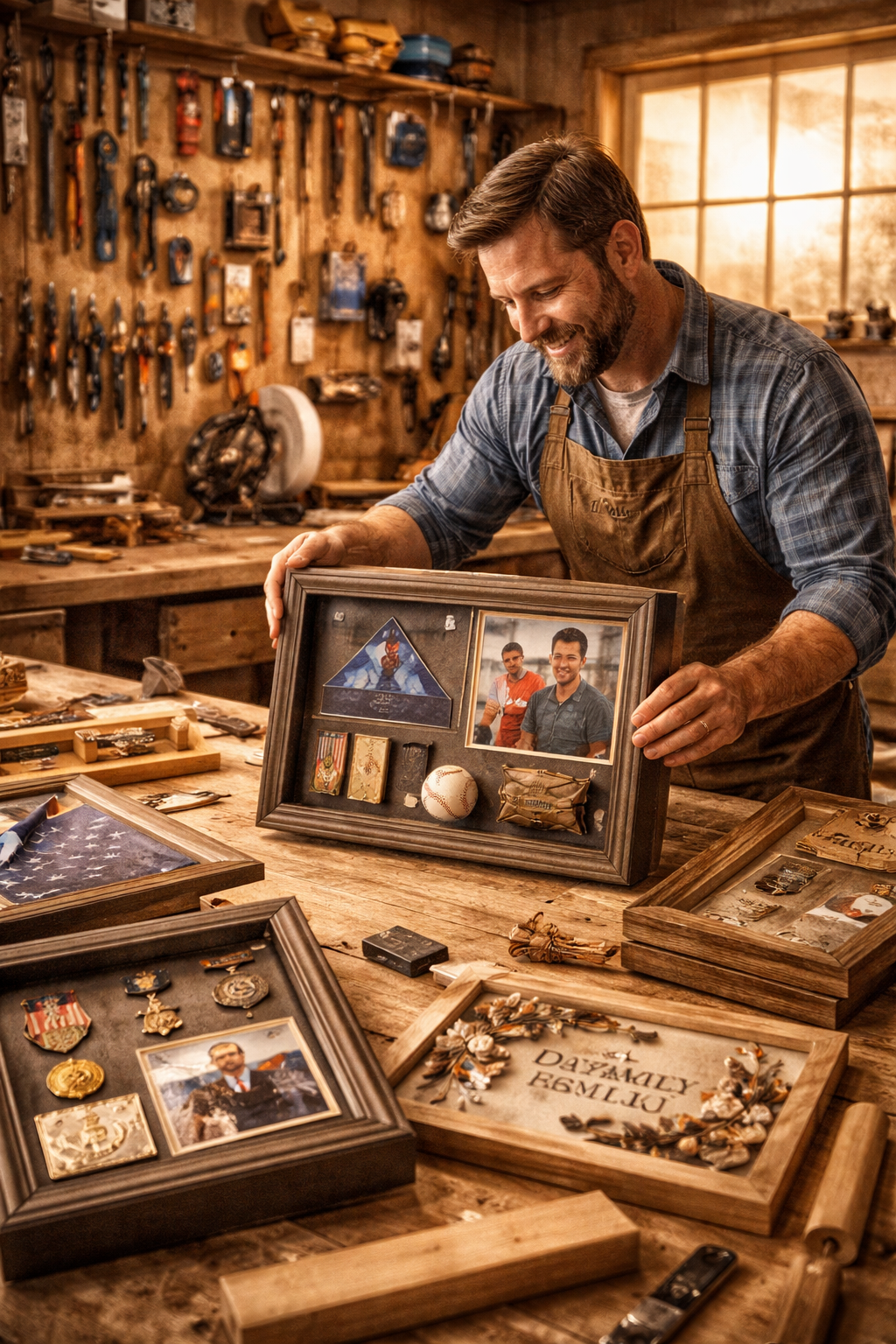
Memorabilia Framing — the wall. The box in the closet, opened. Medals, flags, jerseys, and documents framed so nothing is ever glued, faded, or ruined, and hung where a child walks past them every day.
Performing Arts — the man himself. The toast, the eulogy, Scripture read aloud, the campfire story, the church play, and the first dance. The only room with nothing to set down, and the one that walks out toward the ear.
One Man, Every Material
When Solomon set out to build the temple, he wrote to the king of Tyre for a craftsman, and the king sent him one man. He is trained to work in gold and silver, bronze and iron, stone and wood, and with purple and blue and crimson yarn and fine linen. He is experienced in all kinds of engraving and can execute any design given to him (2 Chronicles 2:14). His name was Huram-Abi. His mother was an Israelite and his father was a foreigner from Tyre.
Read that list again and it's nearly this whole bench: metal, wood, cloth, engraving, and design. The greatest building project in Israel's history went to a man whose hands had crossed every material, not to a specialist in one. And notice the last phrase. He could execute any design given to him. The most skilled craftsman in the region was valued for faithfully building a design he didn't invent. There is no shame in that at a bench, and more wisdom in it than a man first suspects.
The Three Pillars at the Bench
The Workshop's three questions come down to this one bench and get specific. TRUTH. LOVE. LAW. Always in that order.
TRUTH — Am I glorifying God in this, or has it become an idol? At this bench the question is almost literal. The prophet Isaiah described a carpenter who cut down a tree, burned half of it to warm himself and bake his bread, and then carved the other half into a figure. From the rest he makes a god, his idol; he bows down to it and worships (Isaiah 44:17). The same log, the same tools, the same skill. What changed was what the man did with the finished piece. A craftsman rarely bows to a carving now. He bows to the shop, the reputation, the collection of tools, or the perfect piece he's always one project away from. The honest check is simple: does the work leave him more grateful, or only more proud?
LOVE — Am I making this for someone, or am I performing it? Every piece made at this bench has an audience, and the question is who. The keepsake box with a child's name burned into the lid is made for her. The same box built for a video, filmed from four angles and never given to anyone, is made for strangers. There's nothing wrong with showing work. There's something wrong when showing it has become the reason for making it. Count how many things from your bench are in other people's houses. That number tells the truth.
LAW — Am I keeping the joy clean, or killing it? At this bench, two things kill the joy fastest, and both are dishonest. The first is the lie in the work: veneer sold as solid wood, a kit passed off as an original design, a pattern-maker's work copied and sold without credit. The second is comparison: holding your first year up against another man's thirtieth, or holding a beginner's up against yours. Build honestly, credit what you borrowed, and measure yourself against last year's work, not anyone else's.
Hold all three and the bench stays a gift: made with gratitude, given to people you love, and done honestly enough to teach.
This Bench Inside the Workshop
The hands bench trains precision, and precision carries down the building. The man who has learned to measure to a sixteenth of an inch learns timing faster at the ear bench, because a song is measured in time the way a table is measured in inches. And the man who has built frames and albums is already thinking like the eye bench: what goes in, what gets left out, and where the edges go.
The rooms also feed each other directly. The frame for the flag case comes from the wood shop. The leather sheath is for the knife. The costumes for the church play come off the sewing machine, and the sets come out of the woodshop. Scrapbooking and framing need photographs worth keeping, which is the whole reason Photography exists two benches down.
Beyond the shed, this bench reaches across the whole journey. The same skills become a living in Technical Trades. The box in the closet and the album on the shelf belong to the family record kept on the Grounds, in Heirlooms & Mementos and Family Traditions. A father's first gift to a child at this bench is often a hammer at the right height, which is where the Nursery's Children's Arts & Crafts begins. And a man who can mend, build, and repair is one more man who doesn't need to buy his way out of every small problem, which MONEY notices over thirty years.
Where This Bench Stops and Scripture Continues
The first thing human hands ever made in Scripture was a garment. The first man and woman had just disobeyed God, realized they were naked, and felt shame for the first time. Then the eyes of both of them were opened, and they realized they were naked; so they sewed fig leaves together and made coverings for themselves — Genesis 3:7. It was quick work, with the materials at hand. And it didn't work. A few verses later they were still hiding in the trees.
Before they left the garden, a second garment was made, by different hands. The LORD God made garments of skin for Adam and his wife and clothed them — Genesis 3:21. That covering held. It also cost something that the fig leaves hadn't: an animal had to die for it.
A man's hands can make almost everything on this bench. He can build the table, stitch the sheath, and frame the medal. What his hands have never managed to make, in all of history, is a covering that actually holds. That one was always made for him.
After This Bench
A man who has walked the seven rooms leaves this bench with steadier hands, a sharper eye for a square corner, and the first few made things in a house that used to be filled entirely from a store. He has also learned something harder: how to stay with a slow process until it's actually done.
Now the Workshop asks him to train a sense he has barely used on purpose. Down the building, behind a door that stays half shut, the work isn't measured in inches. It's measured in beats, intervals, and the space between two notes. When David brought the ark up to Jerusalem, the singing went to one man for one reason: Kenaniah the head Levite was in charge of the singing; that was his responsibility because he was skillful at it (1 Chronicles 15:22). Skill with the hands got a man trusted with the tabernacle. Skill with the ear got a man trusted with the song.