
Arts & Crafts
Creative Arts
Handcrafts
Memorabilia Framing
Performing Arts
Scrapbooking
Sewing & Upholstery
Woodworking
Every man has something in him that wants out through his hands. The craft is just the door it comes through.
Deep in the Workshop, past the table saw and the lathe and the smell of cut wood, there is a quieter corner. North light comes in soft through a window. There is an easel, a palette smeared with color, a coffee can of brushes, and a man standing in front of a half-finished canvas who is in absolutely no hurry about anything. He has a soft voice and a big head of curly hair, and he is talking to himself almost under his breath about a happy little tree that is going to live right here, on this hill, and have a friend. This is the expressive corner of the Workshop, and the man at the easel is Bob Ross — the patron of this whole bench, and the gentlest teacher a hard man ever had.
This is Arts & Crafts, the part of the Workshop where a man does not just make a thing — he puts himself into it. The other benches build utility; this one builds expression. A cabinet can be plain and still hold dishes, but the hand-cut detail along its edge is a man saying something. The frame around your grandfather's medal is preservation; the way you chose to set it is reverence. The painting on the wall holds nothing and does nothing — it is pure expression, a man's interior made visible. This bench is the creative, expressive side of a man's hand, and it covers everything that side touches: woodworking, the wider handcrafts, sewing and upholstery, framing, the open arts of paint and pencil and clay, the family's memory bound into scrapbooks, and the live arts a man performs with his whole body. The unifying thing is not the material. It is that something of the man comes out, and stays.
Why a Man Needs to Make Something Beautiful
A man can go his whole life being useful and never once make anything that did not have to be made. He earns, he fixes, he provides — all of it necessary, none of it expressive. And something in him slowly goes quiet for lack of use, because a man is made in the image of a Maker, and a maker who never makes anything for the joy of it has shut a door God built into him on purpose. The first thing Scripture tells us about God is that He created — and that He looked at what He made and called it good, not useful. Good. Beautiful. Worth making for its own sake. A man carries a smaller version of that same drive, and this bench is where it gets to breathe.
There is a lie standing between most men and this corner, and it is worth killing at the door: "I'm not artistic." Almost every grown man believes it about himself, usually because someone told him so when he was eight and he never tested it again. It is nearly always false. Bob Ross said the truest thing anyone has said about it — talent is a pursued interest; anything you are willing to practice, you can do. The man who "can't draw" has simply never practiced drawing. The expressive hand is not a gift a few men are born with and the rest are locked out of. It is a muscle, and this bench is the gym for it. A man does not need to become a master. He needs to make one true thing with his own hands and discover that the door was never locked.
And the made thing lasts, which is the part the screen can never touch. A scrolled image is gone the instant the thumb moves. A carved box sits on a shelf for a hundred years. The painting hangs in the hall long enough for a grandchild to ask who made it. Expression that lives in a man's hands and comes out into something solid is one of the few things he produces that outlives him — and a household full of things its father actually made is a different household than one furnished entirely from a catalog.
The Man at the Easel — Bob Ross
To understand why Bob Ross stands over this bench, you have to know the thing almost nobody knows about him. Before the soft voice and the happy little trees, Bob Ross spent twenty years in the United States Air Force. He rose to master sergeant, stationed much of that time in Alaska — which is where he first saw the mountains and the snow he would paint for the rest of his life. And the job, by his own account, made him into a man he did not want to be: the one who had to be hard, who made the recruits scrub the floors, who screamed and bullied and barked because the role demanded it. He hated who it turned him into. So he made a vow. When he got out of the military, he decided, he would never raise his voice again.
He kept it. The gentlest man in the history of television was a twenty-year drill sergeant who chose softness on purpose — and that is the whole reason his gentleness has weight instead of weakness. This was not a soft man who never knew anything else. This was a hard man who had earned the right to be hard and laid it down. His calm was a discipline, not a default. When Bob Ross told a nervous beginner that there were no mistakes, only happy little accidents, it landed because you could feel that the man saying it had known the other way and deliberately walked away from it. That is the same note the whole journey keeps sounding — the Shepherd's gentleness from strength, the Warrior's warm voice over a vise grip. Bob Ross is that note, holding a paintbrush.
And he gave the whole thing away. The Joy of Painting ran for over a decade on public television, for free, and its entire purpose was to take the most intimidating, gatekept, snobbiest corner of the art world and throw the doors open to the truck driver and the grandmother and the kid who thought he could not draw a straight line. "We don't make mistakes," he said, "just happy little accidents." "You can do anything you want to do. This is your world." He was a genuine master — he could lay down a finished landscape in twenty-six minutes — and he spent that mastery entirely on convincing ordinary people they could do it too. He is the living opposite of the Snob at the Bench, the man who uses skill to make others feel small. Bob Ross used his to make others feel capable. That is the disposition this whole bench is built on: high standard, kind hand, doors wide open, and a quiet wonder at a happy little cloud that never once dimmed.
What Lives on This Bench
The expressive hand reaches into a lot of materials, and each one has its own home here.
Woodworking — the door most men walk through first, because the tools are reachable and the made things are useful: the cabinets, the furniture, the frames a man builds for his own house and his friends'. But the expressive turn is real here too — the joint cut clean for the love of it, the grain matched on purpose, the detail no one asked for. Wood is where utility and expression meet on the same board.
Handcrafting — the wider world of making with the hands: leatherwork, small-shop metalwork, knife-making, jewelry, the general craft that doesn't fit neatly under any other roof. The home for the man whose making runs across materials.
Sewing & Upholstery — the needle-and-thread literacy nearly every modern man handed off to a store. The seasoned man takes back at least enough to mend what tears, build something simple, and re-cover the chair instead of dumping it. Not a small thing — a man who can repair cloth is harder to make helpless.
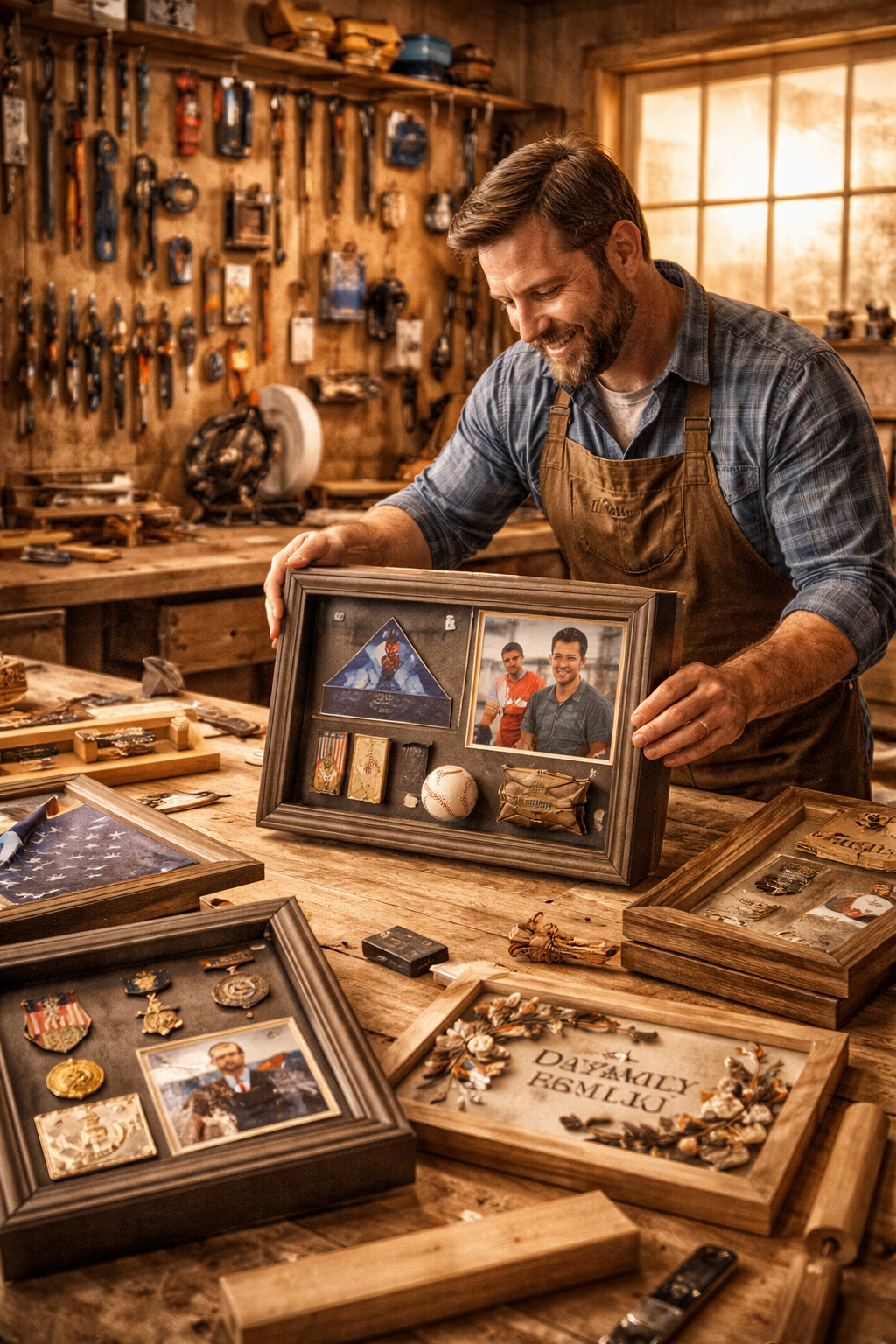
Memorabilia Framing — the preservation craft, and one of the most quietly expressive of all, because how a man chooses to set and frame a thing says what it means to him. The jersey from college, the grandfather's medal, the photo from the wedding — set with reverence by the man's own hand instead of farmed out to the strip-mall counter.
Creative Arts — the open ground of paint, pencil, and clay; the purest expression on the bench, where the made thing holds nothing and does nothing but carry the man's interior into the visible world. This is Bob Ross's home turf, and the place the "I'm not artistic" lie gets killed most directly.
Scrapbooking — the family's memory made into something you can hold and turn the pages of. The digital photo dump replaced the physical album in most homes, and it was not an even trade — the bound book gets pulled off the shelf and looked through for fifty years; the cloud folder gets lost in a phone upgrade. This bench rebuilds the memory you can hand a grandchild.
Performing Arts — the one outlier, because the made thing is not an object but a moment: theater, dance, the arts a man performs with his whole body. It belongs here because performance is hand-craft at the level of the whole man — discipline, expression, and something of himself put out into a room and felt.
How a Man Gets This Bench Wrong
The expressive corner has its own traps, and Bob Ross has the cure for most of them.
The Perfectionist. He sets the bar at the master's level before he has earned a single hour of seasoning, judges his first ugly attempt against a lifetime of someone else's practice, and quits in disgust. This is the exact man Bob Ross spent his life rescuing. There are no mistakes here, only happy accidents — the smear you didn't plan becomes the shadow under the tree, the cut that went wrong teaches the next cut. The standard stays high; the self-contempt goes in the trash. A man who cannot tolerate making something bad will never make anything at all.
The Project Graveyard. He starts a dozen things and finishes none — the half-built dresser, the half-sewn shirt, the canvas blocked in and abandoned. The garage fills with the corpses of good intentions. Finish the thing, even when it disappointed you, especially when it disappointed you, because the finishing is where the learning lives and the unfinished pile is where the discouragement breeds.
The Tool Collector. He buys the whole shop before he makes a single shaving — the overbuilt bench, the professional dust collection, the rack of chisels still in their wrappers — and the actual made work stays thin. Cheap tools and real practice beat a showroom and no miles, every time. The gear earns its place by following the work, never by replacing it.
The Gatekeeper. Less common on this bench but worth naming because Bob Ross built his whole life against it: the man who got good and turned it into a way to look down on everyone who hasn't. He corrects the beginner into quitting, sneers at the simple thing, guards the craft behind jargon. He is the buzzkill of the creative corner. Real masters do what Bob Ross did — hand over the brush, praise the first wobbly tree, and leave the door wide open.
The Three Pillars at the Easel
The Open Country's three questions follow a man right up to the canvas. TRUTH. LOVE. LAW. Always in that order.
TRUTH — Am I making this to the glory of God, or to feed my own name? The expressive hand is a gift from the Maker, and the honest question is whether a man's making points back up in gratitude or curves in on his own ego. The first craftsman Scripture names was filled with the Spirit of God specifically for the work of making beautiful things (Exodus 31:3). A man's creativity is a small echo of the Creator's — held in proper truth, it is worship; turned into a monument to himself, it is just another idol with better lighting.
LOVE — Am I making this for someone, or performing it for an audience? The expressive work aimed at a person builds something real — the cabinet for his wife, the dress for his daughter, the framed photo for his parents, the painting that hangs in a home and not on a feed. The work staged for the likes slowly hollows out. Bob Ross never painted for the critics; he painted for the lonely person at home who needed to be told they could do it too. Make for the people your life is actually inside.
LAW — Are you keeping the joy clean, or killing it? Out here the law pillar is the disposition this whole bench runs on — finish what you start, hold the standard high, and never let perfectionism or snobbery poison the joy, in yourself or in anyone you're teaching. The half-finished pile is the law neglected. The beginner you encouraged instead of crushed is the law honored. Keep it the way Bob Ross kept it: high craft, kind hand, doors open, happy accidents allowed.
The man with all three makes things that carry something true of him, given to people he loves, with a joy clean enough to hand down.
Where This Bench Leads
There is more than one way to make a thing, and more than one sense to train for it. The easel built your hands — taught them to put something real and physical into the world that was not there before. A few steps deeper into the Workshop there is a room with the door half-shut to keep the sound in, and the bench inside it builds something the hands never touch: the ear. A man learns to take a song apart, hear what holds it up, and one day build his own. The hand makes what you can hold. The ear makes what you can only feel.