
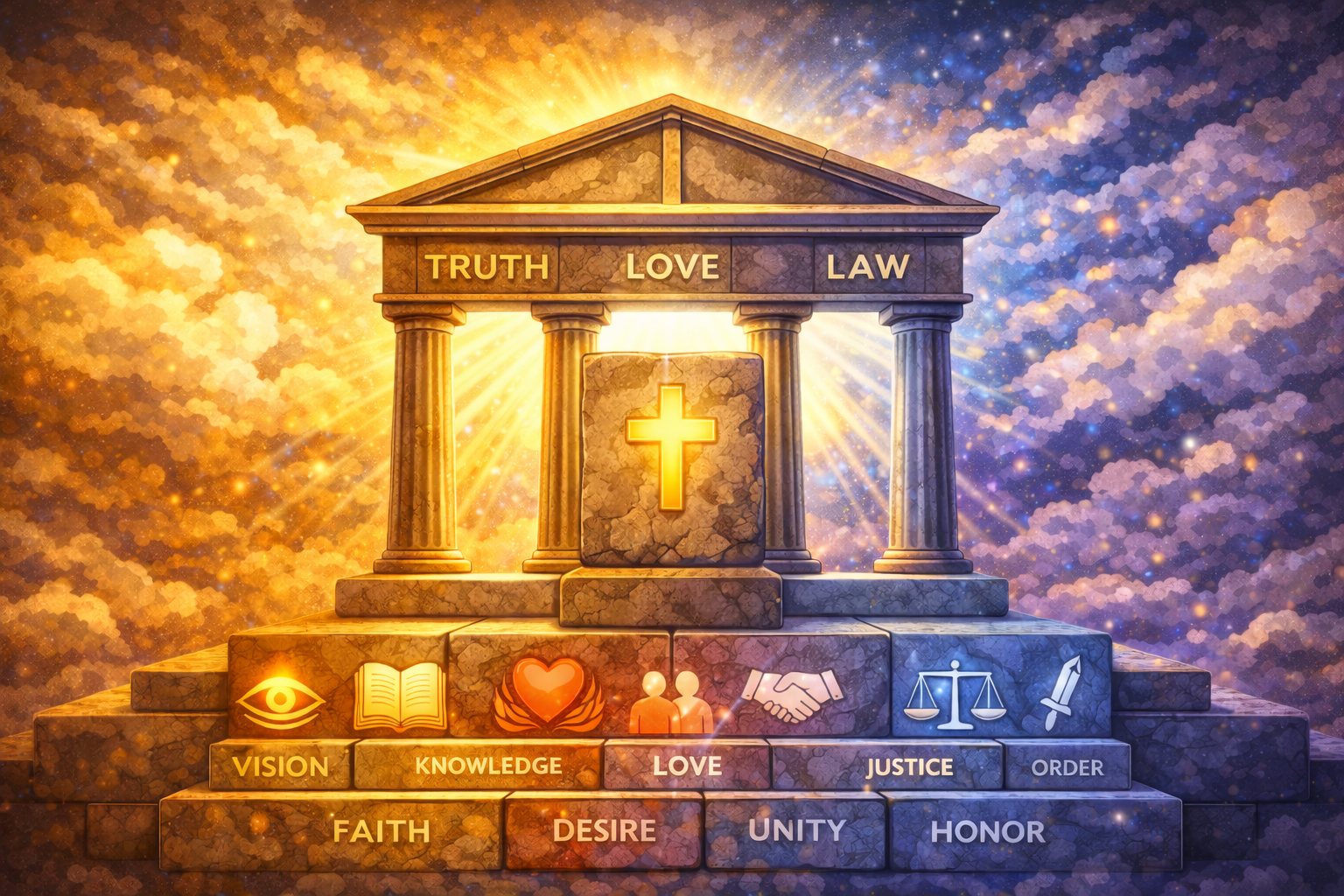
Collective Conscious
There is only one race. The human race.
That is not a political statement. It is a biological one, confirmed by genetic analysis showing that human beings are among the least genetically diverse species on earth, all descending from a common origin. The differences that appear between people groups — in appearance, culture, language, and tradition — are real. They are also surface-level relative to what sits beneath them. Scratch any human being anywhere on earth and you find the same substrate: the same needs, the same fears, the same capacity for love and cruelty, the same longing for meaning, the same awareness that death is coming.
The Collective Conscious is the shared awareness that emerges from this common substrate — the beliefs, values, moral intuitions, and ways of experiencing the world that human beings hold in common simply by virtue of being human. It is not a mystical concept. It is the observable fact that humanity, despite its apparent diversity, is more similar than it is different — and that the similarities are not superficial.
What a Collective Conscious Is
The sociologist Émile Durkheim introduced the concept of the collective consciousness at the turn of the twentieth century — the set of shared beliefs, ideas, and moral attitudes that operate as a unifying force within a society. His observation was that societies are not simply aggregates of individuals. They have a shared mental life that is more than the sum of its parts — a collective agreement about what is real, what matters, and how people should treat each other that gives the society its coherence.
The collective conscious is distinct from the collective unconscious. The collective conscious is what a society openly holds and expresses — its stated values, its public norms, its shared understanding of history and identity. The collective unconscious, as Jung described it, is the layer beneath that — the inherited patterns and archetypes that operate in the depths without being stated.
At the broadest level, the collective conscious of humanity is the shared understanding that all human traditions have converged on: that human life has value, that some actions are wrong regardless of cultural context, that something can be owed between human beings simply by virtue of their shared humanity. These are not universally practiced. They are universally recognized — which is the point.
One Race — The Human Race
"From one man he made all the nations, that they should inhabit the whole earth." — Acts 17:26
The biblical claim and the genetic finding arrive at the same conclusion: humanity is one. The divergence of people groups into the variety of appearances and cultures that currently exists is the product of time, migration, adaptation, and isolation — not the product of fundamentally different origins. The genome does not support a story of multiple, separate human lineages. It supports a single origin.
This matters for how a man sees the people around him. Not with naïve equality that pretends there are no differences — differences in culture, character, competence, and values are real and consequential. But with the baseline recognition that every human being he encounters carries the same substrate, faces the same fundamental questions, and is accountable to the same Creator. That recognition is not sentimentality. It is accuracy.
A man who has internalized this does not reduce people to their group membership. He does not assume that where a person comes from determines what a person is capable of. He reads the individual in front of him — with the context of their formation, the reality of their choices, and the dignity of their common humanity — and he responds to what is actually there.
Shared Moral Intuitions
The most significant evidence for a Collective Conscious operating across humanity is the convergence of moral intuition.
Every culture that has been studied has prohibitions against murder within the in-group, obligations of care toward children, norms around fairness in exchange, and some form of the Golden Rule: treat others as you would be treated. These are not identical across cultures — the details vary, the boundaries of who counts as "in-group" vary, the enforcement mechanisms vary. But the underlying intuitions appear everywhere.
C.S. Lewis documented this in The Abolition of Man, cataloguing what he called the Tao — the moral law that appears in every major human tradition. His argument: the existence of cross-cultural moral convergence is not adequately explained by cultural evolution alone, because cultures with no contact with each other arrived at the same moral intuitions independently. The most adequate explanation is that the intuitions are recognizing something real — that moral truth is embedded in the nature of things, and human moral perception, however distorted, is picking up a signal that is actually there.
This is the biblical position as well: "The work of the law is written on their hearts." (Romans 2:15) The moral law does not require formal instruction to be partially accessible. It is part of what a human being is — a feature of the image of God in which every person is made.
The Contagion of Consciousness
Ideas, behaviors, attitudes, and emotional states spread through human populations. This is not metaphor — it is measurable.
Research on social contagion has demonstrated that obesity, smoking, happiness, loneliness, and divorce all spread through social networks with statistical patterns that resemble the spread of a contagious disease. The behavior and emotional states of the people in a man's network influence his own more than most men are comfortable acknowledging. He does not choose his influences through a fully rational process. He absorbs them through proximity.
This is why the instruction to guard associations is not merely social conservatism. It is an accurate description of how the human mind actually operates in the collective. The people a man spends consistent time with will shape his habits, his language, his expectations, and his emotional baseline — not through explicit instruction, but through the contagion of shared consciousness.
Mass movements operate by the same mechanism at scale. The emotional contagion that characterizes a crowd — whether it is a revival meeting, a political rally, or a riot — is the same process, amplified. A man who has not understood how collective consciousness works is vulnerable to being swept into group states that he would never have chosen individually. Understanding the mechanism is the first protection against it.
World and Mankind
Humanity operates as a single global entity in ways that have been true throughout history but are more visible now than they have ever been. A virus that originates in one city is in sixty countries within weeks. A financial crisis in one economy propagates through global markets within hours. A cultural movement that begins in one nation becomes a reference point for populations that had no part in originating it.
This global interconnectedness is not new — the Silk Road moved ideas and diseases across continents millennia before the internet. What is new is the speed and the visibility. The shared fate of humanity is no longer abstract. It is observable in real time.
A man who grasps this understands that what he builds has implications beyond his immediate context. His children will inhabit a world shaped by what his generation built and failed to build. The culture he participates in or resists is not a local phenomenon — it is a thread in a fabric that extends in every direction. He is not responsible for all of it. He is responsible for his part of it. And his part of it connects to everything else.
Responsibility in the Collective
A man who understands the Collective Conscious understands that he is not a self-contained unit operating independently of what surrounds him. He is embedded in — and contributing to — a shared human consciousness whether he intends to or not.
Every man either lifts the collective or drags it. He either adds to the moral clarity of his environment or contributes to its confusion. He either models something worth imitating or provides a counterexample that others will follow in the wrong direction. The neutrality of non-participation is not available — because the choice not to engage is itself a contribution to whatever fills the space.
The project7 mandate is not to build a private kingdom. It is to build something that matters beyond the man who builds it — something that contributes to what the men around him can become, what his children inherit, and what the collective consciousness of the community he inhabits moves toward. A man who has built himself cannot keep that building to himself. It radiates. The question is only what direction it radiates in.
And this shared mind — stated, known, held in the open — is still not the bottom. Beneath what humanity says out loud runs a layer no culture states, because it operates below speech entirely: patterns and figures every mind carries without ever being taught them, older than any living tradition. That is the last dimension of the signature, and the deepest — the one written where only the man himself, and the One who wrote it, can read.