
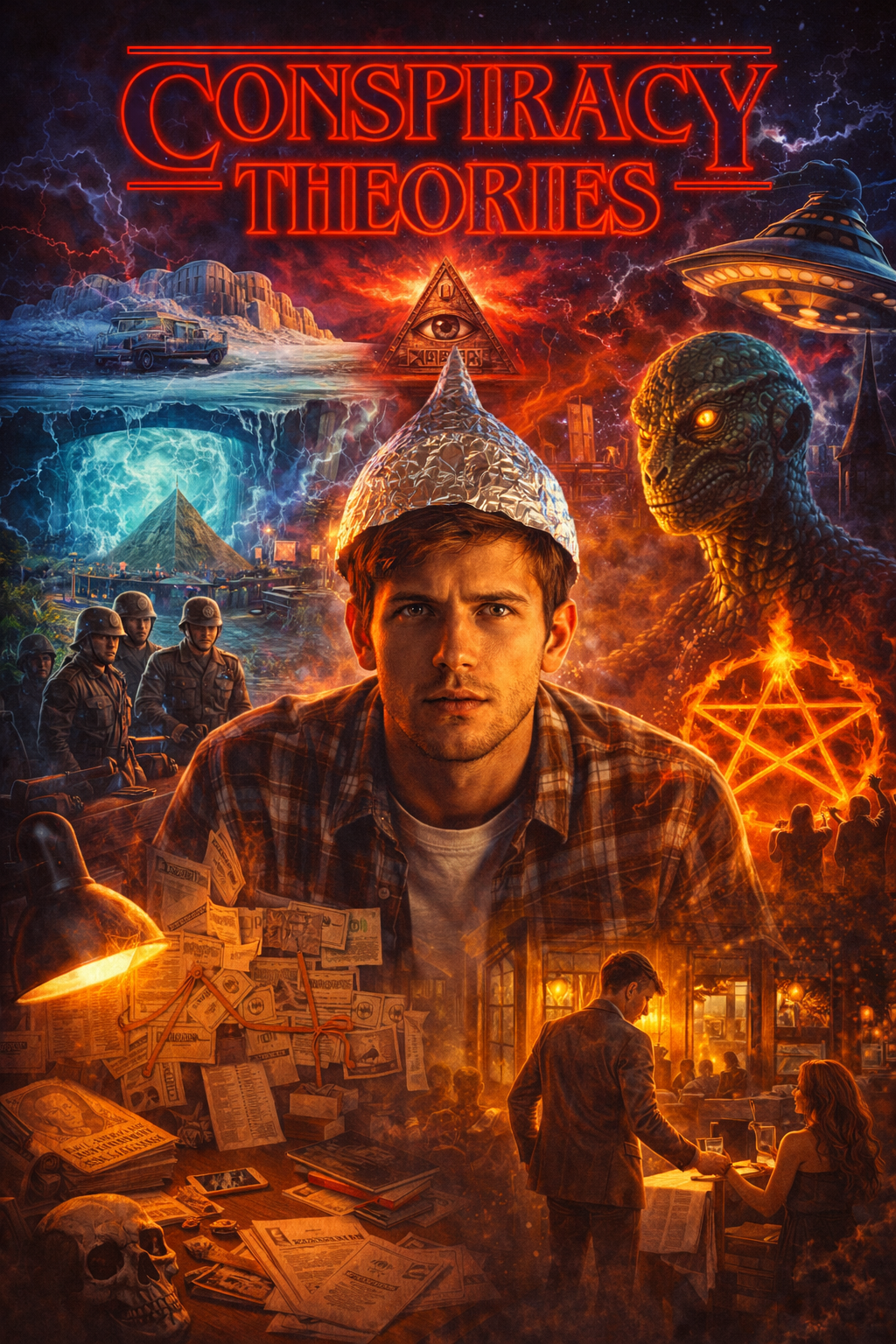
Conspiracy Theories
The chair is pulled out. Take it.
Two in the morning, a kitchen table, a lamp with the shade tipped so the light falls on the paper instead of in your eyes. The AM radio is going low in the corner — the overnight show, a caller from Nevada, a host who does not laugh at him. Across the table is a man in his forties with a pack of cigarettes he never lights and three stacks of folders squared off in front of him. Green, yellow, red.
He does not open with a claim. He pushes the green stack over and lets you go first.
What is in it is not exotic. It is a Senate committee report from 1975. A public-health study that ran for forty years on men who were never told what was being done to them. A program of drug experiments on unwitting subjects, admitted in open hearings in 1977. A domestic surveillance operation against American citizens that ran for fifteen years under a name that is now in every history textbook. Nine files, give or take, depending on the year. Every one of them was called a conspiracy theory by somebody with a title, in public, on the record, before it became a footnote.
You read for an hour. He does not talk while you read. When you finally sit back he asks the only question that matters in this room, and he asks it flatly, without any drama in it at all, because he has had thirty years to get the drama out of it.
"Now. How many more of those are sitting in the red stack tonight?"
Nobody at that table has an answer. That is the night this transmission starts.
Conspiracy Theories
"If you see in a province the oppression of the poor and the violation of justice and righteousness, do not be amazed at the matter, for the high official is watched by a higher, and there are yet higher ones over them" — Ecclesiastes 5:8
Read that slowly, because it is the least expected sentence in the canon on this subject and it is doing three things at once.
It concedes the premise. The oppression of the poor and the violation of justice — not as a hypothetical, not as a warning about what could happen, but as something a man is expected to observe in the ordinary course of paying attention. It concedes the structure. The high official is watched by a higher, and there are yet higher ones over them — layers, each one accountable to the layer above it and to nobody the man on the ground can reach. That is an organizational description, and it is unflattering, and it is in Scripture.
And then it gives the instruction, which is the part nobody expects.
Do not be amazed at the matter.
Not do not look. Not it is not happening. Not tear it down. Do not be astonished. A man who has understood that verse cannot be scandalized into naivety and cannot be scandalized into obsession, because he was told in advance what he would find and told not to lose his composure over it.
That is the disposition this file trains. Everything below is method.
Three Drawers
The whole discipline of this room is the refusal to keep one drawer.
Green — documented. The record that can be pulled. Declassified files, congressional testimony entered into the record, court exhibits, sourced and checkable journalism, the institutional admission that eventually arrived. A man holds the green drawer with confidence, and he can hand it to a hostile reader without flinching, because it does not depend on him being trusted.
Yellow — contested. Real anomalies, serious researchers who disagree with each other, connections that are plausible and unconfirmed, patterns that are genuinely there and whose meaning is genuinely in dispute. A man holds the yellow drawer at arm's length and says so out loud. Most of the interesting work lives here, and most of the damage gets done by men who quietly move a yellow file into green because they liked where it was pointing.
Red — fringe. The frameworks that explain everything. Internally beautiful, externally ungrounded, and built so that contradicting evidence becomes further proof. A man does not throw the red drawer out — some of what is in it will move up one day, and a few things in the green drawer started there. He also does not act on it, quote it as though it were settled, or let it out of the drawer without saying which drawer it came from.
The questions that sort a file are unglamorous and they are always the same. What is the documented record? Who paid? Who staffed it? What is the timeline? What was the outcome? And then: what does that record actually support, what does it leave open, and what does it rule out?
Notice the order, because it is the whole thing. The record disciplines the framework. The framework never disciplines the record. A man who starts with the explanation and goes looking for the evidence will always find some, and he will have learned nothing, and he will be certain.
The Files That Changed Drawers
The lazy reading treats conspiracy theory as a synonym for false. The record does not support the equation, and the following are in the green drawer because institutions that denied them were eventually made to stop.
Operation Mockingbird — the CIA media-influence effort documented by the Church Committee in 1975, which placed agency assets inside major American news organizations through the postwar period.
The Tuskegee syphilis study — the U.S. Public Health Service program that from 1932 to 1972 deliberately withheld treatment from hundreds of Black men to observe the disease's course, and ran four decades before a journalist ended it.
MKUltra — covert administration of LSD and other agents to unwitting subjects, 1953 to 1973, exposed in the 1977 Senate hearings after most of the paperwork had already been destroyed on order.
COINTELPRO — the FBI's domestic counter-intelligence program, 1956 to 1971, run against civil-rights leaders, anti-war organizers and other domestic targets. The surveillance and harassment of Martin Luther King Jr. was part of it.
Iran-Contra — arms to Iran, proceeds to the Nicaraguan contras, run out of the executive branch and exposed in 1986.
The Pentagon Papers — the Defense Department's own internal history of the Vietnam War, at severe variance with what successive administrations had told the public while the study sat in a safe.
The Iraq WMD case — the documented misrepresentation of intelligence that carried the United States and its allies into the 2003 invasion.
NSA mass surveillance — the scope of domestic and global collection, denied under direct questioning and then confirmed by the 2013 disclosures.
The Epstein investigation — the documented financial, political and intelligence-adjacent connections around a man whose death in federal custody has never produced an account that satisfies the people who read the file closely.
None of that proves the next claim. It proves something narrower and more useful: the institutional reflex to call something a conspiracy theory carries no evidentiary weight, because the institution issuing the denial is itself one of the things being weighed. A man who outsources the judgment to that voice has not been careful. He has been obedient, and he has mistaken the one for the other.
Two Ways to Get This Wrong
Making it the whole man. He finds the material, and the material finds him back. He tracks the next disclosure the way other men track a season. His conversations narrow. His marriage gets quieter. He can tell you the funding structure of six foundations and he cannot tell you the last time he did something with his hands that had nothing to do with any of it. The sneering caricature of the conspiracy theorist was aimed at something real, and this is the man it hit. He has not been deceived about the facts. He has been consumed by them, which the people running the operations do not mind at all, because a man in that condition persuades no one.
Refusing to look. The mirror image, and he is usually more respectable. Engagement is uncomfortable, so he calls the discomfort skepticism and outsources his judgment to voices whose track record on precisely this material is the reason the room exists. He treats the label as a verdict. He believes he has no beliefs about any of it, which is never true of anyone, and he lives inside narratives assembled for him by people who were paid to assemble them.
Both men have quit. One quit by drowning, the other quit by not entering the water. The work is harder than either and it is the same work every time: take the claim on its own evidence, hold the documented with confidence, the contested at arm's length, and the speculative as speculation that does not get to make decisions for you.
What Is Underneath the Paperwork
There is a layer under the filing cabinets, and the file is not complete without it.
Scripture is not naive about hidden operations. It has taskmasters running a structural labor economy, imperial machineries the prophets named in detail while they were still standing, a client-king apparatus in the background of the whole New Testament, and a council of religious men who — the text uses the word — conspired to arrange a judicial killing overnight. On the night that arrangement was being executed in the dark a few hundred yards away, the instruction given to men who were about to be blindsided was not investigate.
"Watch and pray that you may not enter into temptation. The spirit indeed is willing, but the flesh is weak" — Matthew 26:41
Watch and pray. He gives them both halves, and they perform neither, and the arrest party arrives on schedule.
Paul locates the real opposition behind flesh and blood — rulers, authorities, powers over this present darkness — which means the documented human operations in the drawers are the surface of something with a longer memory than any agency. A man who reads this material as only political has missed what it is. A man who reads it as only spiritual, and skips the paperwork, has missed where it touches the ground and will be useless to anybody it is happening to.
Hold both. The programs are real and the money is traceable and the personnel have names. And the appetite driving them did not originate in a committee.
"He reveals deep and hidden things; he knows what is in the darkness, and the light dwells with him" — Daniel 2:22
That is the sentence that keeps a man from going strange. Somebody already has the complete file. He is not asking you to reconstruct it. He is asking you to be neither a fool nor a coward with the fragment in front of you.
The disposition the Gospels name for exactly this work is the serpent's shrewdness carried with the dove's harmlessness. Both, in one man. The dove alone gets eaten. The serpent alone becomes what he spent his life tracking, which happens more often than anyone in this room likes to admit.
The Line the Believer Gave the Crew
Somebody eventually asks what the whole shape of it is. The Believer answered it once at a kitchen table and it has held since:
My favorite conspiracy theory, well, it's that there's an ongoing 6,000-year conspiracy by fallen angels, secret societies, and descendants of the Nephilim that is hell-bent on enslaving humankind under an oppressive one-world government that is hostile to God — because they think they somehow could still win, even though God is the Creator of everything and has already won. What's your favorite?
It is a joke and it is not a joke, and the ratio is exactly right.
Take the joke out and you have the frame the whole file sits inside: a rebellion with a long memory, working through institutions because institutions are what it has to work with, aimed at a throne it has already lost, and unable to stop. Take the seriousness out and you have a punchline that lets a man off the hook.
Keep both and something useful happens. The cases stay real, the reading stays disciplined, and the dread comes off — because a man cannot be terrified of a conspiracy whose ending he has already read.
Where the Files Go Deeper
Four drawers. Sixty-some files. Take one at a time, and note which drawer it came out of.
The declassified record. CIA Declassified is the thickest drawer in the cabinet and the place to start if you have never worked this material. MKUltra — the drug experiments and the destroyed paperwork. Project Stargate — remote-viewing research at SRI and under the agency from the 1970s to 1995; the program is documented, the results are argued about. Project Blue Beam — a body of claims about engineered religious deception, held where the evidence actually puts it rather than where the name suggests. Operation High Jump — Byrd's 1946-47 Antarctic expedition, whose mission record is green, whose post-mission interview is yellow, and whose surrounding literature runs through the Antarctica files. The 1954 Judge Letter — one document, worked start to finish.
Operations still running. Agenda 21 and Agenda 2030 — the published UN framework texts and the policy machinery they produced; the documents are real and the argument is about how to read them. Weather Modification — cloud seeding and Operation Popeye in green, contemporary aerosol research in green, the wider claims sorted downward. DARPA — a research portfolio more aggressive than its public presentation. COVID-19 — the origins question, the policy decisions, the suppression of dissenting clinicians, the regulatory capture, worked on the record without adopting the maximalist frames. Blackrock Investments — voting power, the ESG architecture, and influence documented in ordinary financial filings. Bill Gates blocking out the sun — the Harvard SCoPEx program and its funding. New World Order (N.W.O.) — the phrase, its use in political rhetoric since 1990, and what actual coordination it has been attached to.
Events that will not settle. JFK Assassination — the Warren Commission, the 1979 House committee finding of probable conspiracy, the 1992 Records Act, and a declassification process still producing paper. 9/11 & WTC — the Commission report, the structural questions, the intelligence failures, the Saudi material. Helter Skelter — the Manson prosecution narrative alongside Tom O'Neill's CHAOS reconstruction. The Hippie Movement & Laurel Canyon — Dave McGowan's work, the intelligence-family backgrounds, and the question of what a manufactured cultural movement would look like from inside it.
Anomalies and pattern questions. Mandela Effect — the phenomenon is documented, the explanations are not. Reptilians — Icke's specific framework sits in red; what he was reaching for with it does not, and the distinction is worth a man's time. Skybooms — the acoustic events, real and unexplained. Banana Republic — nominal sovereignty under external operational direction, from United Fruit forward. CERN — the experimental program in green, the institution's own symbolism and public presentation as a separate question. Hasidic Tunnel Jews — the January 2024 incident and the reading of it. NPC Theory · Simulation Theory · Movie Theory · Different Scales — the frames about the nature of the thing itself, which is where a man should be most careful and usually is least.
Closing the Transmission
He closes the green folder at two-twenty. The yellow at two-thirty. The red one takes longer, because he reads a few pages of it every night the way other men read a novel they have no intention of finishing.
Then he puts the red folder in the drawer and locks the drawer.
Ask him why and he will tell you, and it is not what a first-time visitor expects. It is not because the red folder is false. Some of it will be green in twenty years and he knows it. He locks it because of who comes looking for it.
Because there is a particular man who walks into rooms like this one, and he is easy to recognize once you have seen him. He has just found out that something he was told his whole life was not true. He is forty, or nineteen, or sixty-one. He is not stupid — usually the opposite. And he has arrived at the exact condition every recruiter on earth is hunting for: he has lost his trust in the ordinary account of things, and he has not yet built anything to put in its place.
That man does not want three drawers. Three drawers is unbearable to him. He wants one drawer, and one story that puts every single thing in it, and he wants somebody confident to hand it to him.
And there is always somebody willing. That is the part the disciplined reader has to understand about his own room. The work in this file is not merely how a man avoids being lied to by institutions. It is also how he avoids being collected, on the rebound, by the next voice that offers him a total explanation and asks only for his judgment in exchange.
"For nothing is hidden except to be made manifest, nor is anything secret except to come to light" — Mark 4:22
Everything opens. That is the promise, and it is the reason a man can afford to be patient with a yellow folder for twenty years instead of forcing it green tonight because he needs an answer before he can sleep.
The radio has drifted off the overnight show to a station out of Memphis playing late blues. He turns the lamp off and leaves it playing.
Across town, in an office with a desk and no lamp at all, another man keeps a third file. His clients are the ones who did not lock the drawer — who took the one story, and the confident voice that came with it, and signed everything over. He has been getting them back out for thirty years, and the first thing he will tell you is that not one of them was a fool on the day he walked in.
→ Continue to Cults, Spiritual Deviations, and Religious Breakaways