
Cultures & Traditions
Pop Culture
Subcultures
"For you know that it was not with perishable things such as silver or gold that you were redeemed from the empty way of life handed down to you from your ancestors" — 1 Peter 1:18
One — Three Different Links
The back room of the county historical society smells like paper and floor wax, and the man they came to see is eighty-one and still wearing the corduroy jacket.
Thirty-odd years in the field before he came home. Mountain villages in Oaxaca. A fishing camp on the Sea of Okhotsk. A Hutterite colony on the Saskatchewan line. A Bedouin tent west of Petra. A holler church in eastern Kentucky where the singing went on past midnight. He ate what was put in front of him every time, in every one of those places, without once making a face — which he mentions not as a virtue but as a method, because a man who will not eat what a household serves him will never be told anything true in that household again.
The notebook on the table is leather and water-stained and it does not do anything except lie there.
Ask him what a culture is and he will not tell you. He has been asked a thousand times and he does not answer it, because the answer would be a generalization and he does not deal in those. What he does instead is open the notebook to a day.
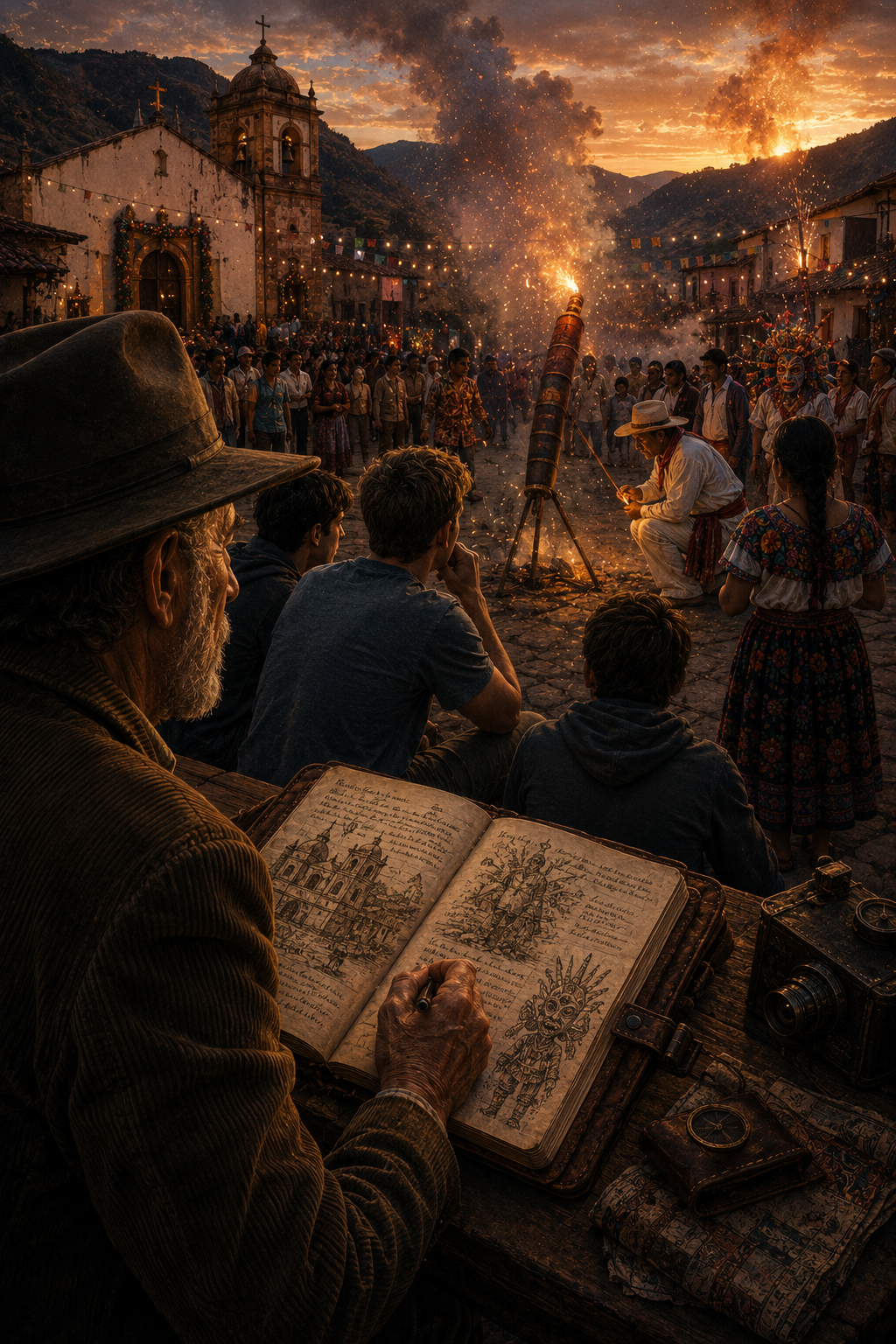
He read them Tultepec first.
The ninth of March, the feast of San Juan de Dios, patron of the pyrotechnicians. He read the entry exactly as written — the smell of black powder over the whole town, the sledgehammers with charges packed into the head, the old man who has done this since he was a boy priming a hammer with hands that are steady in a way the crew has never seen hands be steady. Then the swing. Then the crack that goes through the chest wall. Then the crowd, roaring, and a family of four watching from a wall, and the children not remotely frightened because this is simply what March is.
He turned the page and kept reading in the same voice.
The burn unit. The count that year. The man who lost the use of a hand and was back the following March, standing closer.
Then he flipped forward maybe two-thirds of the notebook and read a second entry, and it took the crew about ninety seconds to work out that he was reading about a county forty minutes from where they were sitting. Their county. A Friday in the fall, the whole town at the same field, three generations in the same bleachers, food nobody charged for. It was the warmest thing any of them had heard in a long time and two of them got a little quiet.
And then he read the rest of the entry, in the same flat voice, and it was about what that town does to a family that will not participate, and how long the punishment lasts, and how everybody involved would deny that any punishment is occurring.
Nobody said anything for a while.
The Scribe, who has kept a notebook since he was twelve and does not usually notice other people's, was looking at the page and not the reader.
"Why is it in three inks?"
The old man looked pleased and did not smile.
"Because I got things wrong, and the people in them told me so, and I went back and fixed it." He tapped the page. "Forty years. Eleven entries I had to change because somebody I wrote about read it and set me straight." He closed the cover. "Those eleven are the only ones I completely trust."
Then the Captain asked the question, because somebody had to, and it was the one the whole room had been circling since Tultepec.
"How do you keep the part you love without keeping the part that's hurting somebody?"
Nobody in that back room had an answer. That is the night this transmission starts.
What the Verse Is Actually Saying
"...the empty way of life handed down to you from your ancestors."
Read it slowly, because it is more careful than a man expects and it cuts in an unexpected direction.
It does not say the ancestors were monsters. It says the way of life was empty — which is a completely different accusation, and a harder one, because empty things are usually beautiful. They have festivals and recipes and songs and a way of holding a funeral. They work. They just do not hold weight when weight is applied.
And note the mechanism: handed down. That is the definition of a tradition, stated neutrally. Nobody chose it. It arrived, in a house, at an age too early to evaluate it, and it came wrapped in the faces of people who loved him.
⚠ And note who Peter is writing to. Not savages. Gentile converts inside a Greco-Roman world with a functioning legal order, engineering, philosophy, poetry and a religious calendar older than anything in their own memory. He is telling people with an admirable inheritance that a portion of it was hollow — and he is doing it without contempt, and he is not telling them to hate their grandparents.
That is the whole assignment of this room. Sort what you were handed, without despising the hands.
Two Reflexes — Both Wrong
Almost everybody arrives here with one of two automatic responses already installed, and both of them are ways of not doing the work.
The first refuses to judge. All cultures are equally valid; criticism is arrogance; every arrangement is just a different way of being human. It sounds humble. It is not, and the tell is what it costs: the person it protects is never the one being hurt. Somebody in that arrangement is on the wrong end of it — usually a woman, usually a child, usually somebody with no standing to object — and a stance that cannot say so out loud has quietly decided that his suffering is a cultural feature.
⚠ It also, as noted in World Religions, insults everybody it claims to respect, because it treats their most serious convictions as decoration nobody could seriously be wrong about.
The second refuses to look. One arrangement — usually the one the man grew up in — gets fused with Christianity itself, and every other arrangement is in error by however far it sits from home. This one is harder to see from inside because it does not feel like a position. It feels like normal. And it has a specific historical record: it sent people out who could not distinguish the gospel from their own furniture, and who therefore demanded the furniture as the price of the gospel.
The gospel made a tax collector and a Zealot eat at the same table, and told both of them their old loyalties were idols. Both halves at once. Neither reflex can do that.
"One of Crete's own prophets has said it: 'Cretans are always liars, evil brutes, lazy gluttons.' This saying is true" — Titus 1:12-13
⚠ Sit with what Paul just did there, because almost nobody notices it and it settles the argument above.
He made a hard cultural criticism — and he made it by quoting a Cretan. The critique came from inside. Then he added three words most translations render this saying is true, which is Paul, an outsider, declining to soften a native's assessment of his own people out of politeness.
Then read the next line, which is the part that keeps this from being contempt: *therefore rebuke them sharply, so that they will be sound in the faith.* The purpose of the criticism is the repair of the people criticized. He is not writing them off. He is staying, and he is leaving a man there to do the work.
Criticism from inside, endorsed rather than softened, aimed at repair rather than dismissal. That is the posture, and it is available to a man about his own culture first.
Three Categories, and the Third Is the Job
Everything anybody inherits sorts into three piles, and the sorting is the entire discipline.
The good. What people made because they were made in the image of a maker and could not help it. Language. Kinship. Craft. Food. Music. Story. The reason a Persian carpet, an Appalachian fiddle tune, a Japanese tea room, a Polish rye loaf, a Yoruba talking drum, a Norwegian stave church and a plate of barbacoa all land as good on the same man is not that he is cosmopolitan. It is that they are all the same activity in different dialects.
The fallen. What the same people built against God. Idol cults. Caste. Honor killing. Foot binding. Slave economies. The ritual disposal of inconvenient infants. Every culture has some, including his own, and a man who believes his own has none is not a scholar of anywhere — he is a tourist in his own house.
The mixed. The largest pile by an enormous margin, and the only one that requires a man rather than a rule.
Most of what anybody inherited is neither holy nor damnable. It is textured — a festival that began as harvest thanks, absorbed a local saint, absorbed a tourism economy, and now employs two hundred people. An arranged marriage that produces stable households across four generations and crushes the wrong daughter in the fifth. A town that will feed your family for a month when your wife is sick and will freeze out a household that declines to attend.
That is Tultepec, and that is the county forty minutes away, and the old man read them in the same voice on purpose.
The two failed reflexes are both ways of emptying the middle pile. The first sweeps the fallen into the mixed and calls it tolerance. The second sweeps the mixed into the fallen and calls it discernment. The notebook sorts, item by item, and it takes a lifetime and it is occasionally revised in a different colour of ink.
How the Sorting Is Actually Done
Three passages do most of the work, and they are rarely read together.
"The voice spoke to him a second time, 'Do not call anything impure that God has made clean'" — Acts 10:15
That is Peter on a roof, hungry, shown a sheet of animals his entire life had trained him to find disgusting — and the correction is not your scruples are silly. It is a jurisdiction correction: the line is not yours to draw and you have been drawing it. What follows immediately is Peter walking into a Gentile's house, which he says plainly he is not supposed to do, and the church ceasing forever to be one culture's property.
⚠ That is the death of the second reflex, delivered to the man who would otherwise have founded it.
"One person considers one day more sacred than another; another considers every day alike. Each of them should be fully convinced in their own mind"
— Romans 14:5
Paul, refusing to legislate a cultural practice that genuinely mattered to both sides, in a congregation that was actively fighting about it. Not this does not matter — the whole chapter takes it seriously — but this is not the kind of thing I am going to settle for you. There is a category of inherited practice where the honest answer is that a man must think it through and then stop policing his brother, and pretending that category does not exist has caused more division in the church than paganism ever did.
"'I have the right to do anything,' you say — but not everything is beneficial"
— 1 Corinthians 10:23
And the test that follows the freedom. Permissible is not the finish line. Does it build anybody up is the finish line, which moves the question off the practice and onto its effect on actual people in an actual room — which is exactly where the old man's notebook keeps ending up.
Freedom to receive. Freedom to decline. And a standard that is about people rather than about purity.
Five Positions, and Knowing Which One You Are Standing In
The Christian tradition has held five distinct postures toward culture, catalogued by H. Richard Niebuhr in 1951, and a man should know them because he is already in one of them and probably could not name it.
Against. Withdraw. Build the parallel town. Refuse the compromise. The Anabaptists, the Desert Fathers, and every era's separatists. Its strength: it stays clean and it produces genuine communities. Its cost: it hands the whole field to somebody else and its children frequently leave.
Of. Christ as the flower of the civilization — the faith and the culture harmonized until nobody can tell where one stops. Its strength: it is at ease, and it evangelizes without friction. Its cost: it cannot criticize its own society, because it has no place to stand outside it, and it has historically blessed things it should have refused.
Above. Two floors of one building; grace completes nature. High medieval Catholicism; Aquinas. Its strength: it takes ordinary human work seriously as good. Its cost: the arrangement tends to sanctify whatever is currently on the lower floor.
In paradox. Both kingdoms at once, held in tension, never resolved. Lutheran two-kingdoms. Its strength: it is honest about the tension every serious man actually feels. Its cost: it can become a permanent excuse for doing nothing about anything.
Transforming. Christ enters the culture and remakes it from inside. Augustine, Calvin, Kuyper. Its strength: it works, historically, and most of what the West likes about itself came out of it. Its cost: it is one step away from believing the remaking is your job and the timeline is yours.
Most of what has actually been built here runs transforming, with a real dose of paradox — Christ enters, Christ transforms, and the tension does not resolve on this side of the resurrection. The point is not to pick a team. It is that a man who cannot name his own posture will mistake it for reality itself.
Where the File Goes Deeper
Read them in this order. Each one is a different page of the same notebook.
Pop Culture — what replaced the village, the parish and the family table as the place a soul gets shaped. Its best entry is two pages twenty-six years apart: a suburban mall in 1998, where the song on the food-court speaker and the clothes in the line and the posters at the cineplex are one continuous transmission — "the mall is the church and they do not know they are in it" — and then a bedroom in the same town in 2024, one girl, two hours and forty minutes into a feed she has not noticed she is in. The mall closed. The transmission did not stop. It moved closer.
Subcultures — the communities the broadcast culture does not index, and the sharpest tool in this whole room: they sort into reactive (formed because the mainstream failed the men who joined — the diagnosis is usually right and the cure is usually wrong), aspirational (offering a craft or discipline the mainstream stopped transmitting), and predatory (naming the wound accurately, charging for the medication, and leaving the condition worse). Four are built at close range, and note that each one is a room with a price of admission: Alpha Male Culture — the ballroom, two thousand dollars a seat · Hustle Culture — the Miami rooftop, five thousand · Doomsday & Prepper Culture — the Idaho compound and fifteen years of one man's work · Chicano Culture — the cleared lot east of Los Angeles, hoods up, and an inheritance being handed to sons in public.
The Failure This Room Refuses
There is one specific way to fail all of this while appearing to pass, and it needs its own paragraph.
A man can wave the flag, eat the food, sing the songs, hang the cross on the wall, put the family Bible on the coffee table, keep every custom his grandmother kept — and never once meet the Christ all of it was pointing at. He has the entire costume. He is not wearing a body.
That failure is not a foreign problem and it is not new. It is the specific thing Christ said to the most religiously observant men of his generation, and it is what The Disney Religion and The Fall of Western Capitalist Ideology are describing from two other directions.
Cultural Christianity that does not produce a changed man is not a weak version of the faith. It is folk costume, and the difference matters most at the moment something is actually required of him.
Closing the File
Go back to the three inks, because that is the answer to the Captain's question and it is not the kind of answer anybody wants.
How do you keep the part you love without keeping the part that is hurting somebody? Slowly. Item by item. In writing. With the willingness to be corrected by the people you are writing about, and to go back and change it in a different colour, eleven times in forty years — and to say afterward that those eleven are the only entries you completely trust.
There is no rule that does it for him. A rule would let him sort his own inheritance without ever going into a room and eating what was served. The old man's method is not a method for avoiding that. It is a method for surviving it honestly.
And a man should notice which entry he is most reluctant to read straight. It will not be Tultepec. It is always the county forty minutes away.
"The nations will walk by its light, and the kings of the earth will bring their splendor into it… The glory and honor of the nations will be brought into it"
— Revelation 21:24, 26
⚠ Read what that verse does to this entire subject, because it is the last word on culture in the whole book and almost nobody knows it is there.
At the end, the nations are not erased. They are not homogenized into one beige international culture with everyone in the same clothes singing the same songs. They walk in, carrying things — their glory, their honor, their splendor. Whatever it was that was actually good in a people, the thing that made the carpet and the fiddle tune and the tea room and the loaf, is not thrown away at the door.
It is carried in. Which means the sorting in this room is not a demolition project. It is a man going through his own inheritance deciding what is worth carrying — and finding out, as he does it, that a great deal of it is, and that the part which is not was never really his to begin with.