
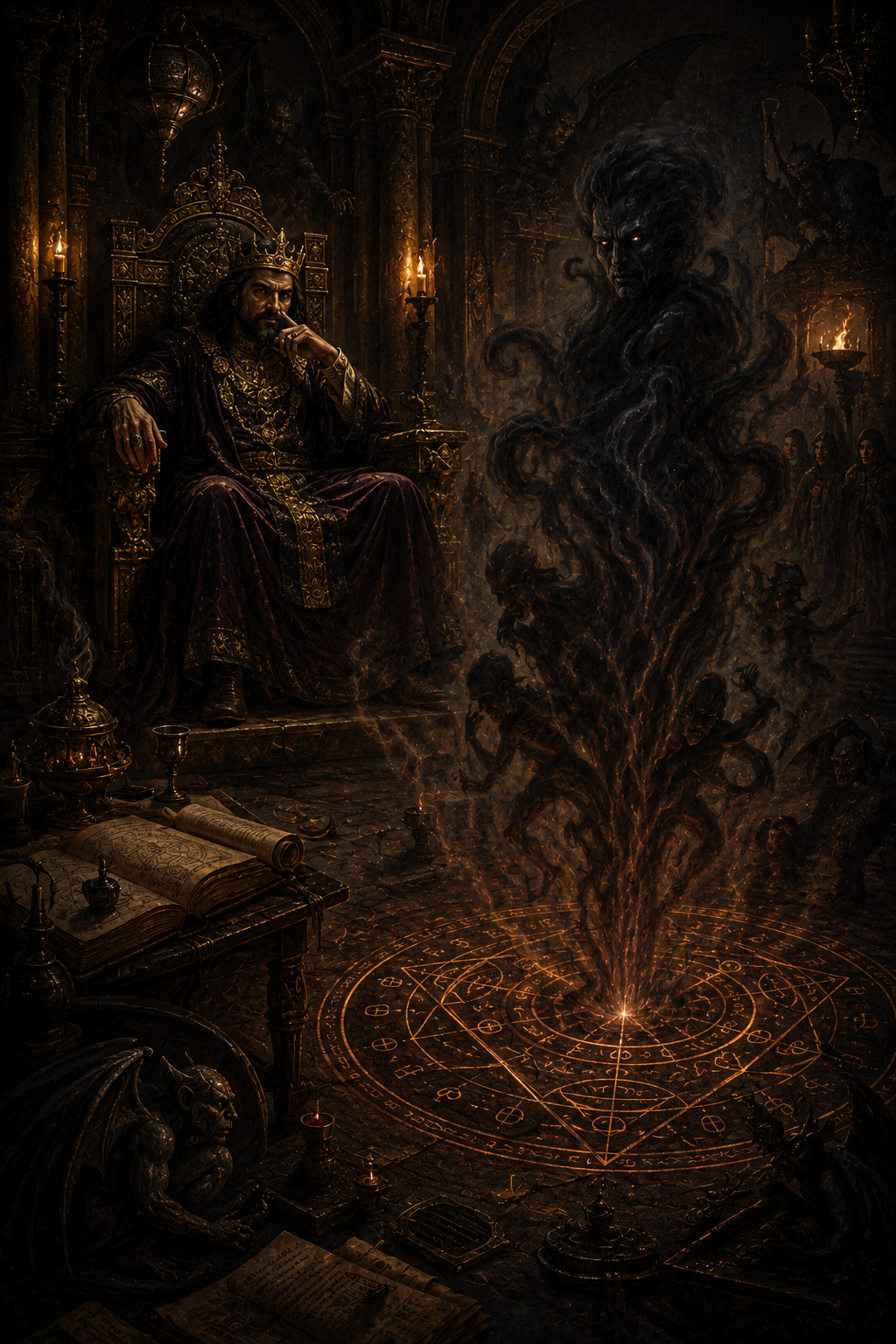
Demonology
Asmodeus
Astaroth
Beelzebub
Belial
Belphegor
Paimon
Python
The Skeptic has three drawers and one file that has never gone into any of them.
It is not a case. That is the problem with it. His drawers sort claims — this is documented, this is contested, this is a framework somebody built — and what is on the table in front of him is not a claim. It is a shape.
He laid it out one night the way he lays everything out. Guyana, 1978. A ranch in Texas. A rented television studio with a phone number running along the bottom of the screen. A sealed order inside a religion that has nothing to do with Christianity. A folding table in a strip mall with eleven people around it. Different continents. Different centuries. Vocabularies that share no words. And no lineage between any of them — nobody read anybody, nobody trained anybody, there is no trail to follow, and he looked for one for years because finding it would have closed the file.
Same three currencies. Same order. Every time.
He can tell you what that is not. It is not imitation, because imitation leaves paper. It is not coincidence at that sample size. It is not simply what power does to men, because most men handed that much power do not end up in the same place, and these do.
So he says the thing out loud, at his own table, in the flattest voice he has, and it is the first time in thirty years anybody has heard him ask a question he was not prepared to answer.
"What has the same appetite in Guyana in 1978 and in a strip mall in 2019?"
Nobody at that table has an answer. That is the night this transmission starts.
Demonology
"They sacrificed to demons that were no gods, to gods they had never known, to new gods that had come recently, whom your fathers had never dreaded"
— Deuteronomy 32:17
Sit with the strangeness of that sentence, because it is not saying what a modern man assumes it says.
It does not say the gods were imaginary. It says they were not gods — a demotion, not a denial. Something was there. Something received what was offered. And the thing that received it was not what the worshippers thought they were dealing with.
Then the detail that gives it away: new gods that had come recently, whom your fathers had never dreaded. Recently. These arrived. They have arrival dates. Whatever else that verse is doing, it is describing traffic — beings entering a situation and being taken for something they were not, by people who had never had reason to be afraid of them before.
The category is real. Most modern men have been trained out of seeing it. This file is the historic Christian tradition on the subject, handed over sober, and it is not a curiosity. The realities under discussion are personal, they are intelligent, and they do not appreciate being studied without reverence. Read accordingly.
What the Text Actually Says
The canon is direct on this, and it is far more crowded than most men have been told.
The Old Testament names the serpent in Genesis 3. It names the bene elohim who left their proper position in Genesis 6, and the giants their union with the daughters of men produced. It names shedim in Deuteronomy 32 and Psalm 106 — the word behind devils in the older English translations, and the thing children were being sacrificed to. It names seirim, goat-demons, in Leviticus 17 and Isaiah 13. It names Lilith in Isaiah 34. It names the princes of Persia and Greece in Daniel 10 — territorial powers that delayed a messenger sent to a praying man for twenty-one days.
Deuteronomy 32:8-9 supplies the architecture in two lines. When the Most High apportioned the nations, he set the boundaries of the peoples according to the number of the bene elohim — and kept Israel for himself. Nations handed out. Governors appointed. The governors rebelled, and the rest of the Old Testament is the long argument with that rebellion.
The New Testament raises the volume. Christ's ministry in Mark's Gospel is very nearly one continuous deliverance tour — the synagogue at Capernaum, the lakeshore, the cemetery at Gerasa, the Syrophoenician woman's house, the road, the foot of the mountain. The apostles carry it on. Paul removes a spirit of divination from a girl at Philippi and gets jailed for the economic damage. The seven sons of Sceva find out in Acts 19 what happens to men who use the name of Jesus as a password without knowing the man it belongs to. Paul locates the real opposition behind flesh and blood in Ephesians 6, and states plainly in Colossians that Christ disarmed the rulers and authorities at the cross and made a public spectacle of them. Revelation closes the canon with the binding and the final removal.
Nobody reading that record honestly comes away thinking the subject is marginal. A man who was taught otherwise was taught wrong, and it is worth asking who benefited from the teaching.
The Church Has Never Stopped Working This
There is no gap in the tradition. There is only a gap in what one part of the modern West was told about it.
Justin Martyr identified the gods of Rome as the rebellious bene elohim the Hebrew Scriptures name. Athanasius wrote forty years of desert warfare into the Life of Anthony, a founding text of Christian monasticism. Augustine took the Roman religious system apart in books eight through ten of City of God and named what was inside it. Aquinas systematized the whole angelology and demonology in the Summa with a care most modern Protestants have never sat down with.
The exorcism tradition runs unbroken. The Roman Rituale Romanum holds the rites, revised in 1614 and again in 1999, and every Catholic diocese in principle has an appointed exorcist. Gabriele Amorth, chief exorcist of Rome until his death in 2016, left two books of pastoral case files that anybody serious about this material should read before he reads anything else. The Eastern Orthodox hold parallel rites inside their sacramental life. Anglican and Lutheran communions retain liturgical resources for this work that most of their own members do not know exist.
The Protestant deliverance tradition came up in the twentieth century — Don Basham, Derek Prince, Frank and Ida Mae Hammond, whose Pigs in the Parlor became the standard Charismatic handbook. That work is not fringe Christianity. It is the historic tradition rendered in the dialect of the Pentecostal renewal, with the renewal's strengths and its excesses both.
And the sharpest correction to Western thinness comes from the field. Sub-Saharan African Christianity, Latin American Pentecostalism, Korean Christianity and much of South Asian Christianity engage this as ordinary pastoral work, weekly. Charles Kraft and Paul Hiebert documented what missionaries have known the entire time: the demonic is not pre-modern naivety that the educated West outgrew. **It is a feature of the human situation the educated West trained itself not to see while continuing to be worked on by it.
Two Ways to Get This Wrong
Seeing it everywhere. A demon behind every flat tire. An interior life organized around detection. Other men's marriages diagnosed from across a parking lot. Diabetes called a generational curse and the insulin left in the drawer. This failure has produced fifty years of documented pastoral wreckage, and its victims are usually the most earnest people in the room.
Refusing to see it at all. Every exorcism in the Gospels read as metaphor. Principalities downgraded to social structures. Powers downgraded to systemic injustice. Demons explained to the seeker as first-century vocabulary for mental illness, by a minister who would be embarrassed to say otherwise in front of his colleagues. This failure produced a Christianity that cannot deliver anybody from anything, because it no longer believes deliverance is what is being asked for.
The tradition refuses both, and the discipline in between is not glamorous. The category is real. The category does not get invoked every time something goes wrong. A man learns the signatures, addresses what is actually there with the authority the church was given, and does not turn an ordinary hard season into a war story. That discernment is a gift the Spirit distributes (1 Corinthians 12:10) — not native equipment, and not available to a man who wants it in order to feel important.
⚠ And the ordinary explanation is checked first, every time. Grief, exhaustion, untreated illness, a marriage nobody has tended in nine years, a drinking problem nobody names at the table. The tradition has always insisted on this order, and a man who skips it will do real harm to someone who needed a doctor, a rest, or a confession.
The Ground It All Stands On
Every honest engagement with this material starts here and ends here, and a man who takes it out of order will get hurt.
"That through death he might destroy the one who has the power of death, that is, the devil" — Hebrews 2:14
"He must reign until he has put all his enemies under his feet" — 1 Corinthians 15:25
The decisive thing has already happened. What is left is a long cleanup under a King who has already won, and a man under covenant with that King is not entering a fight whose outcome is undetermined. He is entering one that was settled at Golgotha, demonstrated at an empty tomb, and described in its final form in the last two chapters of the canon.
And the architecture is legal, which is the part most men miss.
Satan's function in the text is accuser. He appears in the heavenly council in Job to bring a charge. He stands at the right hand of the high priest in Zechariah 3 to bring a charge. He is thrown down in Revelation 12, and the reason given is that the brothers overcame him by the blood of the Lamb and by the word of their testimony. That is courtroom language from beginning to end.
The cross did not argue with the accusations. It paid them. A man whose sin has been paid for has no live charge standing against him — and the accuser will still try the case in his head every morning at four, with real evidence, accurately quoted. The evidence is not the point. The case is closed. Learning the difference between a settled verdict and a voice that keeps re-reading the indictment is most of what this file is for.
Deliverance is conducted in Christ's name on the basis of finished work. The authority is his, extended to his body. A man who tries it in his own name gets what the sons of Sceva got.
The Order Has Ranks
The tradition has catalogued it. Worth knowing in outline, and worth holding loosely where the tradition itself is not unanimous.
Fallen angels — the bene elohim of the original rebellion. Satan and those with him.
Demons and unclean spirits — the broader category, and the term Christ uses most often. Some traditions identify them with the fallen angels. The Enochic stream carried in Genesis 6 Theory identifies them instead with the disembodied spirits of the Nephilim. Neither reading is settled here; both stand in the historic record, and a man should know which one he is assuming.
Principalities and powers — Paul's category. Higher rank, working at structural, political and cultural scale rather than on individuals.
Territorial powers — the rebellious governors over specific regions in Deuteronomy 32, the princes of Persia and Greece in Daniel 10. The reason missionaries crossing a border have reported a change in the air for two thousand years and have generally been told they imagined it.
Named figures — the specific ones the canon and the historic catalogues identify. Astaroth, Asmodeus, Belial, Belphegor, Python. Each has a file below.
The order is not flat. It has rank, specialization and assignment. That is not folk superstition. It is theology, and it has been for a very long time.
How It Actually Arrives
It does not strike at random. It assigns, and it works a man where he already leans. The point of naming the patterns is not so a man can blame them. It is so he stops mistaking them for his own voice.
The one that says later. There is no need to rush. A break will fix this. The work will still be there. He feels like he is resting. Three hours go by. I'll do this later is the whole calling card, and it deepens until later has quietly become never and the thing he was made to do is still sitting on the table, untouched, while he refreshes a screen.
The one that offers something faster. It arrives at the exact moment the hard work is in front of him, never before. Ten minutes of easy pleasure traded for the thing he was put here to do — a feed, a game, a plate, an image. It does not argue with his purpose. It just keeps offering him something quicker, at the threshold, every time.
The one that says you are not enough. It works on self-doubt and fear of failure until the task looks impossible before it has been tested. I cannot do this perfectly, so there is no point starting. The result is a man who could have done the work and did not, and who calls the paralysis humility.
The named files run deeper on the specific patterns. Asmodeus on covenant unions — the marriage-killer of Tobit and the Persian aeshma daeva. Belial on lawlessness and covenant refusal — the Hebrew without yoke, the chief adversary in the Qumran material. Belphegor on sloth dressed as cleverness — the man who calls his laziness efficiency and his shortcuts optimization. Astaroth on despair. Python on counterfeit prophecy and divination — the spirit Paul removed at Philippi, and the thing standing behind the fortune teller, the tarot reader and the astrology app on a man's phone.
A man who can name the pattern the moment it shows up in his own head has started the work this file trains.
Get Under Authority
This is not a solo discipline, and the traditions that have avoided disaster are the ones that never let it become one.
The historic exorcism traditions require authorization for a reason. The Catholic exorcist is appointed by his bishop. The Orthodox parallel requires its own permission. The Protestant deliverance ministries that have not left a trail of damage behind them are the ones that operated under pastoral oversight, in teams, with established discernment, inside a body of mature believers who knew the ground.
A man alone with an algorithm and a paperback is not what the tradition has in mind. He is, in fact, the exact profile it warns about. Anyone meeting something serious in his own life or in the life of someone he is responsible for goes to his pastor, his elders, and the experienced practitioners his tradition holds. The man who insists on doing this alone is the man it turns on most easily.
The same principle holds at ordinary scale, and this is the part that actually protects a household. Confess sin to somebody who knows your name. Sit in a fellowship of men who will notice when you go quiet. Read Scripture daily and let it correct your thinking rather than confirm it. Take the Lord's Supper the way it was given. These are not accessories. They are the ordinary means by which the church has held off the accuser since Pentecost, and they are boring on purpose.
Where the File Goes Deeper
Satan — the four falls, the anointed cherub, the legal architecture of the accuser, and grace, justice and mercy meeting at the cross. Read this one first. Everything else here is built on it.
The named figures. Astaroth — Canaanite Ashtoreth to Grand Duke of the Lesser Key; despair. Asmodeus — Tobit to the Persian aeshma daeva; the destroyer of covenant unions. Belial — without yoke; the Qumran adversary; lawlessness. Belphegor — Baal-Peor in Numbers 25 to the grimoire demon of inventions; sloth as ingenuity. Python — the Delphic-oracle spirit of Acts 16; divination and prophetic counterfeit. Samael — the Kabbalistic figure whose biblical footing is thin and whose later lore is dense; read as religious history, not as doctrine.
The historical files. King James Demonology — James VI and I's Daemonologie of 1597, the 1604 Witchcraft Act, and the translation choices that shaped four centuries of English-language demonology. The Keys of Solomon — the Greater and Lesser Solomonic grimoires, the seventy-two of the Goetia, and the modern occult revival that reprinted them. Lesser Magick — LaVey's distinction, and how the technique got mainstreamed into ordinary persuasion literature without the name attached. Sigils & Semiconductors — Spare and Carroll, chaos magic, memes as sigils, and the oracle a man now carries in his pocket.
Closing the Transmission
Go back to the two lines in Deuteronomy 32, because they leave something enormous sitting in the open.
The nations were apportioned. Governors were appointed over them. The governors rebelled. Israel was kept back for the Most High himself — which means Israel is the one nation in that arrangement that received a corrective account of who the governors actually were.
Everybody else got the governors without the correction.
They were not left with nothing. They were left with an encounter, and an impression, and no canon to measure it against — and being human, they did what humans do with an encounter that will not fit into ordinary life. They wrote it down. They named the thing. They gave it a face, and a temple, and a season of the year, and a story about where it came from, and they handed all of it to their children, who handed it to theirs.
That material still exists. It is enormous. It is older than most nations, it survived in some cases only as a story told to children, and the modern world files it under literature.
"For all the gods of the peoples are worthless idols, but the LORD made the heavens" — Psalm 96:5
Worthless idols is the flat translation of a Hebrew word that carries contempt — nothings, non-entities. But hold that beside Deuteronomy 32:17, where the same nothings are receiving sacrifices from someone, and the picture that emerges is not the nations were worshipping empty air. It is closer to: they were worshipping something, and it was not what it told them it was, and it was not worth what they paid.
Which means the myths of the human race are not a separate subject from this one.
They are this subject, written down by everyone who never got the correction — the same order of beings, met by peoples who had no way to know what they were dealing with, recorded in seventy languages under seventy sets of names, and preserved with astonishing fidelity across cultures that never met each other.
You have just read the covenant account of the order.
There are seventy others.