
Dexterity
Fingers & Toes Strength
Grip Strength
Foot Work
The two ends of the chain, and what modern life did to them.
Two Ends of the Chain
Everything in the last three rooms happened in the middle of the body — hips, trunk, shoulders, the big sequences that move a man around. All of it gets delivered through two places barely anyone trains: the hands and the feet.
And those are the two places modern life has quietly taken away.
Consider what a pair of adult male hands actually did for most of history. Gripped rope, tools, reins, timber, weapons. Tied, whittled, mended, butchered, wrote, built. Now consider what they do this week. They tap glass. They hold a wheel at a fixed angle. They type. The grip strength is unused, the finger independence is unused, and the entire fine-motor apparatus that the human hand is famous for gets exercised almost exclusively by a thumb on a screen.
The feet are worse, because at least the hands are visible. Feet spend the day inside a cushioned shoe on a flat surface — a small dark box that provides the arch support the arch was supposed to provide itself, on ground engineered to demand nothing. Twenty-six bones, thirty-three joints, and more than a hundred muscles, tendons and ligaments in each one, and the overwhelming majority of them have not been asked for anything since childhood.
This room is about getting them back.
Range Is Not Control
The first thing to clear up, because almost everyone conflates them.
Flexibility and mobility are about range — how far a joint can travel. Dexterity is about control within that range — how precisely a body can operate once it gets there. They are related and they are not the same, and one does not produce the other.
A man can have magnificent range and no precision. A hand that opens wide and cannot thread a line, a foot that dorsiflexes beautifully and cannot feel the difference between two surfaces. Range is the space you have to work in. Dexterity is what you can actually do in it.
The range half is real and it belongs to Mobility & Movement, which owns it. This room assumes it and works on the other question.
It is worth noticing where the confusion comes from, because it is instructive. Almost every "hand and wrist" resource a working man will ever be handed is a stretching card — the laminated sheet pinned up in a shop or an office, twelve panels, fifteen seconds each. Those cards exist because employers noticed that modern work does something specific to bodies and wanted a cheap countermeasure. They are not wrong and they are not this. A wrist stretch restores some range to a joint that spent nine hours in one position. It does not give the hand back anything it has stopped being able to do.
Why It Is the Most Overlooked Quality Here
Agility, balance, coordination, explosiveness and functionality all get at least some attention in mainstream training culture. This one gets essentially none, and it sits underneath all of them.
It is where the chain fails. A deadlift ends when the hands quit, not when the back does. A carry ends the same way. A pull-up ends when the fingers open. The whole posterior chain can be ready and the set is over anyway, decided at the last inch by the part nobody trained.
Grip is a health marker, not just a gym metric. Grip strength tracks with all-cause mortality across large populations well enough that clinicians use it as a rough index of how a body is holding up overall. Not because squeezing hard extends anybody's life — because grip is an honest, hard-to-fake readout of total muscular and neurological condition, and it declines early in men who are declining.
The feet are a balance and injury story. A foot that cannot feel the ground or articulate against it sends poor information upstream, and the ankle, knee and hip compensate for the rest of a man's life. Most chronic lower-limb complaints have a foot underneath them that stopped participating decades ago.
And there is one imbalance almost every man now carries. Hands are trained, when they are trained at all, by closing — gripping, holding, squeezing, typing. Almost nothing in modern life trains the hand opening against resistance. The flexors get everything and the extensors get nothing, and that lopsidedness is behind a large share of the elbow and forearm complaints that show up in men who lift, men who climb, and men who spend nine hours on a keyboard. The fix is trivial and takes ninety seconds: put a rubber band around the fingers and open the hand against it. Almost nobody does it because nobody told them the imbalance exists.
Three Rooms Off This One
Three doors, and they run from the smallest tissues outward: wake the digits, build the hold, then go and look at the feet.
Fingers & Toes Strength — twenty levers nobody has asked anything of. Spread your toes so there is air between them; most men cannot, and it is not injury, it is thirty years of a foot in a shaped box. Same story at the other end, where modern hands are busy but narrowly busy — light, repetitive, flexion-dominant tapping in a small range. The room covers what independence and extension actually are, and the encouraging part: almost nothing here is damaged, only unused, and unused wiring comes back fast.
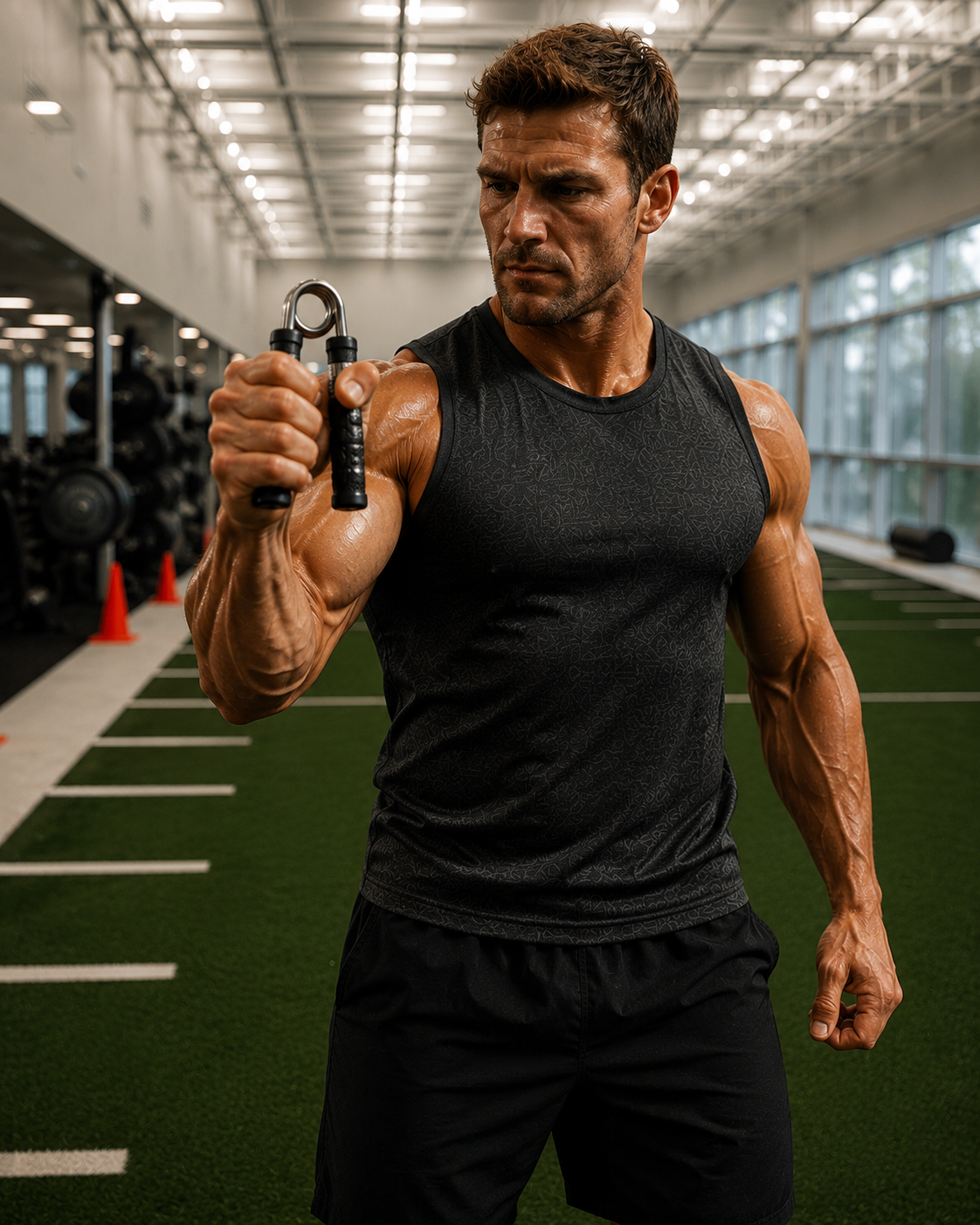
Grip Strength — where every heavy thing ends. A deadlift does not end when the back gives out; it ends when the fingers open. Four kinds that transfer to each other less than men assume — crush, support, pinch, extension — and most men train exactly one. Also the honest reading of the mortality finding: grip is not a cause, it is a readout, which makes it the closest thing to a dashboard light a man has.
Foot Work — the end of the chain nobody has looked at. Two to three million steps a year on a mechanism as intricate as the hand, doing more work, getting none of the attention. What the foot is supposed to do in sequence — absorb, adapt, push — and what goes quiet when a shoe does the first two for it. Includes the reasonable version of the barefoot argument, and the progression that keeps a man from injuring himself acting on it.
How Men Go Wrong Here
They never consider it a quality at all. The dominant failure. It is not in any program because it is not in anyone's mental model of training.
They train grip only by holding heavy things. Real, but one kind of four, and it deepens the flexor-extensor imbalance rather than correcting it.
They mistake it for stretching. Covered above. Range work is worth doing and it is a different subject.
They leave the feet in shoes permanently. Decades of arch support means an arch that stopped working, and the compensation travels upward.
They practice nothing that requires precision. No instrument, no craft, no tool, nothing where the hand has to be exact rather than strong. Fine motor control is a use-it-or-lose-it capacity and most adult men have arranged a life with almost no demand for it.
The Three Pillars at the Ends of the Chain
TRUTH — Is it true? Grip strength is one of the few things in this domain that cannot be talked around — a dynamometer, or a bar you hang from, and the number is the number. But the honest test is broader than strength: can your hands do anything precise? Tie a small knot, thread something, work a tool you have not used before. A man can have crushing hands and no dexterity at all, and only one of those two questions ever gets asked.
LOVE — Is it loving? This is the quality that shows up as making things and fixing things — which is one of the main ways a man's presence gets felt in a household without anybody discussing it. The meal cooked properly. The thing repaired instead of replaced. The knot that holds. The hands that can do something a child wants to learn. A father with capable hands has a currency with his children that a father with an impressive bench press does not, because one of them can be handed down and the other cannot.
LAW — Is it right? Train what has been taken rather than what is already easy. That means the extensors, the pinch, the feet, and the precision — not another set of heavy holds because heavy holds are satisfying. And put the capacity into the day, because a hand skill that lives only in a drill is a hand skill that is being maintained rather than used.
Where This Goes Next
Fine control is force delivered slow and exact. It is the most patient end of what a body does, and it is the end almost nobody trains.
The opposite demand is the same body firing everything it has, as fast as it physically can, with no precision available because there is no time for any. The hand that threads a line and the hand that lands a strike are the same hand. The foot that finds purchase on wet rock and the foot that drives off the ground into a sprint are the same foot. Precision and power are two ends of one control, and a man is meant to own both ends.
The other end is next.